
Blog
What Is Manufacturer Dust-Free Knife Cutting Technology Application?

What Is Manufacturer Dust-Free Knife Cutting Technology Application?
I first encountered the term "dust-free cutting" when a furniture manufacturer called us frustrated—they had been told they needed laser cutting to meet automotive supplier cleanliness standards. Their material was synthetic leather. After visiting their site, I found they only needed a properly configured knife cutting system with dust extraction. The confusion around "dust-free" costs manufacturers both money and production efficiency.
Dust-free knife cutting technology is not about achieving zero dust—it refers to CNC knife cutting machines integrated with dust extraction systems that capture and control dust at the cutting point, keeping airborne particles within specific cleanliness levels required by industries like automotive interiors, medical packaging, and composite material bonding. The system matches dust collection intensity to material type and production environment standards.
Many manufacturers believe "dust-free" means switching from knife cutting to laser or waterjet. That misunderstanding leads to unnecessary equipment investments. Let me walk you through how dust-free knife cutting technology actually works, when you need it, and how it compares to other cutting methods.
What Does "Dust-Free" Actually Mean in Knife Cutting Technology?
When I first started working on dust extraction systems at Realtop, I assumed "dust-free" was a marketing term. Then I visited a medical packaging manufacturer who was being rejected by their clients due to dust contamination. The term became very real.
"Dust-free" in CNC knife cutting means the cutting machine is equipped with a dust extraction system that captures particles at the cutting point, keeping airborne dust below levels specified by downstream industries or production environment standards. It does not mean zero dust output—it means controlled dust levels that meet specific cleanliness requirements.
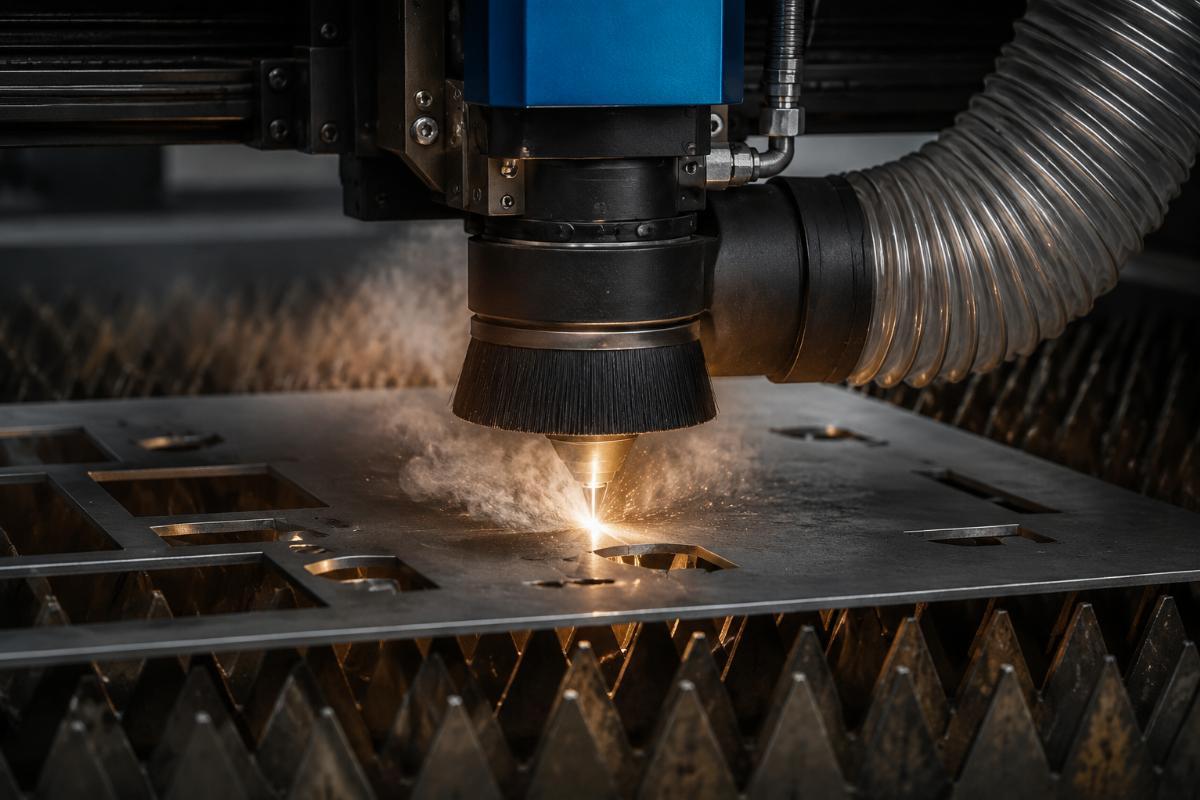
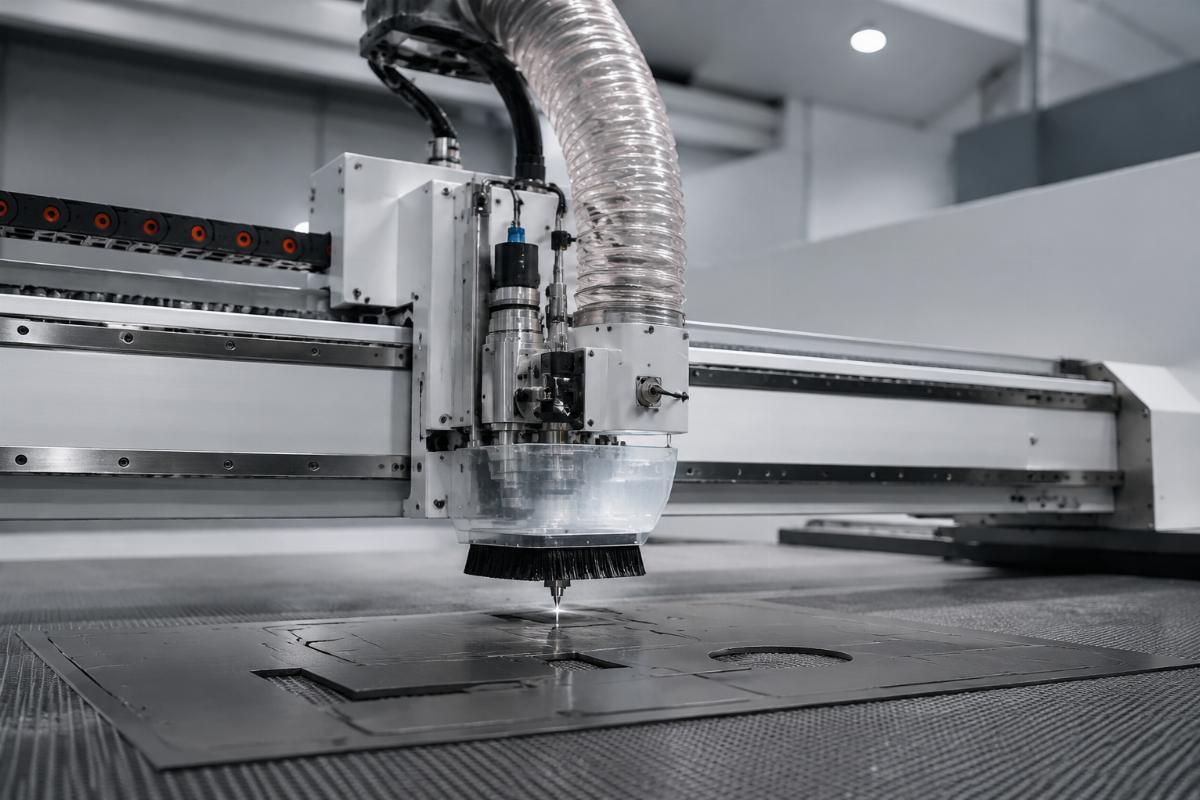
The mechanism is straightforward. As the knife blade cuts through material, it generates dust, fibers, or particles. A dust extraction nozzle positioned near the cutting head creates negative air pressure that pulls particles directly into a collection system. The extracted dust travels through hoses into a filtration unit, where filters trap particles before releasing clean air back into the workshop.
Different materials produce different types of dust. Textiles generate fibrous dust that floats. Leather creates fine powder. Composite materials produce heavier particulate matter. We configure dust extraction intensity, nozzle positioning, and filter types based on these differences. In our testing with automotive interior textiles, we observed that fibrous dust required higher suction velocity than the powder generated by cutting rubber gaskets.
The key components work together:
| Component | Function | Material-Specific Consideration |
|---|---|---|
| Cutting head with integrated extraction nozzle | Captures dust immediately at cutting point | Nozzle distance adjusts based on material thickness |
| Suction system | Creates negative pressure to pull particles | Suction strength varies by dust type (fiber vs. powder) |
| Filter unit | Traps particles before air release | Filter grade depends on particle size and cleanliness standard |
| Collection bin | Stores extracted dust | Capacity matches production volume |
The term "dust-free" sets an expectation that manufacturers should understand correctly. We are not eliminating dust generation—the cutting process inherently creates particles. We are controlling where those particles go and keeping them out of the production environment and the cut material itself.
Do All Materials Need Dust-Free Knife Cutting Systems?
A packaging manufacturer once asked us to add full dust extraction to their corrugated cardboard cutting line. They saw competitors advertising "dust-free cutting" and assumed it was necessary. When I examined their actual production environment and client requirements, I found they did not need it.
Not all materials require dust-free systems. Materials that generate minimal dust, or materials processed in environments where airborne particles do not affect product quality or downstream processes, do not need specialized dust extraction. The need for dust-free cutting depends on material type, dust volume generated, and cleanliness requirements from the industry you serve.
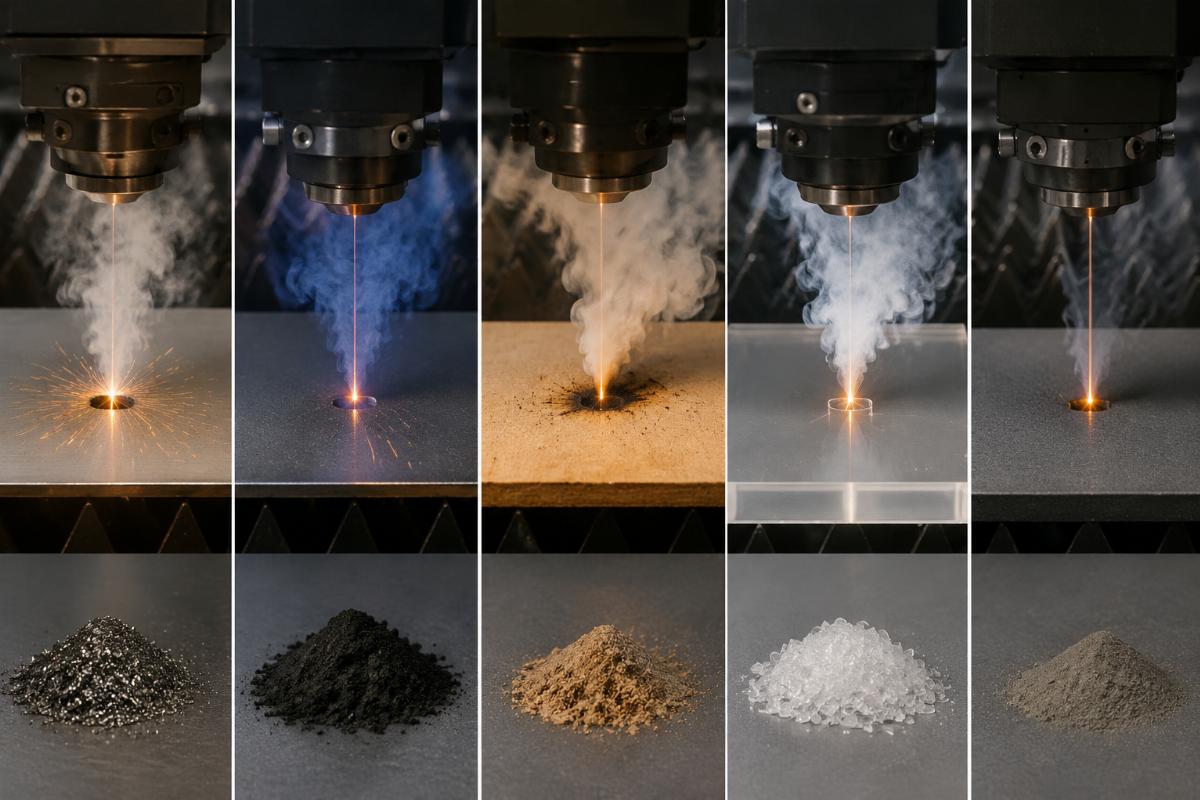
We evaluate dust control needs by examining three factors. First is the material's dust generation characteristics. Synthetic fabrics with loose weaves produce significant fiber dust. Felt materials shed continuously. Leather creates fine powder. Rubber and foam generate minimal dust. Cardboard and paperboard produce manageable dust levels that standard workshop ventilation can handle.
Second is the production environment standard. Automotive interior suppliers must meet cleanliness levels that prevent dust from settling on adhesive surfaces or contaminating visible surfaces. Medical packaging requires controlled environments to prevent particle contamination. Food packaging materials cannot carry dust that might contact food products. Electronics component cutting demands dust-free zones to protect sensitive components.
Third is the downstream process sensitivity. If cut parts move directly to a bonding process, any dust on the material surface will create adhesion failures. If cut fabric will be sewn, fiber dust does not typically affect the process. If cut pieces are stacked for storage, dust accumulation between layers might or might not matter depending on the final application.
Based on dust collection data from packaging material cutting projects, we found that:
- Synthetic leather for automotive interiors generated enough fiber dust to fail cleanliness inspection without dust extraction
- PE/PP composite films produced minimal dust that did not require specialized extraction
- Multi-layer technical textiles created fiber clouds that required immediate extraction at the cutting point
- Rubber gasket materials generated powder that settled quickly and did not disperse widely
These observations help us guide manufacturers. If your material is cardboard for generic packaging boxes, you likely do not need dust-free cutting. If your material is technical fabric for aerospace composites, you definitely need controlled dust extraction. Many materials fall between these extremes, where the decision depends on your specific client requirements and quality standards.
Material types that typically require dust extraction systems include textiles with high fiber content, synthetic leather and suede materials, felt and non-woven materials, multi-layer composite fabrics for technical applications, and materials processed for automotive, medical, or food industries. Materials that often do not require dedicated dust-free systems include solid rubber sheets, dense foam materials, rigid plastics, cardboard and paperboard, and materials processed in applications where surface dust does not affect functionality.
The cost of adding unnecessary dust extraction to your cutting line is not trivial. Dust extraction systems add equipment cost, require filter maintenance, consume additional energy, and may slow cutting speed slightly due to extraction nozzle positioning. We recommend manufacturers first verify whether their clients actually require dust-free processing before investing in these systems.
What Cleanliness Levels Do Different Industries Require?
A composite material processor asked me whether their current dust collection system was sufficient for a new automotive client. They had basic dust extraction but did not know what "cleanliness level" meant or how it was measured.
Cleanliness level requirements vary by industry and are typically defined by downstream assembly or bonding processes. Automotive interiors, medical device components, food packaging materials, and electronics parts require controlled particle counts per cubic meter of air or per surface area. These requirements determine whether a basic dust collection system or a comprehensive dust-free solution is necessary.
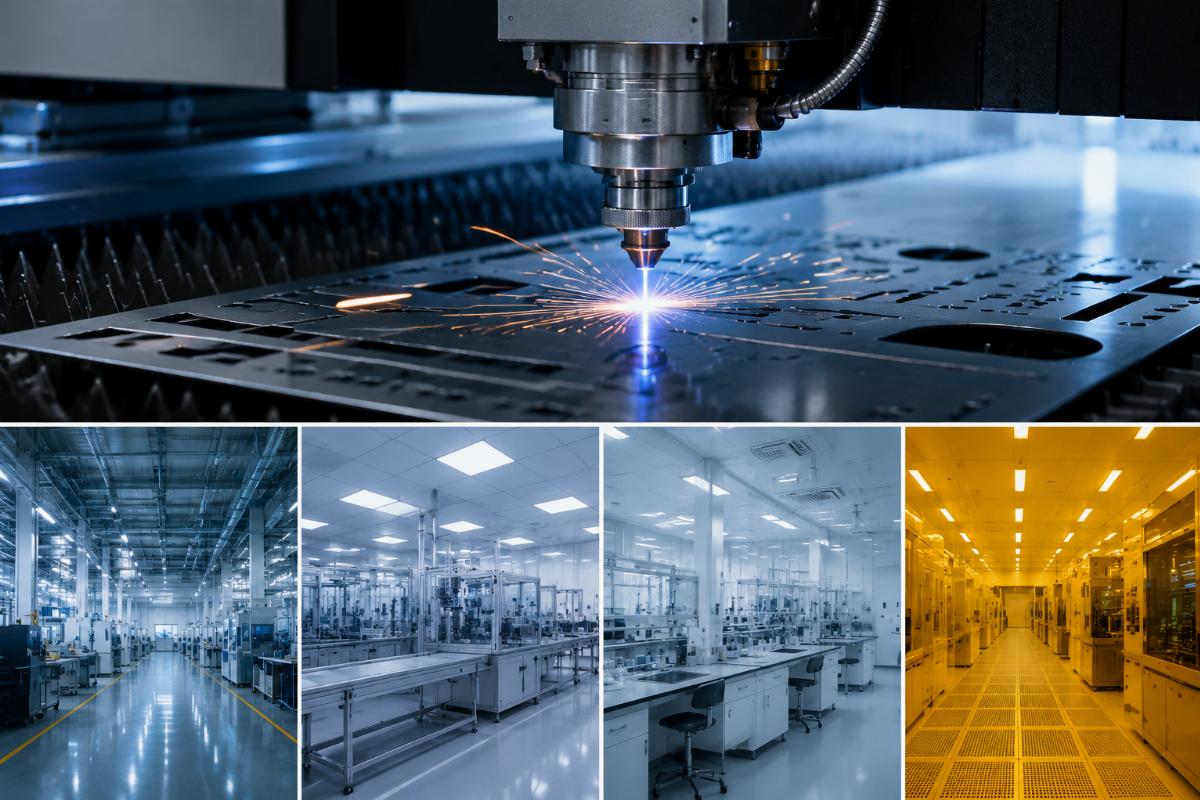
Industries express cleanliness standards in different ways. The specific numbers and test methods are established by industry practice and client specifications rather than universal regulations. I cannot provide verified cleanliness data, but I can explain the practical requirements we encounter.
Automotive interior suppliers face strict cleanliness demands because dust particles can interfere with adhesive bonding between layers of trim materials, create visible contamination on surfaces customers will touch, and affect the appearance of leather or fabric finishes. In our testing with automotive interior textiles, we observed that cut edges needed to be free of loose fibers before moving to the lamination process.
Medical and pharmaceutical packaging requires controlled environments to prevent particle contamination that could compromise sterility or product safety. Manufacturers cutting materials for medical device packaging or pharmaceutical blister packs typically operate in controlled rooms where the cutting equipment must not introduce additional particle sources.
Food packaging materials cannot carry dust that might eventually contact food products. While the packaging material itself might be sealed before food contact, particles on material surfaces can transfer during handling, storage, or package formation processes.
Electronics and semiconductor component cutting demands low particle counts because even small dust particles can cause short circuits, interfere with component mounting, or damage sensitive surfaces. Manufacturers cutting flexible circuit board materials or protective films for electronic components work to strict particle control standards.
Composite material processing for aerospace, automotive structural parts, or industrial applications requires clean bonding surfaces. Any dust or particles between composite layers creates weak points in the cured structure. These manufacturers need dust extraction systems that keep cut edges clean enough for immediate layup and bonding.
The cleanliness level you actually need comes from your client specifications. A furniture manufacturer cutting synthetic leather for office chairs faces different requirements than a manufacturer cutting synthetic leather for luxury automotive interiors. Both materials might be similar, but the application determines whether basic dust collection is acceptable or whether you need a full dust-free cutting system.
We evaluate cleanliness needs by asking manufacturers to review their client quality specifications, examine rejection rates due to dust contamination, and understand the sensitivity of their downstream processes. A manufacturer experiencing frequent adhesion failures due to dust on cut edges clearly needs better dust control. A manufacturer whose cut parts are cleaned before assembly might not need dust extraction at the cutting stage.
Different levels of dust control systems match different cleanliness needs:
| System Level | Dust Control Method | Typical Applications |
|---|---|---|
| Basic ventilation | General workshop air circulation | Materials with minimal dust, non-critical applications |
| Dust collection | Central vacuum system for machine area | Moderate dust generation, non-sensitive processes |
| Integrated extraction | Dust capture at cutting point with filtration | Materials with significant dust, cleanliness-sensitive applications |
| Full dust-free system | Closed extraction with HEPA filtration and controlled environment | Critical cleanliness requirements, aerospace/medical applications |
The progression from basic to full dust-free systems involves increasing cost and complexity. We help manufacturers match their actual requirements to the appropriate system level rather than over-engineering dust control they do not need.
How Does Knife Cutting with Dust Extraction Compare to Laser and Waterjet?
A leather goods manufacturer was convinced they needed laser cutting because a competitor told them knife cutting "cannot be dust-free." They were ready to invest in laser equipment. When I explained how knife cutting with dust extraction actually works, they realized laser would not solve their problem—it would create different ones.
Knife cutting with dust extraction, laser cutting, and waterjet cutting control dust through fundamentally different mechanisms. Knife cutting captures physical particles at the cutting point. Laser cutting vaporizes material, creating fumes and minimal solid particles. Waterjet cutting uses water to suppress dust. The appropriate choice depends on material type, cut quality requirements, and production environment standards—not on which technology is inherently "better."
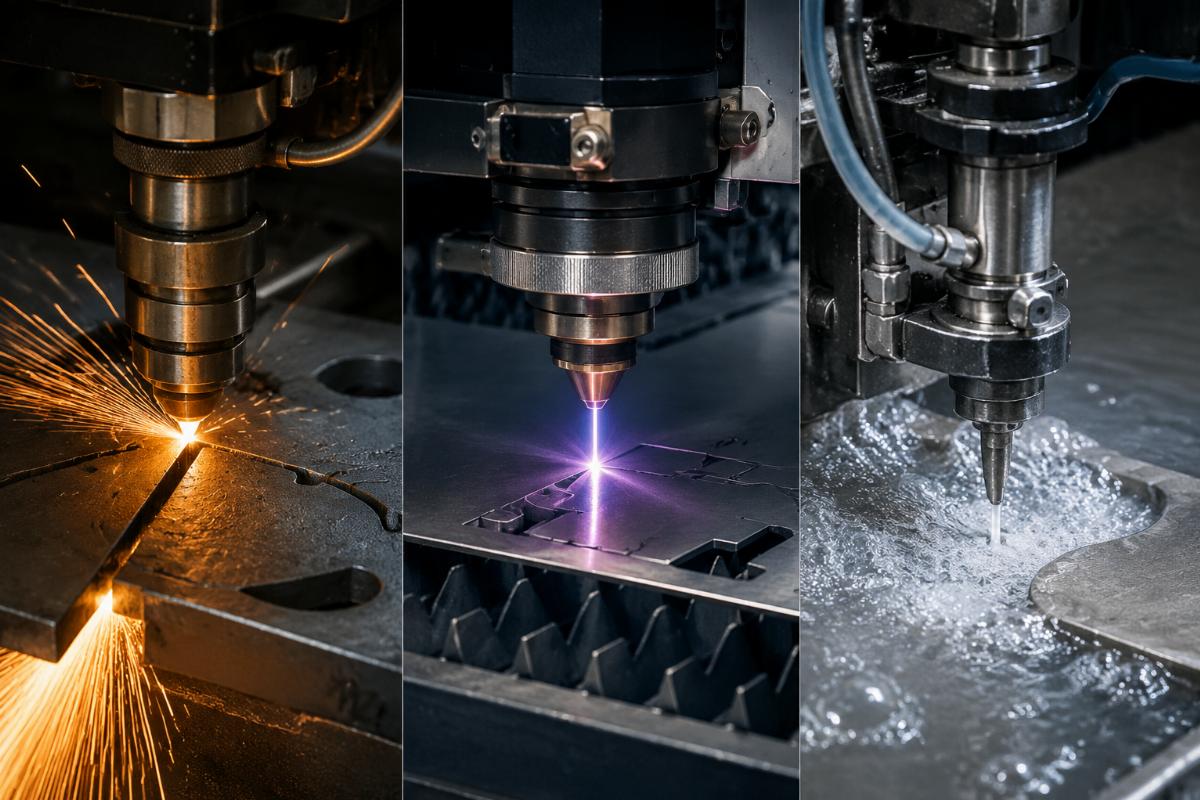
Each cutting method creates and controls dust differently. Understanding these differences helps manufacturers choose based on their actual needs rather than misconceptions about which is "cleaner."
Knife cutting generates dust mechanically. The blade physically shears material fibers or particles, creating loose pieces that become airborne. An integrated dust extraction system captures these particles immediately at the cutting point before they disperse into the workshop. The dust collected is actual material particles—fabric fibers, leather powder, rubber particulate—that can be safely filtered and disposed of. The material edge remains physical, with no heat damage or discoloration.
Laser cutting vaporizes material using focused heat. The cutting process turns material into gas and smoke rather than producing significant solid dust. This creates fumes that require extraction, and the fumes may contain chemical byproducts depending on material composition. Synthetic materials, plastics, and treated fabrics can release harmful fumes when laser cut. The material edge is heat-sealed, which prevents fraying in textiles but can create a hard edge or slight discoloration. Materials that char or melt easily are not suitable for laser cutting.
Waterjet cutting uses high-pressure water to erode material. The water jet inherently prevents dust from becoming airborne because particles are immediately carried away in the water stream. This creates a slurry of water and material particles that requires collection and disposal. The material gets wet during cutting, requiring drying time before further processing. Waterjet is effective for materials that cannot tolerate heat but requires water management systems and cannot be used for materials that absorb water or are damaged by moisture.
Material characteristics determine which approach works best:
| Material Type | Knife + Extraction | Laser | Waterjet |
|---|---|---|---|
| Natural textiles | Excellent—captures fibers, no edge damage | Poor—may char, fumes from treatments | Good—but requires drying |
| Synthetic textiles | Excellent—clean fiber capture | Fair—heat-seals edges but creates fumes | Good—but wets material |
| Leather | Excellent—captures powder, maintains edge appearance | Poor—discolors edges, creates odor | Fair—leather absorbs water |
| Rubber/foam | Good—captures particles | Poor—melts and smokes | Excellent—no heat damage |
| Composite materials | Excellent—maintains bonding surface cleanliness | Poor—damages resin layers | Good—but water contamination risk |
Based on dust collection data from various material cutting projects, we found that knife cutting with proper dust extraction achieved cleanliness levels comparable to or better than laser cutting for most textile and leather applications. Laser cutting reduced solid dust but introduced fume extraction requirements that some manufacturers found more challenging to manage than particulate dust.
The misconception that laser equals dust-free comes from the fact that laser vaporizes material rather than cutting it mechanically. But vaporized material creates fumes that must be extracted and filtered. For materials containing synthetic fibers, adhesives, or chemical treatments, laser fumes require more sophisticated filtration than mechanical dust particles do.
Waterjet eliminates airborne dust completely but introduces different challenges. The water management system, material drying requirements, and unsuitability for water-sensitive materials limit its application. Manufacturers cutting technical textiles or composites for bonding processes cannot introduce moisture into their materials.
Cost considerations also differ. Knife cutting systems with dust extraction represent the lowest capital investment. Laser systems cost significantly more and require ongoing maintenance of optics and laser sources. Waterjet systems require high maintenance on pump components and water treatment systems.
Energy consumption varies considerably. Knife cutting systems consume minimal energy beyond the basic CNC motion and dust extraction vacuum. Laser systems require substantial power for the laser source. Waterjet systems consume energy for high-pressure pumps and water circulation.
We guide manufacturers through these comparisons by focusing on their specific material and application needs rather than presenting one technology as superior. A manufacturer cutting natural leather for fashion goods will find knife cutting with dust extraction provides clean cuts without edge discoloration, making it preferable to laser. A manufacturer cutting technical textiles for medical devices might prioritize knife cutting with dust extraction to avoid introducing chemical fumes from laser processing. A manufacturer cutting dense rubber gaskets might prefer waterjet despite the water management requirements because rubber cutting generates minimal dust that knife cutting can handle, but waterjet provides cleaner edges for thick materials.
The key insight is that "dust-free" is not a property of a single technology. It is a result of matching the cutting method and dust control system to material characteristics and production requirements.
What Components Make a Knife Cutting System Actually Dust-Free?
A gasket manufacturer upgraded their CNC knife cutter with what they believed was dust extraction. They added a shop vacuum connected near the cutting table. When they submitted samples to their automotive client, the parts failed cleanliness inspection. They did not understand why their "dust extraction" did not work.
A dust-free knife cutting system requires integrated components designed to work together: a cutting head with extraction nozzle positioned at the exact cutting point, a suction system calibrated to material dust characteristics, filtration matched to particle size and cleanliness standards, and proper sealing to prevent dust escape. Simply adding a vacuum to a cutting table does not create a dust-free system.
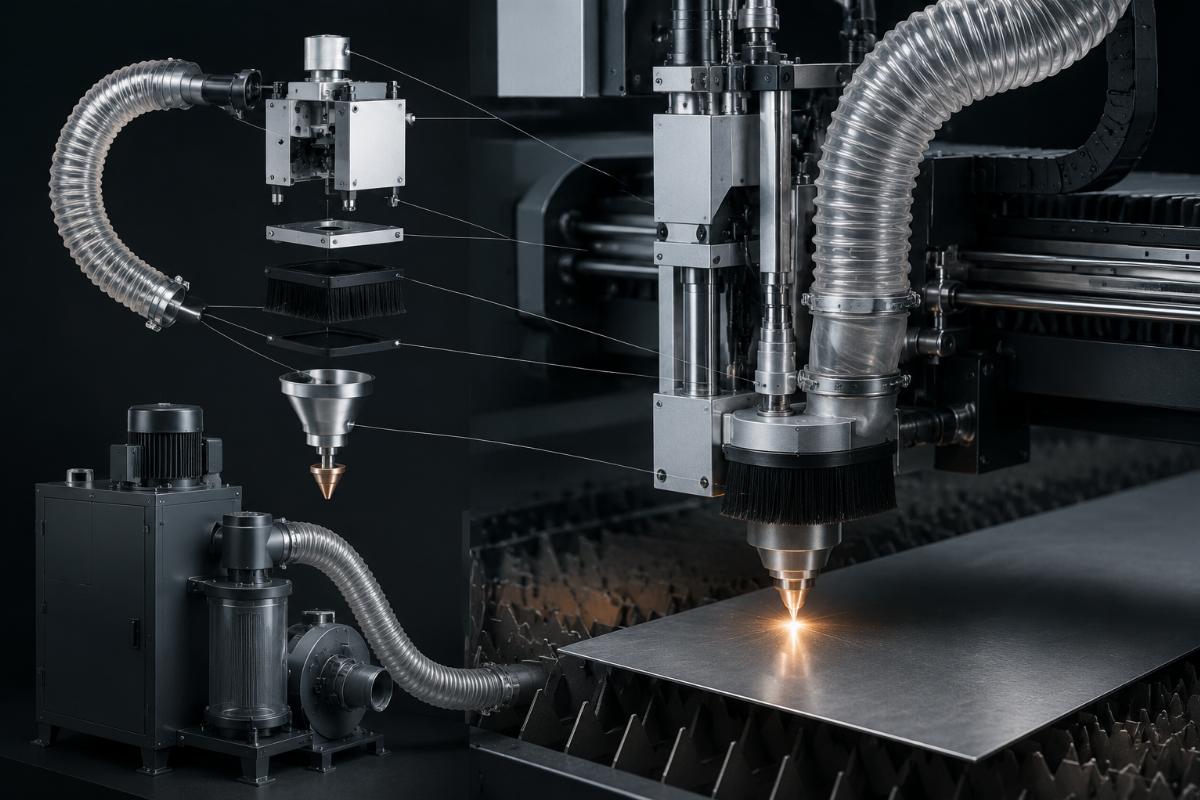
The cutting head design determines dust capture effectiveness. We position the extraction nozzle as close to the blade as physically possible without interfering with cutting motion. The nozzle surrounds the cutting point, creating a capture zone where particles are pulled into the extraction system immediately as they are generated. The distance between nozzle and cutting point is critical—too far and particles escape before extraction, too close and the nozzle interferes with material handling or blade movement.
The suction system must match material characteristics. Fibrous materials require higher air velocity to capture lightweight fibers before they float away. Powder materials require moderate suction to prevent excessive material waste by pulling away usable material along with dust. Particulate materials require consistent suction that captures heavier particles without creating excessive airflow that disturbs the material being cut. In our testing with automotive interior textiles, we observed that suction velocity needed to be 30-50% higher for loose-weave fabrics than for tightly-woven materials to achieve comparable dust capture rates.
Filtration determines whether captured dust stays contained. The filter grade must match particle size and production environment requirements. Basic dust collectors use standard filters suitable for large particles. Dust-free systems require finer filtration to capture small particles and prevent them from being released back into the workshop through filter exhaust. Applications requiring critical cleanliness levels use HEPA-grade filters. Filter maintenance schedules must be followed—clogged filters reduce suction effectiveness and allow dust to bypass the system.
System sealing is frequently overlooked. All connections between the cutting head extraction nozzle, hoses, filter unit, and collection bin must be properly sealed. Leaks at any point allow dust to escape into the workshop instead of being collected. We regularly encounter systems