


Fast Delivery
Quick, reliable shipping to any location.

Free & easy returns
Return this item by mail or in store within 90 days for a full refund.
Matched Cutting Methods — In-house engineering covers both oscillating knife and laser cutting systems, so buyers select the process that fits their material rather than adapting production to a single technology.
Technical Specifications
| Parameter | Value |
|---|---|
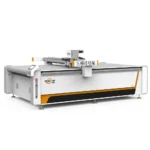
| Product Type | CNC Oscillating Knife Cutting Machine |
| Working Area | 1600×2500 mm |
| Tool Head Options | Oscillating knife, driven rotary knife, creasing wheel, kiss cutting, pneumatic knife, milling, V-groove |
| Cutting Speed | 0–2000 mm/s |
| Cutting Thickness | ≤ 30 mm (depending on material density) |
| Cutting Accuracy | ±0.1 mm |
| Vacuum Pump Power | 9 kW |
| Vacuum Table Type | Aluminum bellows vacuum table |
| Positioning System | CCD camera contour recognition |
| Control System | PLC control panel |
| Voltage Options | 110V, 220V, 380V |
| File Format Support | PLT, DXF, AI, PDF |
| Safety Devices | Infrared sensor, emergency stop |
| Machine Dimensions | 3300×2100×1350 mm |
| Servo Motor Options | Panasonic, Delta, Dorna |
| Language Options | English, Russian, Italian, Chinese (customizable) |
Application Suitability
| Application | Material or Output |
|---|---|
| Automotive interior floor mats and seat covers | Leather, synthetic leather, composite foam layers |
| Shoe uppers and leather goods | Genuine and PU leather, patterned hides |
| Apparel and bag components | Textile, woven and non-woven fabrics |
| Sofa upholstery and soft furnishings | Fabric, velvet, microfiber, coated textiles |
| Advertising boards and vehicle wraps | PVC sheets, vinyl, adhesive films |
| Packaging and carton sample making | Corrugated board, folding carton, foam board |
Why the Tool Head Decision Outweighs Working Area
A machine specified on bed size alone often fails when the material thickness exceeds the tool stroke. When sourcing a CNC oscillating knife cutting machine manufacturer, production teams frequently lead with working dimensions but overlook the relationship between knife amplitude, material density, and cutting depth. A 1600×2500 mm table holds a full hide comfortably, but if the oscillating stroke cannot penetrate layered leather and foam composites at 25 mm total thickness, the lower layers tear rather than shear cleanly [NEED_CITE: oscillating knife stroke versus material density matching]. I have watched automotive mat producers lose entire batches because the specified head handled single-layer leather well but choked on bonded leather-over-foam layups. The stroke must match the densest layup you intend to run, not just the thinnest material on your order book.
Navigating the Full Cutting Equipment Range
This page surveys the equipment range available from one CNC oscillating knife cutting machine manufacturer, organized by material family and production workflow. The core distinction is between cold-cutting with oscillating or driven knife heads — suited to leather, fabric, foam and composites — and thermal cutting with CO2 or fiber lasers for acrylic, wood, sheet metal and synthetic edge-sealing applications. Buyers working with natural leather and automotive textiles generally start with knife configurations because thermal cutting produces burnt edges and odor on organic materials.
How Machine Families Scale by Volume and Format
Production volume determines whether a fixed vacuum table or a conveyor-fed system makes sense. Short-run custom orders — bespoke seat covers, prototype packaging samples, limited-edition footwear — suit the fixed aluminum bellows table where the operator loads and positions each hide manually. Higher-volume garment and automotive interior lines benefit from conveyor systems that advance roll stock continuously, paired with multi-head configurations to double or triple cutting width per pass [NEED_CITE: conveyor versus fixed table throughput comparison in textile cutting]. Compact-format machines handle small leather goods and sample rooms, while large-format beds accommodate full hides and wide-format technical textiles.
Reading the Specifications Against Your Material
The 1600×2500 mm working area fits most automotive leather hides and standard fabric rolls without repositioning, but the cutting thickness ceiling of 30 mm must be read against your actual layup. A single layer of 2 mm automotive leather cuts cleanly at high speed; a bonded composite of leather, adhesive film and 10 mm EVA foam demands a slower feed rate and the pneumatic knife head rather than the standard oscillating blade. The 9 kW vacuum pump paired with the aluminum bellows table provides consistent hold-down, though small die-cut parts may require zoned vacuum activation to prevent material lift at the edges. The CCD camera contour system tracks printed fiducial marks on patterned leather and dyed textiles, but buyers should confirm mark contrast and size against their specific print supplier before ordering. The ±0.1 mm positional accuracy holds across the full bed when the servo system and linear guides are matched correctly — Panasonic, Delta or Dorna servo options each have different torque profiles suited to different head weights and cutting forces.
The Hidden Cost of Underspecified Configurations
Specifying a machine by working area and price alone leaves several failure points exposed. If the vacuum zoning does not match your typical part geometry, small gasket or leather trim pieces lift during cutting and produce ragged edges that fail downstream quality checks [NEED_CITE: vacuum hold-down requirements for small die-cut parts]. If the voltage and plug type are not confirmed before shipment, the machine sits idle while transformers are sourced locally — a delay that compounds when the control language does not match your operators’ fluency. Software file format mismatches cause equal disruption: a nesting workflow built around DXF imports stalls if the supplied software license does not cover that module.
Why Buyers Evaluate the Manufacturing Source Here
In-house design covers both knife and laser cutting technologies under one engineering team, so material-matching recommendations come from a single source rather than competing supplier agendas. Tool head and table configurations are specified per buyer material and production volume, not pulled from a default package. CCD camera positioning is validated against the buyer’s own printed substrate before shipment rather than demonstrated on a factory sample. Voltage, plug type, control language and software compatibility are confirmed line-by-line before production begins. Sample cutting runs on the buyer’s actual material establish edge quality, cutting depth and tool suitability before any commitment is made.
Documentation & Verification
- Machine specification sheet matching the quoted tool head and vacuum table configuration
- Electrical schematic with voltage and plug type confirmed against your factory supply
- Sample cutting report on your leather or composite material with edge quality assessment
- Factory test record documenting full-bed positional accuracy before dispatch
- Software licence and file format compatibility note for PLT, DXF, AI and PDF workflows
- Spare parts list covering blades, vacuum seals and CCD calibration targets
Installation, Commissioning & Support
- Floor loading assessment for the 3300×2100 mm footprint and 1350 mm machine height
- Dedicated electrical circuit matching confirmed voltage — 110V, 220V or 380V — with correct plug type
- Assembly and leveling of the aluminum bellows vacuum table on-site to maintain flatness tolerance
- PLC control panel parameter setup including language selection from English, Russian, Italian or Chinese options
- Operator training on tool head changeover between oscillating knife, creasing wheel and kiss cutting tools
- Scheduled maintenance intervals for vacuum pump, linear guides and servo motor inspection
What to Prepare Before Requesting a Quotation
To match configuration accurately, share the specific leather or composite material type, maximum layup thickness and typical sheet dimensions you process daily. Confirm your factory voltage and frequency, preferred control language, and the CAD file formats currently in use. If your work involves printed or patterned material, provide a sample showing the registration marks the CCD camera will track so contour recognition can be validated before the machine ships.
Frequently Asked Questions
Q: How do I choose between oscillating knife and driven rotary knife heads for different leather types?
A: Oscillating knife heads handle multi-layer composites and denser leathers by driving a reciprocating blade through the full thickness. Driven rotary knife heads suit single-layer genuine and synthetic leather where continuous rotation produces a smoother edge on curved contours. The choice depends on your typical layup thickness and part geometry rather than leather type alone.
Q: Knife versus laser — which method suits leather and fabric cutting?
A: Cold-cutting with oscillating or rotary knife heads preserves the natural edge of leather and avoids the burnt residue and odor that laser cutting produces on organic materials. Laser cutting suits synthetic textiles and coated fabrics where edge sealing prevents fraying. A manufacturer covering both technologies lets you match process to material rather than forcing one method.
Q: How should I match working area size to my production workflow?
A: Choose bed dimensions based on your largest typical sheet or hide size and daily volume, not just maximum possible dimensions. A 1600×2500 mm table fits full automotive hides and standard fabric widths. Higher-volume producers should evaluate conveyor-fed systems, while sample rooms and custom workshops benefit from the fixed vacuum table format for flexibility.
Q: What does the CCD camera system need from my printed material to work reliably?
A: The CCD camera requires printed fiducial marks with sufficient contrast against the substrate background — typically a dark mark on a light field or vice versa. Mark size, spacing and print consistency affect tracking accuracy at production speed. Providing a sample of your actual printed leather or fabric allows the camera parameters to be calibrated before machine dispatch.
Q: What configuration options span the catalogue across knife and laser families?
A: Options include single and multi-head knife configurations, conveyor or fixed vacuum tables, compact and large-format bed sizes, and CO2 or fiber laser systems at varying power ratings. Tool heads, vacuum zoning, voltage, control language and software modules are all specified per application rather than bundled as fixed packages.










商品评价
There are no reviews yet.