



Fast Delivery
Quick, reliable shipping to any location.

Free & easy returns
Return this item by mail or in store within 90 days for a full refund.
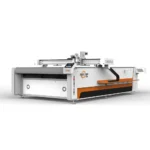
Seven Tool Heads — A single cutting table configurable with oscillating, rotary, creasing, kiss-cut, pneumatic, milling and V-groove tools so the method follows the material, not the other way around.
Technical Specifications
| Parameter | Value |
|---|---|
| Product Type | CNC Oscillating Knife Cutting Machine |
| Working Area | 1600×2500 mm |
| Tool Head Options | Oscillating knife, Driven rotary knife, Creasing wheel, Kiss cutting tool, Pneumatic knife, Milling tool, V-groove knife |
| Applicable Materials | Fabric, Cardboard, Carton, Mats, PVC, EVA, Leather, Acrylic, Foam, PTFE, Rubber |
| Cutting Speed | 0–2000 mm/s |
| Cutting Thickness | ≤ 30 mm (basis not stated in source — confirm material type and layer count) |
| Cutting Accuracy | ±0.1 mm |
| Vacuum Pump | 9 kW |
| Vacuum Table | Aluminum bellows vacuum table |
| Voltage | 110V / 220V / 380V (configurable) |
| File Format Compatibility | PLT, DXF, AI, PDF |
| Control System | PLC control panel with optional display languages |
| Servo Drive Options | Panasonic, Delta, Dorna (source value — verify against manufacturer catalog) |
| Nesting Software | Intelligent nesting with defect avoidance |
| Software Language Options | English, Russian, Italian, Chinese (special languages customizable) |
| Safety Devices | Infrared sensor, Emergency stop |
| Overall Dimensions (L×W×H) | 3300×2100×1350 mm |
| Standards | CE |
Application Suitability
| Application | Material or Output |
|---|---|
| Apparel manufacturing | Suits, knitwear, lace, complex woven and knitted fabrics in single or multi-ply lays |
| Automotive interiors | Seat fabrics, carpets, PVC floor mats, headliner textiles |
| Home textiles | Sofa upholstery fabrics, curtain panels, area rugs, mattress ticking |
| Composite material processing | Carbon fiber prepreg, aramid weaves, specialty reinforcement textiles |
Why Working Area Alone Will Not Tell You If the Machine Fits
A 1600×2500 mm bed only solves the sheet-size question; thickness, ply count and fabric coating determine whether the tool head can actually finish the cut.
I once quoted a round-knife unit to a buyer based on bed size and fabric type alone. The sample he sent was a single layer of woven cotton, and the cut was clean. When the machine arrived at his factory, the real job was multi-layer coated canvas. The blade could not hold an edge through the coating, and every ply came out with frayed margins. An entire batch of material was scrapped before I flew out and spent two weeks re-specifying the blade profile and hold-down system. That is why, for anyone evaluating a CNC oscillating knife cutting machine manufacturer, the first question should never be "what size bed do you need" — it should be "send me the exact material you will run in production." [NEED_CITE: material-thickness mismatch as leading cause of cutting equipment returns]
Matching the Tool Head to the Fabric
The table accepts seven interchangeable heads, and choosing the correct one is where most cutting problems originate. Oscillating knife handles standard woven and knitted apparel fabrics at single or low-ply counts. Driven rotary knife suits continuous straight and gentle-curve cuts on heavier textiles. Pneumatic knife is reserved for high-ply lays where downward force must be maintained through the stack. Selecting the wrong head does not just slow the job down; it produces ragged edges, crushed fibers or incomplete cuts that show up as rejects at the sewing line.
Vacuum Hold-Down and Small-Piece Stability
The aluminum bellows vacuum table provides full-surface adsorption across the 1600×2500 mm bed. This matters most when the nesting software produces small pattern pieces — collar stays, pocket flaps, cuff inserts — that lack enough surface area to stay flat under a weaker vacuum zone. Lifting during a cut shifts the piece by a fraction of a millimeter, and at ±0.1 mm accuracy tolerance that shift is enough to push the part out of spec. [NEED_CITE: vacuum zoning requirements for small-part digital cutting]
What the Specification Sheet Actually Means for Your Floor
Cutting speed is rated at 0–2000 mm/s, but usable speed depends on fabric density and ply height; a loose-weave knit will allow faster travel than a tightly coated technical textile. The 9 kW vacuum pump must be matched to the table’s zoning layout so that suction concentrates under the active cutting zone rather than bleeding across the entire bed. Servo drive options — listed as Panasonic, Delta or Dorna — affect acceleration smoothness and long-term positioning repeatability, which becomes visible only after months of continuous operation. File import covers PLT, DXF, AI and PDF, so the machine can receive patterns directly from most commercial grading and marker-making software without an intermediate conversion step.
The Hidden Cost of Skipping the Sample Cut
Buyers who approve a configuration based on a brochure spec sheet often discover the mismatch only after the machine is installed and wired. By that point the cost is no longer just the wrong blade — it is the shipping return, the production downtime, the material already cut with the incorrect tool, and the loss of confidence from their own downstream customers. Running a sample cut on the buyer’s actual fabric, at the intended ply height and speed, collapses all of those variables into a single report before the order is placed. [NEED_CITE: cost of post-installation reconfiguration in industrial cutting equipment]
Why Source This Cutter From the Same House That Designs It
In-house design covers both the knife table and the laser systems, so when a material sits on the boundary between the two processes — synthetic suede that melts cleanly with CO2 but frays under a blade — the recommendation comes from one engineering team, not two competing sales desks. The tool-head configuration is locked to the buyer’s material, not to whichever head happens to be in stock. Voltage, plug type and control-panel language are confirmed on the electrical schematic before the machine enters assembly, avoiding the surprise of a 380V cabinet arriving in a 220V workshop. Intelligent nesting with defect avoidance is included, not licensed as an annual add-on. Sample cutting on the buyer’s own material is a standard step, not an optional favor.
Documentation & Verification
- Machine specification sheet listing the exact tool head and vacuum zoning confirmed for your fabric type
- Electrical schematic with voltage, frequency and plug type matched to your destination country
- Sample cutting report on your own material at production ply height and speed
- Software licence and file format compatibility note covering PLT, DXF, AI and PDF import
- Factory test record documenting positioning accuracy and vacuum pressure before crate closure
- Spare parts list identifying blade types, vacuum seals and drive belts with part numbers
Installation, Commissioning & Support
- 3300×2100 mm footprint requires a level concrete slab with clearance for full table travel and operator access on three sides
- 9 kW vacuum pump plus servo drives need a dedicated circuit matching the confirmed voltage (110V, 220V or 380V)
- Machine ships fully assembled; positioning and anchor-bolt alignment handled on arrival
- First-run parameter tuning — blade oscillation frequency, vacuum zone mapping, servo acceleration — set against your actual fabric during commissioning
- Operator training covers tool-head changeover, nesting software operation and daily blade inspection
- Wearing parts stock — oscillating blades, rotary knife edges, vacuum bellows seals — identified with reorder numbers in the spare parts list
What to Include With Your Inquiry
Send the exact fabric type, weight per square meter and coating if any, along with the maximum ply height you intend to cut and your target daily output in pieces or layers. Specify the local voltage, frequency and plug standard, plus the preferred control-panel language. If your existing workflow uses a particular nesting or marker-making software, share a sample file so compatibility can be verified before quotation.
Frequently Asked Questions
Q: How do I decide between oscillating knife and laser for my fabric?
A: Oscillating knife suits most woven and knitted apparel textiles where a clean mechanical edge is required and multi-ply cutting is the norm. Laser is considered when the fabric is synthetic and benefits from sealed edges to prevent fraying, or when the pattern involves very fine detail that a blade cannot follow. Material samples tested under both methods remove the guesswork.
Q: Does the 1600×2500 mm bed size guarantee my fabric will lie flat?
A: Bed size only addresses the maximum sheet dimension. Flat holding depends on vacuum pump capacity, table zoning and the surface area of each nested piece. The 9 kW pump and aluminum bellows table are configured to concentrate suction under the active cutting zone, which is critical when cutting small pattern parts at high speed.
Q: What file formats does the nesting software accept?
A: The system imports PLT, DXF, AI and PDF directly. If your marker-making or grading software exports in one of these formats, patterns transfer without intermediate conversion. A sample file is reviewed during the inquiry stage to confirm layer structure, line weights and curve resolution before the order is finalized.
Q: Can the voltage and control language be changed after the machine is built?
A: Voltage and plug type are wired during assembly to the destination country standard, so changes after build require rewiring and re-certification. Control-panel language is configurable from English, Russian, Italian and Chinese, with additional languages available on request. Confirming both items on the electrical schematic before production avoids costly post-build modifications.










商品评价
There are no reviews yet.