


Fast Delivery
Quick, reliable shipping to any location.

Free & easy returns
Return this item by mail or in store within 90 days for a full refund.
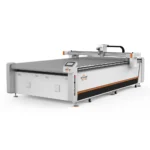
Tool Head Matched to Material — Our in-house design team configures each CNC oscillating knife cutting machine for sale with the exact tool head your fabric, leather or composite material demands, verified by sample cutting before shipment.
Technical Specifications
| Parameter | Value |
|---|---|
| Model | 1625 |
| Product Type | CNC Flat Bed Oscillating Knife Cutting Machine |
| Working Area | 1600 × 2500 mm |
| Available Tool Heads | Oscillating knife, driven rotary knife, creasing wheel, kiss cutting tool, pneumatic knife, milling tool, V-groove knife |
| Applicable Materials | Fabric, cardboard, carton, mats, PVC, EVA, leather, acrylic, foam, PTFE, rubber |
| Cutting Speed | 0–2000 mm/s |
| Single-Layer Cutting Thickness | Up to 30 mm (basis not stated in source — confirm material type and density) |
| Multi-Layer Cutting Thickness | Up to 30–50 mm (basis not stated in source — confirm fabric type and lay count) |
| Cutting Accuracy | ±0.1 mm |
| Vacuum Pump Power | 9 kW |
| Vacuum Table | Aluminum bellows vacuum table |
| Control System | PLC control panel with optional display languages |
| Voltage Options | 110V / 220V / 380V (frequency to be confirmed by target market) |
| Servo Motors | Panasonic, Delta or Dorna (source value — verify against manufacturer catalog) |
| Safety Devices | Infrared sensor and emergency stop |
| Compatible File Formats | PLT, DXF, AI, PDF |
| Machine Dimensions | 3300 × 2100 × 1350 mm |
| Language Options | English, Russian, Italian, Chinese (special languages available on request) |
| Certification | CE |
Application Suitability
| Application | Material or Output |
|---|---|
| Apparel Manufacturing | Suits, knitwear, lace and complex woven fabrics in single or multi-layer lays |
| Automotive Interiors | Seat fabrics, carpets, PVC floor mats requiring burr-free edges |
| Home Textiles | Sofa fabrics, curtains, rugs cut in multi-layer stacks |
| Composite Material Processing | Carbon fiber prepreg, aramid and specialty technical textiles |
| Signage and Packaging | Vinyl sheets, corrugated board, carton sample prototypes |
Why Thickness Ratings Alone Do Not Tell the Full Story
A CNC oscillating knife cutting machine for sale listed at 30 mm cutting depth may still struggle on your material if the density, lay count and tool head combination are never verified together.
The only reliable way to confirm cutting capacity is a sample test on your actual material stack.
I once watched a buyer receive a flatbed cutter that handled his polyester samples perfectly during trials, then choked on the multi-layer composite fabric he ran daily. The thickness number on the spec sheet was technically correct for the test piece, but it meant nothing for his real production environment [NEED_CITE: material density and compressibility affect effective cutting depth on oscillating knife tables]. That is why we always ask for the buyer’s own roll goods or sheet stock before finalizing any tool head or vacuum table configuration.
Matching the Tool Head to Your Specific Fabric
Every fabric behaves differently under a blade. Woven suit material needs a clean oscillating stroke to avoid fraying at the cut edge, while knitwear demands a driven rotary knife that slices without pulling the yarn loop. Lace and plush require kiss cutting to protect the backing layer, and dense automotive carpet calls for a pneumatic knife with higher downward force. The 1625 supports all these tool heads on a single gantry, so a garment factory cutting both outer shell and lining fabric can switch tools in the same nesting program without moving the material to another table.
Vacuum Holding Power and Small Part Stability
A full-surface vacuum table looks impressive on paper, but production reality involves cutting dozens of small pattern pieces that lift and shift under high-speed knife travel. The aluminum bellows vacuum table on this CNC oscillating knife cutting machine for sale provides uniform suction across the bed, though zoning configuration matters just as much as total pump capacity. If your nesting layout includes collar pieces or small gussets, confirming the zone layout against your actual file is a step we handle before the machine leaves the factory [NEED_CITE: vacuum zoning requirements for small pattern pieces in garment cutting].
Reading the Specification Sheet Against Real Production Needs
The ±0.1 mm positioning accuracy matters most when pattern-matching striped or checked fabric, where even a slight drift throws off the alignment across an entire lay. Servo motor selection — whether Panasonic, Delta or Dorna — affects acceleration smoothness and how quickly the head stabilizes after direction changes on tight curves. The 0–2000 mm/s speed range gives the PLC room to slow automatically on complex contours while maintaining straight-line pace on long edges. File format compatibility with PLT, DXF, AI and PDF means most nesting software outputs load directly without manual conversion, preserving the yield calculation your production team already relies on.
The Hidden Cost of Skipping the Sample Cut
Buyers who approve a machine based on catalog thickness ratings alone often discover edge quality problems only after installation. Ragged edges on foam mean the oscillating frequency was wrong for that density. Crushed layers on multi-ply fabric mean the knife stroke exceeded what the material could absorb. Insufficient vacuum on small parts causes re-cutting, wasted material and missed shipment deadlines [NEED_CITE: material lift during high-speed cutting causes secondary trimming waste]. Every one of these issues is preventable with a sample cutting report run on the buyer’s own stock before the order is confirmed.
Why Production Teams Source This Range Here
In-house design covers both knife and laser cutting, so buyers compare methods side by side rather than being steered toward whatever is in stock. Tool head and vacuum table configurations are specified per material type and daily volume, not chosen from a default list. CCD camera positioning is available for printed contour work where the knife must follow registered marks on pre-printed fabric. Software and file format compatibility are confirmed before the order, avoiding nesting workflow surprises on the factory floor. Voltage, plug type and control panel language are documented and agreed in advance, matching the buyer’s local electrical standards and operator preferences.
Documentation & Verification
- Machine specification sheet listing the exact tool heads and table zones configured for your material
- Electrical schematic confirming voltage and frequency before the machine enters assembly
- Sample cutting report run on your fabric or composite stock showing edge quality and achievable lay count
- Software license with file format compatibility note for your existing nesting workflow
- Factory test record documenting positioning accuracy and vacuum holding performance across the bed
- Packing photographs showing crate bracing and component protection before container loading
Installation, Commissioning & Support
- Floor space of at least 4000 × 3000 mm required to accommodate the 3300 × 2100 mm frame with operator access
- Dedicated 380V three-phase circuit with appropriate breaker rating for the 9 kW vacuum pump and servo drives
- Machine ships partially assembled; gantry and control cabinet are mounted on site to reduce shipping volume
- First-run parameter tuning includes blade depth, oscillation frequency and vacuum zone mapping for your material
- Operator training covers tool head changeover, nesting file import and daily blade inspection routines
- Spare parts list includes oscillating blades, rotary knife discs and vacuum seals sized for your configuration
Before You Request a Quote
Send us your material type, typical lay count or sheet thickness, maximum sheet width and daily cutting volume so we can recommend the correct tool head and vacuum table layout. Let us know your local voltage and frequency, preferred control panel language, and whether your existing nesting software outputs DXF, PLT or another format. If you can ship a roll or sample sheets to our facility, we will run a cutting test and return a full report with edge quality photos and throughput data before you commit.
Frequently Asked Questions
Q: How do I choose between an oscillating knife and a driven rotary knife for my fabric?
A: Oscillating knives suit woven and dense materials where a vertical stroke produces a clean edge. Driven rotary knives work better on knits and stretch fabrics because the continuous circular slice prevents yarn pulling. We test both on your sample material and recommend the tool head that delivers the edge quality your downstream sewing or bonding process requires.
Q: How is multi-layer cutting thickness verified before I place the order?
A: We ask for your actual fabric roll or swatch stack, then run cuts at increasing lay counts on our test floor. The sample cutting report documents the maximum layers that produce a clean, burr-free edge with the selected tool head and vacuum pressure, so the thickness figure you see reflects your specific material rather than a generic benchmark.
Q: Will the vacuum table hold small pattern pieces during high-speed cutting?
A: The aluminum bellows table provides full-surface adsorption, but holding power on small parts depends on zone layout and total pump capacity relative to the open area around each piece. We review your nesting file during the specification stage and adjust zone boundaries so that vacuum is maintained even when surrounding material has already been cut away.
Q: How are voltage, plug type and control language confirmed before shipment?
A: During the quotation stage we document your target market’s voltage and frequency, the required plug or hardwired connection type, and the operator’s preferred control panel language. These details are written into the machine specification sheet and electrical schematic, then verified again during the factory test before the machine is crated.










商品评价
There are no reviews yet.