


Fast Delivery
Quick, reliable shipping to any location.

Free & easy returns
Return this item by mail or in store within 90 days for a full refund.
Swiss Knife Integration — oscillating and drag knife heads configured per leather density, from soft garment PU to automotive seating composites with glass-fiber backing.
Technical Specifications
| Parameter | Value |
|---|---|
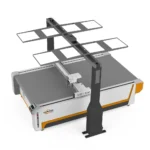
| Product Type | CNC Oscillating Knife Cutting Machine |
| Working Area | 1600 × 2500 mm |
| Machine Size (L×W×H) | 3450 × 2300 × 1250 mm |
| Rated Power | 11 kW |
| Cutting Speed | 200–800 mm/s (according to different cutting materials) |
| Translational Velocity | 800–1200 mm/s |
| Repeated Accuracy | ≤0.1 mm |
| Vacuum Pump | 7.5 kW |
| Voltage | 380V ± 10% |
| Instruction System | HP-GL compatible format |
| Servo Motor | Japanese Yaskawa |
| Linear Rail | Taiwan Hiwin |
| Conveyor Belt | Germany imported |
| Table Type | Flatbed working table with vacuum hold-down and auto feeding |
| Safety Device | Infrared sensors |
Application Suitability
| Application | Material or Output |
|---|---|
| Footwear and leather goods production | Genuine leather, PU leather, split leather hides up to full working area |
| Automotive interior trim cutting | Sponge composite leather, PVC-coated fabrics, synthetic seat covers |
| Garment and flexible textile manufacturing | Clothing flexible materials, layered fabric stacks on conveyor feed |
| Gasket and seal fabrication | Soft glass, silicon sheets, rubber compounds |
| Signage and display component cutting | Vinyl, flexible sign materials, thin foam board |
Why Specified Cutting Speed Ranges Matter More Than Travel Speed
The 200–800 mm/s cutting range exists because leather is never a single material — it is a stack of variables.
Buyers often anchor on translational velocity of 800–1200 mm/s and assume production throughput scales linearly with that number. In practice, an oscillating knife cutting through a 3 mm garment PU runs comfortably at the upper end, while a 6 mm automotive seating composite with woven reinforcement forces the head to slow, adjust oscillation frequency, and sometimes take a second pass. The machine’s digital servo and linear guide system can physically travel fast, but the cutting speed depends entirely on what sits on the table. I have seen lines where the feed rate was set aggressively on the first shift, edges frayed on the second, and by the third shift the operator had dialed everything back to a pace that matched the material rather than the spec sheet [NEED_CITE: oscillation frequency tuning for multi-layer composites].
Matching the Tool Head to Leather Grade and Thickness
The Swiss imported knife assembly supports vibration full cutting, vibration half cutting, and cursor location function. Full cutting is the default for hide-through work on genuine leather and thick PU. Half cutting scores kiss-cut patterns on adhesive-backed leather or laminated stacks where the backing must remain intact. Cursor location handles repositioning when a hide shifts slightly on the vacuum table after the first pass — a common occurrence with irregularly shaped natural hides that cannot be pinned like roll goods. Selecting the correct mode before the first production run prevents ragged edges and reduces blade consumption noticeably.
Vacuum Zoning Across the 1600 × 2500 mm Bed
A flatbed this size holds a full spread of garment leather or multiple footwear panels simultaneously. The 7.5 kW vacuum pump paired with the Germany-imported conveyor belt generates consistent suction across zones, but small gasket parts and narrow strip offcuts can still lift if the active vacuum zone is not matched to the piece footprint. Configuring which zones pull vacuum — and which stay neutral — is a decision made during commissioning, not something to leave at factory defaults [NEED_CITE: vacuum table zoning practices for small-part retention]. When automotive interior shops cut irregularly shaped door panel inserts, proper zoning prevents material migration that would otherwise push tolerances beyond the ≤0.1 mm repeated accuracy the Yaskawa servos and Hiwin rails are built to hold.
Reading the Transmission and Control Chain as a System
The digital servo motor drives the cutting head through a synchronous belt and ball screw on Taiwan Hiwin linear rails. Repeatability of ≤0.1 mm depends on all four elements performing together — a worn belt or contaminated rail degrades accuracy just as surely as a servo fault. The HP-GL compatible instruction system accepts nesting files from most leather CAD platforms, and the auto feeding conveyor advances material between cuts without manual repositioning. When buyers run their existing nesting software against the machine’s file format before order confirmation, they avoid discovering a workflow mismatch on delivery day. Voltage at 380V ± 10% must be confirmed against the workshop supply; three-phase fluctuations outside that window can trip the servo drives or cause inconsistent oscillation amplitude mid-cut.
The Hidden Cost of Skipping Material-Specific Trials
A buyer once specified a working area large enough for full hides and assumed the default knife head would handle everything from soft nappa to glass-fiber-reinforced automotive leather. The machine arrived, soft leather cut cleanly, and production started. Within days the glass-fiber layer dulled the standard blade, edges frayed, and output dropped sharply because every second piece required rework. The fix required a different oscillation profile and blade geometry — configuration choices that would have been settled in a single sample cutting session on the buyer’s actual material roll [NEED_CITE: blade wear patterns on reinforced composite leathers]. Skipping that step turned a multi-week lead time into a multi-week delay.
Why Source Oscillating Knife and Laser From the Same Manufacturer
In-house design covers both knife and laser cutting technologies, so a buyer producing leather goods alongside acrylic signage can match the cutting method to each material rather than forcing one method across the entire shop floor. Tool head and table configurations are specified per material and production volume, not sold as a one-size package. CCD camera positioning is available for printed contour work where leather panels carry registration marks. Software compatibility — HP-GL file import and nesting workflow — is confirmed before the order is locked. Voltage, control language, and plug type are set to the destination market before the machine leaves the factory. Sample cutting on the buyer’s own leather, PU, or composite is completed and documented before any commitment to ship.
Documentation & Verification
- Machine specification sheet listing tool head options and vacuum table zone map
- Electrical schematic confirming 380V ± 10% supply and Yaskawa servo wiring
- Sample cutting report on your specific leather grade and thickness
- Factory test record showing repeated accuracy across the 1600 × 2500 mm bed
- Software licence and HP-GL file format compatibility confirmation note
Installation, Commissioning & Support
- 3450 × 2300 mm footprint requires level concrete floor with clearance for auto feeding conveyor
- Dedicated 380V three-phase circuit rated above 11 kW plus 7.5 kW vacuum pump draw
- Flatbed table arrives assembled; conveyor belt and vacuum lines connected on site
- First-run oscillation frequency and cutting speed tuned to your leather stock
- Operator training covers HP-GL file loading, vacuum zoning, and half-cut mode setup
- Swiss knife blades and synchronous belt listed in spare parts kit for scheduled replacement
What to Include With Your Inquiry
Send the specific leather or composite type, thickness range, and maximum hide or roll width you plan to cut. Note your workshop voltage and frequency so the electrical system is configured before build. If your nesting workflow runs on a particular CAD platform, share a sample file so HP-GL compatibility is verified in advance. State whether you need sample cutting on your own material before order confirmation.
Frequently Asked Questions
Q: How do I decide between oscillating knife and laser for my leather products?
A: Oscillating knife handles thick genuine leather, layered PU, and reinforced composites where laser would leave burnt edges or fail to penetrate glass-fiber backing. Laser suits thin synthetic leather for decorative perforation or sealed-edge cutting on PU film. Both methods are available from the same production line, so the choice is made per material rather than per shop.
Q: Which working area size fits my daily leather cutting volume?
A: The 1600 × 2500 mm bed accommodates full natural hides and multiple nested panels per cycle. Higher daily volumes benefit from pairing the auto feeding conveyor with roll-fed PU, letting the machine advance material between cuts without manual repositioning. Smaller batch workshops cutting single hides may operate on the flatbed table without conveyor feed.
Q: Is CCD camera contour recognition available for printed leather panels?
A: CCD positioning is offered as a configuration option across the range for applications where leather panels carry printed registration marks. The camera tracks contours at production speed, compensating for minor hide stretch or placement shift. Confirm mark size, contrast, and placement with a sample file before the machine is built.
Q: What tool heads can I switch between on this machine?
A: The multifunctional head accepts a Swiss imported oscillating knife for full and half cutting, along with cursor location for repositioning. Additional tool head options such as drag knife, creasing wheel, and pen marking are configurable depending on the materials in your production mix. Each tool is matched to your specific leather type during the sample cutting phase.
Q: Can voltage and control language be customized for my market?
A: Voltage is configurable within the 380V ± 10% range or adapted to local three-phase standards before shipment. Control interface language, plug type, and electrical documentation are set to match the destination workshop. Confirmation of these parameters is part of the pre-production specification review, not an afterthought at packing.










商品评价
There are no reviews yet.