
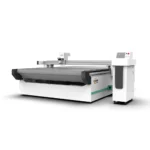
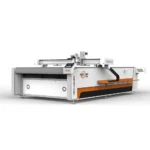


Fast Delivery
Quick, reliable shipping to any location.

Free & easy returns
Return this item by mail or in store within 90 days for a full refund.
Configuration-Specific Tooling — seven interchangeable heads mapped to fabric density and composite structure before order confirmation.
Technical Specifications
| Parameter | Value |
|---|---|
| Product Type | CNC Oscillating Knife Cutting Machine |
| Working Area | 1600 × 2500 mm |
| Available Tools | Oscillating knife, Driven rotary knife, Creasing wheel, Kiss cutting tool, Pneumatic knife, Milling tool, V-groove knife |
| Applicable Materials | Fabric, Cardboard, Carton, Mats, PVC, EVA, Leather, Acrylic, Foam, PTFE, Rubber |
| Cutting Speed Range | 0–2000 mm/s |
| Maximum Cutting Thickness | ≤ 30 mm (basis not stated in source — confirm material type / density / multi-layer stacking) |
| Cutting Accuracy | ±0.1 mm |
| Vacuum Pump | 9 kW |
| Voltage Options | 110V, 220V, 380V (frequency not specified in source) |
| Compatible File Formats | PLT, DXF, AI, PDF |
| Safety Equipment | Infrared sensor device, Emergency stop device |
| Machine Dimensions | 3300 × 2100 × 1350 mm |
| Control Interface | PLC control panel with optional display languages |
| Servo Drive Options | Panasonic, Delta, Dorna (source value — verify against manufacturer catalog) |
| Table Construction | Aluminum bellows vacuum table |
| Language Options | English, Russian, Italian, Chinese, custom languages available |
| Certification | CE |
Application Suitability
| Application | Material or Output |
|---|---|
| Apparel Manufacturing | Suits, knitwear, lace, and complex layered fabrics |
| Automotive Interiors | Seat fabrics, carpets, and PVC floor mats |
| Home Textiles | Sofa upholstery fabrics, curtains, and area rugs |
| Composite Processing | Carbon fiber prepreg, aramid, and specialty layered materials |
Why Material Thickness Dictates More Than Just Blade Depth
A cutting depth rating means nothing without the material density and layup structure that produced it.
A machine specified purely on working area often arrives on the shop floor only to stall on thicker composite stacks or produce frayed edges on technical textiles. The oscillating frequency, blade geometry, and vacuum hold-down must all align with the specific fabric or foam being processed. I have walked through garment factories where the cutting table looked right on paper but spent half the week re-cutting pieces that didn’t separate cleanly from the ply [NEED_CITE: material hold-down requirements for multi-ply fabric cutting].
This CNC oscillating knife cutting machine manufacturer approach starts with the buyer sending actual production material, not a showroom sample, so the tool head and vacuum zoning are validated before the build goes into assembly.
Matching the Tool Head to the Fabric Structure
The seven available tool heads on this flatbed system are not interchangeable accessories; each one addresses a distinct failure mode in fabric cutting. An oscillating knife handles woven and non-woven textiles cleanly at high ply counts, while a driven rotary knife is specified for single-ply or knitted materials where the blade must follow the stretch of the fabric. The creasing wheel and kiss cutting tool serve packaging sample makers who need scored fold lines without penetrating the corrugated layer. Choosing the wrong head for a given textile produces pulled threads, delaminated composite layers, or incomplete cuts that require manual finishing.
Vacuum Zoning and Small-Pattern Stability
The 1600 × 2500 mm aluminum bellows vacuum table provides full-surface adsorption, but the real question is how the zones are configured for the buyer’s typical nesting layout. Small pattern pieces—collar stays, cuff panels, gasket profiles—lift off the table mid-cut if the vacuum zone is larger than the material footprint. A CNC oscillating knife cutting machine manufacturer that does not confirm zone segmentation before shipment leaves the buyer to solve hold-down problems on their own time [NEED_CITE: vacuum table zoning standards for flatbed digital cutters]. The 9 kW pump is sized for the full bed, but zoning valves determine whether that suction actually reaches the workpiece.
Reading the Specification Sheet Against the Production Floor
The ±0.1 mm cutting accuracy figure applies under controlled conditions with a flat, homogenous material. In actual garment and automotive textile production, accuracy depends on how well the fabric is relaxed before laying, whether the vacuum table surface is truly planar across the 3300 mm machine length, and whether the PLC control panel compensates for blade deflection in denser stacks. The 0–2000 mm/s speed range is the travel speed of the head; actual cutting speed through multi-ply fabric or 30 mm foam depends on oscillation frequency, blade angle, and material resistance. Servo drive selection from Panasonic, Delta, or Dorna options influences positional repeatability, which matters most when cutting interlocking pattern pieces where a fraction of a millimeter accumulates across a full lay. File format compatibility with PLT, DXF, AI, and PDF imports must be confirmed against the buyer’s existing nesting software before the machine ships, not after.
The Cost of Guessing the Configuration
Specifying a flatbed cutter on working area alone, then discovering the chosen tool head crushes foam instead of slicing it, means weeks of rework and material waste. A vacuum table with insufficient zoning for small automotive interior panels causes pieces to shift mid-cut, ruining an entire lay. Buying a machine whose control software cannot import the buyer’s nesting files forces a complete workflow change or a second software purchase [NEED_CITE: software compatibility verification in CNC cutting procurement]. Voltage mismatch discovered after shipment means a transformer rental or a rewound motor before production can start.
Why This Build Suits Full-Catalogue Buyers
In-house design and production covering both oscillating knife and laser cutting technologies means the buyer selects the method that fits the material, rather than forcing one process across every fabric type. Tool head and table configuration are specified per material sample and production volume, not pulled from a standard menu. CCD camera contour recognition is available for printed mark tracking on dyed or printed textiles where optical registration matters. Software compatibility is confirmed against the buyer’s file format and nesting workflow before the order is finalized. Voltage, plug standard, and control language are documented on the electrical schematic before the machine enters assembly, matching destination market requirements.
Documentation & Verification
- Machine specification sheet confirming tool head and vacuum table zoning for your material
- Electrical schematic with voltage and frequency locked to your facility supply
- Sample cutting report produced on your actual fabric stack before order commitment
- Software licence and file format note confirming PLT, DXF, AI, PDF import paths
- Factory test record documenting cutting accuracy on your specified material thickness
Installation, Commissioning & Support
- 3300 × 2100 mm footprint requires level concrete floor with clearance for material loading on both ends
- 9 kW vacuum pump and servo drives need a dedicated circuit matching confirmed 110V, 220V, or 380V supply
- Machine ships partially assembled; table leveling and gantry alignment completed on-site
- PLC control panel language set and cutting parameters tuned to buyer’s material during commissioning
- Oscillating knife blades, rotary knife discs, and vacuum seals listed in spare parts pack
- Scheduled vacuum pump filter and blade wear inspections aligned with production shifts
Preparing Your Inquiry
To size this CNC oscillating knife cutting machine correctly, share the fabric or composite material type, single-ply thickness, and the maximum layup height you run in production. Include your typical nesting sheet size and the daily volume of cut pieces your line requires. Confirm the voltage, frequency, and control language your operators need at the machine panel.
Frequently Asked Questions
Q: How do I decide between oscillating knife and laser cutting for my fabric?
A: Oscillating knife cutting suits multi-ply fabric stacks and materials where sealed edges are not required, preserving the textile’s natural hand. Laser cutting seals synthetic edges and handles intricate single-ply contours but can melt or discolor certain natural fibers. Send your actual material for sample cutting on both platforms before committing to a configuration.
Q: What vacuum table zoning do I need for small garment panels?
A: Small pieces like collar and cuff panels require tightly segmented vacuum zones so suction concentrates directly beneath the workpiece. Without correct zoning, lightweight fabric lifts during the knife stroke, causing misalignment. Zone layout is confirmed against your nesting pattern before the table is built.
Q: Which tool head matches my material thickness and edge requirement?
A: The oscillating knife handles most woven fabrics and foams up to the rated thickness. The driven rotary knife suits knitted and stretch materials. The pneumatic knife is specified for dense, heavy composites. Edge quality depends on blade geometry and oscillation frequency matched to your specific material during sample testing.
Q: How is file format and nesting software compatibility confirmed?
A: The control system accepts PLT, DXF, AI, and PDF file imports. Before order placement, your existing nesting output files are loaded onto the machine software to verify that tool paths, layer assignments, and cut sequences translate without manual rework. A compatibility note is included in the documentation pack.
Q: What voltage and language options are available for my destination market?
A: The machine is configurable for 110V, 220V, or 380V supply, with frequency confirmed against your local grid standard. The PLC control panel supports English, Russian, Italian, Chinese, and custom language interfaces. Voltage and language are locked on the electrical schematic before production begins.










商品评价
There are no reviews yet.