


Fast Delivery
Quick, reliable shipping to any location.

Free & easy returns
Return this item by mail or in store within 90 days for a full refund.
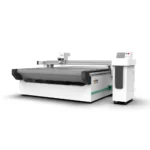
Specified per material and volume — every tool head and table configuration on the CNC High Speed Oscillating Knife Fabric Cutter is matched to a tested sample of your actual stock, not assumed from generic catalog defaults.
Technical Specifications
| Parameter | Value |
|---|---|
| Product Type | CNC Oscillating Knife Cutting Machine |
| Working Area | 1600×2500 mm |
| Tool Head Options | Oscillating knife, Driven rotary knife, Creasing wheel, Kiss cutting tool, Pneumatic knife, Milling tool, V groove knife |
| Cutting Speed | 0–2000 mm/s |
| Cutting Thickness | ≤30 mm (basis not stated in source — confirm block format / material / thickness) |
| Positioning / Cutting Accuracy | ±0.1 mm |
| Vacuum Pump Power | 9 kW |
| Vacuum Table | Aluminum bellows vacuum table |
| Control System | PLC control panel with optional display languages |
| Voltage Options | 110V / 220V / 380V (frequency to be confirmed) |
| Servo Motor Options | Panasonic, Delta, Dorna |
| Nesting | Intelligent nesting system with automatic defect avoidance |
| Software & File Formats | PLT, DXF, AI, PDF; dedicated packaging box structure design software included |
| Language Options | English, Russian, Italian, Chinese; special languages customizable |
| Safety Devices | Infrared sensor device, emergency stop |
| Machine Dimensions | 3300×2100×1350 mm |
| Certification | CE |
Application Suitability
| Application | Material or Output |
|---|---|
| Apparel and knitwear cutting | Suits, lace, multi-layer knits, complex woven fabrics |
| Automotive interior production | Seat fabrics, carpets, PVC mats, multi-layer composite leather with foam backing |
| Home textile manufacturing | Sofa upholstery fabrics, heavy curtains, woven rugs |
| Composite material processing | Carbon fiber prepreg, aramid, PTFE, specialty laminates |
| Flexible material conversion | Knits, plush, leather, foam, cardboard, carton, PVC, EVA, acrylic, rubber |
Why "Maximum Thickness" Without Context Causes Production Rejects
A stated cutting depth is only valid when the material structure, stack height, and vacuum hold-down are tested together.
Buyers often specify a machine based on working area and quoted thickness capacity alone. When the real material is a multi-layer composite with a foam core or a high-nap textile, the blade encounters resistance that a flat spec sheet does not capture. The result is ragged edges, delaminated layers, or parts that shift mid-cycle because the vacuum zoning could not hold small nested pieces. I have seen full batches returned because the oscillation frequency and table suction were never matched to the actual lay-up. [NEED_CITE: material hold-down requirements for multi-layer flexible cutting]
Matching the Tool Head to the Fabric Structure
Selecting the correct tool head is the first decision that determines edge quality. An oscillating knife handles dense woven and technical textiles by cutting with rapid vertical strokes, while a driven rotary knife is suited for continuous straight-line cuts on lighter knits. For kiss cutting adhesive-backed vinyl or protective films, a dedicated kiss cutting tool scores the top layer without damaging the carrier sheet. A CNC oscillating knife cutting machine for sale configured with the wrong head will either crush foam-backed materials or fail to penetrate aramid composites cleanly.
CCD Contour Recognition for Printed Textile Layouts
When cutting pre-printed fabrics or sublimated sportswear panels, the system must track registration marks that shift with fabric stretch and weave distortion. CCD camera positioning reads these printed contours and adjusts the cut path in real time. This matters at production speed, where a static file-based cut path drifts off-register after the first few panels. Buyers should confirm that the contour recognition performs reliably on their specific print density and mark contrast before finalizing the configuration. [NEED_CITE: CCD positioning accuracy on stretchable printed textiles]
Reading the Specifications That Actually Affect Output
The 1600×2500 mm working area defines the maximum single-sheet lay-up, but effective yield depends on the intelligent nesting system with automatic defect avoidance, which positions pattern pieces around fabric flaws to reduce waste. The 9 kW vacuum pump powers the aluminum bellows vacuum table, and the zoning configuration determines whether small cut parts stay flat or lift during high-speed traverses. Positioning accuracy of ±0.1 mm holds tolerance across long cuts, while the 0–2000 mm/s cutting speed range is achievable only on materials and thicknesses confirmed through sample testing — thicker or more abrasive composites require reduced feed rates to maintain edge quality and blade life.
What Happens When Configuration Is Skipped
A machine ordered without material-specific testing often arrives with a generic tool head and undivided vacuum zoning. Small pattern pieces lift off the table during cutting, producing miscut parts. The blade oscillation frequency may be too low for dense foam composites, leaving compressed and frayed edges that fail downstream quality checks. Software file compatibility issues surface only when the operator tries to import nesting layouts. These problems are expensive to fix after shipment and are entirely avoidable with a pre-order sample cutting report. [NEED_CITE: cost of post-shipment reconfiguration versus pre-order material testing]
Why the Build Process Matters for This Equipment Class
The design team and production facility cover both knife and laser cutting technologies, so the cutting method is matched to the material rather than forced into one platform. Tool head and table configurations are specified individually per material type and production volume. Software compatibility with DXF, PLT, AI, and PDF formats is confirmed before the order is finalized, not assumed. Voltage, plug type, and control language are verified against the destination market’s electrical standards. Sample cutting on the buyer’s own material is performed before commitment, providing a documented baseline for edge quality and dimensional accuracy.
Documentation & Verification
- Machine specification sheet listing confirmed tool head and table configuration per material
- Electrical schematic with voltage and frequency validated for destination market
- Sample cutting report produced on buyer-supplied fabric or composite stock
- Software licence and file format compatibility note for nesting workflow
- CE declaration documentation where applicable to destination market
- Factory test record capturing cutting accuracy and vacuum hold-down performance
Installation, Commissioning & Support
- Floor space must accommodate the 3300×2100 mm footprint with clearance for material loading
- Dedicated electrical circuit matching confirmed voltage (110V/220V/380V) and frequency
- 9 kW vacuum pump requires separate power provisioning and exhaust routing
- PLC control panel configured to operator language during commissioning
- First-run calibration of tool head offset, oscillation frequency, and vacuum zoning
- Spare blade and wear part list provided with recommended replacement intervals
Moving Forward with a Configuration Inquiry
To determine the correct machine setup, share your material type, layer count, and individual ply thickness. Provide the maximum sheet or roll width and your target daily cut volume. Specify the local voltage and frequency, the preferred control language, and whether your workflow requires CCD contour recognition for printed fabrics. If possible, send a sample of your actual production material so that a documented cutting test can be completed before quotation.
Frequently Asked Questions
Q: How do I decide between oscillating knife and laser cutting for my fabric?
A: Oscillating knife cuts without thermal damage, making it suitable for synthetic composites, foam-backed textiles, and multi-layer stacks where heat sealing or edge melting is unacceptable. Laser cutting seals edges on synthetics but generates fumes and is limited by material reflectivity. The choice depends on your specific material composition and the edge finish your product requires.
Q: How is cutting thickness verified for my material?
A: A sample of your actual material — including all layers, backing, and adhesive — is cut under production conditions before the machine is configured. The test confirms whether the oscillation frequency, blade type, and vacuum hold-down achieve clean edges at the required stack height. Results are documented in a sample cutting report.
Q: What working area sizes are available across the range?
A: The 1600×2500 mm format is one option within a broader range of table sizes and multi-head configurations. Selection depends on your standard material sheet or roll width, nesting efficiency requirements, and available floor space. Configuration is confirmed during the pre-order consultation.
Q: How does CCD camera contour recognition perform on printed marks at production speed?
A: The CCD system reads registration marks on printed textiles and adjusts the cut path to compensate for stretch and distortion. Performance depends on mark contrast, print density, and fabric weave. Buyers should provide printed samples so recognition reliability can be tested at the intended cutting speed before the order is finalized.
Q: What voltage, plug, and language options are confirmed before shipment?
A: Voltage is configured to 110V, 220V, or 380V based on your local supply, with frequency confirmed separately. Plug type matches the destination standard. The PLC control panel display language is set to English, Russian, Italian, Chinese, or a customized language as specified during order confirmation.










商品评价
There are no reviews yet.