



Fast Delivery
Quick, reliable shipping to any location.

Free & easy returns
Return this item by mail or in store within 90 days for a full refund.
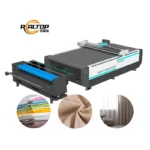
In-House Knife and Laser Build — the RTT6080 series integrates oscillating knife, kiss-cut, creasing and CCD tooling on a single flatbed, letting converters align the head to the stock rather than forcing one toolpath across every job.
Technical Specifications
| Parameter | Value |
|---|---|
| Model | RTT6080 / RTT6080 Pro |
| Product Type | CNC Flatbed Digital Cutting Plotter |
| Max Working Area | 600mm × 800mm |
| Tool Group | cutting tool, kiss cutting tool, creasing tool, CCD camera; high speed oscillating knife (Pro) |
| Max Cutting Speed | 1500 mm/s (according to the material — basis not stated in source) |
| Cutting Thickness | ≤2mm (RTT6080); ≤5mm (RTT6080 Pro) — material basis not stated in source |
| Positioning Accuracy | 0.05mm |
| File Format | DXF, PLT, PDF, AI |
| Transfer Method | Ethernet port |
| Rated Power | 3.2KW |
| Voltage & Frequency | 220V/380V, 50Hz |
| Control System | CNC (source value — verify against manufacturer catalog) |
Application Suitability
| Application | Material or Output |
|---|---|
| Packaging Sample Making | A4 paper board, corrugated sheet, prototyping die-lines |
| Label Converting | Self-adhesive labels, printed vinyl, synthetic tag stock |
| Thin Non-Metal Fabrication | Gasket material, card stock, thin foam sheet, carton proofing |
Why Working Area Alone Misleads Packaging Buyers
Selecting a CNC flatbed cutting plotter manufacturer solely by bed dimensions often leaves converters with a machine that cannot grip small label runs or push through multi-ply carton stock.
I have seen procurement teams focus on the 600mm × 800mm envelope and skip the conversation about vacuum zoning. When short-run packaging prototypes are nested with tight clearances, inadequate zoning allows the stock to lift under the knife, ruining the registration. Confirming the hold-down strategy is just as critical as measuring the table [NEED_CITE: vacuum table zoning standards for digital cutting plotters].
Tool Head Alignment for Short-Run Converting
The standard RTT6080 carries cutting, kiss cutting and creasing tools alongside a CCD camera. This configuration suits converters who run self-adhesive labels and thin paper board where edge sealing is unnecessary. The CCD camera tracks printed marks to maintain contour accuracy when the stock shifts slightly during the run, a common occurrence in label production.
When the Pro Model Earns Its Place
The RTT6080 Pro adds a high speed oscillating knife, shifting the capacity to 5mm thickness. This matters for synthetic gasket materials or layered carton samples that drag knives struggle to penetrate cleanly. Buyers moving from simple paper board to composite foam or thicker corrugated drafts usually find the oscillating action produces a square edge where a drag knife leaves a bevel.
Reading the Speed and Accuracy Figures
The 1500 mm/s cutting speed and 0.05mm positioning accuracy are the headline figures, but their real impact depends on material behavior. On thin label stock, the positioning accuracy ensures the CCD camera can track registration marks within tolerance. On thicker board, the oscillating knife on the Pro model maintains that accuracy by cutting with a vertical stroke rather than dragging, preventing the material from shifting under lateral force [NEED_CITE: positional accuracy requirements for printed contour cutting].
The Cost of Mismatched Tool Heads
Choosing a drag knife for a material that requires an oscillating head results in ragged edges and crushed foam cores. Conversely, running thin label stock through an oscillating knife can tear the face material. These mismatches are rarely apparent during the sales demo if the sample material differs from production stock [NEED_CITE: tool head selection criteria for composite materials].
Procurement Based on Configuration, Not Speculation
Realtop Machinery (Jinan) Co., Ltd builds both knife and laser platforms in-house, so the tooling recommendation is based on material testing rather than a single technology bias. The RTT6080 series is configured per material, with CCD contour recognition and software file compatibility confirmed before the order is locked. Voltage, plug type and control language are specified for the destination market, not left to default settings.
Documentation & Verification
- Factory test record on buyer’s specific paper board or label stock before dispatch
- Tool head and vacuum table configuration list matching the quoted cutting thickness
- Software licence and file format compatibility note for DXF, PLT, PDF and AI imports
- Electrical schematic and voltage confirmation for 220V/380V destination supply
Installation, Commissioning & Support
- 3.2KW rated power requires a dedicated circuit matching the confirmed 50Hz frequency
- 600mm × 800mm footprint fits standard workshops; level floor required for gantry accuracy
- Ethernet port setup verified with buyer’s existing network and file server structure
- CCD camera calibration performed on buyer’s printed stock during on-site commissioning
- Oscillating knife blade change procedure and spare blade inventory established at handover
Preparing Your Material Brief
To configure the RTT6080 correctly, specify the exact material type, thickness and maximum sheet size you will run daily. Confirm the local voltage supply, the control panel language your operators need, and whether your existing design workflow outputs DXF, PLT, PDF or AI files so the software bridge can be validated before shipment.
Frequently Asked Questions
Q: How do I confirm the cutting thickness is real and not just a catalog figure?
A: Request a sample cutting report run on your exact material. The standard RTT6080 quotes up to 2mm and the Pro up to 5mm, but these figures depend on material density. A test cut on your board or gasket stock proves whether the knife pressure and tool head match your production needs.
Q: Standard vs Pro — which tool configuration covers packaging samples and labels?
A: The standard RTT6080 with cutting, kiss cutting and creasing tools handles most paper board and label work. If you run thicker corrugated drafts or composite gasket materials, the Pro model’s oscillating knife provides the vertical cutting action needed for clean edges at higher thicknesses.
Q: Does the CCD camera track all printed mark formats at production speed?
A: The CCD camera provides contour recognition for printed marks, but supported formats and tracking speed vary by mark size and contrast. Confirm your specific label artwork and print mark layout during the sample test to verify the camera maintains registration across the full bed.
Q: Can my existing design files import without conversion issues?
A: The system accepts DXF, PLT, PDF and AI files via Ethernet transfer. Before ordering, provide a sample of your actual design files so the software compatibility can be verified, ensuring no conversion loss occurs when your operators load production jobs.










商品评价
There are no reviews yet.