

Fast Delivery
Quick, reliable shipping to any location.

Free & easy returns
Return this item by mail or in store within 90 days for a full refund.
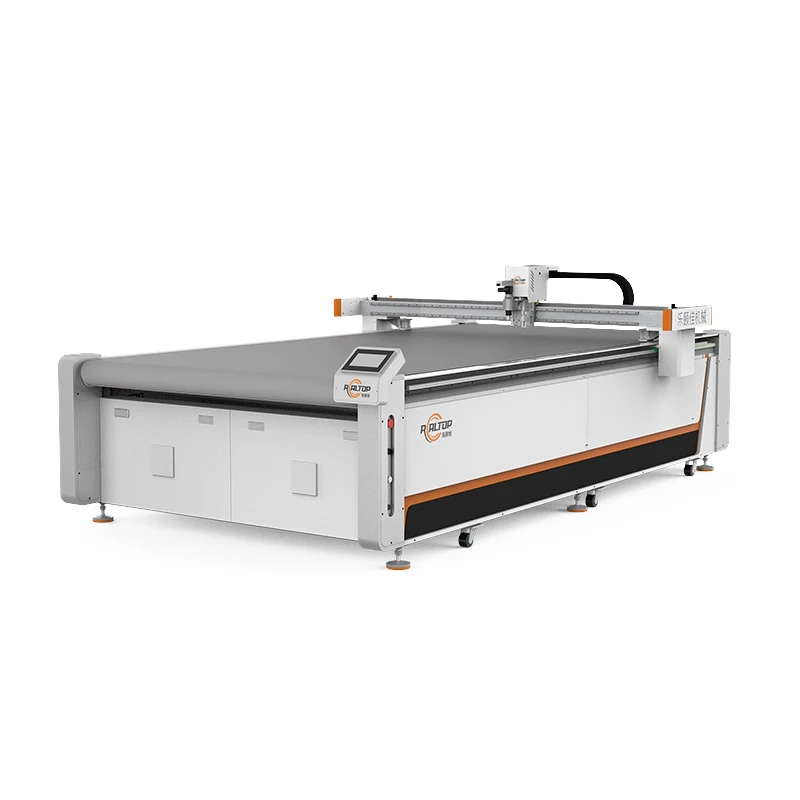
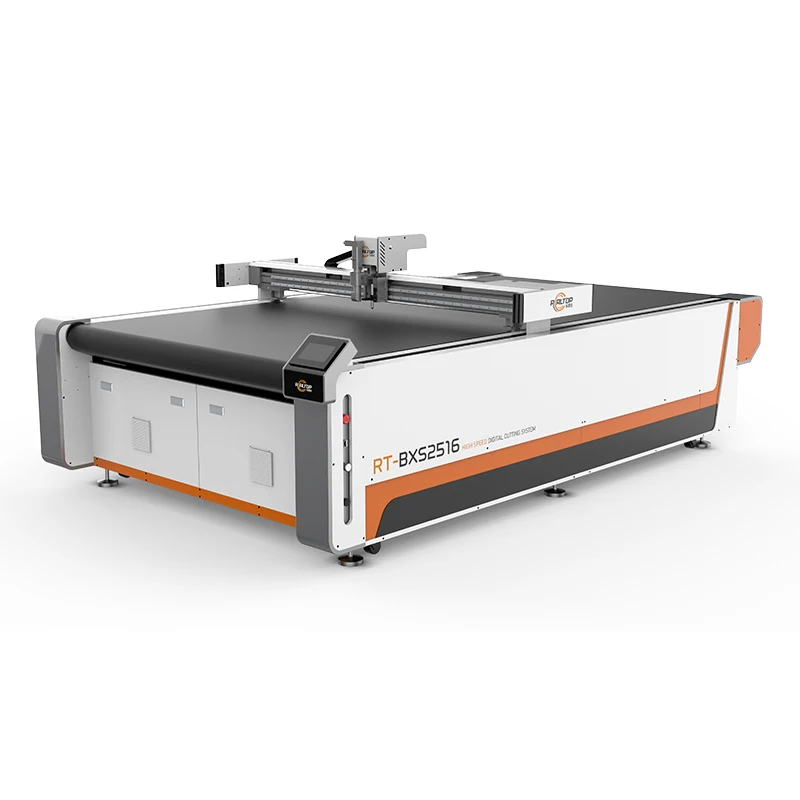
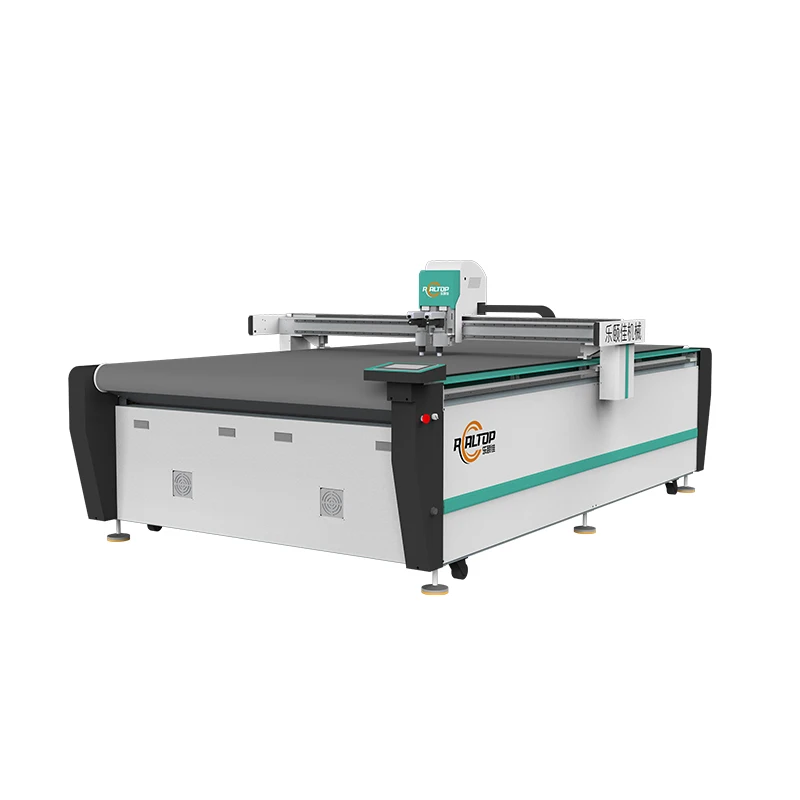
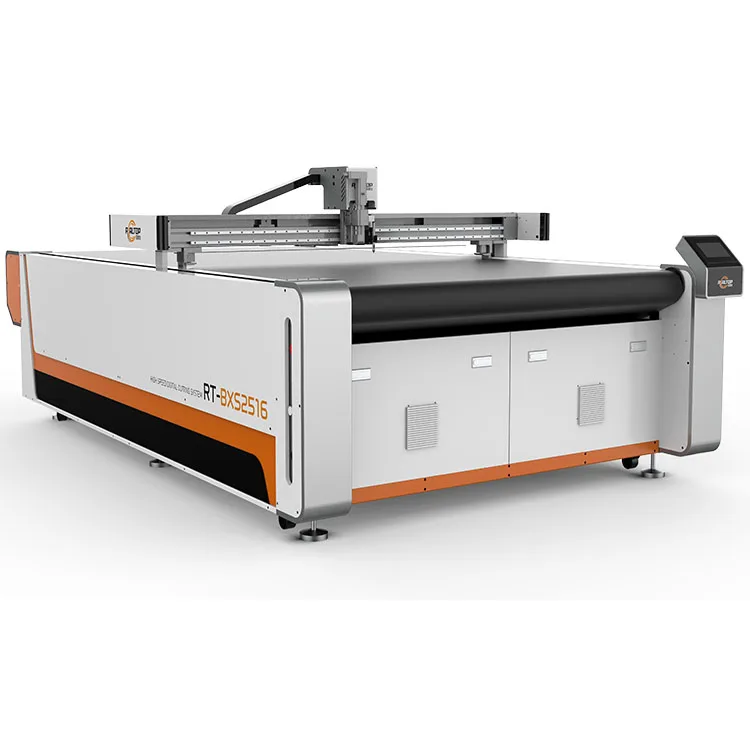
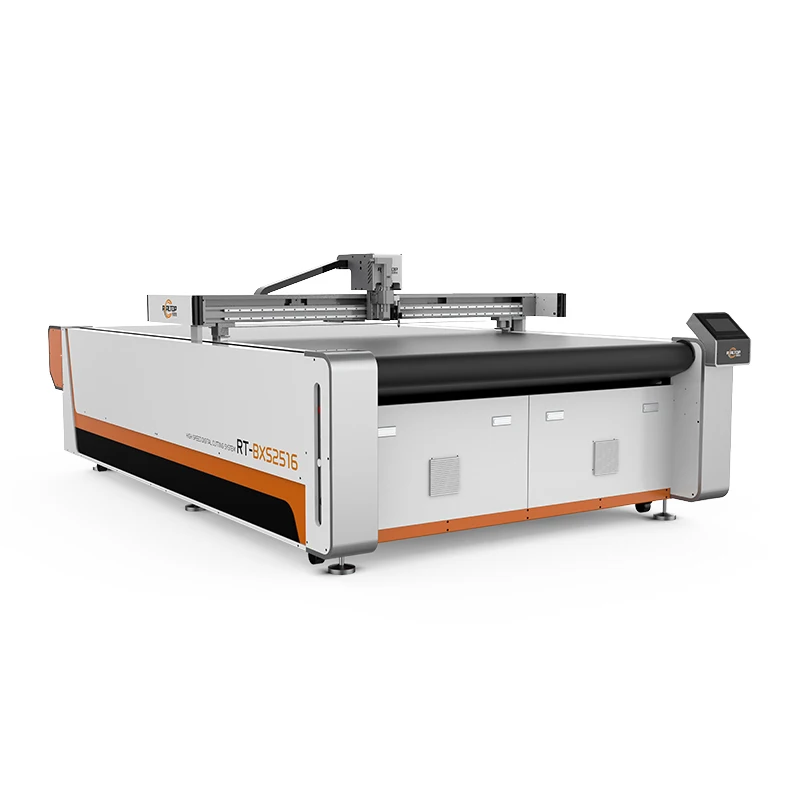
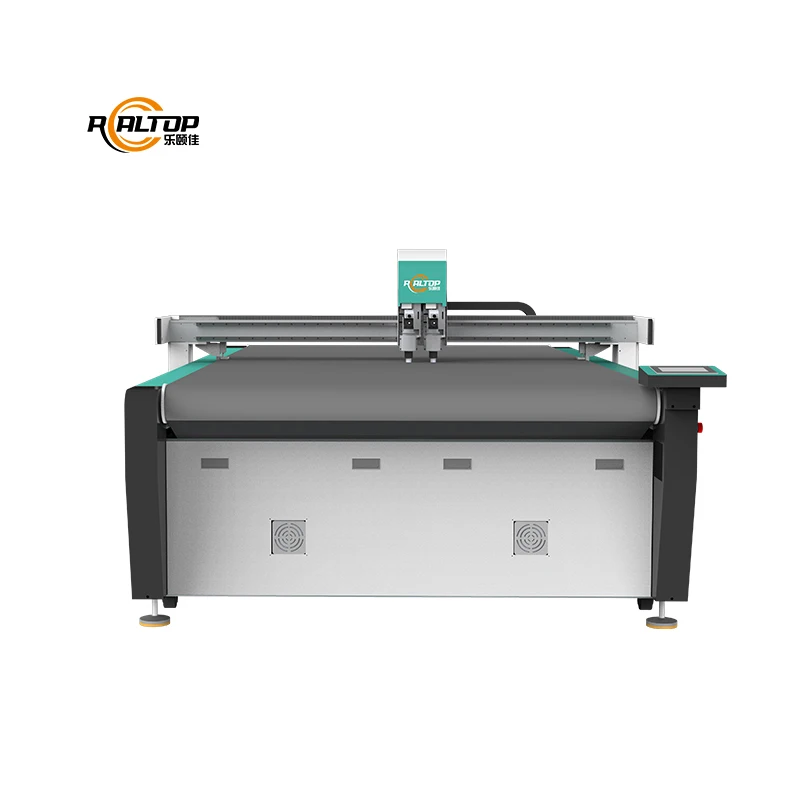
Tool Head Versatility — In-house design across knife and laser platforms lets the RT-D2516/RT-S2516 match oscillating, pneumatic, drag and circular knife options to denim or knitted fabric stacks instead of forcing a single blade through incompatible textiles.
Technical Specifications
| Parameter | Value |
|---|---|
| Model | RT-D2516 / RT-S2516 |
| Product Type | CNC Oscillating Knife Cutting Machine |
| Working Area | 1600 × 2500 mm |
| Overall Dimensions (L×W×H) | 3450 × 2300 × 1250 mm |
| Rated Power | 9 kW |
| Voltage & Frequency | 380V ±10% |
| Translational Velocity | 800–2000 mm/s |
| Cutting Speed | 200–800 mm/s (according to different cutting materials) |
| Cutting Thickness | ≤100 mm (varies with material) |
| Repeatability | ≤0.1 mm |
| Tool Head Options | Oscillating knife, pneumatic knife, high-power vibrating knife, circular knife, V-cutting knife, drag knife, creasing wheel, dotted line knife, punching, brush |
| Visual Positioning | CCD camera mark point, panoramic camera recognition, projection positioning |
| Transmission System | Digital servo motor (Delta or Panasonic, IP67), linear guide, synchronous belt, ball screw |
| Work Table | Magnesium-aluminum alloy vacuum table with fluorocarbon PVDF coating, flat or auto-feeding |
| Vacuum Pump | 7.5 kW, integrated aviation aluminum shell with built-in silencer |
| Conveyor Belt | Germany imported |
| Guide Rail | Taiwan Hiwin |
| Instruction System | HP-GL compatible format |
| Software Compatibility | PLT, DXF, AI and other formats via auto typesetting software |
| Safety Devices | Infrared induction blocking, beam anti-collision, emergency stop with in-situ resume |
Application Suitability
| Application | Material or Output |
|---|---|
| Garment pattern cutting | Denim, knitted fabric, lining and interlining in single or multi-layer stacks |
| Footwear and luggage production | Leather, synthetic leather, shoe upper material, textile composites |
| Automotive interior trimming | Sponge composite leather, foam gaskets, headliner fabric, carpet |
| Soft home furnishings | Curtain fabric, upholstery textile, non-woven fabric, carpet and floor mats |
| Technical textile processing | PU, EVA, XPE, PVC, PP, PE, PTFE, ETFE sheets and composite panels |
Why Specified Working Area Is Not Enough for Denim Stacks
A 1600×2500 mm table tells you how much fabric fits, not whether the blade will cut through six layers of denim without crushing the knit underneath.
When a buyer sources a flatbed cutter by working area and price alone, the machine arrives and fails on the exact material it was purchased for. I have watched a denim factory receive a machine that handled single-layer samples perfectly, then struggled when the production floor loaded mixed denim and knitted fabric stacks. The knife pressure needed for heavy denim distorted the lighter knit layers beneath, producing unusable cut pieces across an entire batch. A CNC Oscillating Knife Cutting Machine manufacturer must confirm blade type, oscillation frequency and vacuum hold-down against the buyer’s actual fabric lay-up before the order is finalised, not after the crate is opened [NEED_CITE: fabric lay-up tension and knife deflection in multi-layer garment cutting].
Matching the Blade to the Fabric Stack
The RT-D2516/RT-S2516 supports a multifunctional tool head that accepts Swiss-imported oscillating knives alongside pneumatic, circular, drag and V-cutting options. This matters because denim at 14 oz per square yard demands a different stroke frequency and blade geometry than a lightweight knitted lining. Rather than locking the buyer into one blade at purchase, the head accepts swaps as production orders shift between heavy outerwear fabric and delicate interlining, keeping edge quality consistent across the full garment range.
Holding Small Pattern Pieces Flat at Speed
Garment nests contain dozens of small pieces — collars, cuffs, pocket facings — that tend to lift off the table when the knife exits a cut at 800 mm/s translational speed. The magnesium-aluminum vacuum table on this platform pairs with a 7.5 kW pump and zoned adsorption to maintain suction exactly where the cutting head is working. The fluorocarbon PVDF powder-sprayed surface resists abrasion from repeated fabric loading, and the auto-feeding variant uses a German-imported conveyor belt to advance rolled textile without manual repositioning between nests.
Reading Printed Marks at Line Speed
Contour cutting around printed plaids or pre-registered logos requires the vision system to locate marks faster than the gantry moves. The RT-D2516/RT-S2516 offers CCD mark point positioning, panoramic camera recognition and projection positioning as selectable options. A CCD Oscillating Knife Cutting Machine manufacturer that only quotes one camera type leaves the buyer exposed when the print register tolerance tightens on a new seasonal collection [NEED_CITE: CCD camera recognition latency at production cutting speed].
Interpreting the Specs That Reach the Shop Floor
The 9 kW rated power covers both the servo drives and the vacuum pump draw, so electrical planning must account for sustained load rather than intermittent peaks. The IP67-rated digital servo motors (Delta or Panasonic) resist textile dust ingress that accumulates inside garment workshops over successive shifts. Taiwan Hiwin linear guides paired with ball screw and synchronous belt transmission maintain the ≤0.1 mm repeatability across the full 2500 mm stroke, which is critical when nested pattern pieces share tight seam allowances. The touch-screen control panel supports English, Russian, Italian and Chinese with custom language orders available, reducing operator error in multilingual production facilities.
What Happens When the Wrong Configuration Ships
A machine quoted with a drag knife instead of an oscillating knife will leave ragged edges on woven denim and crush the pile on sponge-backed automotive textiles. Insufficient vacuum zoning causes small collar pieces to shift mid-cut, producing mismatched pairs that only surface at the sewing line. Software that cannot import the buyer’s existing DXF or PLT nesting files forces the pattern department to redraw every marker, adding hours of preparation per production run [NEED_CITE: nesting file format compatibility in garment CAD workflows]. Voltage confirmed too late means a 380V machine arrives in a 220V workshop and sits idle while a transformer is sourced locally.
What the Factory Brings to This Platform
REALTOP designs and produces both knife and laser cutting platforms in-house at its Jinan facility, so a buyer evaluating denim against acrylic can compare methods under one roof instead of forcing textile work onto a laser or leather work onto a knife. Tool head and table configuration is specified per material sample before quotation, not selected from a fixed catalogue page. Sample cutting on the buyer’s own fabric documents blade type, speed and edge quality before commitment. Software compatibility is confirmed against the buyer’s existing PLT, DXF and AI files during the order process. Voltage, plug type and control language are locked in before production begins rather than assumed at shipment.
Documentation & Verification
- Machine specification sheet listing confirmed tool head and blade options for your fabric type
- Electrical schematic with 380V ±10% circuit diagram and breaker sizing for workshop planning
- Tool head and vacuum table configuration list matched to your material thickness and stack height
- Sample cutting report on your denim or knitted fabric documenting edge quality and cutting speed
- Software licence and file format compatibility note covering PLT, DXF, AI and HP-GL workflows
- Factory test record with repeatability measurement across the 1600 × 2500 mm working area
Installation, Commissioning & Support
- Requires a level concrete floor to support the 3450 × 2300 × 1250 mm footprint plus material staging area
- Dedicated 380V ±10% circuit rated for the 9 kW machine load plus 7.5 kW vacuum pump draw
- Ships fully assembled with forklift pockets; rigging plan needed for workshop door clearance
- First-run parameter setting covers oscillation frequency, vacuum zone mapping and servo tuning on your fabric
- Operator training includes tool head blade change, CCD mark registration and nesting software workflow
- Spare blade inventory and wear parts list provided with recommended replacement intervals
Before You Send the Inquiry
To match the right configuration, we need to know the fabric types you cut (denim weight, knit composition, composite construction), the maximum stack height and sheet dimensions you load, and your daily cutting volume. Confirm your workshop voltage and frequency, preferred control panel language, and whether your pattern department works in PLT, DXF or AI format. If you can send a roll of your actual production fabric, we will run a sample cut and document the results before any specification is locked in.
Frequently Asked Questions
Q: How do you select the correct tool head for different garment fabrics?
A: The RT-D2516/RT-S2516 accepts oscillating, pneumatic, circular and drag knife options on the same multifunctional head. Selection depends on fabric weight, stack height and edge finish requirement. We cut samples on your actual denim, knit or composite material to confirm the blade type and oscillation frequency before the machine configuration is finalised.
Q: Can the CCD camera track printed contour marks at full cutting speed?
A: The platform offers CCD mark point positioning, panoramic camera recognition and projection positioning as selectable options. The appropriate vision system depends on your print register tolerance and the translational speed your nesting layout demands. We verify mark acquisition on your printed fabric sample before shipment.
Q: How is voltage and control language confirmed for export markets?
A: The standard configuration runs on 380V ±10% with control panel support for English, Russian, Italian and Chinese. Special language requests and alternative voltage requirements are confirmed during the specification review stage, documented in the electrical schematic and locked before production begins.
Q: What documentation accompanies the machine at shipment?
A: You receive the machine specification sheet, electrical schematic, tool head and table configuration list, sample cutting report on your material, software licence with file format compatibility note, CE declaration where applicable, operation and maintenance manual, spare parts list and packing photographs.
Tool Head Versatility — In-house design across knife and laser platforms lets the RT-D2516/RT-S2516 match oscillating, pneumatic, drag and circular knife options to denim or knitted fabric stacks instead of forcing a single blade through incompatible textiles.
Technical Specifications
| Parameter | Value |
|---|---|
| Model | RT-D2516 / RT-S2516 |
| Product Type | CNC Oscillating Knife Cutting Machine |
| Working Area | 1600 × 2500 mm |
| Overall Dimensions (L×W×H) | 3450 × 2300 × 1250 mm |
| Rated Power | 9 kW |
| Voltage & Frequency | 380V ±10% |
| Translational Velocity | 800–2000 mm/s |
| Cutting Speed | 200–800 mm/s (according to different cutting materials) |
| Cutting Thickness | ≤100 mm (varies with material) |
| Repeatability | ≤0.1 mm |
| Tool Head Options | Oscillating knife, pneumatic knife, high-power vibrating knife, circular knife, V-cutting knife, drag knife, creasing wheel, dotted line knife, punching, brush |
| Visual Positioning | CCD camera mark point, panoramic camera recognition, projection positioning |
| Transmission System | Digital servo motor (Delta or Panasonic, IP67), linear guide, synchronous belt, ball screw |
| Work Table | Magnesium-aluminum alloy vacuum table with fluorocarbon PVDF coating, flat or auto-feeding |
| Vacuum Pump | 7.5 kW, integrated aviation aluminum shell with built-in silencer |
| Conveyor Belt | Germany imported |
| Guide Rail | Taiwan Hiwin |
| Instruction System | HP-GL compatible format |
| Software Compatibility | PLT, DXF, AI and other formats via auto typesetting software |
| Safety Devices | Infrared induction blocking, beam anti-collision, emergency stop with in-situ resume |
Application Suitability
| Application | Material or Output |
|---|---|
| Garment pattern cutting | Denim, knitted fabric, lining and interlining in single or multi-layer stacks |
| Footwear and luggage production | Leather, synthetic leather, shoe upper material, textile composites |
| Automotive interior trimming | Sponge composite leather, foam gaskets, headliner fabric, carpet |
| Soft home furnishings | Curtain fabric, upholstery textile, non-woven fabric, carpet and floor mats |
| Technical textile processing | PU, EVA, XPE, PVC, PP, PE, PTFE, ETFE sheets and composite panels |
Why Specified Working Area Is Not Enough for Denim Stacks
A 1600×2500 mm table tells you how much fabric fits, not whether the blade will cut through six layers of denim without crushing the knit underneath.
When a buyer sources a flatbed cutter by working area and price alone, the machine arrives and fails on the exact material it was purchased for. I have watched a denim factory receive a machine that handled single-layer samples perfectly, then struggled when the production floor loaded mixed denim and knitted fabric stacks. The knife pressure needed for heavy denim distorted the lighter knit layers beneath, producing unusable cut pieces across an entire batch. A CNC Oscillating Knife Cutting Machine manufacturer must confirm blade type, oscillation frequency and vacuum hold-down against the buyer’s actual fabric lay-up before the order is finalised, not after the crate is opened [NEED_CITE: fabric lay-up tension and knife deflection in multi-layer garment cutting].
Matching the Blade to the Fabric Stack
The RT-D2516/RT-S2516 supports a multifunctional tool head that accepts Swiss-imported oscillating knives alongside pneumatic, circular, drag and V-cutting options. This matters because denim at 14 oz per square yard demands a different stroke frequency and blade geometry than a lightweight knitted lining. Rather than locking the buyer into one blade at purchase, the head accepts swaps as production orders shift between heavy outerwear fabric and delicate interlining, keeping edge quality consistent across the full garment range.
Holding Small Pattern Pieces Flat at Speed
Garment nests contain dozens of small pieces — collars, cuffs, pocket facings — that tend to lift off the table when the knife exits a cut at 800 mm/s translational speed. The magnesium-aluminum vacuum table on this platform pairs with a 7.5 kW pump and zoned adsorption to maintain suction exactly where the cutting head is working. The fluorocarbon PVDF powder-sprayed surface resists abrasion from repeated fabric loading, and the auto-feeding variant uses a German-imported conveyor belt to advance rolled textile without manual repositioning between nests.
Reading Printed Marks at Line Speed
Contour cutting around printed plaids or pre-registered logos requires the vision system to locate marks faster than the gantry moves. The RT-D2516/RT-S2516 offers CCD mark point positioning, panoramic camera recognition and projection positioning as selectable options. A CCD Oscillating Knife Cutting Machine manufacturer that only quotes one camera type leaves the buyer exposed when the print register tolerance tightens on a new seasonal collection [NEED_CITE: CCD camera recognition latency at production cutting speed].
Interpreting the Specs That Reach the Shop Floor
The 9 kW rated power covers both the servo drives and the vacuum pump draw, so electrical planning must account for sustained load rather than intermittent peaks. The IP67-rated digital servo motors (Delta or Panasonic) resist textile dust ingress that accumulates inside garment workshops over successive shifts. Taiwan Hiwin linear guides paired with ball screw and synchronous belt transmission maintain the ≤0.1 mm repeatability across the full 2500 mm stroke, which is critical when nested pattern pieces share tight seam allowances. The touch-screen control panel supports English, Russian, Italian and Chinese with custom language orders available, reducing operator error in multilingual production facilities.
What Happens When the Wrong Configuration Ships
A machine quoted with a drag knife instead of an oscillating knife will leave ragged edges on woven denim and crush the pile on sponge-backed automotive textiles. Insufficient vacuum zoning causes small collar pieces to shift mid-cut, producing mismatched pairs that only surface at the sewing line. Software that cannot import the buyer’s existing DXF or PLT nesting files forces the pattern department to redraw every marker, adding hours of preparation per production run [NEED_CITE: nesting file format compatibility in garment CAD workflows]. Voltage confirmed too late means a 380V machine arrives in a 220V workshop and sits idle while a transformer is sourced locally.
What the Factory Brings to This Platform
REALTOP designs and produces both knife and laser cutting platforms in-house at its Jinan facility, so a buyer evaluating denim against acrylic can compare methods under one roof instead of forcing textile work onto a laser or leather work onto a knife. Tool head and table configuration is specified per material sample before quotation, not selected from a fixed catalogue page. Sample cutting on the buyer’s own fabric documents blade type, speed and edge quality before commitment. Software compatibility is confirmed against the buyer’s existing PLT, DXF and AI files during the order process. Voltage, plug type and control language are locked in before production begins rather than assumed at shipment.
Documentation & Verification
- Machine specification sheet listing confirmed tool head and blade options for your fabric type
- Electrical schematic with 380V ±10% circuit diagram and breaker sizing for workshop planning
- Tool head and vacuum table configuration list matched to your material thickness and stack height
- Sample cutting report on your denim or knitted fabric documenting edge quality and cutting speed
- Software licence and file format compatibility note covering PLT, DXF, AI and HP-GL workflows
- Factory test record with repeatability measurement across the 1600 × 2500 mm working area
Installation, Commissioning & Support
- Requires a level concrete floor to support the 3450 × 2300 × 1250 mm footprint plus material staging area
- Dedicated 380V ±10% circuit rated for the 9 kW machine load plus 7.5 kW vacuum pump draw
- Ships fully assembled with forklift pockets; rigging plan needed for workshop door clearance
- First-run parameter setting covers oscillation frequency, vacuum zone mapping and servo tuning on your fabric
- Operator training includes tool head blade change, CCD mark registration and nesting software workflow
- Spare blade inventory and wear parts list provided with recommended replacement intervals
Before You Send the Inquiry
To match the right configuration, we need to know the fabric types you cut (denim weight, knit composition, composite construction), the maximum stack height and sheet dimensions you load, and your daily cutting volume. Confirm your workshop voltage and frequency, preferred control panel language, and whether your pattern department works in PLT, DXF or AI format. If you can send a roll of your actual production fabric, we will run a sample cut and document the results before any specification is locked in.
Frequently Asked Questions
Q: How do you select the correct tool head for different garment fabrics?
A: The RT-D2516/RT-S2516 accepts oscillating, pneumatic, circular and drag knife options on the same multifunctional head. Selection depends on fabric weight, stack height and edge finish requirement. We cut samples on your actual denim, knit or composite material to confirm the blade type and oscillation frequency before the machine configuration is finalised.
Q: Can the CCD camera track printed contour marks at full cutting speed?
A: The platform offers CCD mark point positioning, panoramic camera recognition and projection positioning as selectable options. The appropriate vision system depends on your print register tolerance and the translational speed your nesting layout demands. We verify mark acquisition on your printed fabric sample before shipment.
Q: How is voltage and control language confirmed for export markets?
A: The standard configuration runs on 380V ±10% with control panel support for English, Russian, Italian and Chinese. Special language requests and alternative voltage requirements are confirmed during the specification review stage, documented in the electrical schematic and locked before production begins.
Q: What documentation accompanies the machine at shipment?
A: You receive the machine specification sheet, electrical schematic, tool head and table configuration list, sample cutting report on your material, software licence with file format compatibility note, CE declaration where applicable, operation and maintenance manual, spare parts list and packing photographs.










商品评价
There are no reviews yet.