



Fast Delivery
Quick, reliable shipping to any location.

Free & easy returns
Return this item by mail or in store within 90 days for a full refund.
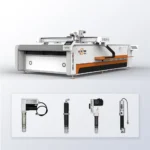
Interchangeable Tool Head Configuration — The 1625 CNC oscillating knife cutting machine for sale supports seven distinct tool head options, allowing buyers to match the cutting method to their exact material rather than forcing one method across all jobs.
Technical Specifications
| Parameter | Value |
|---|---|
| Model | 1625 |
| Product Type | CNC Oscillating Knife Fabric Cutting Machine |
| Working Area | 1600*2500mm |
| Tool Head Options | Oscillating knife, Driven rotary knife, Creasing wheel, Kiss cutting tool, Pneumatic knife, Milling tool, V groove knife |
| Cutting Speed | 0-2000 mm/s |
| Cutting Thickness | ≤ 30mm (basis not stated in source — confirm material type, density and layer configuration) |
| Cutting Accuracy | ±0.1 mm |
| Applicable Materials | Fabric, Cardboard, Carton, Mats, PVC, EVA, Leather, Acrylic, Foam, PTFE, Rubber |
| Vacuum Table | Aluminum bellows vacuum table |
| Vacuum Pump | 9KW |
| Servo Motor Options | Panasonic, Delta, Dorna |
| Control System | PLC control panel with optional display languages |
| File Formats | PLT, DXF, AI, PDF |
| Voltage Options | 110V, 220V, 380V (frequency not specified) |
| Language Options | English, Russian, Italian, Chinese (special languages customizable) |
| Software | Dedicated packaging box structure design software included |
| Safety Device | Infrared sensor device and emergency stop device |
| Machine Size | 330021001350 mm |
| Certification | CE |
Application Suitability
| Application | Material or Output |
|---|---|
| Apparel manufacturing | Suits, knitwear, lace, complex woven and knit fabrics |
| Automotive interiors | Seat fabrics, carpets, PVC mats cut to burr-free tolerances |
| Home textiles | Sofa upholstery fabrics, curtain panels, rugs with vacuum-assisted multi-layer cutting |
| Composite material processing | Carbon fiber prepreg, aramid layers for aerospace and industrial use |
| Packaging sample making | Cardboard and carton structural prototypes using creasing wheel and kiss cutting tools |
Why the Tool Head Choice Matters More Than Working Area for a CNC Oscillating Knife Cutting Machine for Sale
A machine specified on working area alone will fail if the wrong tool head is paired with your material.
I once set up a flatbed cutter for an automotive floor mat producer who sent a standard foam sample for testing. I configured the oscillating knife based on that sample, but their actual production material was a high-density EVA composite. The first cut crushed the edge and left fibers fraying across the entire perimeter. The line stopped immediately. It was only after switching to a high-frequency oscillating knife with adjusted stroke parameters that the edge came out clean. Since then, I have insisted on receiving the buyer’s actual production material before confirming any tool head configuration on a CNC oscillating knife cutting machine for sale. [NEED_CITE: material density and tool head matching requirements for industrial cutting]
Matching Tool Head to Fabric Type and Ply Height
The 1625 platform supports seven interchangeable tool heads, each designed for a different material behavior. An oscillating knife works through thick foam and multi-layer fabric stacks by vibrating at high frequency to shear cleanly without dragging. A driven rotary knife suits single-ply woven textiles where continuous motion produces a sealed edge. The pneumatic knife handles dense leather and rubber where downward force must be precisely regulated. Buyers often assume one tool head covers everything, but switching between heads based on the day’s production job is what keeps edge quality consistent and eliminates rework downstream.
Vacuum Table Zoning for Small Pattern Pieces
Holding fabric flat across a 1600×2500mm surface sounds straightforward until you cut small pattern pieces at high speed. Without proper vacuum zoning, lightweight textiles lift off the table mid-cut, producing dimensional drift that compounds across a nesting layout. The aluminum bellows vacuum table on this system provides full-surface adsorption, but the zoning configuration must match your typical piece size. A garment producer cutting dozens of collar and cuff pieces from a single lay will need finer zone control than an automotive carpet producer cutting a few large panels per sheet. Confirming zone layout before order placement prevents material lift during production runs. [NEED_CITE: vacuum table zoning standards for CNC flatbed cutting systems]
How Core Specifications Translate to Production Reality
Cutting accuracy of ±0.1 mm matters most when nested pattern pieces must align during downstream sewing or assembly — even a fraction of a millimeter of drift across a multi-layer lay produces mismatched panels. The 9KW vacuum pump rating indicates the suction capacity available to hold material against the table, but actual holding power depends on the porosity of your fabric and the zone configuration beneath it. Cutting speed ranges from 0 to 2000 mm/s, though the achievable speed on your material depends on thickness, density, and the selected tool head rather than the maximum rated value. File format compatibility with PLT, DXF, AI, and PDF means most buyers can import existing nesting layouts directly without converting through intermediate software, reducing the setup time between design and first cut.
The Hidden Cost of Skipping Material Trials Before Purchase
When a buyer commits to a CNC oscillating knife cutting machine for sale based on brochure specifications alone, the first production run often reveals mismatches that should have been caught earlier. Ragged edges on foam mean the oscillation frequency was wrong for that density. Crushed gasket material means the pneumatic pressure was too high. Incomplete kiss cuts on adhesive-backed vinyl mean the depth calibration was off. Each of these problems can be solved, but solving them after the machine arrives at your facility costs far more in downtime and frustration than conducting a sample cutting trial on your actual material before the order is finalized. [NEED_CITE: common causes of cutting quality defects in CNC knife systems]
Why Source This Machine Through Our Process
In-house design and production covering both knife and laser technologies means a buyer can evaluate which cutting method truly suits their material before committing to a platform. Tool head and table configurations are specified per material and production volume, not sold as a fixed package. CCD camera positioning is available for printed contour work where registration marks must be tracked at production speed. Software compatibility with your existing file formats is confirmed before the order is placed, not discovered during installation. Voltage, plug type, and control panel language are verified against your destination facility requirements before shipment. Sample cutting on your own material happens before you commit, so you see the edge quality and dimensional accuracy your actual production will deliver.
Documentation & Verification
- Machine specification sheet confirming working area, tool head setup and vacuum pump rating matched to your material
- Sample cutting report on your own fabric at target thickness and speed before order commitment
- Electrical schematic and voltage confirmation aligned to 110V, 220V or 380V at your destination facility
- Software licence and file format compatibility note confirming your nesting workflow is supported
- Factory test record showing cutting accuracy and edge quality on your submitted material samples
- Operation and maintenance manual in your selected control language with spare parts reference list
Installation, Commissioning & Support
- Floor space allocation based on 3300×2100×1350mm machine dimensions plus operator access clearance
- Dedicated electrical circuit provision matching confirmed 110V, 220V or 380V voltage and frequency requirements
- Assembly and leveling of the aluminum bellows vacuum table on-site to ensure uniform adsorption across the full 1600×2500mm surface
- First-run parameter tuning with your selected tool head on your actual production material and ply configuration
- Operator training on PLC control panel functions and dedicated packaging structure design software in your chosen language
- Spare parts kit covering high-wear oscillating knife blades and vacuum table seals for initial production period
What We Need From You to Provide an Accurate Quotation
To specify the right configuration for your production line, please share the material types and thicknesses you will be cutting, along with your typical daily volume and sheet size. Confirm your facility’s voltage and frequency standards, and let us know your preferred control panel language. If you can send physical samples of your production materials, we will run sample cuts and return a report showing edge quality and achievable speed before you make any commitment.
Frequently Asked Questions
Q: How do I choose between oscillating knife, driven rotary knife and pneumatic knife for my fabrics?
A: Oscillating knives suit multi-layer stacks and foam where high-frequency vibration shears without dragging. Driven rotary knives work best on single-ply woven textiles where continuous motion seals the edge. Pneumatic knives handle dense leather and rubber with regulated downward force. We test your actual material with each relevant tool head and recommend based on the cut quality observed, not generic charts.
Q: What cutting thickness is actually achievable on my specific material?
A: The listed ≤30mm thickness is a general reference. Real achievable thickness depends on material density, fiber composition, and layer configuration. We run sample cuts on your submitted material at various thicknesses and document the results in a cutting report before you commit to an order, so you know exactly what your production will deliver.
Q: Which servo motor brand should I select for my production volume?
A: Panasonic, Delta, and Dorna servo motors are available on this platform. The right choice depends on your duty cycle, production intensity, and local service availability. Higher-volume continuous production generally favors servo systems with proven thermal stability, while lighter-duty sample making operations have more flexibility. We match the recommendation to your stated daily volume.
Q: How is vacuum zoning configured to prevent small pieces from lifting?
A: The aluminum bellows vacuum table can be configured with zone control matching your typical pattern piece size. Small garment components need finer zoning than large automotive panels to maintain holding force across the entire cutting area. We configure zone layout based on your nesting layouts and test holding performance on your actual material before finalizing the table specification.
Q: What voltage and control language are confirmed before the machine ships?
A: The system supports 110V, 220V, and 380V configurations with language options including English, Russian, Italian, Chinese, and custom languages. We confirm your facility’s exact voltage, frequency, plug type, and preferred control panel language before production begins, and document these in the electrical schematic provided with your shipment.










商品评价
There are no reviews yet.