


Fast Delivery
Quick, reliable shipping to any location.

Free & easy returns
Return this item by mail or in store within 90 days for a full refund.
One cutting method per substrate — tool head and vacuum zoning specified after material trial, not forced into a single approach.
Technical Specifications
| Parameter | Value |
|---|---|
| Model | RT-D2516/RT-S2516 |
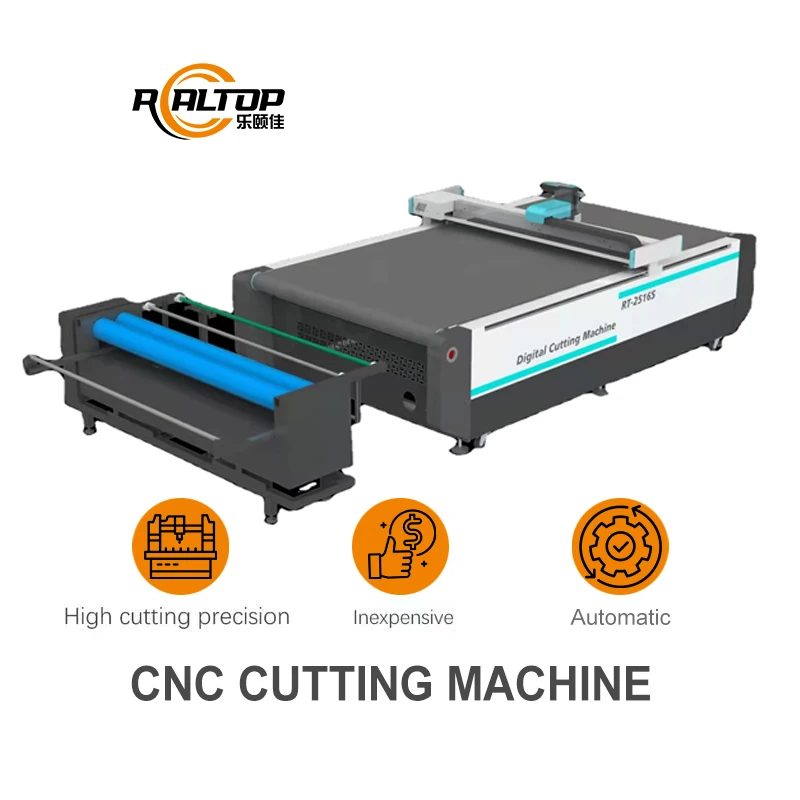
| Product Type | CNC Oscillating Knife Cutting Machine |
| Working Area | 1600 × 2500 mm |
| Overall Dimensions | 3450 × 2300 × 1250 mm |
| Rated Power | 9 kW |
| Voltage | 380V ±10% |
| Translational Velocity | 800 – 1200 mm/s |
| Repeated Accuracy | ≤ 0.1 mm |
| Table Surface | Flat vacuum table, magnesium-aluminum alloy with PVDF fluorocarbon coating and anodic oxidation |
| Vacuum Pump | 7.5 kW, aviation aluminum shell, built-in silencer sponge |
| Servo Drive | Digital servo motor (Delta or Panasonic optional), IP67 rated |
| Linear Motion | Taiwan Hiwin linear guide, synchronous belt, ball screw |
| Tool Head Options | Swiss imported vibration knife (full/half cutting, cursor location), pneumatic knife, high-power vibrating knife, circular knife, V-cutting knife, drag knife, creasing wheel, dotted line knife, punching, brush |
| Visual Positioning | Small CCD camera mark point positioning, panoramic camera recognition, projection positioning |
| Control Format | HP-GL compatible |
| Safety Devices | Infrared induction blocking, dual-side beam anti-collision sensors, emergency stop |
| Frame Construction | Thick-walled seamless steel structure, high-temperature tempering, CNC machining center finished |
| Language Options | English, Russian, Italian, Chinese (special languages customizable) |
Application Suitability
| Application | Material or Output |
|---|---|
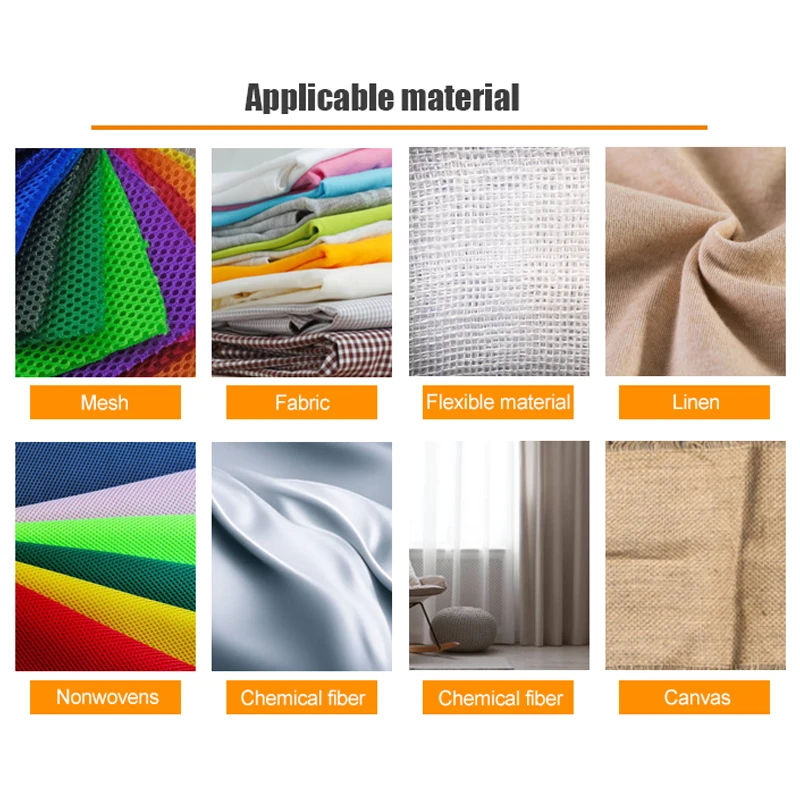
| Automotive interior trimming | EVA, XPE, PU foam, composite leather for floor mats and door panels |
| Garment and footwear production | Woven fabric, non-woven fabric, PU leather, textile layers |
| Packaging and carton sampling | Corrugated cardboard, sticker film, soft board |
| Sealing and gasket fabrication | PTFE, ETFE, rubber, silicone, composite gasket sheets |
| Advertising and signage | PVC, soft glass, PP, PE, film, foam board |
| Sports and outdoor goods | Sponge, composite leather, carpet, fiberglass layers |
Why Cutting Thickness Alone Fails at the Quotation Stage
A number on a spec sheet tells you nothing without the material it was measured on.
I once shipped an oscillating knife cutter to a buyer who quoted 30 mm as his maximum thickness. What he meant was 30 mm of soft EVA foam. When his production switched to multi-layer compressed carpet with a woven backing, the knife deflected, the edge frayed, and his operators spent more time re-cutting than running the table. The machine was not wrong — the specification conversation was. That is why a CNC oscillating knife cutting machine manufacturer must ask what you actually cut, at what stack height, and on what shift schedule before recommending a tool head [NEED_CITE: material hardness and knife deflection in oscillating cutting].
Tool Head Selection Defines the Machine, Not the Frame
The RT-D2516/RT-S2516 frame is the same whether it leaves the factory with a Swiss vibration knife or a drag knife, but those two heads produce entirely different results on the same substrate. Oscillating knives slice through foam and textile composites without crushing the material, while drag knives follow contours on thinner vinyl and sticker films at higher translational speeds. Matching the head to the material mix — not just the working area — is the single decision that separates a machine that runs from one that sits idle between re-blade cycles.
Vacuum Zoning and Small-Part Holding
A 7.5 kW vacuum pump sounds adequate until you place a small gasket pattern in the corner of a 1600 × 2500 mm table. Without zoned suction, the vacuum bleeds across the full surface and the part lifts during the final pass. The magnesium-aluminum alloy table on this unit uses PVDF fluorocarbon coating and anodic oxidation to maintain flatness, but the zoning layout must be confirmed against your typical nesting pattern [NEED_CITE: vacuum hold-down requirements for small CNC cut parts]. Buyers running high-mix, low-volume gasket or signage work should request the zone map before signing the specification sheet.
Reading the Specification Sheet Beyond the Headline Numbers
The Delta or Panasonic IP67 servo drives with real-time automatic gain adjustment keep the beam steady when the knife meets a density change mid-cut — such as transitioning from a foam core to a woven backing layer. Repeated accuracy at ≤ 0.1 mm matters less on a single pass than it does on a kiss-cut where the blade must stop at a precise depth without scoring the conveyor belt below. The HP-GL control format keeps file compatibility straightforward for shops already running nesting software, but buyers importing DXF or AI workflows need to confirm post-processor support before the machine ships. Translational velocity between 800 and 1200 mm/s is the travel speed, not the cutting speed — cutting speed drops with material resistance, so thick rubber runs slower than thin film on the same unit.
The Cost of Skipping a Material Trial
A buyer who orders on working area alone and receives a machine configured for thin film will find the vacuum table overwhelmed when he later loads 50 mm sponge composites. The knife oscillates but cannot penetrate cleanly, the edge compresses rather than severs, and operators slow the feed rate to compensate — cutting throughput without any mechanical fault to point to. I have watched this exact scenario turn a profitable month into a penalty negotiation. Requesting a sample cutting report on your own production material, not a generic demo sheet, is the cheapest insurance in the entire procurement cycle [NEED_CITE: sample cutting validation before CNC equipment purchase].
Why the Full Catalogue Matters to a Sourcing Decision
One manufacturer building both oscillating knife and laser cutting systems means a buyer evaluating fabric does not have to accept a laser-edge burn mark just because the supplier only sells lasers. The tool head and table configuration on the RT-D2516/RT-S2516 is specified per material and confirmed in writing before production starts. Voltage, plug type, and control language are locked in at the quotation stage — 380V ±10% is the default, but the electrical schematic is confirmed against the buyer’s local supply before the cabinet is wired. CCD camera options include mark-point, panoramic, and projection positioning, so printed contour work does not rely on manual alignment at production speed. An in-house design team adjusts frame and motion components rather than bolting on a generic kit.
Documentation & Verification
- Machine specification sheet listing every tool head and zone configuration confirmed for your material
- Electrical schematic with voltage, frequency, and plug type matched to your facility supply
- Sample cutting report run on your actual substrate with edge quality photographs
- Factory test record showing repeated accuracy and translational velocity under load
- Software licence and HP-GL file format compatibility note signed before dispatch
- Operation and maintenance manual in your selected control language
Installation, Commissioning & Support
- Floor space must accommodate 3450 × 2300 mm footprint plus operator clearance on all sides
- Dedicated 380V circuit required to handle 9 kW rated draw plus 7.5 kW vacuum pump
- Machine ships in single-frame configuration; table leveling completed on-site after positioning
- First-run commissioning includes tool head calibration and vacuum zone verification on your material
- Operator training covers knife change intervals, CCD mark-point setup, and nesting workflow
- Spare parts list provided with recommended consumable knife stock for your cutting volume
What to Include in Your First Inquiry
Send the material type, maximum thickness in millimeters, and whether you cut single sheets or stacked layers. Note your typical sheet size and how many hours per day the table will run. If your facility operates on a voltage or frequency other than 380V/50Hz, state the local standard and preferred control language so the electrical cabinet and interface are built accordingly.
Frequently Asked Questions
Q: How do I choose between oscillating knife and drag knife for my material mix?
A: Oscillating knives cut through foam, textile composites, and thick gasket material without crushing the layers. Drag knives work on thinner vinyl, sticker film, and cardboard at higher speeds. The tool head is selected based on your thickest and most abrasive substrate, not the easiest one. Confirm both with a sample cutting report before ordering.
Q: Does the CCD camera track printed marks at full production speed?
A: The system offers small CCD mark-point positioning, panoramic camera recognition, and projection positioning. Tracking reliability at full translational velocity depends on mark contrast, print registration tolerance, and ambient lighting. Request a contour-cutting test on your actual printed material to verify before committing.
Q: Can the vacuum table hold small parts in the corners of the working area?
A: The magnesium-aluminum alloy table uses zoned vacuum adsorption with PVDF coating for flatness. Zone effectiveness on small parts depends on the zone map relative to your nesting pattern. Share your typical layout so the zoning can be verified against your smallest production piece.
Q: What voltage and language options are available before shipment?
A: The standard voltage is 380V ±10%, with control language available in English, Russian, Italian, and Chinese. Special voltages and languages are configurable. The electrical schematic and language setting are confirmed in writing during the quotation stage to prevent a mismatch on arrival.
Q: How do I verify edge quality before the machine is built?
A: Provide your production material — type, thickness, and layer count — for a sample cutting test at the factory. You receive a cutting report with edge photographs and measured accuracy. This step happens before the quotation is finalized, not after.
One cutting method per substrate — tool head and vacuum zoning specified after material trial, not forced into a single approach.
Technical Specifications
| Parameter | Value |
|---|---|
| Model | RT-D2516/RT-S2516 |
| Product Type | CNC Oscillating Knife Cutting Machine |
| Working Area | 1600 × 2500 mm |
| Overall Dimensions | 3450 × 2300 × 1250 mm |
| Rated Power | 9 kW |
| Voltage | 380V ±10% |
| Translational Velocity | 800 – 1200 mm/s |
| Repeated Accuracy | ≤ 0.1 mm |
| Table Surface | Flat vacuum table, magnesium-aluminum alloy with PVDF fluorocarbon coating and anodic oxidation |
| Vacuum Pump | 7.5 kW, aviation aluminum shell, built-in silencer sponge |
| Servo Drive | Digital servo motor (Delta or Panasonic optional), IP67 rated |
| Linear Motion | Taiwan Hiwin linear guide, synchronous belt, ball screw |
| Tool Head Options | Swiss imported vibration knife (full/half cutting, cursor location), pneumatic knife, high-power vibrating knife, circular knife, V-cutting knife, drag knife, creasing wheel, dotted line knife, punching, brush |
| Visual Positioning | Small CCD camera mark point positioning, panoramic camera recognition, projection positioning |
| Control Format | HP-GL compatible |
| Safety Devices | Infrared induction blocking, dual-side beam anti-collision sensors, emergency stop |
| Frame Construction | Thick-walled seamless steel structure, high-temperature tempering, CNC machining center finished |
| Language Options | English, Russian, Italian, Chinese (special languages customizable) |
Application Suitability
| Application | Material or Output |
|---|---|
| Automotive interior trimming | EVA, XPE, PU foam, composite leather for floor mats and door panels |
| Garment and footwear production | Woven fabric, non-woven fabric, PU leather, textile layers |
| Packaging and carton sampling | Corrugated cardboard, sticker film, soft board |
| Sealing and gasket fabrication | PTFE, ETFE, rubber, silicone, composite gasket sheets |
| Advertising and signage | PVC, soft glass, PP, PE, film, foam board |
| Sports and outdoor goods | Sponge, composite leather, carpet, fiberglass layers |
Why Cutting Thickness Alone Fails at the Quotation Stage
A number on a spec sheet tells you nothing without the material it was measured on.
I once shipped an oscillating knife cutter to a buyer who quoted 30 mm as his maximum thickness. What he meant was 30 mm of soft EVA foam. When his production switched to multi-layer compressed carpet with a woven backing, the knife deflected, the edge frayed, and his operators spent more time re-cutting than running the table. The machine was not wrong — the specification conversation was. That is why a CNC oscillating knife cutting machine manufacturer must ask what you actually cut, at what stack height, and on what shift schedule before recommending a tool head [NEED_CITE: material hardness and knife deflection in oscillating cutting].
Tool Head Selection Defines the Machine, Not the Frame
The RT-D2516/RT-S2516 frame is the same whether it leaves the factory with a Swiss vibration knife or a drag knife, but those two heads produce entirely different results on the same substrate. Oscillating knives slice through foam and textile composites without crushing the material, while drag knives follow contours on thinner vinyl and sticker films at higher translational speeds. Matching the head to the material mix — not just the working area — is the single decision that separates a machine that runs from one that sits idle between re-blade cycles.
Vacuum Zoning and Small-Part Holding
A 7.5 kW vacuum pump sounds adequate until you place a small gasket pattern in the corner of a 1600 × 2500 mm table. Without zoned suction, the vacuum bleeds across the full surface and the part lifts during the final pass. The magnesium-aluminum alloy table on this unit uses PVDF fluorocarbon coating and anodic oxidation to maintain flatness, but the zoning layout must be confirmed against your typical nesting pattern [NEED_CITE: vacuum hold-down requirements for small CNC cut parts]. Buyers running high-mix, low-volume gasket or signage work should request the zone map before signing the specification sheet.
Reading the Specification Sheet Beyond the Headline Numbers
The Delta or Panasonic IP67 servo drives with real-time automatic gain adjustment keep the beam steady when the knife meets a density change mid-cut — such as transitioning from a foam core to a woven backing layer. Repeated accuracy at ≤ 0.1 mm matters less on a single pass than it does on a kiss-cut where the blade must stop at a precise depth without scoring the conveyor belt below. The HP-GL control format keeps file compatibility straightforward for shops already running nesting software, but buyers importing DXF or AI workflows need to confirm post-processor support before the machine ships. Translational velocity between 800 and 1200 mm/s is the travel speed, not the cutting speed — cutting speed drops with material resistance, so thick rubber runs slower than thin film on the same unit.
The Cost of Skipping a Material Trial
A buyer who orders on working area alone and receives a machine configured for thin film will find the vacuum table overwhelmed when he later loads 50 mm sponge composites. The knife oscillates but cannot penetrate cleanly, the edge compresses rather than severs, and operators slow the feed rate to compensate — cutting throughput without any mechanical fault to point to. I have watched this exact scenario turn a profitable month into a penalty negotiation. Requesting a sample cutting report on your own production material, not a generic demo sheet, is the cheapest insurance in the entire procurement cycle [NEED_CITE: sample cutting validation before CNC equipment purchase].
Why the Full Catalogue Matters to a Sourcing Decision
One manufacturer building both oscillating knife and laser cutting systems means a buyer evaluating fabric does not have to accept a laser-edge burn mark just because the supplier only sells lasers. The tool head and table configuration on the RT-D2516/RT-S2516 is specified per material and confirmed in writing before production starts. Voltage, plug type, and control language are locked in at the quotation stage — 380V ±10% is the default, but the electrical schematic is confirmed against the buyer’s local supply before the cabinet is wired. CCD camera options include mark-point, panoramic, and projection positioning, so printed contour work does not rely on manual alignment at production speed. An in-house design team adjusts frame and motion components rather than bolting on a generic kit.
Documentation & Verification
- Machine specification sheet listing every tool head and zone configuration confirmed for your material
- Electrical schematic with voltage, frequency, and plug type matched to your facility supply
- Sample cutting report run on your actual substrate with edge quality photographs
- Factory test record showing repeated accuracy and translational velocity under load
- Software licence and HP-GL file format compatibility note signed before dispatch
- Operation and maintenance manual in your selected control language
Installation, Commissioning & Support
- Floor space must accommodate 3450 × 2300 mm footprint plus operator clearance on all sides
- Dedicated 380V circuit required to handle 9 kW rated draw plus 7.5 kW vacuum pump
- Machine ships in single-frame configuration; table leveling completed on-site after positioning
- First-run commissioning includes tool head calibration and vacuum zone verification on your material
- Operator training covers knife change intervals, CCD mark-point setup, and nesting workflow
- Spare parts list provided with recommended consumable knife stock for your cutting volume
What to Include in Your First Inquiry
Send the material type, maximum thickness in millimeters, and whether you cut single sheets or stacked layers. Note your typical sheet size and how many hours per day the table will run. If your facility operates on a voltage or frequency other than 380V/50Hz, state the local standard and preferred control language so the electrical cabinet and interface are built accordingly.
Frequently Asked Questions
Q: How do I choose between oscillating knife and drag knife for my material mix?
A: Oscillating knives cut through foam, textile composites, and thick gasket material without crushing the layers. Drag knives work on thinner vinyl, sticker film, and cardboard at higher speeds. The tool head is selected based on your thickest and most abrasive substrate, not the easiest one. Confirm both with a sample cutting report before ordering.
Q: Does the CCD camera track printed marks at full production speed?
A: The system offers small CCD mark-point positioning, panoramic camera recognition, and projection positioning. Tracking reliability at full translational velocity depends on mark contrast, print registration tolerance, and ambient lighting. Request a contour-cutting test on your actual printed material to verify before committing.
Q: Can the vacuum table hold small parts in the corners of the working area?
A: The magnesium-aluminum alloy table uses zoned vacuum adsorption with PVDF coating for flatness. Zone effectiveness on small parts depends on the zone map relative to your nesting pattern. Share your typical layout so the zoning can be verified against your smallest production piece.
Q: What voltage and language options are available before shipment?
A: The standard voltage is 380V ±10%, with control language available in English, Russian, Italian, and Chinese. Special voltages and languages are configurable. The electrical schematic and language setting are confirmed in writing during the quotation stage to prevent a mismatch on arrival.
Q: How do I verify edge quality before the machine is built?
A: Provide your production material — type, thickness, and layer count — for a sample cutting test at the factory. You receive a cutting report with edge photographs and measured accuracy. This step happens before the quotation is finalized, not after.










商品评价
There are no reviews yet.