

Fast Delivery
Quick, reliable shipping to any location.

Free & easy returns
Return this item by mail or in store within 90 days for a full refund.
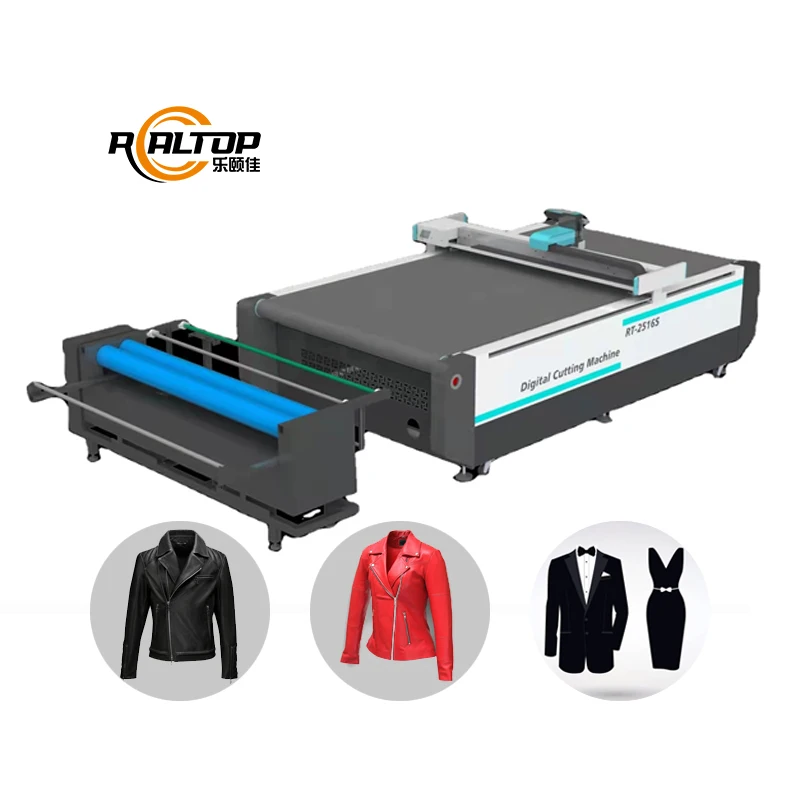
Complete Equipment Range — REALTOP covers both knife and laser cutting technologies under one roof, letting buyers match the method to the material instead of forcing a single process across every job.
Technical Specifications
| Parameter | Value |
|---|---|
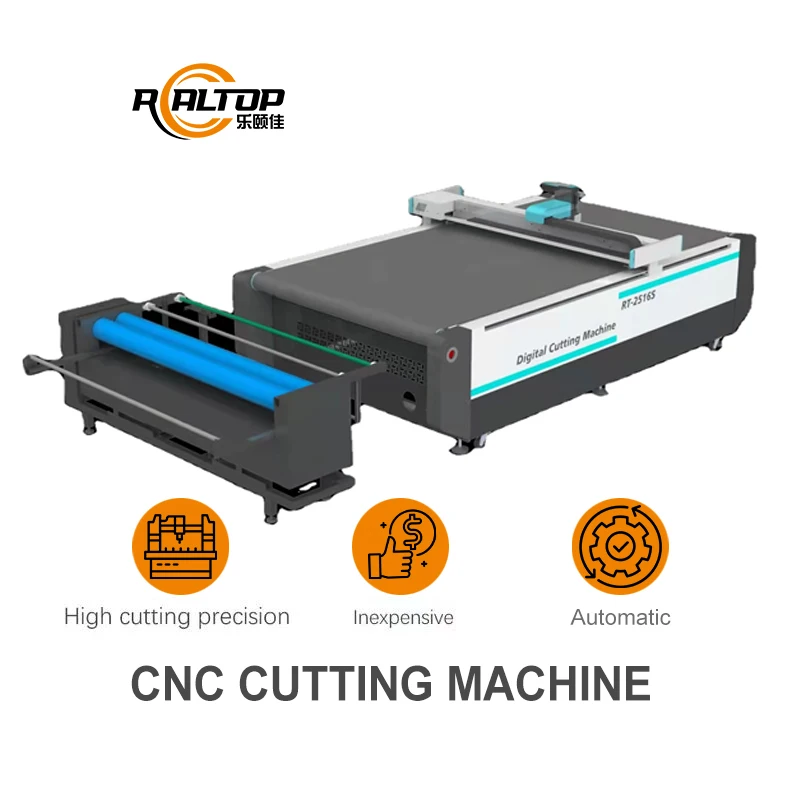
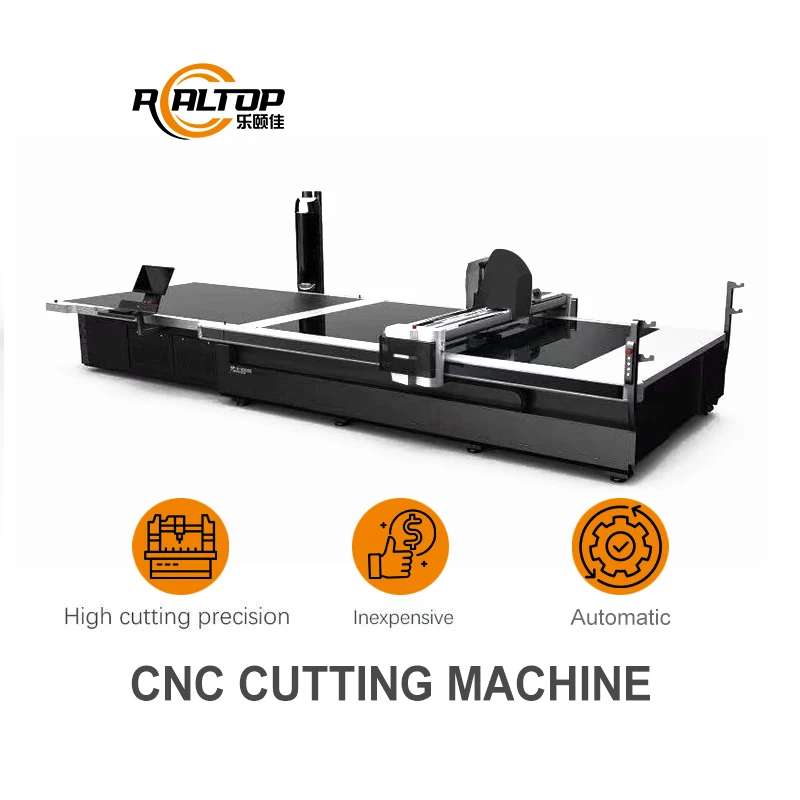
| Product Type | CNC Oscillating Knife Cutting Machine |
| Working Area | 1600×2500 mm |
| Machine Size (L×W×H) | 3450×2300×1250 mm |
| Rated Power | 9 kW |
| Voltage | 380V ±10% (frequency to be confirmed for target market) |
| Translational Velocity | 800–1200 mm/s |
| Cutting Thickness | 20–80 mm (varies by material and density; basis to be confirmed) |
| Repeated Accuracy | ≤0.1 mm |
| Table Type | Magnesium-aluminum alloy vacuum adsorption table with PVDF powder spraying, anodic and hard oxidation |
| Tool Head Options | Oscillating knife, pneumatic knife, high-power vibrating knife, circular knife, V-cutting knife, drag knife, creasing wheel, dotted-line knife, punching, brush, Swiss imported knife (vibration full/half cutting, cursor location) |
| Visual Positioning | Small CCD camera mark-point positioning, panoramic camera recognition, projection positioning |
| Transmission System | Digital servo motor (Delta or Panasonic optional, IP67), linear guide, synchronous belt, ball screw (Taiwan Hiwin rail) |
| Vacuum Pump | 7.5 kW, aviation aluminum shell, built-in silencer sponge (noise reduced by approximately 35%) |
| Conveyor | Germany imported conveyor belt with auto feeding |
| Safety Devices | Infrared induction blocking, anti-collision sensors on both sides of beam, emergency stop |
| Instruction System | HP-GL compatible format |
| Control Language | English, Russian, Italian, Chinese (special languages customizable) |
| Certification | CE (certificate details to confirm) |
Application Suitability
| Application | Material or Output |
|---|---|
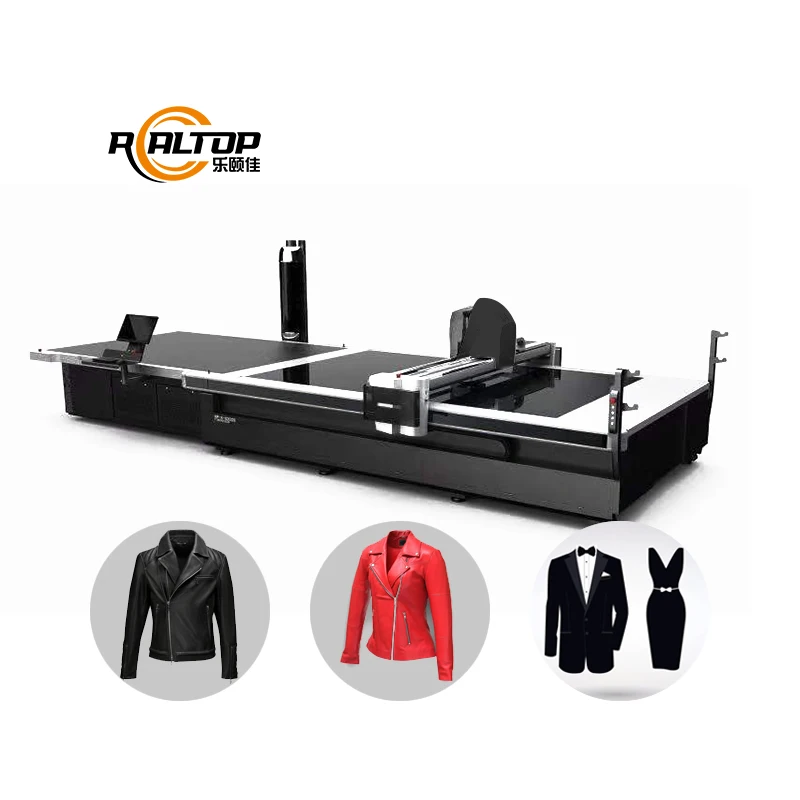
| Garment and footwear production | Clothing cloth, shoe material, leather, non-woven fabric |
| Automotive interior trimming | Leather, PU, EVA, composite materials, carpet |
| Packaging and carton sample making | Cardboard, corrugated cardboard, plastic box |
| Signage and graphic advertising | Sticker, film, PVC, PP, PE |
| Gasket and sealing fabrication | Rubber, PTFE, ETFE, fiberglass |
| Soft home furnishings | Fabric, textile, carpet, sponge, foam board |
| Sports and outdoor goods | XPE, EVA, composite materials |
Why Material Thickness Changes the Machine You Actually Need
A cutting table rated for 80 mm on foam will stall on 80 mm of dense gasket rubber — the difference is material density, not just depth.
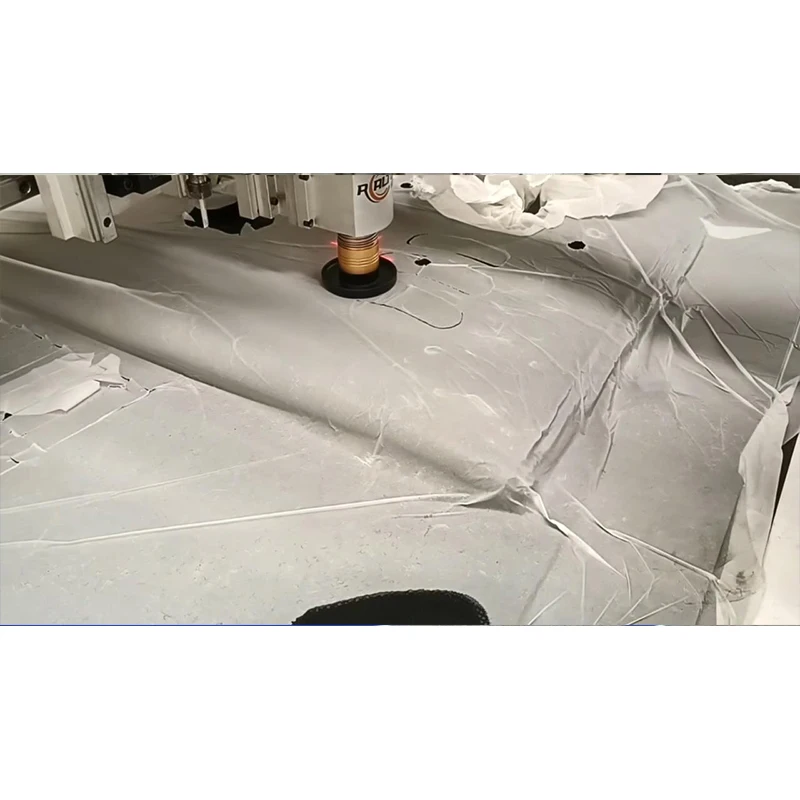
When buyers compare CNC knife cutting machine options, the headline number is usually working area. I have walked into workshops where a 1600×2500 mm table sat idle because the vacuum hold-down could not keep 4 mm coated textile flat at production speed. The knife dragged the fabric into a ridge, and the edge wandered off the nest line. Cutting thickness on the RT-D2516/RT-S2516 spans 20–80 mm, but that range shifts depending on whether you are slicing open-cell foam or dense PTFE sheet. The only reliable way to confirm capacity is a sample cut on your actual material stack, with the same coating and backing paper you run in production [NEED_CITE: material density and cutting force relationship in oscillating knife systems].
Matching the Cutting Method to the Material
The complete REALTOP catalogue covers oscillating knife, drag knife, circular knife, and laser cutting — each suited to different material behaviors. Knife cutting handles layered textiles, compressible foams, and abrasive composites without melting the edge. Laser cutting seals synthetic edges and engraves detail that a blade cannot reach. Choosing the right CNC Knife Cutting Machine manufacturer means starting with the material, not the machine size, and narrowing to the method that holds tolerances on your specific stock.
Vacuum Zoning and Small-Part Stability
A 1600×2500 mm table with full-sheet vacuum works well when the sheet is large and intact. Once nesting software fills that area with dozens of small gasket or garment pieces, the uncut lattice between them loses suction. The RT-D2516/RT-S2516 magnesium-aluminum table supports multi-zone adsorption so vacuum concentrates where the knife is actively cutting. This keeps small parts locked in place and prevents the material from lifting into the blade path, which is where most edge-quality failures originate on high-mix production runs [NEED_CITE: vacuum table zoning practices in flatbed digital cutting].
Reading the Specs That Actually Affect Output
Translational velocity of 800–1200 mm/s defines how fast the head moves between cuts, not how fast it cuts through material. The real throughput depends on the oscillating knife stroke rate, material resistance, and the complexity of the contour path. The 7.5 kW vacuum pump with aviation aluminum shell and built-in silencer sponge maintains consistent hold-down without the noise levels that force operators to shut the system off mid-shift. Repeated accuracy of ≤0.1 mm means nested parts stay within tolerance across the full table area, which matters when automotive interior panels or shoe uppers must match a stitching template downstream. The HP-GL compatible instruction system accepts files from most nesting and CAD platforms, so existing design workflows carry over without reformatting.
The Hidden Cost of Specifying by Working Area Alone
Buyers who select a flatbed cutter based on table dimensions alone often discover the problem weeks after installation. The tool head specified for thin vinyl cannot push through 20 mm EVA foam. The CCD camera tracks registration marks at slow speed but loses them at full production velocity. The voltage arrives as 380V/50Hz for a workshop wired at 220V/60Hz, and the servo drives fault on day one. Each of these mismatches traces back to a specification that was assumed rather than confirmed before the purchase order was signed [NEED_CITE: common specification mismatches in CNC cutting equipment procurement].
Why Source This Range Here
In-house design and production span both knife and laser platforms, so a buyer evaluating the full catalogue gets a single point of accountability rather than two separate vendors pointing at each other when a material falls between methods. Tool head and table configurations are specified per material and production volume, not quoted as a standard package. CCD camera positioning for printed contour work is tested against the buyer’s actual print registration marks. Software compatibility is confirmed — file format, nesting workflow, and control language — before the order enters production. Sample cutting on the buyer’s own material is standard practice, not a special request, so edge quality and achievable thickness are documented before commitment.
Documentation & Verification
- Machine specification sheet confirming working area, tool head list, and voltage for target market
- Sample cutting report on buyer-supplied material showing edge quality and thickness achieved
- Electrical schematic with voltage and frequency matched to destination workshop
- Factory test record documenting the exact RT-D2516/RT-S2516 configuration before crating
- Software licence and file format compatibility note for HP-GL workflow integration
Installation, Commissioning & Support
- 3450×2300 mm footprint requires level concrete floor with clearance for conveyor auto-feeding
- 9 kW rated power plus 7.5 kW vacuum pump need dedicated circuit at confirmed voltage and frequency
- Machine ships fully assembled; verify access dimensions for workshop door and overhead crane
- First-run parameter tuning on your material thickness and tool head combination during commissioning
- Operator training covers tool head changeover, vacuum zone assignment, and CCD camera calibration
- Spare parts list provided covering knives, blades, and wear items specific to your tool head configuration
What to Include in Your Inquiry
To match the right configuration to your production, share the material type, thickness range, and maximum sheet size you run daily. Confirm your workshop voltage, frequency, and preferred control language. If you work with printed materials, describe the registration mark type and spacing so the CCD positioning can be validated before shipment.
Frequently Asked Questions
Q: How do I decide between knife cutting and laser cutting for my material?
A: Knife cutting suits compressible and layered materials like foam, textile, and gasket where a melted edge is unacceptable. Laser cutting seals synthetic edges and handles fine detail on acrylic or wood. The decision starts with the material and the edge finish your downstream process requires.
Q: Which tool head fits my material thickness and type?
A: Oscillating knives handle thick foam and sponge. Pneumatic knives cut denser rubber and gasket stock. Drag knives score thin vinyl and sticker. Creasing wheels fold cardboard without cutting through. The correct head is confirmed by sample cutting on your actual material.
Q: Can the CCD camera track my printed registration marks at production speed?
A: The small CCD and panoramic camera options both read printed marks, but reliable tracking depends on mark contrast, size, and spacing. Sample testing with your printed sheets confirms whether the system holds registration at your target cutting speed.
Q: What voltage and language options are available before shipment?
A: The standard configuration is 380V ±10%, but frequency and plug type must match your local supply. Control language options include English, Russian, Italian, and Chinese, with other languages available on request. These details are confirmed before production begins.
Complete Equipment Range — REALTOP covers both knife and laser cutting technologies under one roof, letting buyers match the method to the material instead of forcing a single process across every job.
Technical Specifications
| Parameter | Value |
|---|---|
| Product Type | CNC Oscillating Knife Cutting Machine |
| Working Area | 1600×2500 mm |
| Machine Size (L×W×H) | 3450×2300×1250 mm |
| Rated Power | 9 kW |
| Voltage | 380V ±10% (frequency to be confirmed for target market) |
| Translational Velocity | 800–1200 mm/s |
| Cutting Thickness | 20–80 mm (varies by material and density; basis to be confirmed) |
| Repeated Accuracy | ≤0.1 mm |
| Table Type | Magnesium-aluminum alloy vacuum adsorption table with PVDF powder spraying, anodic and hard oxidation |
| Tool Head Options | Oscillating knife, pneumatic knife, high-power vibrating knife, circular knife, V-cutting knife, drag knife, creasing wheel, dotted-line knife, punching, brush, Swiss imported knife (vibration full/half cutting, cursor location) |
| Visual Positioning | Small CCD camera mark-point positioning, panoramic camera recognition, projection positioning |
| Transmission System | Digital servo motor (Delta or Panasonic optional, IP67), linear guide, synchronous belt, ball screw (Taiwan Hiwin rail) |
| Vacuum Pump | 7.5 kW, aviation aluminum shell, built-in silencer sponge (noise reduced by approximately 35%) |
| Conveyor | Germany imported conveyor belt with auto feeding |
| Safety Devices | Infrared induction blocking, anti-collision sensors on both sides of beam, emergency stop |
| Instruction System | HP-GL compatible format |
| Control Language | English, Russian, Italian, Chinese (special languages customizable) |
| Certification | CE (certificate details to confirm) |
Application Suitability
| Application | Material or Output |
|---|---|
| Garment and footwear production | Clothing cloth, shoe material, leather, non-woven fabric |
| Automotive interior trimming | Leather, PU, EVA, composite materials, carpet |
| Packaging and carton sample making | Cardboard, corrugated cardboard, plastic box |
| Signage and graphic advertising | Sticker, film, PVC, PP, PE |
| Gasket and sealing fabrication | Rubber, PTFE, ETFE, fiberglass |
| Soft home furnishings | Fabric, textile, carpet, sponge, foam board |
| Sports and outdoor goods | XPE, EVA, composite materials |
Why Material Thickness Changes the Machine You Actually Need
A cutting table rated for 80 mm on foam will stall on 80 mm of dense gasket rubber — the difference is material density, not just depth.
When buyers compare CNC knife cutting machine options, the headline number is usually working area. I have walked into workshops where a 1600×2500 mm table sat idle because the vacuum hold-down could not keep 4 mm coated textile flat at production speed. The knife dragged the fabric into a ridge, and the edge wandered off the nest line. Cutting thickness on the RT-D2516/RT-S2516 spans 20–80 mm, but that range shifts depending on whether you are slicing open-cell foam or dense PTFE sheet. The only reliable way to confirm capacity is a sample cut on your actual material stack, with the same coating and backing paper you run in production [NEED_CITE: material density and cutting force relationship in oscillating knife systems].
Matching the Cutting Method to the Material
The complete REALTOP catalogue covers oscillating knife, drag knife, circular knife, and laser cutting — each suited to different material behaviors. Knife cutting handles layered textiles, compressible foams, and abrasive composites without melting the edge. Laser cutting seals synthetic edges and engraves detail that a blade cannot reach. Choosing the right CNC Knife Cutting Machine manufacturer means starting with the material, not the machine size, and narrowing to the method that holds tolerances on your specific stock.
Vacuum Zoning and Small-Part Stability
A 1600×2500 mm table with full-sheet vacuum works well when the sheet is large and intact. Once nesting software fills that area with dozens of small gasket or garment pieces, the uncut lattice between them loses suction. The RT-D2516/RT-S2516 magnesium-aluminum table supports multi-zone adsorption so vacuum concentrates where the knife is actively cutting. This keeps small parts locked in place and prevents the material from lifting into the blade path, which is where most edge-quality failures originate on high-mix production runs [NEED_CITE: vacuum table zoning practices in flatbed digital cutting].
Reading the Specs That Actually Affect Output
Translational velocity of 800–1200 mm/s defines how fast the head moves between cuts, not how fast it cuts through material. The real throughput depends on the oscillating knife stroke rate, material resistance, and the complexity of the contour path. The 7.5 kW vacuum pump with aviation aluminum shell and built-in silencer sponge maintains consistent hold-down without the noise levels that force operators to shut the system off mid-shift. Repeated accuracy of ≤0.1 mm means nested parts stay within tolerance across the full table area, which matters when automotive interior panels or shoe uppers must match a stitching template downstream. The HP-GL compatible instruction system accepts files from most nesting and CAD platforms, so existing design workflows carry over without reformatting.
The Hidden Cost of Specifying by Working Area Alone
Buyers who select a flatbed cutter based on table dimensions alone often discover the problem weeks after installation. The tool head specified for thin vinyl cannot push through 20 mm EVA foam. The CCD camera tracks registration marks at slow speed but loses them at full production velocity. The voltage arrives as 380V/50Hz for a workshop wired at 220V/60Hz, and the servo drives fault on day one. Each of these mismatches traces back to a specification that was assumed rather than confirmed before the purchase order was signed [NEED_CITE: common specification mismatches in CNC cutting equipment procurement].
Why Source This Range Here
In-house design and production span both knife and laser platforms, so a buyer evaluating the full catalogue gets a single point of accountability rather than two separate vendors pointing at each other when a material falls between methods. Tool head and table configurations are specified per material and production volume, not quoted as a standard package. CCD camera positioning for printed contour work is tested against the buyer’s actual print registration marks. Software compatibility is confirmed — file format, nesting workflow, and control language — before the order enters production. Sample cutting on the buyer’s own material is standard practice, not a special request, so edge quality and achievable thickness are documented before commitment.
Documentation & Verification
- Machine specification sheet confirming working area, tool head list, and voltage for target market
- Sample cutting report on buyer-supplied material showing edge quality and thickness achieved
- Electrical schematic with voltage and frequency matched to destination workshop
- Factory test record documenting the exact RT-D2516/RT-S2516 configuration before crating
- Software licence and file format compatibility note for HP-GL workflow integration
Installation, Commissioning & Support
- 3450×2300 mm footprint requires level concrete floor with clearance for conveyor auto-feeding
- 9 kW rated power plus 7.5 kW vacuum pump need dedicated circuit at confirmed voltage and frequency
- Machine ships fully assembled; verify access dimensions for workshop door and overhead crane
- First-run parameter tuning on your material thickness and tool head combination during commissioning
- Operator training covers tool head changeover, vacuum zone assignment, and CCD camera calibration
- Spare parts list provided covering knives, blades, and wear items specific to your tool head configuration
What to Include in Your Inquiry
To match the right configuration to your production, share the material type, thickness range, and maximum sheet size you run daily. Confirm your workshop voltage, frequency, and preferred control language. If you work with printed materials, describe the registration mark type and spacing so the CCD positioning can be validated before shipment.
Frequently Asked Questions
Q: How do I decide between knife cutting and laser cutting for my material?
A: Knife cutting suits compressible and layered materials like foam, textile, and gasket where a melted edge is unacceptable. Laser cutting seals synthetic edges and handles fine detail on acrylic or wood. The decision starts with the material and the edge finish your downstream process requires.
Q: Which tool head fits my material thickness and type?
A: Oscillating knives handle thick foam and sponge. Pneumatic knives cut denser rubber and gasket stock. Drag knives score thin vinyl and sticker. Creasing wheels fold cardboard without cutting through. The correct head is confirmed by sample cutting on your actual material.
Q: Can the CCD camera track my printed registration marks at production speed?
A: The small CCD and panoramic camera options both read printed marks, but reliable tracking depends on mark contrast, size, and spacing. Sample testing with your printed sheets confirms whether the system holds registration at your target cutting speed.
Q: What voltage and language options are available before shipment?
A: The standard configuration is 380V ±10%, but frequency and plug type must match your local supply. Control language options include English, Russian, Italian, and Chinese, with other languages available on request. These details are confirmed before production begins.










商品评价
There are no reviews yet.