



Fast Delivery
Quick, reliable shipping to any location.

Free & easy returns
Return this item by mail or in store within 90 days for a full refund.
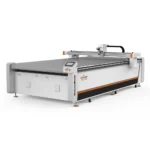
Customized Cutting Solutions — Buyers specify the 1625’s tool head and table configuration per material rather than forcing a single cutting method.
Technical Specifications
| Parameter | Value |
|---|---|
| Product Type | CNC Oscillating Knife Cutting Machine |
| Working Area | 1600 × 2500 mm |
| Tool Head Options | Oscillating knife, Driven rotary knife, Creasing wheel, Kiss cutting tool, Pneumatic knife, Milling tool, V groove knife |
| Cutting Speed | 0 – 2000 mm/s |
| Cutting Thickness | ≤30 mm (basis not stated in source) |
| Positioning Accuracy | ±0.1 mm |
| Vacuum Pump Power | 9 kW |
| Vacuum Table | Aluminum bellows vacuum table |
| Voltage Options | 110V / 220V / 380V (frequency not specified) |
| Control System | PLC control panel (brand not specified in source) |
| Servo Motor Options | Panasonic, Delta, Dorna |
| Software Compatibility | PLT, DXF, AI, PDF |
| Machine Dimensions | 3300 × 2100 × 1350 mm |
| Interface Languages | English, Russian, Italian, Chinese; other languages customizable |
| Safety Devices | Infrared sensor, emergency stop |
Application Suitability
| Application | Material or Output |
|---|---|
| Garment and knitwear cutting | Suits, lace, complex fabrics with pattern-matching layouts |
| Automotive interior components | Seat fabrics, carpets, PVC mats |
| Home textile production | Sofa fabrics, curtains, rugs, multi-layer cutting |
| Composite material processing | Carbon fiber prepreg, aramid fabrics, specialty technical textiles |
| Signage and packaging samples | Cardboard, carton, mats, EVA, leather, foam |
Why the Voltage Question Should Come Before the Price
A 1625 CNC oscillating knife cutting machine manufacturer must confirm the local power grid before quoting, not after shipment.
A textile converter in a region with unstable single-phase power once received a 380V unit that simply would not start. The production delay stretched for weeks while a step-down transformer was sourced locally [NEED_CITE: voltage and frequency standards by export market]. When evaluating a CNC flatbed digital cutting table for sale, buyers frequently focus on the working area and cutting speed, yet the voltage configuration is what determines whether the machine can run on the first day it is unpacked.
Catalogue Positioning for Material-Matched Cutting
The 1625 sits within a broader range where knife cutting and laser cutting options are presented side by side. This allows a fabric producer to review the full spectrum of CNC oscillating knife cutting machine manufacturer capabilities and select the cutting method that actually suits the textile. A buyer processing woven polyester might choose the driven rotary knife, while a technical textile converter handling aramid would lean toward the oscillating tool head.
Navigating Seven Tool Heads Without Guesswork
Selecting the correct tool head is often where buyers lose time. The oscillating knife handles general fabrics and foam; the driven rotary knife suits woven textiles where a clean shear cut is critical; the kiss cutting tool scores adhesive-backed vinyl without cutting the liner. The creasing wheel and V-groove knife serve packaging sample makers folding carton stock. Choosing wrongly produces ragged edges or crushed layers, and the cost only becomes visible once production waste accumulates [NEED_CITE: CE machinery directive requirements for industrial equipment].
Reading the Specification Sheet Beyond Working Area
A 1600 × 2500 mm bed covers most garment lay lengths and automotive seat panel spreads. The 9 kW vacuum pump paired with the aluminum bellows table must be assessed against the smallest part being cut; if vacuum zoning is insufficient, small pattern pieces lift during the pass and shift the ±0.1 mm positioning accuracy out of tolerance. The PLC control panel accepts DXF, PLT, AI, and PDF files, which means most nesting workflows can import directly without a conversion step. Intelligent nesting software reduces fabric waste, though the actual yield depends on the pattern geometry and fabric width fed into the system.
The Cost of a Mis-Matched Configuration
A buyer who selected a pneumatic knife for a delicate lace ended up with frayed edges that required manual trimming on every piece. Another specified a single-zone vacuum table for small footwear uppers, only to find the parts drifted during high-speed passes. These missteps are rarely caught during a factory demonstration on standard sample cloth [NEED_CITE: typical consequences of wrong tool head selection on textile cutting quality].
Why Buyers Start Here
The design and production of both knife and laser systems means a distributor can evaluate the 1625 against CO2 and fiber models in a single conversation, matching each technology to its strongest material. Sample cutting on the buyer’s own fabric is completed before commitment, so the actual edge quality and cutting speed are documented, not assumed. Tool head and table zoning are specified per production volume. Voltage, plug type, and control language are confirmed before shipment, eliminating the on-site commissioning delays that plague cross-border equipment purchases.
Documentation & Verification
- Machine specification sheet listing the exact tool head and vacuum zoning configured for your fabric
- Sample cutting report on your own material showing edge quality and dimensional accuracy
- Electrical schematic confirming voltage and frequency matched to your local grid
- Software licence and file format compatibility note for your existing nesting workflow
- Operation and maintenance manual in your preferred control language
Installation, Commissioning & Support
- The 3300 × 2100 mm footprint requires a level concrete floor with clearance on three sides for material loading
- 9 kW vacuum pump needs a dedicated circuit separate from the servo motor supply to prevent voltage drop during start-up
- Machine arrives partially assembled; gantry and tool head carriage require on-site alignment by the installation technician
- First-run parameter setting covers blade oscillation frequency, vacuum zone activation, and servo tuning for your material
- Operator training covers file import, nesting adjustment, and tool head changeover procedures for each of the seven options
- Spare parts list includes oscillating knife blades, vacuum seals, and servo drive belts specific to the 1625 configuration
Request a Cutting Evaluation
Provide the fabric type, weight per square meter, maximum lay thickness, and your daily cutting volume. Specify your local voltage and frequency, and note whether your existing design files use DXF, AI, or another format. A sample cutting run on your own material is the next step before any order is confirmed.
Frequently Asked Questions
Q: How does the 1625 compare to other models in the catalogue by material and volume?
A: The 1625 is a mid-format CNC oscillating knife cutting machine manufacturer option suited to garment, home textile, and automotive interior producers running single to multi-layer fabric. Buyers cutting heavier composites or requiring larger lay widths should review the wider-format knife tables, while those processing acrylic or sheet metal should compare the CO2 and fiber laser models in the same range.
Q: Which tool head is recommended for my fabric — oscillating, rotary, or pneumatic?
A: Oscillating knife suits general woven and non-woven textiles; driven rotary knife provides a shear cut for woven fabrics where edge integrity matters; pneumatic knife is reserved for single-ply coated or stiff materials. A sample cut on your actual fabric determines which tool head and blade profile produces the correct edge before an order is placed.
Q: What voltage and frequency options are available for the 1625?
A: The machine is configurable for 110V, 220V, or 380V supply. Frequency and plug type must be confirmed against the destination market’s grid standards before production begins. The electrical schematic and voltage confirmation document are issued as part of the order package.
Q: Can I review sample cutting results on my own material before committing?
A: A sample cutting report is prepared on the buyer’s own fabric, documenting edge quality, dimensional accuracy, and cutting speed achieved. This report forms part of the pre-order documentation and is used to finalize the tool head and vacuum zoning specification.










商品评价
There are no reviews yet.