


Fast Delivery
Quick, reliable shipping to any location.

Free & easy returns
Return this item by mail or in store within 90 days for a full refund.
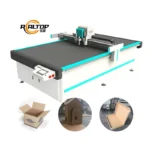
Tool Head Matched Per Material — a single oscillating knife setup rarely covers corrugated board, sticker vinyl, and greyboard at once, so we specify the RT-D2516/S2516 head and vacuum zoning against your actual sheet stock before the order is released.
Technical Specifications
| Parameter | Value |
|---|---|
| Model | RT-D2516 / RT-S2516 |
| Product Type | CNC Oscillating Knife Cutting Table |
| Working Area | 1600 × 2500 mm |
| Machine Size (Overall) | 3450 × 2300 × 1250 mm |
| Rated Power | 9 kW |
| Voltage | 380V ±10% (50/60 Hz to confirm per market) |
| Control System | CNC with HP-GL compatible instruction format |
| Table Surface | Aluminum alloy honeycomb vacuum adsorption platform |
| Multifunctional Tool Head | Swiss imported knife — vibration full cut, vibration half cut, cursor location |
| Translational Velocity | 800–2000 mm/s |
| Cutting Speed | 200–800 mm/s (basis not stated in source — confirm per material and thickness) |
| Cutting Thickness | ≤100 mm (varies with material) |
| Repeated Accuracy | ≤0.1 mm |
| Transmission | Taiwan Delta servo, Hiwin linear guide, synchronous belt, ball screw, rack |
| Vacuum Pump | 7.5 kW |
| Conveyor Belt | Germany imported (optional auto-feeding) |
| Safety | Infrared sensors, emergency stop |
| Software | Professional carton nesting and cutting design software, multi-format import |
| Control Language | English, Russian, Italian, Chinese (customizable) |
| Standards | CE declaration applicable |
Application Suitability
| Application | Material or Output |
|---|---|
| Carton and corrugated box sample making | Single, double, and triple-wall corrugated board, greyboard, kraft liner |
| Electrical appliance packaging | High-grammage greyboard and honeycomb paper panels |
| Express and food packaging boxes | Folding carton stock, micro-flute corrugated, coated board |
| High-end gift box production | Thick card stock, decorative laminates, foam inserts |
| Sticker and label contour cutting | Vinyl decals, printed adhesive sheets, hang tags |
| Billboard and business card cutting | PVC foam board, soft glass, composite sheet |
| Flexible material processing | Leather, garment fabric, sponge composite, silicone, rubber |
Why "200–800 mm/s" Means Nothing Without the Material Name
Cutting speed is only real when tied to a specific board grade and thickness.
When packaging houses quote cutting speed without naming the stock, they are describing a best-case scenario that rarely matches production reality. A standard single-wall corrugated sheet might allow the upper end of the range, but switch to 2 mm greyboard and the head must slow down to hold crease-line accuracy. I saw this first-hand when a carton sample shop ran their trial on lightweight flute and then moved to heavy greyboard — every crease line punched straight through [NEED_CITE: cutting speed variation across board grades and grammage]. A CNC digital cutting machine manufacturer worth working with will always tie speed claims to a named material.
Knife Head Selection Across Corrugated, Greyboard, and Vinyl
The Swiss imported oscillating knife head on the RT-D2516/S2516 handles full cut, half cut, and cursor positioning within a single cycle. For corrugated board, the vibrating blade shears cleanly through flute structures without crushing the edges, which matters when the box sample must fold along the same crease multiple times during client review. For sticker contour work, half-cut mode scores the vinyl face without cutting through the backing liner, a requirement the CNC digital cutting machine manufacturer must confirm against your specific sticker stock before the tool head configuration is locked in.
Vacuum Zoning and Small-Part Hold-Down
The 7.5 kW vacuum pump feeds an aluminum honeycomb platform with follow-area suction zoning. When cutting large corrugated sheets, the full table area draws down evenly. When the job shifts to small hang tags or business cards, the system concentrates suction on the active zone to prevent parts from lifting under the knife [NEED_CITE: vacuum zoning requirements for small-format die-cut parts]. Without proper zoning, lightweight card stock shifts mid-cut and the registration drifts beyond the ≤0.1 mm repeatability the Taiwan Delta servo and Hiwin linear guide are designed to hold.
Reading the Spec Sheet Against Real Production Jobs
The 1600 × 2500 mm working area accommodates full-size corrugated sheets and multiple nested carton blanks in one layup. The 9 kW rated power covers the servo drives, oscillating head, and control system, while the separate 7.5 kW vacuum pump runs on its own circuit — a detail that matters when planning the workshop’s electrical panel. The HP-GL compatible instruction format allows the bundled carton nesting software to import common design files, but the actual file format compatibility must be validated against your existing design workflow before the order. Taiwan Delta servos paired with Hiwin linear guides and rack transmission hold ≤0.1 mm repeatability across the full travel, which keeps crease lines aligned with cut lines on complex box structures.
What Happens When the Wrong Tool Head Meets Your Material
A drag knife on thick corrugated board drags the flute instead of shearing it, leaving torn edges that reject the sample on sight. A creasing wheel set too deep on lightweight card stock punches through rather than scoring, turning a gift box blank into scrap. When the vacuum zone layout does not match the nesting pattern, small sticker parts lift off the table mid-cut and the contour recognition loses registration [NEED_CITE: tool head and material mismatch consequences in flatbed cutting]. These are not theoretical failures — they show up the first week the machine runs production jobs instead of demo sheets.
Why Source the RT-D2516/S2516 From This CNC Digital Cutting Machine Manufacturer
Realtop builds both knife and laser systems in-house, so the cutting method is matched to the material rather than forced onto one platform. The tool head and vacuum table configuration for the RT-D2516/S2516 is specified per buyer material, not pulled from a default list. CCD camera contour recognition is available and must be tested at production speed on your printed stock before commitment. Software compatibility, control language, and voltage are confirmed before the machine enters assembly. Sample cutting runs on the buyer’s own material generate a report that travels with the shipment documentation.
Documentation & Verification
- Machine specification sheet confirming RT-D2516/S2516 working area, power, and voltage
- Tool head and table configuration list matched to your board grade and sticker stock
- Sample cutting report produced on your own corrugated and greyboard material
- Electrical schematic with voltage, frequency, and plug type for destination market
- Software licence and file format compatibility note for your nesting workflow
- Factory test record documenting repeatability across the 1600 × 2500 mm table
Installation, Commissioning & Support
- Dedicated 380V circuit required for the 9 kW machine plus separate 7.5 kW vacuum pump
- Machine ships fully assembled; verify workshop door clearance against 3450 × 2300 mm overall dimensions
- First-run parameter setup includes oscillation frequency tuning to your specific board thickness
- Operator training covers tool head changeover between full cut, half cut, and creasing modes
- Spare parts list identifies Swiss knife blades, vacuum cups, and synchronous belt intervals
What to Include With Your Inquiry
Send the specific board grades, flute profiles, and sticker stocks you run most often, along with typical sheet dimensions and daily volume. Note your workshop voltage, frequency, and preferred control language. If you already use nesting software, share a sample file so format compatibility can be verified on the RT-D2516/S2516 before the quotation stage.
Frequently Asked Questions
Q: How is the 200–800 mm/s cutting speed verified for packaging materials?
A: The published speed range depends on material type, board grade, and thickness. We verify cutting speed by running your actual corrugated board and greyboard on the RT-D2516/S2516 during sample testing, then document the achievable speed with acceptable edge quality in the sample cutting report before the order is confirmed.
Q: Which tool head is specified for corrugated board versus sticker stock?
A: The Swiss imported oscillating knife head supports full cut, half cut, and cursor positioning. For corrugated board, oscillation frequency is tuned to shear flutes cleanly. For stickers, half-cut mode scores the face without cutting the liner. The correct configuration is locked after sample testing on your material.
Q: What voltage and control language will be set before shipment?
A: The RT-D2516/S2516 runs on 380V ±10%, with frequency and plug type confirmed for your destination market. Control language options include English, Russian, Italian, and Chinese, with custom languages available. All electrical details are documented in the specification sheet before assembly begins.
Q: How does this knife cutting table compare to laser options in the full catalogue?
A: Knife cutting handles thick corrugated board, greyboard, and foam without burning edges or producing fumes. Laser cutting suits thin acrylic, wood veneer, and textile where sealed edges are needed. A CNC digital cutting machine manufacturer offering both methods can recommend the right one based on your material and edge-quality requirements.
Q: Can the bundled carton software import my existing design files?
A: The professional carton nesting software supports multiple file format imports and HP-GL compatible instructions. We validate compatibility against your current design files and nesting workflow before the order, so there are no surprises when the RT-D2516/S2516 arrives on your production floor.










商品评价
There are no reviews yet.