



Fast Delivery
Quick, reliable shipping to any location.

Free & easy returns
Return this item by mail or in store within 90 days for a full refund.
Blade and laser integration under one roof — matching the cutting method to the material instead of forcing a single process onto every job.
Technical Specifications
| Parameter | Value |
|---|---|
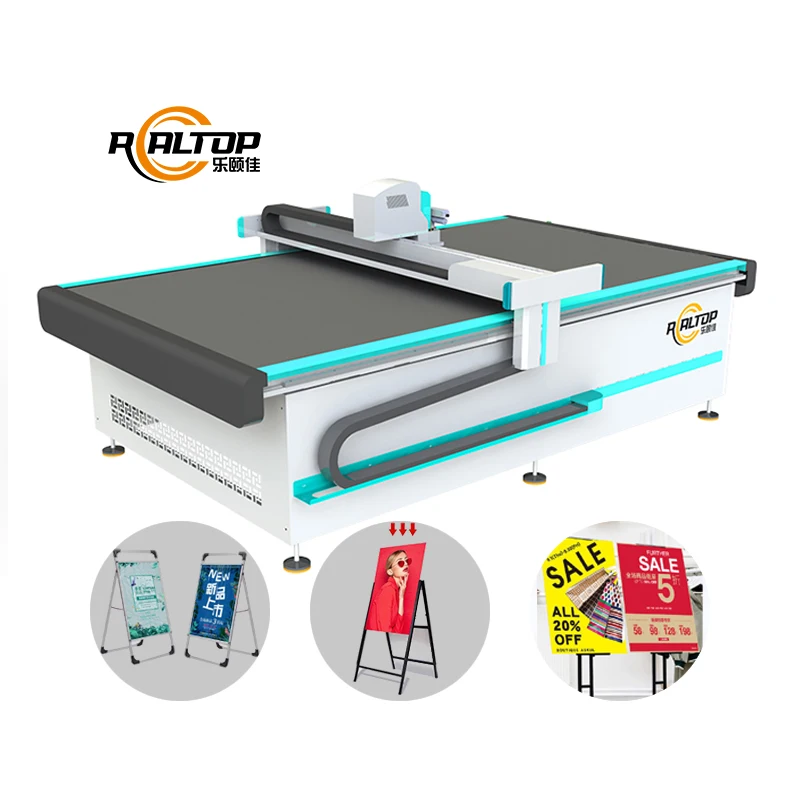
| Product Type | CNC Oscillating Knife Cutting Machine |
| Working Area | 1600 × 2500 mm |
| Machine Dimensions | 3450 × 2300 × 1250 mm |
| Rated Power | 9 kW |
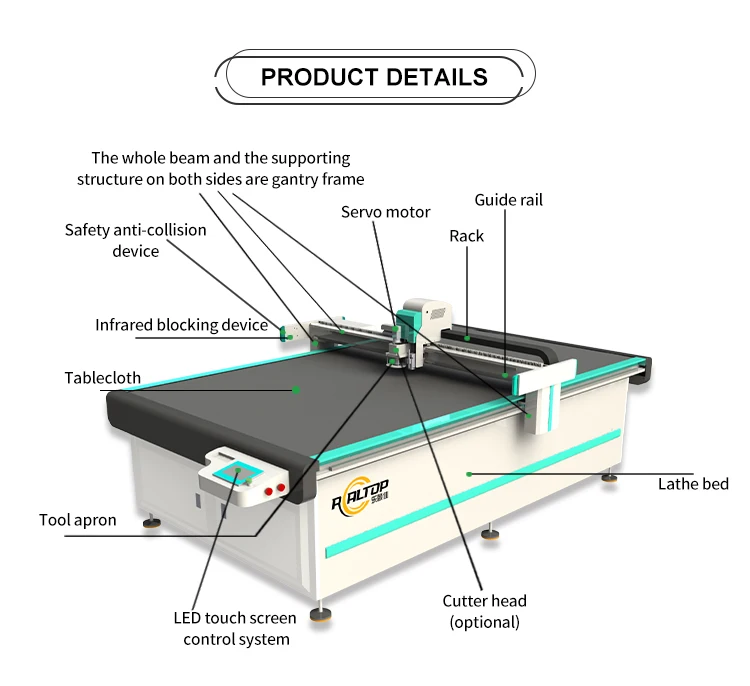
| Working Table | Magnesium-aluminum alloy flat table with vacuum adsorption |
| Multifunctional Head | Swiss imported knife (vibration full cut, half cut, cursor location); options: pneumatic knife, high-power vibrating knife, circular knife, V-cutting knife, drag knife, creasing wheel, dotted line knife, punching, brush |
| Translational Velocity | 800–1200 mm/s |
| Cutting Thickness | 20–80 mm depending on material (basis not stated in source) |
| Repeated Accuracy | ≤0.1 mm |
| Transmission System | Imported digital servo motor, linear guide, synchronous belt, ball screw |
| Servo Motor Brand | Delta (Panasonic optional) |
| Safety Devices | Infrared sensors, anti-collision, emergency stop |
| Instruction System | HP-GL compatible format |
| Voltage | 380V ±10% |
| Vacuum Pump | 7.5 kW, integrated aviation aluminum shell with built-in silencer sponge |
| Additional Configuration | German imported conveyor belt, auto-feeding, Taiwan Hiwin rail |
| Visual Positioning Options | Small CCD camera mark point positioning, panoramic camera recognition, projection positioning |
| Certification | CE |
Application Suitability
| Application | Material or Output |
|---|---|
| Advertising and signage production | Vinyl stickers, self-adhesive film, PVC board, reflective sheeting |
| Packaging and carton sample making | Corrugated cardboard, greyboard, honeycomb board, folding carton stock |
| Garment and footwear manufacturing | Woven fabric, non-woven fabric, PU leather, genuine leather, shoe insole board |
| Automotive interior and gasket production | Sponge, XPE foam, EVA, rubber gasket sheet, carpet, headliner fabric |
| Composite and industrial material processing | Fiberglass, PTFE, ETFE, carbon fiber prepreg, sealing pads |
Why the Wrong Tool Head Costs More Than the Machine Itself
Choosing a CNC oscillating knife cutting machine for sale based on working area alone is one of the most common mistakes in digital cutting procurement, and it surfaces only after the machine lands on the factory floor.
Match the tool head to the material first, then size the table.
I spent three days in a Philippine workshop not long ago because the customer ordered an oscillating blade setup for thick vinyl stickers, and the adhesive layer kept gumming up the blade and leaving ragged edges. We swapped to a different knife geometry and adjusted the oscillation frequency, and the cuts came clean. That kind of mismatch is invisible on a spec sheet but shuts down production the moment you power on [NEED_CITE: tool head selection criteria for adhesive-backed materials].
Tool Head Configurations Across Material Types
The multifunctional head accepts a range of interchangeable tools — oscillating knife, drag knife, creasing wheel, circular knife, and punching tool among them. For vinyl stickers and thin films, a high-frequency oscillating blade with a sharp acute angle typically delivers the cleanest edge. Heavier materials like 30 mm EVA foam or rubber gaskets need a longer stroke and a sturdier blade shank to push through without deflection. The CNC knife cutting machine manufacturer configures the head combination based on your sample material before the machine ships, so the operator is not guessing on day one.
Visual Positioning for Printed Contour Work
When cutting pre-printed vinyl or woven labels, contour accuracy depends entirely on how well the camera tracks registration marks. The available options include a small CCD camera for mark-point positioning, a panoramic camera for full-sheet recognition, and projection positioning for manual alignment tasks. Panoramic recognition is generally preferred for high-volume sticker jobs because it captures the entire sheet in one pass, reducing mark-hunting time between cuts [NEED_CITE: CCD positioning accuracy standards in digital finishing].
Reading the Spec Sheet Like a Production Engineer
The 7.5 kW vacuum pump paired with the magnesium-aluminum alloy table is critical for thin, flexible materials like sticker vinyl. If the vacuum zones are too large, small cut parts lift off the table mid-cycle and shift position, which ruins nesting yield. The 800–1200 mm/s translational velocity range is governed by the Delta servo motors on Taiwan Hiwin linear guides — at higher speeds, servo response and rail straightness together determine whether the repeated accuracy holds at ≤0.1 mm. The Swiss imported knife assembly handles both full-cut and half-cut (kiss-cut) operations, which is essential for sticker sheets where the liner must stay intact.
The Hidden Cost of Skipping Material Trials
When a buyer skips the sample cutting step, the first sign of trouble is usually edge quality on the production floor. Foam that crushes instead of slicing, sticker vinyl that peels up at corners, or corrugated board that frays along the cut line all point to a tool head or vacuum zone mismatch. Retraining operators and re-ordering blade sets after installation costs far more in downtime than a two-week sample evaluation beforehand [NEED_CITE: material trial protocols for digital flatbed cutters].
What Makes This Build Different
The design and production team handles both knife and laser platforms in-house, which means the cutting method is chosen to fit the material rather than forced into a single technology. Every tool head and table zone configuration is documented per material before the order is confirmed. Voltage, plug type, and control language are locked in during the specification stage, not discovered at uncrating. Sample cutting on the buyer’s own material is a standard step, not an optional add-on. The CNC knife cutting machine manufacturer provides a full factory test record so the buyer can verify edge quality and dimensional accuracy before shipment.
Documentation & Verification
- Machine specification sheet listing every tool head and vacuum zone assigned to your material
- Electrical schematic with voltage and plug confirmation matched to your facility
- Sample cutting report on your actual sticker vinyl, foam, or fabric before commitment
- Factory test record showing repeated accuracy and edge quality on your specified materials
- Operation and maintenance manual with blade change intervals and vacuum pump service schedule
- Software license and file format compatibility note covering your existing nesting workflow
Installation, Commissioning & Support
- Dedicated 380V ±10% circuit required for the 9 kW rated power plus 7.5 kW vacuum pump
- Machine footprint of 3450 × 2300 mm needs clear access on three sides for maintenance and material loading
- Auto-feeding conveyor belt calibrated on-site to match your roll width and liner tension
- Servo motor parameters and vacuum zone mapping tuned to your specific material during commissioning
- Operator training covers blade selection, CCD camera calibration, and HP-GL file import workflow
- Spare blade inventory and Hiwin rail lubrication schedule documented for the first year of operation
Preparing Your Inquiry
To get an accurate configuration, send the material type, thickness, and maximum sheet or roll width you plan to cut, along with your target daily volume. Specify your facility voltage and frequency, and whether your existing design software exports HP-GL or another format. If you work with pre-printed graphics, indicate the mark type and minimum contour size so the right camera system is selected.
Frequently Asked Questions
Q: How do I decide between knife cutting and laser cutting for vinyl stickers?
A: Knife cutting is generally preferred for vinyl stickers because it avoids the melted or discolored edges that a CO2 laser can leave on PVC-based films. For very intricate contours under a few millimeters, laser may offer tighter corner detail. Send your actual sticker material for a side-by-side sample test to compare edge quality and throughput before committing to one method.
Q: What working area sizes and multi-head options are available?
A: The standard flatbed configuration provides a 1600 × 2500 mm working area, covering most roll-fed sticker and fabric jobs. Multi-head setups can be configured for higher-volume production, with the number of heads balanced against the vacuum pump capacity needed to hold material flat across all zones simultaneously.
Q: Does the software accept my existing nesting files?
A: The control system is compatible with HP-GL format, which covers most mainstream nesting and CAD outputs. File format compatibility is confirmed during the specification stage, and the software license is documented before shipment. If your workflow relies on a proprietary nesting platform, a trial import is arranged before the order is finalized.
Q: How does the vacuum table handle small sticker parts that tend to lift?
A: The magnesium-aluminum alloy table is divided into vacuum zones sized to match typical nesting layouts. For very small parts, finer zoning keeps suction concentrated directly under each cut piece, preventing lift at high translational speeds. The zone configuration is matched to your material and part geometry during the sample cutting stage.
Blade and laser integration under one roof — matching the cutting method to the material instead of forcing a single process onto every job.
Technical Specifications
| Parameter | Value |
|---|---|
| Product Type | CNC Oscillating Knife Cutting Machine |
| Working Area | 1600 × 2500 mm |
| Machine Dimensions | 3450 × 2300 × 1250 mm |
| Rated Power | 9 kW |
| Working Table | Magnesium-aluminum alloy flat table with vacuum adsorption |
| Multifunctional Head | Swiss imported knife (vibration full cut, half cut, cursor location); options: pneumatic knife, high-power vibrating knife, circular knife, V-cutting knife, drag knife, creasing wheel, dotted line knife, punching, brush |
| Translational Velocity | 800–1200 mm/s |
| Cutting Thickness | 20–80 mm depending on material (basis not stated in source) |
| Repeated Accuracy | ≤0.1 mm |
| Transmission System | Imported digital servo motor, linear guide, synchronous belt, ball screw |
| Servo Motor Brand | Delta (Panasonic optional) |
| Safety Devices | Infrared sensors, anti-collision, emergency stop |
| Instruction System | HP-GL compatible format |
| Voltage | 380V ±10% |
| Vacuum Pump | 7.5 kW, integrated aviation aluminum shell with built-in silencer sponge |
| Additional Configuration | German imported conveyor belt, auto-feeding, Taiwan Hiwin rail |
| Visual Positioning Options | Small CCD camera mark point positioning, panoramic camera recognition, projection positioning |
| Certification | CE |
Application Suitability
| Application | Material or Output |
|---|---|
| Advertising and signage production | Vinyl stickers, self-adhesive film, PVC board, reflective sheeting |
| Packaging and carton sample making | Corrugated cardboard, greyboard, honeycomb board, folding carton stock |
| Garment and footwear manufacturing | Woven fabric, non-woven fabric, PU leather, genuine leather, shoe insole board |
| Automotive interior and gasket production | Sponge, XPE foam, EVA, rubber gasket sheet, carpet, headliner fabric |
| Composite and industrial material processing | Fiberglass, PTFE, ETFE, carbon fiber prepreg, sealing pads |
Why the Wrong Tool Head Costs More Than the Machine Itself
Choosing a CNC oscillating knife cutting machine for sale based on working area alone is one of the most common mistakes in digital cutting procurement, and it surfaces only after the machine lands on the factory floor.
Match the tool head to the material first, then size the table.
I spent three days in a Philippine workshop not long ago because the customer ordered an oscillating blade setup for thick vinyl stickers, and the adhesive layer kept gumming up the blade and leaving ragged edges. We swapped to a different knife geometry and adjusted the oscillation frequency, and the cuts came clean. That kind of mismatch is invisible on a spec sheet but shuts down production the moment you power on [NEED_CITE: tool head selection criteria for adhesive-backed materials].
Tool Head Configurations Across Material Types
The multifunctional head accepts a range of interchangeable tools — oscillating knife, drag knife, creasing wheel, circular knife, and punching tool among them. For vinyl stickers and thin films, a high-frequency oscillating blade with a sharp acute angle typically delivers the cleanest edge. Heavier materials like 30 mm EVA foam or rubber gaskets need a longer stroke and a sturdier blade shank to push through without deflection. The CNC knife cutting machine manufacturer configures the head combination based on your sample material before the machine ships, so the operator is not guessing on day one.
Visual Positioning for Printed Contour Work
When cutting pre-printed vinyl or woven labels, contour accuracy depends entirely on how well the camera tracks registration marks. The available options include a small CCD camera for mark-point positioning, a panoramic camera for full-sheet recognition, and projection positioning for manual alignment tasks. Panoramic recognition is generally preferred for high-volume sticker jobs because it captures the entire sheet in one pass, reducing mark-hunting time between cuts [NEED_CITE: CCD positioning accuracy standards in digital finishing].
Reading the Spec Sheet Like a Production Engineer
The 7.5 kW vacuum pump paired with the magnesium-aluminum alloy table is critical for thin, flexible materials like sticker vinyl. If the vacuum zones are too large, small cut parts lift off the table mid-cycle and shift position, which ruins nesting yield. The 800–1200 mm/s translational velocity range is governed by the Delta servo motors on Taiwan Hiwin linear guides — at higher speeds, servo response and rail straightness together determine whether the repeated accuracy holds at ≤0.1 mm. The Swiss imported knife assembly handles both full-cut and half-cut (kiss-cut) operations, which is essential for sticker sheets where the liner must stay intact.
The Hidden Cost of Skipping Material Trials
When a buyer skips the sample cutting step, the first sign of trouble is usually edge quality on the production floor. Foam that crushes instead of slicing, sticker vinyl that peels up at corners, or corrugated board that frays along the cut line all point to a tool head or vacuum zone mismatch. Retraining operators and re-ordering blade sets after installation costs far more in downtime than a two-week sample evaluation beforehand [NEED_CITE: material trial protocols for digital flatbed cutters].
What Makes This Build Different
The design and production team handles both knife and laser platforms in-house, which means the cutting method is chosen to fit the material rather than forced into a single technology. Every tool head and table zone configuration is documented per material before the order is confirmed. Voltage, plug type, and control language are locked in during the specification stage, not discovered at uncrating. Sample cutting on the buyer’s own material is a standard step, not an optional add-on. The CNC knife cutting machine manufacturer provides a full factory test record so the buyer can verify edge quality and dimensional accuracy before shipment.
Documentation & Verification
- Machine specification sheet listing every tool head and vacuum zone assigned to your material
- Electrical schematic with voltage and plug confirmation matched to your facility
- Sample cutting report on your actual sticker vinyl, foam, or fabric before commitment
- Factory test record showing repeated accuracy and edge quality on your specified materials
- Operation and maintenance manual with blade change intervals and vacuum pump service schedule
- Software license and file format compatibility note covering your existing nesting workflow
Installation, Commissioning & Support
- Dedicated 380V ±10% circuit required for the 9 kW rated power plus 7.5 kW vacuum pump
- Machine footprint of 3450 × 2300 mm needs clear access on three sides for maintenance and material loading
- Auto-feeding conveyor belt calibrated on-site to match your roll width and liner tension
- Servo motor parameters and vacuum zone mapping tuned to your specific material during commissioning
- Operator training covers blade selection, CCD camera calibration, and HP-GL file import workflow
- Spare blade inventory and Hiwin rail lubrication schedule documented for the first year of operation
Preparing Your Inquiry
To get an accurate configuration, send the material type, thickness, and maximum sheet or roll width you plan to cut, along with your target daily volume. Specify your facility voltage and frequency, and whether your existing design software exports HP-GL or another format. If you work with pre-printed graphics, indicate the mark type and minimum contour size so the right camera system is selected.
Frequently Asked Questions
Q: How do I decide between knife cutting and laser cutting for vinyl stickers?
A: Knife cutting is generally preferred for vinyl stickers because it avoids the melted or discolored edges that a CO2 laser can leave on PVC-based films. For very intricate contours under a few millimeters, laser may offer tighter corner detail. Send your actual sticker material for a side-by-side sample test to compare edge quality and throughput before committing to one method.
Q: What working area sizes and multi-head options are available?
A: The standard flatbed configuration provides a 1600 × 2500 mm working area, covering most roll-fed sticker and fabric jobs. Multi-head setups can be configured for higher-volume production, with the number of heads balanced against the vacuum pump capacity needed to hold material flat across all zones simultaneously.
Q: Does the software accept my existing nesting files?
A: The control system is compatible with HP-GL format, which covers most mainstream nesting and CAD outputs. File format compatibility is confirmed during the specification stage, and the software license is documented before shipment. If your workflow relies on a proprietary nesting platform, a trial import is arranged before the order is finalized.
Q: How does the vacuum table handle small sticker parts that tend to lift?
A: The magnesium-aluminum alloy table is divided into vacuum zones sized to match typical nesting layouts. For very small parts, finer zoning keeps suction concentrated directly under each cut piece, preventing lift at high translational speeds. The zone configuration is matched to your material and part geometry during the sample cutting stage.










商品评价
There are no reviews yet.