

Fast Delivery
Quick, reliable shipping to any location.

Free & easy returns
Return this item by mail or in store within 90 days for a full refund.
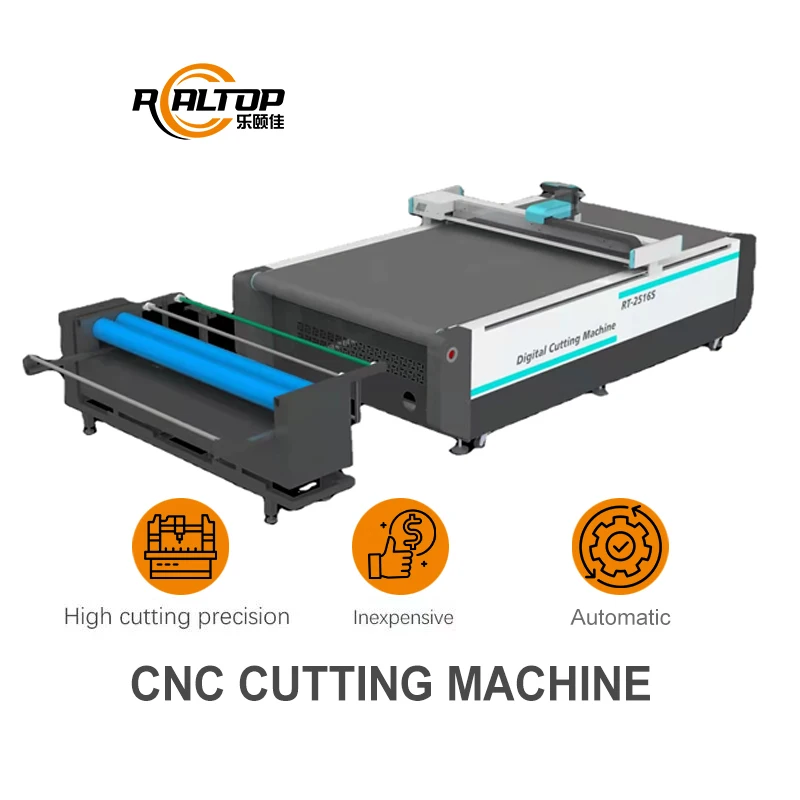
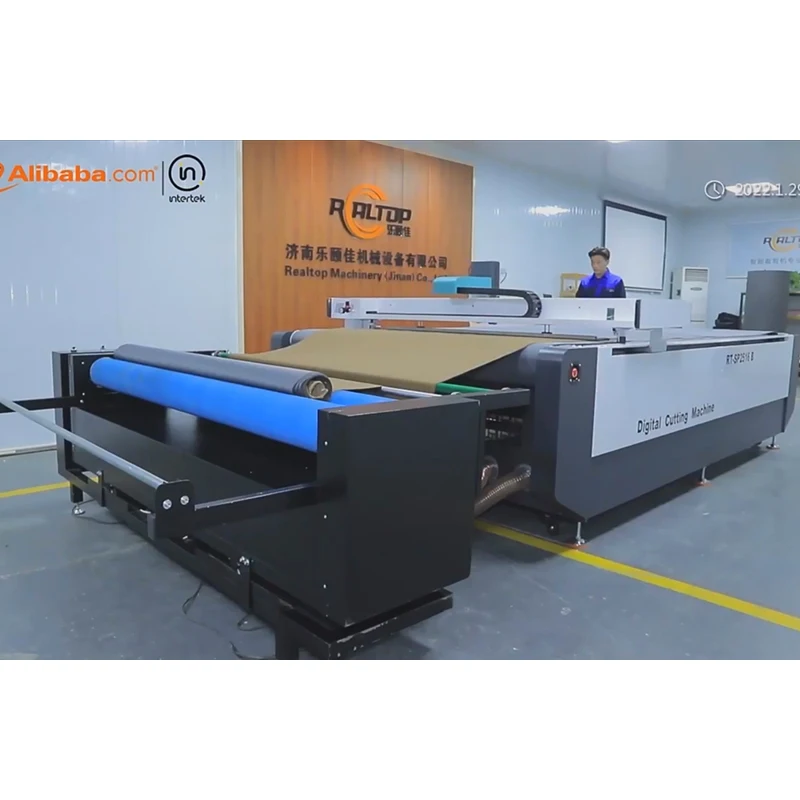
Tool head and table configuration specified per material and production volume — the RT-D2516/RT-S2516 platform accepts modular cutting heads and zones its vacuum bed to match the actual nest layout rather than assuming full-sheet coverage.
Technical Specifications
| Parameter | Value |
|---|---|
| Model | RT-D2516/RT-S2516 |
| Product Type | CNC Oscillating Knife Fabric Cutting Machine |
| Working Area | 1600 × 2500 mm |
| Machine Size | 3450 × 2300 × 1250 mm |
| Rated Power | 9 kW |
| Cutting Thickness | Up to 50 mm depending on material density and tool head |
| Translational Velocity | 800–1200 mm/s |
| Repeated Accuracy | ≤ 0.1 mm |
| Transmission System | Digital servo motor, linear guide, synchronous belt, ball screw |
| Drive Mechanism | Pinion and rack |
| Table Surface | High-density felt on aviation aluminum countertop with inner wind suction structure |
| Vacuum Pump | 7.5 kW |
| Voltage | 380 V ± 10 % |
| Instruction System | HP-GL compatible format |
| Tool Head Options | Round knife, marking pen, auto feeder (modular tool holder) |
| Lathe Bed | Overall welding with imported milling machine processing |
| Safety Device | Infrared sensors |
| Software Language Options | English, Russian, Italian, Chinese; custom languages available |
Application Suitability
| Application | Material or Output |
|---|---|
| Garment and fashion fabric cutting | Woven textiles, knits, technical fabrics in multi-ply lays |
| Leather goods production | Genuine and synthetic leather for bags, footwear uppers and belts |
| Automotive interior trimming | Sponge composite leather, PVC, soft-touch foam laminates |
| Gasket and seal fabrication | Silicon, rubber and soft non-metallic sheet |
| Soft furnishing and upholstery | Heavy woven cloth, felt and composite padding |
| Signage flexible media | Vinyl, banner material and flexible PVC sheets |
When "Working Area" Is the Only Spec You Check, Material Thickness Becomes the Surprise
Matching the tool head to the material prevents ragged edges and crushed layers that no amount of working area can fix.
I have walked into workshops where a CNC oscillating knife cutting machine manufacturer had quoted a large bed and the buyer signed off without discussing what they were actually cutting. The machine arrived, the oscillating knife was swapped for a drag knife better suited to thin vinyl, and suddenly sponge composite leather was tearing instead of shearing. The buyer blamed the machine; the real gap was in the specification conversation [NEED_CITE: oscillating versus drag knife selection for flexible composites].
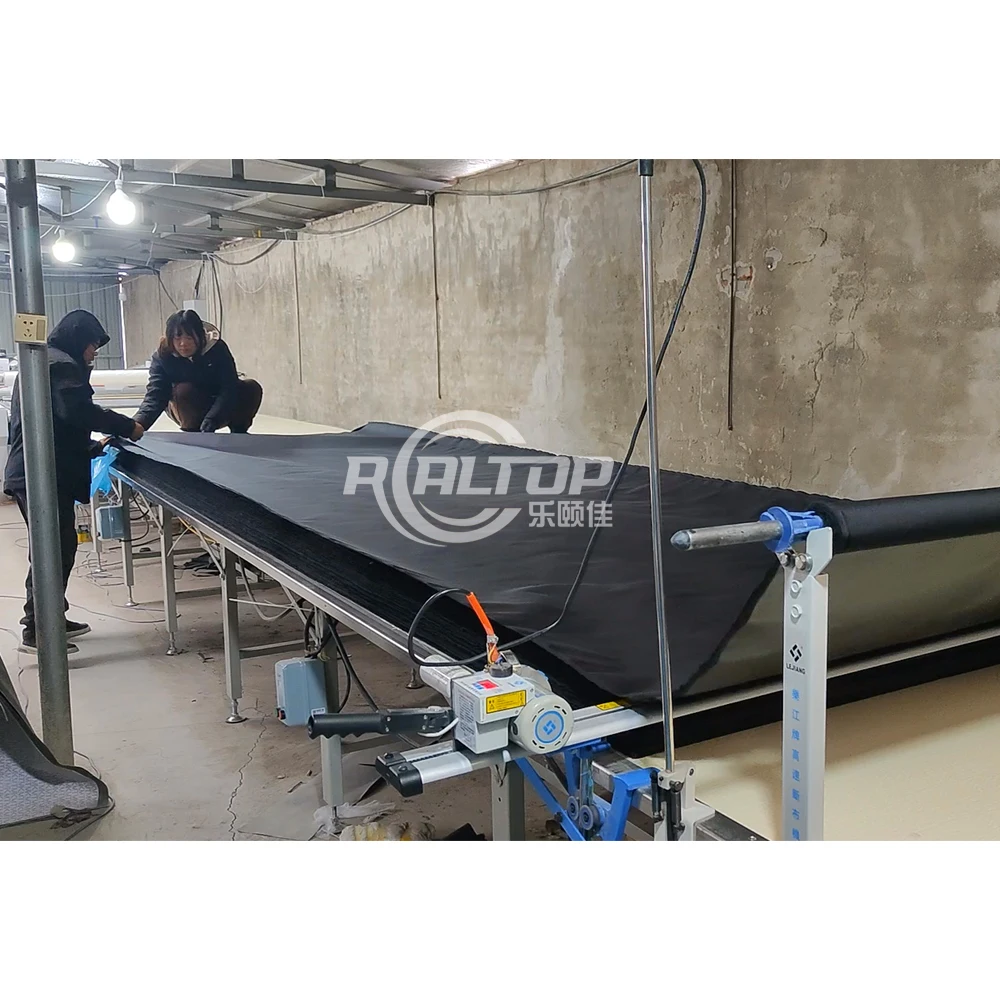
With the RT-D2516/RT-S2516, cutting thickness is rated up to 50 mm, but that figure shifts with material density, ply count and the head in use. A thick felt pad and a thin silicone gasket sheet demand different strokes, frequencies and hold-down pressures. This CNC fabric cutting machine for sale is offered with a modular tool holder so round knife, oscillating blade and marking pen can be changed as the job requires, rather than forcing one head across every material on the shop floor.
Modular Tool Heads Across the Fabric Range
A round knife handles continuous single-ply cuts through woven cloth and knit fabric where a clean shear matters more than intricate corners. An oscillating knife takes over on multi-ply lays and denser composites, vibrating at high frequency to slice through without dragging the bottom plies out of alignment. The CNC oscillating knife cutting machine manufacturer configures the tool holder on the RT-D2516/RT-S2516 to accept these heads interchangeably, so a garment workshop can run silk in the morning and leather in the afternoon on the same table.
Vacuum Zoning That Follows the Nest, Not Just the Sheet
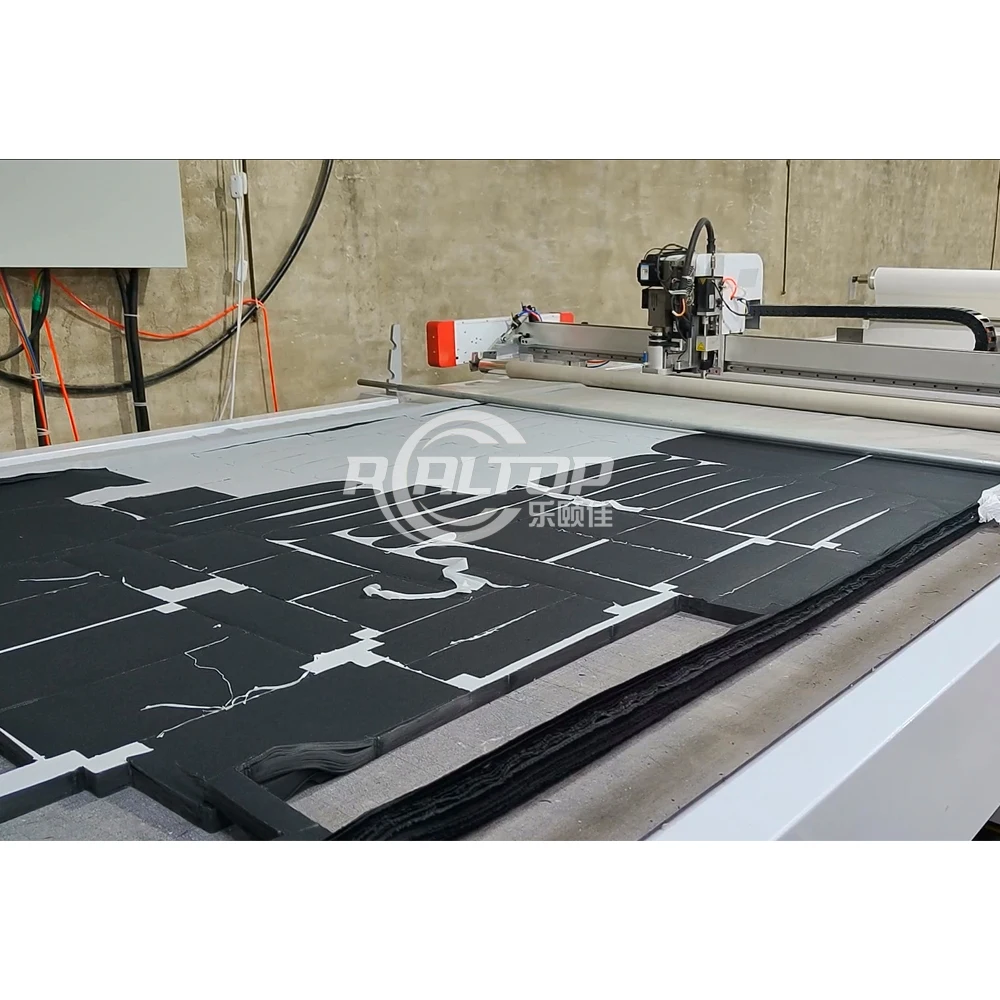
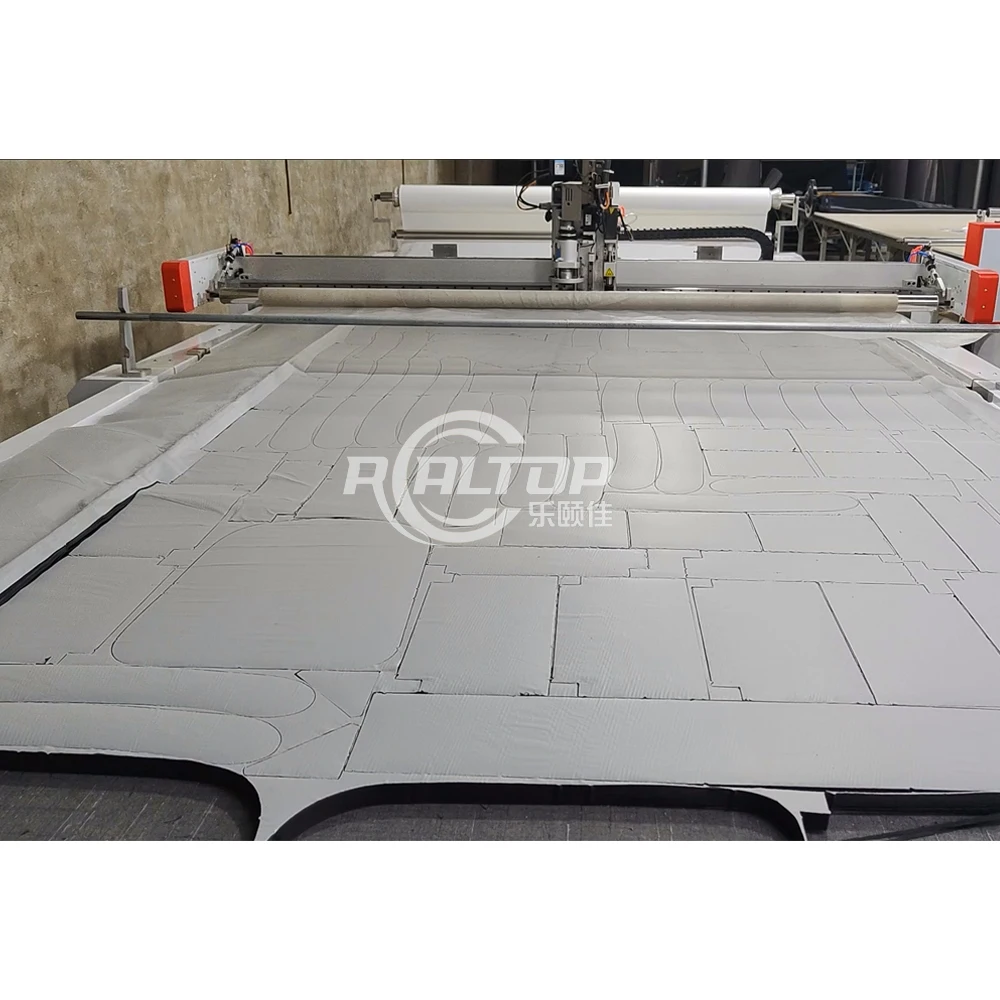
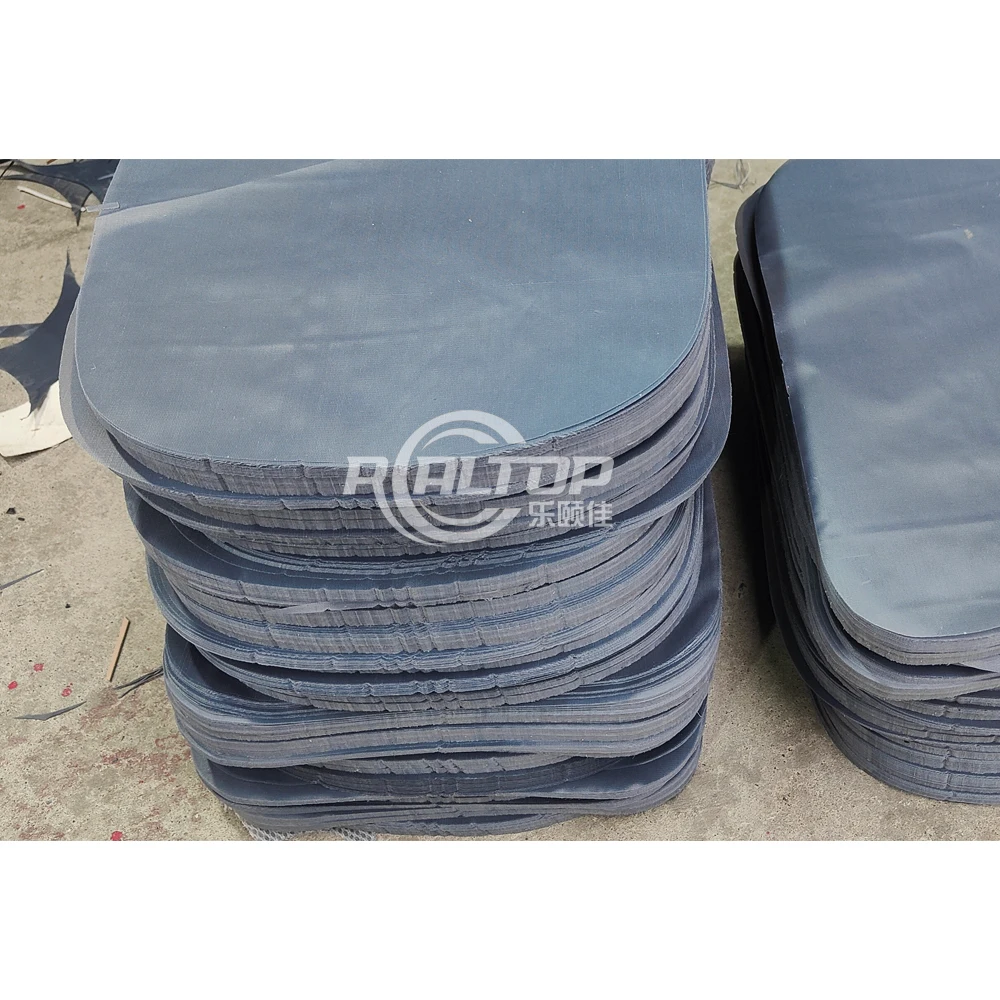
The aviation aluminum countertop with inner wind structure distributes suction across the felt surface, but suction only works where the material covers the ports. Small pattern pieces in a nesting layout leave open zones that bleed vacuum and let adjacent parts lift mid-cut. I once spent two days reworking zone layouts on a fabric cutter in West Africa because the factory test had used full sheets and the buyer’s real production was small garment panels. On the RT-D2516/RT-S2516, vacuum zoning should be specified against the buyer’s typical nest, not the 1600 × 2500 mm envelope [NEED_CITE: vacuum zone mapping for nested small-part cutting].
What the Numbers on the Spec Sheet Actually Mean on the Floor
The 800–1200 mm/s translational velocity is the travel speed of the head between cuts and during straight runs; cornering and intricate contours will run slower to hold the ≤ 0.1 mm repeated accuracy. Pinion and rack drive gives the gantry a stiff, non-elastic path that matters when the head is pushing through dense multi-ply fabric where belt stretch would otherwise show up as jagged arcs. The 7.5 kW vacuum pump is sized to pull through high-density felt, which restricts airflow more than a perforated steel table would; pairing that pump with a flat table that lacks inner wind channels would leave outer zones underpowered. HP-GL compatibility means most existing nesting and pattern software can send jobs directly, but confirming file format and nesting workflow before shipment avoids a machine that sits idle while the buyer rewrites their CAD pipeline [NEED_CITE: HP-GL and DXF nesting workflow compatibility in garment CAD].
The Cost of Skipping the Tool Head Conversation
When a buyer specifies a machine on working area and price alone, the tool head often defaults to whatever is on the standard build. A drag knife on foam produces crushed edges that reject at the sewing stage. A round knife on thick leather stalls and leaves uncut fibers at the base. Reworking the cutting path to compensate burns more time than a proper head swap would have taken, and the buyer ends up running the machine slower than its rated velocity just to hold acceptable edge quality [NEED_CITE: edge quality defects from incorrect knife selection on flexible composites].
Why Source This Platform Through This Catalogue
The RT-D2516/RT-S2516 sits inside a broader catalogue that places knife and laser cutting side by side, so a buyer comparing methods for a mixed-material workshop can see where oscillating knife ends and CO2 laser begins. In-house design covers both the flatbed knife tables and the laser systems, meaning the frame, motion and control architecture share common engineering rather than being assembled from unrelated supplier skids. Sample cutting on the buyer’s own material is run before the order is finalized, so cutting thickness, edge quality and vacuum hold-down are verified on the actual stock, not on a generic test sheet. Voltage, plug type and control language are confirmed line by line, and the software licence and file format compatibility note travels with the machine.
Documentation & Verification
- Machine specification sheet listing working area, tool head options and vacuum zone map for the RT-D2516/RT-S2516
- Electrical schematic confirming 380 V ± 10 % supply and servo wiring before container loading
- Sample cutting report on buyer-supplied fabric or leather showing edge quality at rated thickness
- Software licence and HP-GL file format compatibility note matching buyer’s nesting workflow
- CE declaration covering the complete flatbed cutting system as shipped
- Factory test record documenting repeated accuracy and vacuum hold-down on the production nest
Installation, Commissioning & Support
- 3450 × 2300 × 1250 mm footprint requires level concrete floor with clearance for auto feeder infeed
- 9 kW rated power plus 7.5 kW vacuum pump need dedicated circuits at confirmed 380 V ± 10 %
- Fixed control electrical box on fuselage reduces on-site wiring to main supply and extraction
- First-run calibration covers pinion-and-rack backlash, servo tuning and vacuum zone balancing
- Operator training covers tool head changeover, felt replacement and daily rail inspection
- Spare parts list includes high-density felt, oscillating blades and high-flexibility cables
What to Include With Your Inquiry
Send the material type, thickness range and typical ply count, along with a sample nesting layout so vacuum zoning can be matched to the real production job. State the local voltage, frequency and plug type, plus the control language your operators will use. If you have an existing CAD or nesting system, share the file format so software compatibility is confirmed before the RT-D2516/RT-S2516 is built.
Frequently Asked Questions
Q: How does oscillating knife compare with laser cutting for my fabric and leather mix?
A: Oscillating knife handles multi-ply fabric and thick leather without heat-affected edges, while CO2 laser suits single-ply synthetics where sealed edges prevent fraying. The full catalogue places both methods side by side so you can assign each material to the right process rather than forcing one machine to cover everything.
Q: What working area and tool head do I actually need for my daily volume?
A: Working area should match your longest pattern piece plus auto feeder infeed, and the tool head should match material density and ply count. The RT-D2516/RT-S2516 offers a 1600 × 2500 mm bed with interchangeable round knife, oscillating knife and marking pen modules.
Q: Which voltage and control language will be confirmed before shipment?
A: Voltage is specified at 380 V ± 10 % and must be confirmed against your local supply along with plug type and frequency. Control language options include English, Russian, Italian and Chinese, with custom languages available when agreed before production.
Q: Can I see a sample cutting report on my own material before ordering?
A: Yes. Send your fabric, leather or composite stock and a sample nest layout. A cutting report documents edge quality, achievable thickness and vacuum hold-down on your exact material before the order is finalized.
Q: What else does the full REALTOP catalogue cover beyond this model?
A: The catalogue spans CNC flatbed knife tables, carton sample cutters, CO2 laser machines for non-metals and fiber laser systems for sheet metal and tube. Each family is positioned by material and volume so buyers can compare methods before narrowing to a specific configuration.
Tool head and table configuration specified per material and production volume — the RT-D2516/RT-S2516 platform accepts modular cutting heads and zones its vacuum bed to match the actual nest layout rather than assuming full-sheet coverage.
Technical Specifications
| Parameter | Value |
|---|---|
| Model | RT-D2516/RT-S2516 |
| Product Type | CNC Oscillating Knife Fabric Cutting Machine |
| Working Area | 1600 × 2500 mm |
| Machine Size | 3450 × 2300 × 1250 mm |
| Rated Power | 9 kW |
| Cutting Thickness | Up to 50 mm depending on material density and tool head |
| Translational Velocity | 800–1200 mm/s |
| Repeated Accuracy | ≤ 0.1 mm |
| Transmission System | Digital servo motor, linear guide, synchronous belt, ball screw |
| Drive Mechanism | Pinion and rack |
| Table Surface | High-density felt on aviation aluminum countertop with inner wind suction structure |
| Vacuum Pump | 7.5 kW |
| Voltage | 380 V ± 10 % |
| Instruction System | HP-GL compatible format |
| Tool Head Options | Round knife, marking pen, auto feeder (modular tool holder) |
| Lathe Bed | Overall welding with imported milling machine processing |
| Safety Device | Infrared sensors |
| Software Language Options | English, Russian, Italian, Chinese; custom languages available |
Application Suitability
| Application | Material or Output |
|---|---|
| Garment and fashion fabric cutting | Woven textiles, knits, technical fabrics in multi-ply lays |
| Leather goods production | Genuine and synthetic leather for bags, footwear uppers and belts |
| Automotive interior trimming | Sponge composite leather, PVC, soft-touch foam laminates |
| Gasket and seal fabrication | Silicon, rubber and soft non-metallic sheet |
| Soft furnishing and upholstery | Heavy woven cloth, felt and composite padding |
| Signage flexible media | Vinyl, banner material and flexible PVC sheets |
When "Working Area" Is the Only Spec You Check, Material Thickness Becomes the Surprise
Matching the tool head to the material prevents ragged edges and crushed layers that no amount of working area can fix.
I have walked into workshops where a CNC oscillating knife cutting machine manufacturer had quoted a large bed and the buyer signed off without discussing what they were actually cutting. The machine arrived, the oscillating knife was swapped for a drag knife better suited to thin vinyl, and suddenly sponge composite leather was tearing instead of shearing. The buyer blamed the machine; the real gap was in the specification conversation [NEED_CITE: oscillating versus drag knife selection for flexible composites].
With the RT-D2516/RT-S2516, cutting thickness is rated up to 50 mm, but that figure shifts with material density, ply count and the head in use. A thick felt pad and a thin silicone gasket sheet demand different strokes, frequencies and hold-down pressures. This CNC fabric cutting machine for sale is offered with a modular tool holder so round knife, oscillating blade and marking pen can be changed as the job requires, rather than forcing one head across every material on the shop floor.
Modular Tool Heads Across the Fabric Range
A round knife handles continuous single-ply cuts through woven cloth and knit fabric where a clean shear matters more than intricate corners. An oscillating knife takes over on multi-ply lays and denser composites, vibrating at high frequency to slice through without dragging the bottom plies out of alignment. The CNC oscillating knife cutting machine manufacturer configures the tool holder on the RT-D2516/RT-S2516 to accept these heads interchangeably, so a garment workshop can run silk in the morning and leather in the afternoon on the same table.
Vacuum Zoning That Follows the Nest, Not Just the Sheet
The aviation aluminum countertop with inner wind structure distributes suction across the felt surface, but suction only works where the material covers the ports. Small pattern pieces in a nesting layout leave open zones that bleed vacuum and let adjacent parts lift mid-cut. I once spent two days reworking zone layouts on a fabric cutter in West Africa because the factory test had used full sheets and the buyer’s real production was small garment panels. On the RT-D2516/RT-S2516, vacuum zoning should be specified against the buyer’s typical nest, not the 1600 × 2500 mm envelope [NEED_CITE: vacuum zone mapping for nested small-part cutting].
What the Numbers on the Spec Sheet Actually Mean on the Floor
The 800–1200 mm/s translational velocity is the travel speed of the head between cuts and during straight runs; cornering and intricate contours will run slower to hold the ≤ 0.1 mm repeated accuracy. Pinion and rack drive gives the gantry a stiff, non-elastic path that matters when the head is pushing through dense multi-ply fabric where belt stretch would otherwise show up as jagged arcs. The 7.5 kW vacuum pump is sized to pull through high-density felt, which restricts airflow more than a perforated steel table would; pairing that pump with a flat table that lacks inner wind channels would leave outer zones underpowered. HP-GL compatibility means most existing nesting and pattern software can send jobs directly, but confirming file format and nesting workflow before shipment avoids a machine that sits idle while the buyer rewrites their CAD pipeline [NEED_CITE: HP-GL and DXF nesting workflow compatibility in garment CAD].
The Cost of Skipping the Tool Head Conversation
When a buyer specifies a machine on working area and price alone, the tool head often defaults to whatever is on the standard build. A drag knife on foam produces crushed edges that reject at the sewing stage. A round knife on thick leather stalls and leaves uncut fibers at the base. Reworking the cutting path to compensate burns more time than a proper head swap would have taken, and the buyer ends up running the machine slower than its rated velocity just to hold acceptable edge quality [NEED_CITE: edge quality defects from incorrect knife selection on flexible composites].
Why Source This Platform Through This Catalogue
The RT-D2516/RT-S2516 sits inside a broader catalogue that places knife and laser cutting side by side, so a buyer comparing methods for a mixed-material workshop can see where oscillating knife ends and CO2 laser begins. In-house design covers both the flatbed knife tables and the laser systems, meaning the frame, motion and control architecture share common engineering rather than being assembled from unrelated supplier skids. Sample cutting on the buyer’s own material is run before the order is finalized, so cutting thickness, edge quality and vacuum hold-down are verified on the actual stock, not on a generic test sheet. Voltage, plug type and control language are confirmed line by line, and the software licence and file format compatibility note travels with the machine.
Documentation & Verification
- Machine specification sheet listing working area, tool head options and vacuum zone map for the RT-D2516/RT-S2516
- Electrical schematic confirming 380 V ± 10 % supply and servo wiring before container loading
- Sample cutting report on buyer-supplied fabric or leather showing edge quality at rated thickness
- Software licence and HP-GL file format compatibility note matching buyer’s nesting workflow
- CE declaration covering the complete flatbed cutting system as shipped
- Factory test record documenting repeated accuracy and vacuum hold-down on the production nest
Installation, Commissioning & Support
- 3450 × 2300 × 1250 mm footprint requires level concrete floor with clearance for auto feeder infeed
- 9 kW rated power plus 7.5 kW vacuum pump need dedicated circuits at confirmed 380 V ± 10 %
- Fixed control electrical box on fuselage reduces on-site wiring to main supply and extraction
- First-run calibration covers pinion-and-rack backlash, servo tuning and vacuum zone balancing
- Operator training covers tool head changeover, felt replacement and daily rail inspection
- Spare parts list includes high-density felt, oscillating blades and high-flexibility cables
What to Include With Your Inquiry
Send the material type, thickness range and typical ply count, along with a sample nesting layout so vacuum zoning can be matched to the real production job. State the local voltage, frequency and plug type, plus the control language your operators will use. If you have an existing CAD or nesting system, share the file format so software compatibility is confirmed before the RT-D2516/RT-S2516 is built.
Frequently Asked Questions
Q: How does oscillating knife compare with laser cutting for my fabric and leather mix?
A: Oscillating knife handles multi-ply fabric and thick leather without heat-affected edges, while CO2 laser suits single-ply synthetics where sealed edges prevent fraying. The full catalogue places both methods side by side so you can assign each material to the right process rather than forcing one machine to cover everything.
Q: What working area and tool head do I actually need for my daily volume?
A: Working area should match your longest pattern piece plus auto feeder infeed, and the tool head should match material density and ply count. The RT-D2516/RT-S2516 offers a 1600 × 2500 mm bed with interchangeable round knife, oscillating knife and marking pen modules.
Q: Which voltage and control language will be confirmed before shipment?
A: Voltage is specified at 380 V ± 10 % and must be confirmed against your local supply along with plug type and frequency. Control language options include English, Russian, Italian and Chinese, with custom languages available when agreed before production.
Q: Can I see a sample cutting report on my own material before ordering?
A: Yes. Send your fabric, leather or composite stock and a sample nest layout. A cutting report documents edge quality, achievable thickness and vacuum hold-down on your exact material before the order is finalized.
Q: What else does the full REALTOP catalogue cover beyond this model?
A: The catalogue spans CNC flatbed knife tables, carton sample cutters, CO2 laser machines for non-metals and fiber laser systems for sheet metal and tube. Each family is positioned by material and volume so buyers can compare methods before narrowing to a specific configuration.










商品评价
There are no reviews yet.