


Fast Delivery
Quick, reliable shipping to any location.

Free & easy returns
Return this item by mail or in store within 90 days for a full refund.
Integrated Knife and Laser Engineering — In-house design across oscillating knife, drag knife and V-cutting systems lets us configure the exact tool head for your material rather than forcing a single cutting method.
Technical Specifications
| Parameter | Value |
|---|---|
| Model | RT-D2516/RT-S2516 |
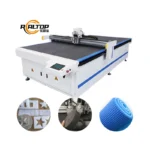
| Product Type | CNC Oscillating Knife Cutting Machine |
| Working Area | 1600 × 2500 mm |
| Machine Size | 3450 × 2300 × 1250 mm |
| Rated Power | 9 kW |
| Translational Velocity | 800–1200 mm/s |
| Maximum Cutting Thickness | ≤100 mm (varies with material) |
| Cutting Thickness Range | 20–80 mm (basis not stated in source — confirm with material type) |
| Repeated Accuracy | ≤0.1 mm |
| Table Type | Magnesium-aluminum alloy vacuum adsorption table, fluorocarbon PVDF powder spraying, anodic and hard oxidation |
| Vacuum Pump | 7.5 kW, integrated aviation aluminum shell with built-in silencer sponge |
| Transmission System | Digital servo motor, linear guide, synchronous belt, imported ball screw |
| Servo Motor | Delta or Panasonic (optional), IP67 waterproof |
| Multifunctional Tool Head | Swiss imported knife; options include oscillating knife, pneumatic knife, high-power vibrating knife, circular knife, V-cutting knife, drag knife, creasing wheel, dotted line knife, punching, brush |
| Visual Positioning Options | Small CCD camera mark point positioning, panoramic camera recognition positioning, projection positioning |
| Safety Device | Infrared sensors, anti-collision beam, emergency stop |
| Voltage | 380V ± 10% |
| Instruction System | HP-GL compatible format |
| Software Language | English, Russian, Italian, Chinese (special languages customizable) |
| Additional Configuration | Auto feeding system, Germany imported conveyor belt |
Application Suitability
| Application | Material or Output |
|---|---|
| Garment and footwear production | Leather, fabric, textile, shoe material, luggage material, non-woven fabric |
| Automotive interior and gasket fabrication | Sponge composite leather, PU, EVA, XPE, sealing pads, composite materials |
| Packaging and carton sample making | Corrugated cardboard, plastic box, sticker, film |
| Soft home furnishings and carpets | Carpet, sponge, cloth, soft glass, silicon, rubber |
| Graphic advertising and printing | PVC, sticker, film, board materials |
| Sports and outdoor products | Fiberglass, foam board, composite materials, PTFE, ETFE |
Why "Working Area" Alone Will Ruin Your First Production Run
A 1600 × 2500 mm table means nothing if the tool head cannot penetrate your actual material at full thickness.
I learned this the hard way on an automotive floor mat line. The machine was specified around table size and travel speed. The customer’s daily stock turned out to be an aluminum-backed composite rather than standard EVA foam. The V-cutting knife stalled mid-sheet, the edge delaminated, and an entire shift’s output was scrapped before anyone understood why [NEED_CITE: material density and layered composition effects on oscillating knife penetration]. When you source a CNC knife cutting machine manufacturer, the conversation must start with what you cut, how thick it is, and what the cross-section looks like — not with the footprint on your shop floor.
Matching the Tool Head to the Cross-Section
Every material behaves differently under an oscillating blade. Leather tears if the vibration frequency is too low. Foam crushes when the downward pressure is excessive. Corrugated cardboard demands a drag knife for clean score lines and an oscillating knife for through-cuts. The RT-D2516/RT-S2516 supports a full range of interchangeable heads — oscillating, pneumatic, V-cutting, circular, drag knife, creasing wheel, punching and brush tools — so the cutting method follows the material rather than the other way around. As a CNC knife cutting machine manufacturer covering both knife and laser technologies, the build philosophy is to let the production job dictate the tooling selection.
Visual Positioning for Printed Contour Work
When your material arrives pre-printed — logos on packaging samples, patterns on garment fabric, registration marks on signage vinyl — the cutting path must follow the print, not the sheet edge. Small CCD mark point positioning reads fiducial marks at each contour start. Panoramic camera recognition captures the entire sheet to compensate for stretch and skew introduced during printing. Projection positioning overlays the cut path onto the material surface so the operator can verify alignment before the blade touches down [NEED_CITE: CCD contour recognition accuracy standards in digital finishing]. Without this, a CNC knife cutting machine manufacturer is selling you blind cutting on registered print work.
What the Specification Sheet Actually Means on the Floor
The 7.5 kW vacuum pump with integrated silencer sponge is not a comfort feature — it determines whether small gasket parts stay flat or lift into the blade path during high-speed traversal. The magnesium-aluminum alloy table with PVDF coating and hard oxidation resists the scoring and chemical exposure that degrades painted steel tables within months. Delta or Panasonic IP67 servo motors handle the dust and humidity common in textile and foam workshops where open-frame motors fail prematurely. The ≤0.1 mm repeated accuracy matters when you are nesting garment panels where a millimeter drift across a 2500 mm travel accumulates into misaligned pattern pieces.
The Cost of Skipping the Sample Cut
I have seen machines arrive at a facility, get bolted down, powered up — and fail to cut the buyer’s material on the first sheet. The wrong tool head produces ragged edges on leather, compressed ridges on foam, or delamination on layered composites. Vacuum zoning that is too coarse lets small signage letters lift and tear mid-cut. Software that cannot import the buyer’s DXF or PLT nesting files means the machine sits idle while the operator redraws every job from scratch [NEED_CITE: common CNC cutting machine commissioning failures in production environments]. These are not warranty claims. They are specification failures that happened before the order was placed.
Why Buyers Come Back for a Second Machine
The in-house design team covers both knife and laser cutting, so when a buyer’s material portfolio shifts — say from pure fabric to foil-backed composites — the conversation is about switching methods, not switching suppliers. Tool head and table zoning are specified per material and production volume before the order is confirmed. CCD camera positioning is tested on the buyer’s own printed samples, not on generic test sheets. Software compatibility with the buyer’s existing nesting workflow and file formats is verified before the machine leaves the factory. Voltage, plug configuration and control panel language are locked in during the specification stage, not discovered at installation.
Documentation & Verification
- Machine specification sheet confirming selected tool heads and table zoning for your material range
- Electrical schematic with 380V ± 10% supply verified against your facility input
- Sample cutting report produced on your own material with edge quality and speed records
- Software licence and file format compatibility note covering HP-GL and your existing nesting formats
- Factory test record documenting repeated accuracy and vacuum hold-down performance before dispatch
- Spare parts list matched to your selected tool head configuration and consumable blade types
Installation, Commissioning & Support
- Foundation must support 3450 × 2300 mm footprint with level tolerance for the magnesium-aluminum vacuum table
- Dedicated 380V ± 10% circuit rated for 9 kW continuous draw with correct phase sequence confirmed on site
- Machine ships in single assembly; vacuum pump and auto-feeding conveyor connect during on-site commissioning
- First-run parameter tuning covers oscillation frequency, blade depth and vacuum zoning per your material
- Operator training includes tool head changeover, CCD mark point calibration and emergency stop recovery procedures
- Consumable blade stock and creasing wheel spares provided based on your daily cutting volume
What to Prepare Before Requesting a Quote
Send us your actual material samples — the exact stock you run in production, not a catalog reference. Tell us the thickness range, the daily sheet volume, and whether your work involves printed contour following. Confirm your facility voltage and frequency, your preferred control panel language, and whether your current nesting software exports HP-GL or other vector formats. If your parts include small geometries that tend to lift, note the smallest piece dimension so we can configure vacuum zoning accordingly.
Frequently Asked Questions
Q: How do I match the right tool head to my material type and thickness?
A: We start with your actual material sample — type, density, layer composition and thickness. Oscillating knives suit foam and fabric; drag knives handle corrugated board scoring; V-cutting knives work on layered composites. Each tool head is selected and tested on your sample before the machine configuration is finalized, so you see the edge quality before committing.
Q: What is the difference between oscillating knife, drag knife and V-cutting?
A: An oscillating knife vibrates vertically to slice through soft and semi-rigid materials cleanly. A drag knife pulls through thinner sheets and is used for scoring cardboard. A V-cutting knife removes a wedge of material for fold lines on composites. The right choice depends entirely on your material structure and the edge finish your downstream process requires.
Q: How is CCD contour recognition configured for printed materials?
A: Small CCD cameras read fiducial marks at each contour start point, while panoramic recognition captures the full sheet to correct for print stretch and skew. We test the system on your printed samples at production speed to confirm tracking accuracy before the machine ships, so contour alignment is verified — not assumed.
Q: How do I verify vacuum table zoning is sufficient for small parts?
A: Small gaskets and signage letters lift when vacuum zones are too large relative to part size. We configure zone segmentation on the magnesium-aluminum table based on your smallest piece dimension. The 7.5 kW pump provides the suction capacity, but zoning layout determines whether that suction actually holds your specific parts flat during cutting.
Q: What software file formats are supported and how is compatibility confirmed?
A: The system accepts HP-GL compatible formats. Before your order is confirmed, we verify that your existing nesting software exports correctly and that the import workflow handles your file structure. Language settings for the control panel are also locked in at this stage so operators can work in their preferred language from day one.










商品评价
There are no reviews yet.