



Fast Delivery
Quick, reliable shipping to any location.

Free & easy returns
Return this item by mail or in store within 90 days for a full refund.
Complete Equipment Range Survey — Compare oscillating knife and flatbed cutting configurations across working areas, tool heads and vacuum zoning to match your actual sticker, vinyl or corrugated material before committing to a model.
Technical Specifications
| Parameter | Value |
|---|---|
| Model | RT-D2516/RT-S2516 |
| Product Type | CNC Oscillating Knife Cutting Machine |
| Working Area | 1600 × 2500 mm |
| Machine Dimensions | 3450 × 2300 × 1250 mm |
| Rated Power | 9 kW (basis not stated in source) |
| Working Table | Flatbed vacuum adsorption platform |
| Tool Head | Swiss imported knife; full cut, half cut, cursor location |
| Safety Device | Infrared sensors, emergency stop |
| Translational Velocity | 800 – 2000 mm/s |
| Cutting Speed | 200 – 800 mm/s (basis to be confirmed by material and thickness) |
| Cutting Thickness | ≤ 100 mm (varies with material) |
| Compatible Materials | Sticker, vinyl, cardboard, corrugated paper, PVC, leather, sponge composite, silicon, rubber, soft glass |
| Repeated Accuracy | ≤ 0.1 mm |
| Transmission System | Digital servo motor, linear guide, synchronous belt, ball screw |
| Instruction System | HP-GL compatible format |
| Voltage | 380 V ± 10 % |
| Servo Motor | Delta |
| Vacuum Pump | 7.5 kW |
| Linear Rail | Taiwan Hiwin |
| Software | Professional nesting, multiple format imports, language customization |
| Certification | CE (source value — verify against manufacturer catalog) |
Application Suitability
| Application | Material or Output |
|---|---|
| Self-adhesive sticker contour cutting | Vinyl, reflective film, printed self-adhesive sheets |
| Corrugated packaging sample making | Single-, double- and triple-wall corrugated board, greyboard |
| Signage and display graphic trimming | PVC foam board, magnetic sheet, window perforated film |
| Leather and flexible gasket processing | Split leather, PU synthetic, rubber sheet, cork composite |
| Business card and hang-tag production | Coated card stock, kraft board, laminated tags |
Why Working Area Alone Will Not Tell You If the Machine Fits
Cutting thickness, tool head selection and vacuum zoning determine whether a CNC oscillating knife cutting machine handles your material — not the table size printed on the brochure.
I have stood next to a freshly delivered flatbed cutter watching the operator struggle with 3 mm foam board because the seller quoted a working area but never discussed vacuum hold-down on small nested parts. The material lifted, the knife dragged and half a morning’s run went straight to the scrap bin. That scene repeats more often than it should [NEED_CITE: common causes of material lift on flatbed digital cutters]. When buyers narrow their choice on footprint first, they discover tool head limitations later — a drag knife that cannot penetrate laminated vinyl stacks, or an oscillating head whose stroke is too short for multi-layer corrugated. Matching the cutting method to the material and daily volume keeps the machine productive instead of parked.
Surveying the Knife-Based Lineup for Sticker and Vinyl Work
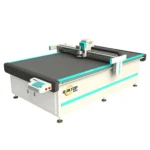
The RT-D2516/RT-S2516 sits in the middle of the oscillating knife range, offering a 1600 × 2500 mm surface that covers most roll-to-sheet sticker formats and standard corrugated blanks. A CNC Oscillating Knife Cutting Machine manufacturer typically positions this size between compact desktop plotters and the larger conveyor-fed systems used for high-volume textile nests. Buyers surveying options at this tier can compare single-head versus multi-head configurations, decide whether a conveyor extension is needed for roll-fed vinyl, and confirm vacuum pump capacity before the order is locked.
How the Catalogue Breaks Down by Material Family
Across the full catalogue, knife machines are grouped by the dominant material they cut — flexible rolls, rigid boards or layered composites — while laser systems sit separately for edge-sealed synthetics and sheet metal. This separation matters when a workshop handles both printed vinyl stickers and acrylic lettering; forcing one method onto the wrong material produces frayed edges or melt-back [NEED_CITE: knife versus laser suitability for mixed-material workshops]. Starting with the material family lets buyers filter the range quickly, then zoom into the working area and tool head that match their sheet size and daily throughput.
Translating the Specification Sheet into Workshop Reality
The 7.5 kW vacuum pump paired with an aluminum honeycomb platform is sized to hold thin vinyl and stiff corrugated board without excessive bleed-through. Delta servo motors running on Taiwan Hiwin rails keep the carriage within a ≤ 0.1 mm repeated accuracy window, which matters when a kiss-cut on 80 µm vinyl must leave the backing paper intact. Cutting speed is listed as 200 – 800 mm/s, but the usable point inside that range depends on material density and knife angle — a setting that will be confirmed during sample cutting on your own stock. The HP-GL compatible instruction system and professional nesting software accept DXF, PLT and AI files, removing the format-conversion step that often stalls first-week production.
The Cost of Skipping the Material-Match Conversation
Ordering on working area alone leaves the buyer exposed to tool head mismatch, insufficient vacuum zoning and software that cannot open the existing design files. The first symptom is usually ragged edges on thicker stock, followed by small sticker parts lifting mid-cut and nested layouts that waste material [NEED_CITE: financial impact of nesting inefficiency in short-run sticker production]. Rectifying these issues after arrival means sourcing a different knife holder, re-zoning the vacuum table or buying third-party nesting software — expenses that could have been avoided with a pre-shipment sample cut on the buyer’s own material.
Why Buyers Source This Catalogue Here
In-house design covers both knife and laser technologies, so the cutting method is selected for the material rather than forced into one available process. Tool head and table configuration are specified per material thickness and production volume before the order is confirmed. CCD camera positioning is available for printed contour work where registration marks vary in size and contrast. Software compatibility is verified against the buyer’s existing file formats, preventing workflow dead-ends on day one. Voltage, control language and plug type are confirmed to the destination market, avoiding transformer rentals or rewired panels after delivery. Sample cutting on the buyer’s own sticker or vinyl stock is completed before the machine leaves the factory.
Documentation & Verification
- Machine specification sheet confirming working area, tool head and cutting thickness range
- Electrical schematic with 380 V ± 10 % circuit diagram and recommended breaker sizing
- Tool head and vacuum table configuration list matched to your material
- Sample cutting report on your sticker or vinyl stock before dispatch
- Software licence and file format compatibility note for your existing workflow
- Packing photographs showing crate bracing and moisture barrier
Installation, Commissioning & Support
- Verify floor levelness within 3 mm over the 3450 × 2300 mm machine footprint before delivery
- Provide a dedicated 380 V ± 10 % circuit with rated capacity above 9 kW plus vacuum pump draw
- Assemble and align the flatbed platform on-site; rails and belt tension checked after transit
- First-run parameter tuning on your sticker and vinyl stock for knife angle, oscillation frequency and vacuum zoning
- Operator training covering HP-GL file import, nesting setup and daily blade inspection routine
- Spare knife blades, vacuum seals and drive belts supplied for initial production months
What We Need From You to Size the Configuration
Send the thickest and thinnest material you plan to cut, along with typical sheet dimensions and your daily volume target. Include your workshop voltage, frequency and preferred control language so the electrical cabinet and HMI are configured before assembly. If you run an existing nesting workflow, share a sample file so software compatibility is confirmed before the order is finalized.
Frequently Asked Questions
Q: How do I decide between knife and laser for my sticker and vinyl work?
A: Knife cutting leaves no burnt edge and handles thicker foam-backed vinyl cleanly, while laser seals the edge of thin synthetic films. Your material composition, thickness and edge-quality requirement determine the method. We run sample cuts on your stock to confirm before you commit to either path.
Q: Which working area and tool head fit my sheet size and material thickness?
A: The 1600 × 2500 mm table covers most standard sticker sheets and corrugated blanks. The Swiss oscillating head handles full cut, half cut and cursor location. We match knife stroke and blade angle to your thickest material during the pre-sale sample test to avoid under-specification.
Q: What file formats and nesting workflows does the software support?
A: The system imports DXF, PLT, AI and HP-GL compatible formats out of the box. We verify your existing design files open correctly and that nesting parameters match your material yield targets. A file format compatibility note ships with the machine so your IT team has a reference.
Q: Which voltage and control language options are available before shipment?
A: The standard rating is 380 V ± 10 %, but the transformer and control cabinet can be configured for your local supply. Control language is set to your preference during assembly. Confirming these points at order stage avoids on-site rewiring or operator confusion during commissioning.
Q: Where does this machine sit within the full catalogue?
A: The RT-D2516/RT-S2516 is a mid-format oscillating knife unit for sticker, vinyl and corrugated work. Larger conveyor-fed models serve high-volume textile nests, while compact flatbeds handle short-run tag and card stock. Laser systems sit in a separate family for edge-sealed synthetics and sheet metal.










商品评价
There are no reviews yet.