



Fast Delivery
Quick, reliable shipping to any location.

Free & easy returns
Return this item by mail or in store within 90 days for a full refund.
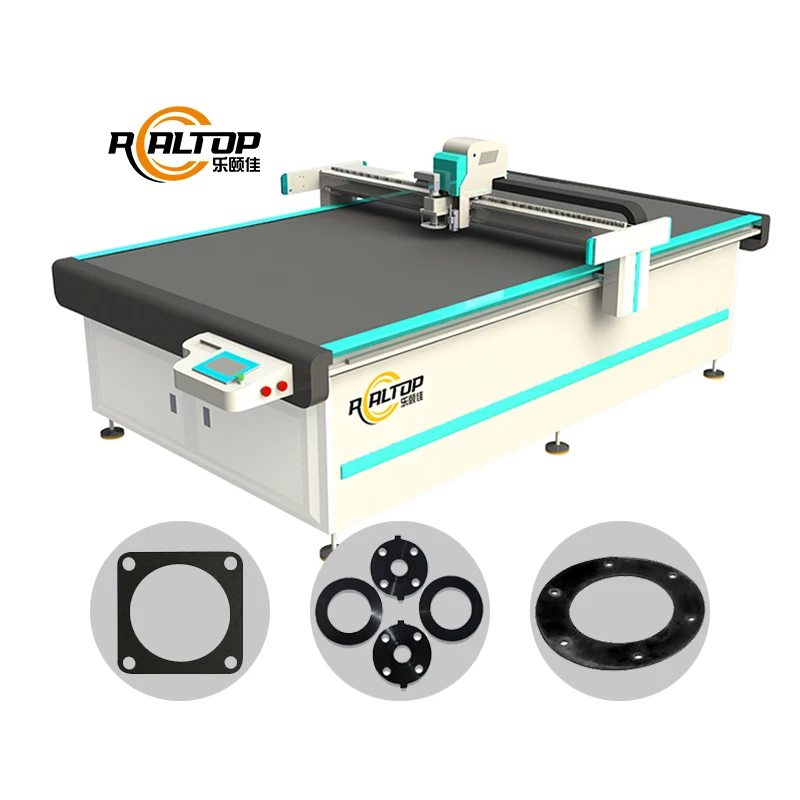
Per-Material Configuration — The Realtop 2516 offers interchangeable tool heads and table zoning matched to your specific gasket or composite sheet rather than forcing a single cutting method across incompatible materials.
Technical Specifications
| Parameter | Value |
|---|---|
| Model | 2516 |
| Product Type | CNC Oscillating Knife Cutting Machine |
| Working Area | 1600×2500 mm |
| Cutting Speed | 0–2000 mm/s |
| Cutting Thickness | ≤ 30 mm (basis not stated in source — confirm material type and density) |
| Cutting Accuracy | ±0.1 mm |
| Tool Head Options | Oscillating knife, Driven rotary knife, Creasing wheel, Kiss cutting tool, Pneumatic knife, Milling tool, V groove knife |
| Vacuum Pump | 9 kW |
| Vacuum Table | Aluminum bellows vacuum table |
| Voltage Options | 110V / 220V / 380V (frequency to be confirmed by target market) |
| Control System | PLC control panel with intuitive interface |
| Servo Drive Options | Panasonic, Delta, Dorna (source value — verify against manufacturer catalog) |
| Profile Formats | PLT, DXF, AI, PDF |
| Safety Device | Infrared sensor device and emergency stop device |
| Machine Dimensions (L×W×H) | 3300×2100×1350 mm |
| Software Language Options | English, Russian, Italian, Chinese (custom languages available) |
| Assembly State | Fully assembled |
| Standards | CE (declaration where applicable) |
Application Suitability
| Application | Material or Output |
|---|---|
| Conventional and special-shaped gasket cutting | PTFE, rubber, composite sealing materials, fiber-reinforced gasket sheet |
| Aerospace composite preform cutting | Carbon fiber prepreg, aramid honeycomb, thermal and acoustic insulation foam |
| Automotive interior and lightweight body panel cutting | Non-woven fabric, PU foam, fiberglass mat, interior trim composites |
| Wind power blade infusion material cutting | Infusion mesh, core material preforms, peel ply |
| Sporting goods composite cutting | Helmet liner foam, surfboard core blanks, bicycle frame prepreg |
| Packaging and carton sample making | Corrugated board, greyboard, folding carton stock |
What "Cutting Thickness ≤ 30 mm" Really Means for Your Gasket Line
Thickness ratings only hold value when matched to a specific material density and tool head configuration.
I once watched a gasket manufacturer lose nearly half their expected daily output because the machine they ordered was rated for 30 mm on soft foam, but their actual stock was multi-layer compressed asbestos board. The oscillating knife stalled at two-thirds of the stated depth, forcing a second pass on every sheet. The CNC oscillating knife cutting machine manufacturer should confirm your exact material stack before quoting a configuration [NEED_CITE: material density and tool head selection for industrial gasket cutting]. Without that conversation upfront, the thickness number on the spec sheet becomes a starting point for negotiation rather than a production guarantee.
Matching the Oscillating Knife to Gasket and Composite Stock
The 2516 sits within a broader equipment range where buyers compare knife versus laser methods side by side. For gasket materials like compressed fiber, PTFE, and rubber compounds, cold cutting with an oscillating knife preserves material integrity — no thermal degradation, no edge charring, no resin vaporization that could weaken the seal face. The driven rotary knife option handles continuous contour cuts on thinner gasket sheets, while the pneumatic knife tackles denser composite stacks that would deflect a standard blade. Selecting the correct CNC oscillating knife cutting machine manufacturer means finding one who tests your actual material before locking in the tool head.
Vacuum Hold-Down and Zoning for Small Gasket Profiles
Gasket cutting often produces dozens of small, irregular profiles from a single sheet. The aluminum bellows vacuum table on the 2516 delivers consistent adsorption across the 1600×2500 mm working area, but the real question is whether the zoning matches your part geometry. Small sealing rings and flange gaskets can lift during the final cuts if vacuum zones are too broad [NEED_CITE: vacuum table zoning requirements for small-part digital cutting]. The 9 kW vacuum pump provides the suction capacity, yet buyers should verify zone segmentation against their typical nesting layout before confirming the order.
Reading the Specification Sheet Beyond the Headline Numbers
The ±0.1 mm cutting accuracy matters most when gasket profiles must match machined flange tolerances — a deviation here causes leakage at the assembly stage, not on the cutting table. Cutting speed ranges from 0 to 2000 mm/s, but achievable speed depends on material resistance; dense composite gasket sheets require slower passes to maintain edge quality. The PLC control panel accepts PLT, DXF, AI, and PDF profiles, which covers most gasket design workflows, yet software compatibility should be confirmed with your existing nesting files before production begins. Servo drive options span Panasonic, Delta, and Dorna, each with different maintenance and parts availability depending on your region.
The Hidden Cost of Skipping Material Testing
Buyers who specify a machine based on working area alone often discover the problem weeks after installation. A gasket producer cutting multi-layer composite sheet may find that the standard oscillating knife produces frayed edges on aramid reinforcement layers, requiring manual trimming that erodes the productivity gain. Another common failure occurs when vacuum zoning proves insufficient for nesting layouts dominated by small flange gaskets, causing material shift mid-cut and scrapping entire sheets [NEED_CITE: material hold-down failures in oscillating knife cutting operations]. These issues surface only when the machine runs your specific stock under production conditions, which is why sample cutting on the buyer’s own material should precede any purchase commitment.
Why Source the 2516 From This Production Line
The 2516 benefits from in-house design covering both knife and laser cutting technologies, so a buyer processing mixed materials can match the cutting method to each job rather than forcing one technology across incompatible stocks. Tool head and table configurations are specified per material type and daily volume, not selected from a fixed menu. CCD camera positioning is available for printed contour work on gasket sheets with registration marks. Voltage, plug type, and control panel language are confirmed before the machine enters assembly. The factory runs sample cuts on the buyer’s actual gasket or composite material and provides a cutting report before the order advances to production.
Documentation & Verification
- Machine specification sheet listing tool head and vacuum table configuration matched to your gasket material
- Electrical schematic confirming voltage, frequency, and plug type for your local supply standard
- Sample cutting report documenting edge quality and dimensional accuracy on your submitted material
- Software licence and file format compatibility note for PLT, DXF, AI, and PDF profile import
- Factory test record showing machine performance under load before crating
- Operation and maintenance manual in your selected control language
Installation, Commissioning & Support
- Fully assembled delivery to the 3300×2100×1350 mm footprint with no on-site frame welding required
- Dedicated 380V or 220V circuit with confirmed frequency matching the servo drive and 9 kW vacuum pump
- First-run parameter tuning on your gasket stock to establish cutting speed and oscillation frequency baselines
- Operator training on PLC interface navigation, tool head changeover, and vacuum zone adjustment
- Spare parts list covering oscillating knife blades, vacuum table seals, and drive belts with recommended reorder intervals
- Routine maintenance schedule for aluminum bellows table surface inspection and servo drive calibration
Before You Send the Inquiry
To get a configuration that runs your gasket or composite material without surprises, provide the material type, thickness range, typical sheet dimensions, and the nesting layout you plan to use. Confirm your workshop voltage and frequency, the control panel language your operators need, and whether your existing design files import as PLT, DXF, or PDF. If your production includes printed registration marks, mention that so the CCD option can be evaluated alongside the standard tool head package.
Frequently Asked Questions
Q: How do I choose the right tool head for my gasket material?
A: The correct tool head depends on your material composition, thickness, and edge quality requirement. Compressed fiber and PTFE gasket sheets typically run on the oscillating knife, while thinner rubber compounds may suit the driven rotary knife. Denser composite stacks sometimes require the pneumatic knife. Submit a material sample so the configuration can be tested and confirmed before the order is finalized.
Q: Should I choose knife cutting or laser cutting for my gasket production?
A: Knife cutting avoids thermal damage, making it the standard choice for resin-based composites, PTFE, and rubber gasket materials where edge charring or heat-affected zones would compromise sealing performance. Laser cutting suits applications requiring sealed edges on synthetic textiles. A manufacturer offering both methods can recommend the appropriate technology based on your specific material rather than defaulting to one option.
Q: Will the vacuum table hold small gasket parts securely during cutting?
A: The 9 kW vacuum pump and aluminum bellows table provide strong adsorption, but small gasket profiles require adequate zone segmentation to prevent lift during the final cut passes. Share your typical nesting layout so the vacuum zone configuration can be reviewed against your part geometry and adjusted if the standard zoning proves too broad for your production profile.
Q: Can the system track printed registration marks on my gasket sheets?
A: CCD camera contour recognition is available as an option for printed mark tracking. The system must be tested with your actual print contrast and mark size to confirm reliable detection at production speed. Specify this requirement during the inquiry stage so the camera system is integrated and calibrated before the machine ships from the factory.
Q: What voltage and language options are confirmed before shipment?
A: The 2516 supports 110V, 220V, and 380V configurations with frequency matched to your local supply standard. The PLC control panel is available in English, Russian, Italian, and Chinese, with custom languages configurable on request. Voltage, plug type, and language must be confirmed during the specification review before the machine enters the assembly stage to avoid costly rework after delivery.










商品评价
There are no reviews yet.