


Fast Delivery
Quick, reliable shipping to any location.

Free & easy returns
Return this item by mail or in store within 90 days for a full refund.
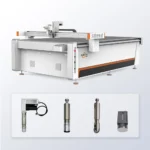
Material-matched tooling selection — The 1625 oscillating knife platform supports seven interchangeable heads, configured per material rather than offered as a one-size-fits-all package.
Technical Specifications
| Parameter | Value |
|---|---|
| Product Type | CNC Oscillating Knife Cutting Machine |
| Working Area | 1600 × 2500 mm |
| Available Tool Heads | Oscillating knife, Driven rotary knife, Creasing wheel, Kiss cutting tool, Pneumatic knife, Milling tool, V-groove knife |
| Cutting Thickness | Up to 30 mm (single layer); up to 30–50 mm for multi-layer fabric lay-ups (basis to be confirmed) |
| Cutting Speed | 1200–2000 mm/s (basis to be confirmed by material, thickness, and path complexity) |
| Cutting Accuracy | ±0.1 mm |
| Vacuum Pump | 9 kW |
| Vacuum Table | Aluminum bellows vacuum table |
| Control Panel | PLC control panel with optional display languages |
| Language Options | English, Russian, Italian, Chinese; custom languages available |
| Compatible File Formats | PLT, DXF, AI, PDF |
| Voltage Options | 110V, 220V, 380V |
| Safety Devices | Infrared sensor device and emergency stop device |
| Machine Dimensions | 3300 × 2100 × 1350 mm |
| Certifications | CE (inferred) |
Application Suitability
| Application | Material or Output |
|---|---|
| Inflatable surfboard and water sport equipment production | PVC tarpaulin, PVC-coated mesh, reinforced drop-stitch base cloth |
| Tent, awning and shade structure fabrication | PVC-coated polyester, heavy-duty canvas, PU-laminated fabric |
| Truck tarpaulin and cargo cover manufacturing | PVC tarpaulin rolls, reinforced laminated fabric |
| Automotive interior trimming | Seat fabrics, headliner material, trunk carpet, PVC floor mats |
| Apparel and multi-layer garment cutting | Suits, knitwear, lace, technical fabrics in stacked lay-ups |
| Composite material processing | Carbon fiber prepreg, aramid fabric, specialty layered materials |
| Gasket and technical seal production | PTFE sheets, rubber compounds, non-asbestos fiber |
Why Specifying Working Area Without Material Data Leads to Rework
A working area alone does not tell you whether the machine will hold and cut the material you actually run.
Many purchasers start their search by matching sheet size to table dimensions, then discover during acceptance that the vacuum table zoning is too coarse for small parts or the selected tool head cannot penetrate the full lay-up thickness. With PVC tarpaulin and inflatable surfboard fabrics, the issue usually surfaces when a buyer runs multi-layer drop-stitch base cloth or reinforced PVC mesh — materials that demand specific oscillation frequencies and blade geometries that differ substantially from standard single-layer vinyl [NEED_CITE: common misconfiguration causes in flexible material CNC cutting]. The result is frayed edges, incomplete cuts at the bottom layer, or parts lifting off the table mid-cycle.
Tool Head Selection Determines Edge Quality on PVC Tarpaulin
Cutting PVC tarpaulin and inflatable surfboard materials requires matching the oscillation amplitude and blade profile to the specific fabric construction. The oscillating knife head handles single-layer PVC tarpaulin up to a few millimeters with a clean, sealed-edge cut. When the material shifts to reinforced PVC mesh or drop-stitch composites, the driven rotary knife or pneumatic knife becomes necessary to push through the woven reinforcement without delaminating the layers. A CNC Oscillating Knife Cutting Machine manufacturer with interchangeable heads lets the operator swap tooling for different production runs rather than forcing one blade type across incompatible materials.
Vacuum Zoning and Material Hold-Down for Heavy Fabrics
PVC tarpaulin rolls used in inflatable surfboard construction are heavy and tend to curl at the edges. The aluminum bellows vacuum table on the 1625 platform provides full-surface adsorption across the 1600 × 2500 mm working area, which keeps thick PVC sheets flat during long cutting paths. Insufficient vacuum zoning is a recurring complaint on smaller tables where the suction zones are too large to hold small cut pieces in place. Proper zone segmentation ensures that even after a part is fully cut, it stays registered on the table until the operator removes it [NEED_CITE: vacuum table design principles for flexible sheet materials].
Reading the Specifications Against Your Production Reality
The 30 mm single-layer cutting thickness covers most PVC tarpaulin grades used in marine and outdoor applications. For multi-layer lay-ups — such as stacked garment fabric or composite prepreg — the stated 30–50 mm multi-layer range requires confirmation against your specific material density and layer count. The 9 kW vacuum pump provides the suction force needed for the full table area, but actual hold-down effectiveness depends on the porosity of your material; highly porous fabrics may require a sacrificial cover sheet to maintain vacuum pressure. Servo motor selection — from Panasonic, Delta, or Dorna — should be confirmed at the quotation stage based on the acceleration requirements of your cutting paths.
The Hidden Cost of Skipping a Material Trial
When a buyer approves a configuration based solely on a brochure specification and the first production run uses a heavier PVC tarpaulin than the sample, the consequences are immediate. Ragged edges on inflatable surfboard panels mean the welded seams will not hold air pressure, and entire batches must be scrapped. On gasket materials like PTFE or compressed rubber, an incorrect oscillation frequency can crush the material rather than cut it, ruining dimensional accuracy and compromising the seal function [NEED_CITE: material trial importance in CNC cutting procurement]. These failures are avoidable with a full-thickness trial on the actual roll stock before the purchase order is finalized.
What Sets This Configuration Process Apart
The design and production team covers both knife and laser cutting technologies under one roof, so the recommendation starts with whether an oscillating knife or a CO2 laser suits your material — not with pushing one machine type onto every job. Each tool head and table configuration is specified per your material sample, and the 1625 platform supports seven tooling options for this reason. Software file format compatibility — PLT, DXF, AI, PDF — is confirmed against your existing nesting workflow before the order is placed. Voltage, plug type, and control language are locked down at quotation to match your destination workshop. A sample cutting report on your own PVC tarpaulin or composite material is produced before you commit, so the edge quality and dimensional accuracy are verified on the real production stock.
Documentation & Verification
- Machine specification sheet listing the confirmed tool head and vacuum table configuration for your material
- Electrical schematic and voltage confirmation matched to your workshop supply standard
- Sample cutting report produced on your PVC tarpaulin or fabric roll before order commitment
- CE declaration and factory test record documenting the acceptance run parameters
- Software licence documentation with file format compatibility note for your nesting system
- Spare parts list identifying consumable blades and vacuum table maintenance items
Installation, Commissioning & Support
- The 3300 × 2100 mm footprint requires a level concrete floor with clearance for material loading on both long sides
- 9 kW vacuum pump and servo drives require a dedicated circuit matching the confirmed voltage (110V, 220V, or 380V)
- Machine ships partially assembled; table frame and gantry require on-site alignment and calibration
- First-run parameter setting includes oscillation frequency tuning and vacuum zone mapping for your specific material
- Operator training covers tool head changeover, PLC language selection, and file import from your nesting software
- Consumable blade inventory and vacuum table seal replacement schedule provided at handover
Moving from Inquiry to Production-Ready Configuration
To size the tooling and vacuum setup correctly, share the specific PVC tarpaulin grade, layer count, and roll width you intend to process. Include your daily cutting volume and whether you run single-layer or stacked lay-ups, so the configuration matches your throughput requirement. Confirm your workshop voltage and frequency, along with your preferred control panel language, to avoid on-site electrical rework. If you have an existing nesting system, send a sample file so format compatibility is verified before the machine ships.
Frequently Asked Questions
Q: How do I decide between oscillating knife and laser cutting for PVC tarpaulin?
A: Oscillating knife cutting produces no thermal damage and is preferred when PVC tarpaulin edges must remain flexible for welding. Laser cutting seals edges automatically but can melt or discolor certain PVC compounds. A material trial on your specific tarpaulin grade confirms which method delivers the required edge quality and downstream weld performance.
Q: Which tool head should I use for multi-layer fabric lay-ups?
A: Single-layer fabric typically runs on the standard oscillating knife head. Multi-layer lay-ups up to 50 mm thick often require the driven rotary knife or pneumatic knife to penetrate the full stack without shifting. The correct tool head depends on your specific fabric weight, layer count, and edge finish requirement.
Q: Can the machine handle small cut parts without them lifting off the table?
A: The aluminum bellows vacuum table provides zoned suction across the 1600 × 2500 mm surface. For very small parts, vacuum zone configuration and cover sheet selection are adjusted during commissioning to prevent lift during the final cut passes.
Q: What file formats does the control system accept from my nesting software?
A: The system accepts PLT, DXF, AI, and PDF formats. Before the order is finalized, your specific nesting output file is tested on the control panel to confirm import accuracy, including layer recognition and cut path sequencing.
Q: Is a sample cutting test available before I place the order?
A: Yes. A sample cutting test on your actual PVC tarpaulin or fabric material is standard procedure. The trial report documents edge quality, dimensional accuracy, and cutting speed on your specific material so you can evaluate the result before committing to the purchase.










商品评价
There are no reviews yet.