



Fast Delivery
Quick, reliable shipping to any location.

Free & easy returns
Return this item by mail or in store within 90 days for a full refund.
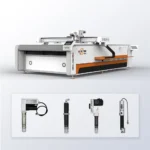
Tool Head Matching — Every RT-D2516/RT-S2516 is configured with a cutting tool selected after testing on the buyer’s own material, ensuring the machine handles thickness and composition rather than forcing one method across every job.
Technical Specifications
| Parameter | Value |
|---|---|
| Model | RT-D2516/RT-S2516 |
| Product Type | CNC Oscillating Knife Cutting Machine |
| Working Area | 1600 × 2500 mm |
| Overall Dimensions (L×W×H) | 3450 × 2300 × 1250 mm |
| Rated Power | 9 kW |
| Table Type | Flat working table with conveyor belt and vacuum table, auto feeding |
| Tool Head | Swiss imported knife with vibration full cutting, vibration half cutting and cursor location function |
| Safety Device | Infrared sensors |
| Translational Velocity | 800–1200 mm/s |
| Cutting Speed | 200–800 mm/s (depending on material type and thickness) |
| Repeated Accuracy | ≤0.1 mm |
| Transmission System | Digital servo motor, linear guide, synchronous belt, ball screw (imported) |
| Servo Motor | Japanese Yaskawa |
| Linear Guide | Taiwan Hiwin rail |
| Vacuum Pump | 7.5 kW |
| Conveyor Belt | Germany imported |
| Instruction System | HP-GL compatible format |
| Voltage | 380V ± 10% |
| Warranty | 12 months for whole machine |
Application Suitability
| Application | Material or Output |
|---|---|
| Garment and footwear cutting | Multi-layer fabric, sponge composite leather, flexible textile |
| Automotive interior production | PVC, soft glass, silicon, rubber sheets |
| Packaging and carton sample making | Corrugated board, gasket material, composite sheets |
| Leather goods manufacturing | Genuine leather, synthetic leather, flexible composites |
| Signage and vinyl cutting | Vinyl films, flexible board materials |
What the Working Area Figure Leaves Out About Material Handling
A 1600×2500 mm table does not guarantee clean cuts through every material placed on it.
Many buyers shortlist machines based on table size alone, then discover during commissioning that the tool head, vacuum zoning, or cutting speed envelope cannot handle their actual stock. I once watched a workshop run a standard sample cut on single-layer cotton with no issues, only to switch to their real production material — a multi-layer composite with a foam core — and find every edge ragged and the foam crushed between layers. Two days of parameter adjustments followed. That kind of on-site failure happens because the specification sheet listed the working area but never confirmed the cutting method against the buyer’s real material stack. [NEED_CITE: CNC oscillating knife cutting machine manufacturer configurations matched to material density and layer count]
Knife, Blade, and Tool Head Configuration Across Material Types
The RT-D2516/RT-S2516 ships with a Swiss imported vibrating knife as the primary CNC Oscillating Knife Cutting Machine tool head, supporting full cutting, half cutting, and cursor location. This matters because flexible materials behave differently under each mode. A single-layer polyester may cut cleanly with a standard oscillating stroke, while a three-layer sponge composite leather requires a wider oscillation amplitude to shear through the foam core without delamination. The tool head selection should be locked in before the machine leaves the factory, not debated during installation.
Vacuum Hold-Down and Conveyor Feeding for Flexible Stock
The flat working table pairs a Germany imported conveyor belt with a 7.5 kW vacuum pump for hold-down. Flexible materials like fabric and thin PVC tend to lift at the edges during high-speed cutting, especially when the knife exits a contour. The vacuum system must generate enough suction across the active zone to pin the material flat throughout the cut path. When the conveyor auto-feeds the next sheet, the belt surface itself needs enough grip to advance the material without slippage, which would shift the registered origin point. [NEED_CITE: vacuum table zoning effectiveness on small-part cutting at production speed]
Reading the Transmission Stack for Repeatability
The machine uses a Japanese Yaskawa digital servo motor driving through Taiwan Hiwin linear rails, a synchronous belt, and an imported ball screw. This combination delivers ≤0.1 mm repeated accuracy, which directly affects nested pattern cutting where adjacent pieces share a cut line. If the carriage drifts even half a millimeter over a long cut path, the nested pieces will not match the pattern file, and material yield drops. The synchronous belt absorbs vibration that a direct-drive screw would transmit into the knife head, keeping the oscillation frequency stable through long production runs.
Speed Ranges and What Controls Them
The translational velocity sits at 800–1200 mm/s, while actual cutting speed ranges from 200–800 mm/s depending on the material. This gap exists because the knife must slow down through dense or thick stock to maintain edge quality. A thin vinyl film might allow the upper end of the speed range, but a 10 mm sponge composite leather forces the system toward the lower bound. The HP-GL compatible instruction system translates the nesting file into motion commands, and the controller adjusts feed rate in real time based on the programmed material profile.
The Cost of Skipping the Material Test Before Order
When a buyer commits to a CNC Oscillating Knife Cutting Machine without running a sample cut on their actual production material, the consequences surface at commissioning. The wrong tool head produces ragged edges on foam composites or crushed fibers on multi-layer fabric. A vacuum pump that holds down large panels may leave small nested parts lifting during contour cuts, forcing the operator to re-cut entire sheets. These failures are not machine defects — they are specification mismatches that a pre-shipment sample cut would have caught. [NEED_CITE: material-specific sample cutting before CNC equipment purchase commitment]
Why Source This Cutting Equipment Here
In-house design covers both knife and laser technologies, so a buyer cutting mixed materials can match the method to the job rather than force one machine type across every task. Tool head and table configurations are specified per material and production volume before the order is finalized. CCD camera positioning is available for printed contour work where the cut path follows a printed registration mark. Software compatibility with the buyer’s existing file format is confirmed during the quotation stage, not discovered during installation. Voltage, language, and specification customization are handled at the factory so the machine arrives ready for the target market’s electrical and operational environment.
Documentation & Verification
- Machine specification sheet listing tool head, table, and vacuum pump configuration for your material
- Electrical schematic and voltage confirmation matching your facility supply before dispatch
- Factory test record with sample cut results on your actual fabric or composite material
- Software licence and HP-GL file format compatibility note for your nesting workflow
- CE declaration documentation where applicable to your import market
- Spare parts list covering consumable blades, belts, and vacuum seals
Installation, Commissioning & Support
- Foundation must support 3450×2300 mm footprint with level tolerance for the Hiwin rail alignment
- Dedicated 380V ± 10% circuit rated for 9 kW machine load plus 7.5 kW vacuum pump
- Machine ships assembled; conveyor belt and vacuum table require on-site leveling and belt tensioning
- First-run commissioning includes cutting speed calibration on your material at 200–800 mm/s range
- Operator training covers HP-GL file import, nesting setup, and tool head changeover procedures
- Consumable spare blades and belt segments included; reorder schedule based on your daily cutting hours
Preparing Your Inquiry
Send the specific material type, thickness range, and maximum sheet size you will be cutting daily. Include your facility voltage and frequency, preferred control language, and whether your existing CAD workflow outputs HP-GL or requires file conversion. If your production involves multi-layer composites or foam-core materials, ship a sample roll so the cutting parameters can be verified before the machine enters production.
Frequently Asked Questions
Q: How is the 200–800 mm/s cutting speed range confirmed for my material?
A: We run a sample cut on your actual material — including any multi-layer or foam-core composites — before the order is finalized. The cutting speed, oscillation frequency, and tool head selection are recorded in a test report so you know the exact parameters your production will use, not a generic speed claim.
Q: Which tool head suits sponge composite leather versus single-layer fabric?
A: Sponge composites typically require a wider oscillation amplitude and a specific blade geometry to shear through the foam core without delaminating the outer layers. Single-layer fabric cuts cleanly with a standard oscillating knife at higher speed. The correct head is selected during the material test and locked into the configuration before shipment.
Q: Does the vacuum table hold small nested parts flat at production speed?
A: The 7.5 kW vacuum pump provides hold-down across the table zones. For small parts, zoning configuration matters — if the active vacuum zone is much larger than the part, suction disperses and the piece can lift. We confirm zone layout against your nesting pattern during the sample cutting stage.
Q: What voltage, plug, and control language are confirmed before shipment?
A: The standard configuration is 380V ± 10%, but voltage and frequency are confirmed against your facility supply before production. Plug type and control panel language are specified in the order documentation so the machine arrives ready for your electrical standard and operator preference.










商品评价
There are no reviews yet.