


Fast Delivery
Quick, reliable shipping to any location.

Free & easy returns
Return this item by mail or in store within 90 days for a full refund.
Precision tooling matched to material — the Swiss oscillating knife head is specified against your actual board grade and flute profile before the machine leaves our Jinan assembly floor.
Technical Specifications
| Parameter | Value |
|---|---|
| Model | RT-D2516 / RT-S2516 |
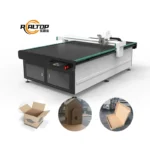
| Product Type | CNC Oscillating Knife Cutting Machine for Packaging and Carton Sample Making |
| Working Area | 1600 × 2500 mm |
| Machine Size | 3450 × 2300 × 1250 mm |
| Rated Power | 9 kW |
| Voltage | 380V ±10% (frequency to be confirmed per market) |
| Tool Head | Swiss imported oscillating knife — vibration full cut, half cut, cursor location |
| Multifunction Head | Interactive cutting, punching, marking, creasing |
| Transmission | Taiwan Delta digital servo motor, Taiwan Hiwin linear guide, rack and synchronous belt |
| Translational Velocity | 800–2000 mm/s |
| Cutting Speed | 200–800 mm/s (varies with material) |
| Cutting Thickness | ≤100 mm (performance varies by material and flute profile) |
| Repeated Accuracy | ≤0.1 mm |
| Vacuum Table | Aluminum alloy honeycomb, auto-follow adsorption |
| Vacuum Pump | 7.5 kW |
| Auto Feeding | Germany imported conveyor belt |
| Safety Device | Infrared sensors, emergency stop |
| Instruction Format | HP-GL compatible |
| Software | Professional carton cutting and nesting software, multi-format import |
| Language Options | English, Russian, Italian, Chinese; custom languages available |
| Certification | CE (verify per unit) |
Application Suitability
| Application | Material or Output |
|---|---|
| Carton and corrugated sample making | Single, double and triple-wall corrugated board, grey board |
| Packaging short-run production | Folding carton stock, honeycomb paperboard |
| Advertising and signage | Foam board, grey board, PVC sheet, vinyl |
| Sticker and label contour cutting | Self-adhesive paper and film on liner |
| Gasket and industrial flat cutting | Rubber, silicone, soft glass, composite leather |
Why Board Thickness Is the Wrong Starting Question
When buyers ask us about a digital packaging sample cutter for sale, the first number they quote is working area. The second is price. The third — if we are lucky — is the material they actually intend to cut. We have watched V-slot creasing wheels crush three-layer corrugated because the machine was specified for grey board, and we have seen oscillating knives tear through E-flute when the buyer assumed all corrugated behaves the same. [NEED_CITE: oscillating knife cutting dynamics on corrugated board grades]
Specify the flute, not just the thickness.
A 3 mm grey board and a 3 mm E-flute corrugated sheet demand completely different blade angles, oscillation frequencies and vacuum hold-down strategies. The RT-D2516 and RT-S2516 are configured after we see your actual stock, not before.
Knife Method Selection for Packaging Substrates
Packaging prototyping lives or dies on edge quality. The Swiss imported oscillating knife on this CNC carton cutting machine manufacturer platform delivers high-frequency vibration full cutting and half cutting from a single multifunctional carriage. For corrugated board, the oscillation frequency must match the flute structure — too slow and the blade drags through the liner; too fast and the flutes collapse before the cut completes. The creasing wheel, mounted alongside the knife, scores fold lines without severing the outer ply, which is the failure point on most sample cutters we have serviced in Shandong workshops.
Vacuum Zoning and Small-Part Stability
A 1600 × 2500 mm honeycomb aluminum table is standard, but what matters in carton sample making is how the vacuum behaves when you are cutting small die shapes from a large sheet. The 7.5 kW vacuum pump with auto-follow adsorption activates only the zones beneath the active cutting path. This prevents small sticker contours or narrow gasket profiles from lifting mid-cut — a problem we encounter regularly when buyers switch from large-format carton work to short-run label production on the same table. [NEED_CITE: vacuum table zoning principles for flatbed digital cutting]
Reading the Specs That Actually Govern Cut Quality
Translational velocity of 800–2000 mm/s describes head movement between cuts; cutting speed of 200–800 mm/s is the figure that governs edge quality on your specific board. The gap between these two numbers defines your real cycle time. Taiwan Delta servo motors paired with Hiwin linear guides and rack transmission hold repeated accuracy within 0.1 mm — critical when a creasing line must register to a printed contour across a 2500 mm sheet length. The HP-GL compatible instruction system and professional nesting software allow import from the DXF and PLT files your design team already generates, avoiding the re-draw bottleneck that delays sample approval in most packaging houses we supply.
The Cost of Skipping a Material Test Run
We once configured a machine for a buyer who specified 5 mm grey board. His actual production stock was B-flute corrugated with a coated liner. The oscillating knife produced clean cuts, but the creasing wheel crushed the flute profile, leaving visible ridges on the finished carton exterior. The entire sample batch was rejected by his client. A single test cut on the buyer’s own material — something we now insist on before every order — would have caught the mismatch in tool pressure and oscillation setting before the machine shipped. [NEED_CITE: creasing wheel pressure requirements across corrugated flute types]
Why Buyers Source This Platform
In-house design covers both knife and laser cutting technologies, so a packaging buyer can match the cutting method to the substrate rather than force one method across incompatible materials. Tool head and table configuration are specified per material and daily volume, not pulled from a generic catalogue. CCD camera positioning is available for printed contour work where registration marks must drive the cut path. Voltage, plug type and control language are confirmed before production begins. Sample cutting on the buyer’s own corrugated or grey board stock is a standard step, not a favour.
Documentation & Verification
- Machine specification sheet matching your confirmed tool head and table configuration
- Electrical schematic with voltage and frequency locked to your facility supply
- Sample cutting report produced on your exact board grade and flute profile
- Tool head and blade configuration list with recommended consumable part numbers
- Software licence and file format compatibility note for your existing design workflow
- Factory test record documenting repeated accuracy and cut edge quality before dispatch
Installation, Commissioning & Support
- Floor space allocation of 3450 × 2300 mm plus operator clearance on three sides
- Dedicated 380V circuit rated for 9 kW continuous draw with confirmed frequency
- Machine arrives assembled; vacuum pump and conveyor belt require on-site connection
- First-run parameter tuning performed on your supplied board stock by our technician
- Operator training covers blade change, creasing wheel adjustment and nesting software workflow
- Spare blade and creasing wheel kit shipped with initial order based on your material volume
What to Send With Your Inquiry
Before we quote a CNC carton cutting machine manufacturer configuration, we need your actual board samples — flute type, ply count, coating status and the thickest stock you run. Tell us your target daily sample volume and whether your workflow requires CCD registration for printed contours. Confirm your local voltage, frequency and preferred control language so we can lock the electrical build before production starts.
Frequently Asked Questions
Q: How do I verify cutting thickness and speed for my corrugated flute?
A: Send us a sample of your actual board stock. We run it on the RT-D2516 or RT-S2516 at our Jinan facility and document the cutting speed, edge quality and creasing result in a sample report before you commit to the order. Thickness capacity varies with flute structure, not just millimetre measurement.
Q: Which tool head handles carton creasing versus full cutting?
A: The multifunctional carriage carries both the Swiss oscillating knife for full and half cuts and a creasing wheel for fold-line scoring. The correct blade angle and wheel pressure depend on your board grade, which we determine during the material test run.
Q: What voltage and control language options are available?
A: The standard build is 380V ±10%, but frequency and plug type must match your local supply. Control language options include English, Russian, Italian and Chinese, with custom languages configurable before the machine enters final assembly.
Q: Does the software accept my existing DXF or PLT files?
A: The professional carton nesting software supports HP-GL compatible format and imports multiple file types including DXF and PLT. We confirm file format compatibility against your design workflow during the pre-order specification stage.
Q: Can I send my own material for sample cutting before ordering?
A: Yes — this is a standard step in our sales process. We cut, crease and mark your actual production stock and send you the sample report with edge photographs and measured accuracy data before the purchase order is finalized.










商品评价
There are no reviews yet.