


Fast Delivery
Quick, reliable shipping to any location.

Free & easy returns
Return this item by mail or in store within 90 days for a full refund.
Customized tool configuration — we test every cutting method on your actual material before recommending a head, rather than quoting a standard setup and hoping it works on arrival.
Technical Specifications
| Parameter | Value |
|---|---|
| Model | 1625 |
| Product Type | CNC Oscillating Knife Cutting Machine |
| Working Area | 1600×2500 mm |
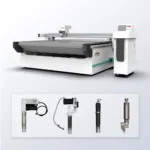
| Tool Head Options | Oscillating knife, Driven rotary knife, Creasing wheel, Kiss cutting tool, Pneumatic knife, Milling tool, V groove knife |
| Cutting Speed | 0–2000 mm/s |
| Cutting Thickness | Up to 30–50 mm (basis not stated in source — confirm block format, material and thickness) |
| Cutting Accuracy | ±0.1 mm |
| Vacuum Pump Power | 9 kW |
| Vacuum Table | Aluminum bellows vacuum table |
| Servo Motor Brands | Panasonic, Delta, Dorna |
| Control System | PLC control panel |
| Voltage Options | 110V / 220V / 380V |
| Software & File Formats | PLT, DXF, AI, PDF |
| Nesting System | Intelligent nesting with automatic defect avoidance |
| Safety Device | Infrared sensor and emergency stop |
| Software Language Options | English, Russian, Italian, Chinese (customizable) |
| Machine Size (L×W×H) | 3300×2100×1350 mm |
| Assembly State | Fully assembled, factory tested before shipment |
Application Suitability
| Application | Material or Output |
|---|---|
| Apparel manufacturing | Suits, knitwear, lace, pattern-matching fabrics |
| Automotive interiors | Seat fabrics, carpets, PVC floor mats |
| Home textiles | Sofa upholstery, curtains, rugs in multi-layer stacks |
| Composite processing | Carbon fiber prepreg, aramid, specialty reinforced textiles |
| General non-metal | Leather, EVA foam, PTFE gasket, rubber, cardboard |
Why Working Area Alone Decides Nothing About Cutting Performance
A 1600×2500 mm bed tells you how much material fits — not whether the machine can cut your specific fabric at production speed without fraying, lifting or leaving ragged edges. I have watched buyers in Latin America commit to a CNC textile cutting machine for sale based on table size, only to discover on day one that the vacuum zoning cannot hold small pattern pieces flat, or that the oscillating blade chews through coated composites in half the expected lifespan. The real question is whether the cutting head, vacuum configuration and feed system match the thickness, coating and layer count you actually run. [NEED_CITE: industrial fabric cutting challenges with coated and composite textiles]
Matching the Tool Head to the Fabric, Not the Other Way Around
A single blade type cannot cleanly cut lace, EVA foam and carbon fiber prepreg on the same shift. The 1625 platform supports an oscillating knife for standard woven and knit layers, a driven rotary knife for continuous high-speed fabric runs, a pneumatic knife for thicker foam stacks, and a V-groove knife for packaging and carton work. Selecting the correct head per material avoids crushed edges, blade drag and mid-shift tool changes that kill throughput on a CNC textile cutting machine for sale.
Holding Small Pattern Pieces Flat Across the Entire Bed
Loose fabric lifts under blade pressure, especially when the cutter reverses direction at high speed. The aluminum bellows vacuum table on this unit provides even suction distribution, and the 9 kW pump maintains draw through porous and non-porous materials alike. When cutting nested small pieces for automotive seat covers or garment panels, consistent hold-down is what separates clean edges from a pile of rejected parts. [NEED_CITE: vacuum table flatness standards for digital flatbed cutting]
Reading the Specs That Actually Dictate Cutting Quality
The ±0.1 mm cutting accuracy matters most when pattern-matching stripes or plaids across garment panels — a drift of even half a millimeter accumulates over a long cut and shows up as misaligned seams downstream. Servo motor selection between Panasonic, Delta and Dorna affects acceleration behavior on tight corners, which is where lesser drives leave micro-jags on curved pattern edges. The intelligent nesting system with automatic defect avoidance goes further by scanning for material flaws and routing the cut path around them, preserving yield on expensive technical textiles. Software compatibility with PLT, DXF, AI and PDF files means most existing pattern libraries import without an intermediate conversion step that might distort curves or layer assignments.
The Hidden Cost of Skipping Material-Specific Configuration
When a buyer does not verify tool head selection against their actual production stack, the consequences are quiet at first and expensive by week three. A driven rotary knife specified for a single-layer silk operation will shred multi-layer automotive carpet, while an oscillating blade pushed through fiberglass-reinforced composite will dull before the first shift ends. I once saw a Chilean automotive seating plant burn through replacement blades at three times the projected rate because the machine had been tested on standard polyester, not the coated composite they actually ran. [NEED_CITE: blade wear rates on coated and reinforced technical textiles]
Why Source This CNC Textile Cutting Machine From Here
In-house design covers both knife and laser cutting technologies, so the cutting method is matched to the material rather than forced into one system. Tool head and table configuration is specified per material and production volume, not pulled from a default list. CCD camera positioning is available for printed contour work where registration marks must be tracked at speed. Software compatibility is confirmed before order placement, preventing file format surprises on the shop floor. Voltage, plug type and control language are validated against the destination market so the machine runs the day it is plugged in. Sample cutting on the buyer’s own material is completed before any commitment is made.
Documentation & Verification
- Machine specification sheet with tool head and vacuum table configuration matched to your fabric type
- Electrical schematic and voltage confirmation aligned with your local grid standard
- Sample cutting report produced on your actual material, not a generic demo stock
- Software licence and file format compatibility note issued before order confirmation
- Factory test record documenting accuracy and edge quality on your specified stack height
- Packing photographs taken before crate closure for shipment verification
Installation, Commissioning & Support
- Floor space allocation based on the 3300×2100 mm machine footprint plus operator clearance on three sides
- Dedicated electrical circuit matching confirmed voltage — 110V, 220V or 380V — with correct plug and frequency
- Machine arrives fully assembled; commissioning involves leveling, vacuum pump start-up and axis calibration
- First-run parameter tuning covers blade depth, oscillation frequency and vacuum zoning for your specific material
- Operator training includes nesting software workflow, tool change procedure and file import from PLT, DXF, AI or PDF
- Spare parts list covers blades, vacuum seals and sensor components with reorder intervals noted
What We Need From You Before Quoting
Tell us the exact fabric or composite you cut, including coating type if any, and the thickness of a single layer along with how many layers you stack for production. Share your local voltage and frequency so the electrical cabinet is built correctly from the start. If you can send a roll or sheet of your actual production material, we will run a complete sample test and send back the cut pieces, a blade wear log and a configuration recommendation before you decide.
Frequently Asked Questions
Q: Which tool head should be matched to my specific fabric type and thickness?
A: The 1625 supports oscillating knife, driven rotary knife, pneumatic knife, creasing wheel and V-groove knife heads. For standard woven and knit fabrics in multi-layer stacks, the oscillating knife is the default. Continuous single-layer runs suit the driven rotary knife, while thicker foam or gasket materials need the pneumatic knife. We test your actual material to confirm the right head before final configuration.
Q: How is cutting thickness verified — single-layer or multi-layer stack?
A: The spec sheet lists up to 30–50 mm depending on material density and format. We verify on your actual production stack during sample testing, documenting blade type, oscillation frequency and number of layers cut cleanly. This report ships with the machine so you have a confirmed baseline rather than a generic range.
Q: What voltage and plug configuration will ship to my market?
A: The machine is configurable for 110V, 220V or 380V systems. We confirm your local voltage, frequency and plug type during the specification review so the electrical cabinet and wiring are built correctly. An electrical schematic and voltage confirmation document is issued before production begins.
Q: Which file formats does the software import, and how does nesting work?
A: The system imports PLT, DXF, AI and PDF files directly. The intelligent nesting engine performs automatic defect avoidance and layout optimization to maximize material yield. If you use a specific nesting workflow or third-party pattern software, we confirm compatibility during the pre-order review stage.
Q: Can I send my own material for sample cutting before placing an order?
A: Yes. Send a roll or sheet of your production material and we will run a full cutting test using the tool head and stack height matched to your application. You receive the cut samples, a blade wear log and a written configuration recommendation before any purchase commitment.










商品评价
There are no reviews yet.