


Fast Delivery
Quick, reliable shipping to any location.

Free & easy returns
Return this item by mail or in store within 90 days for a full refund.
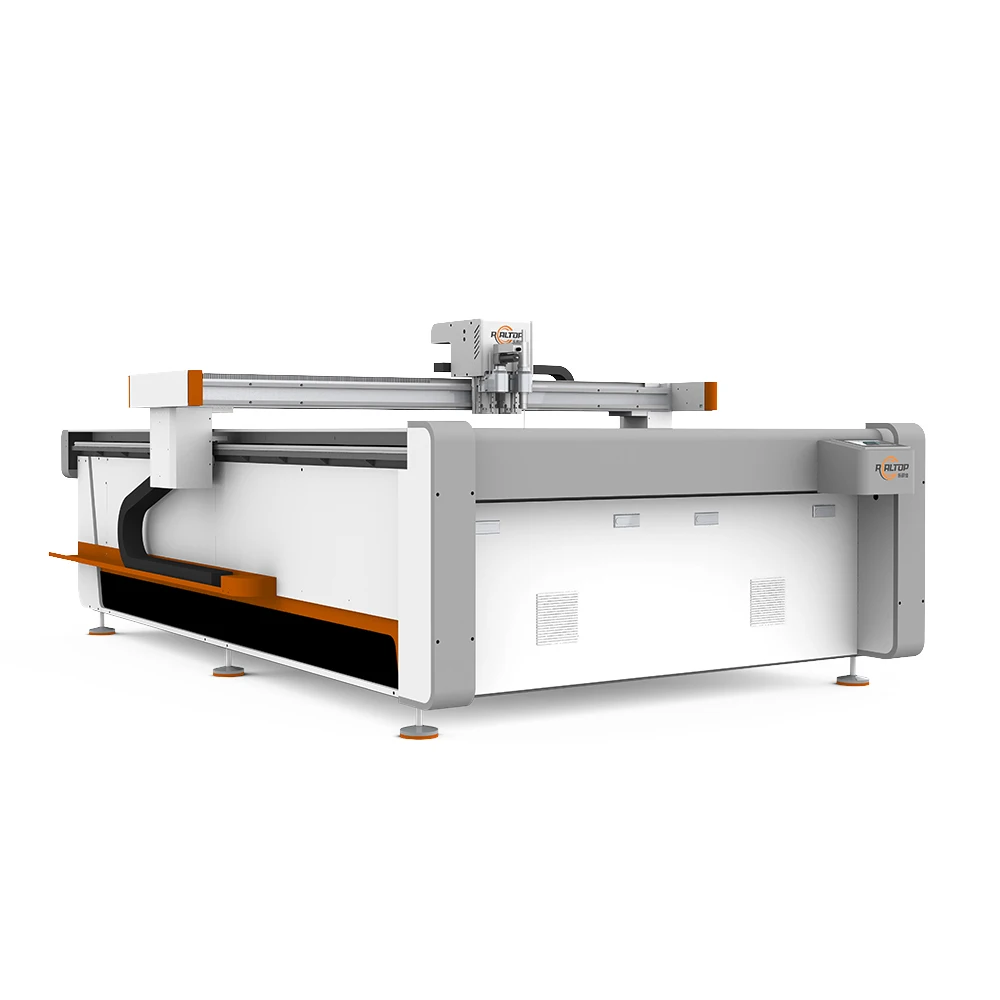
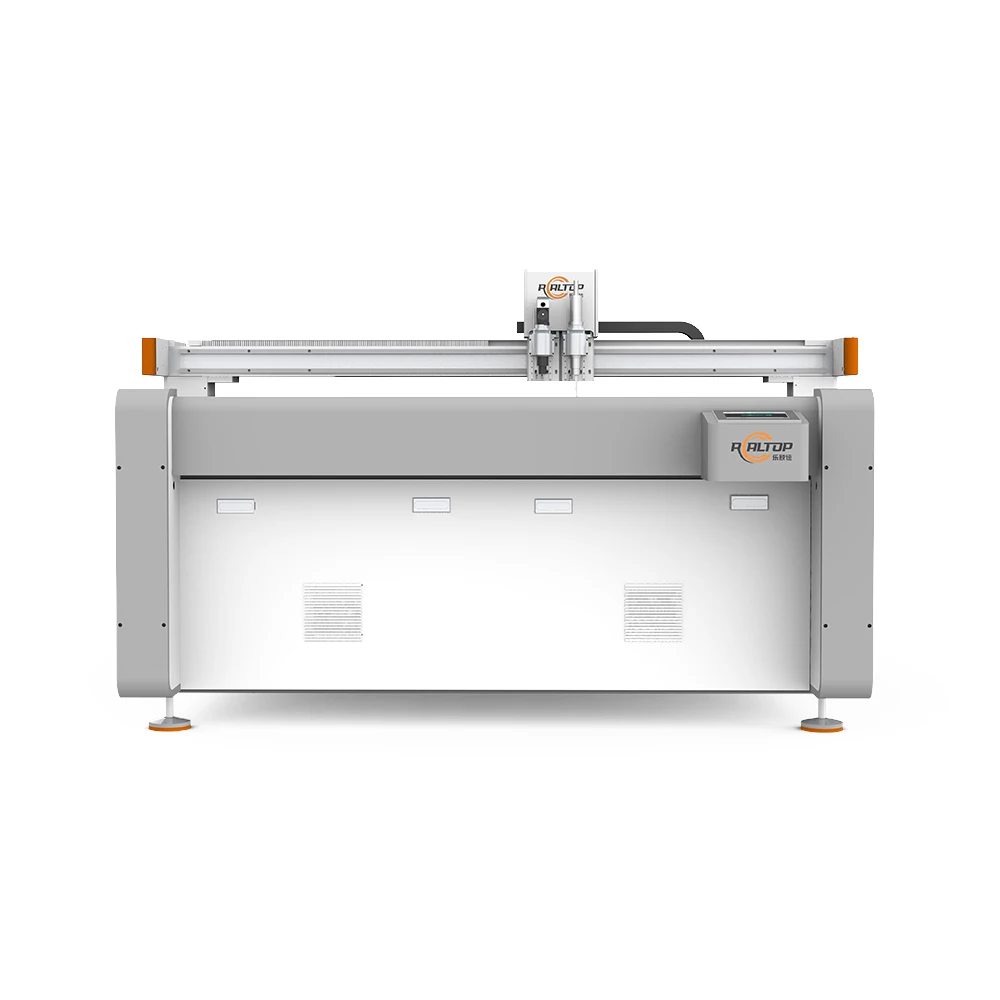
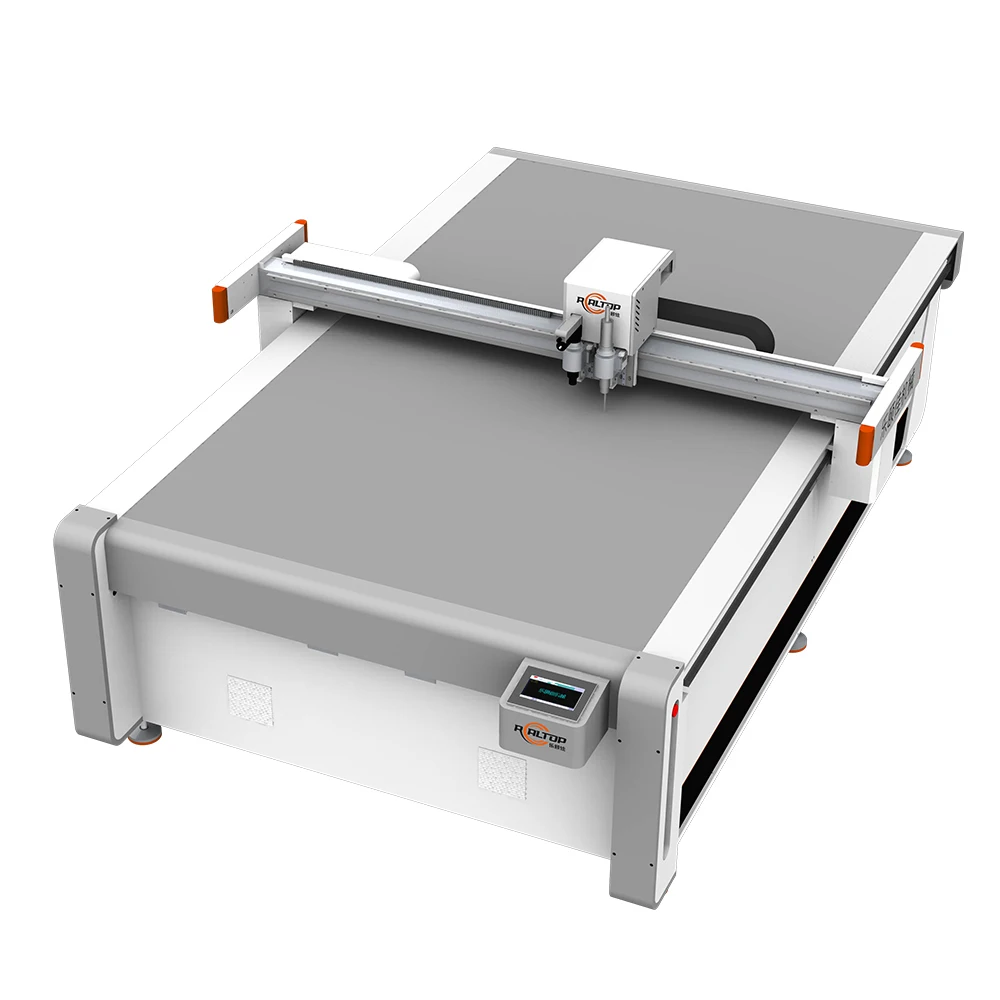
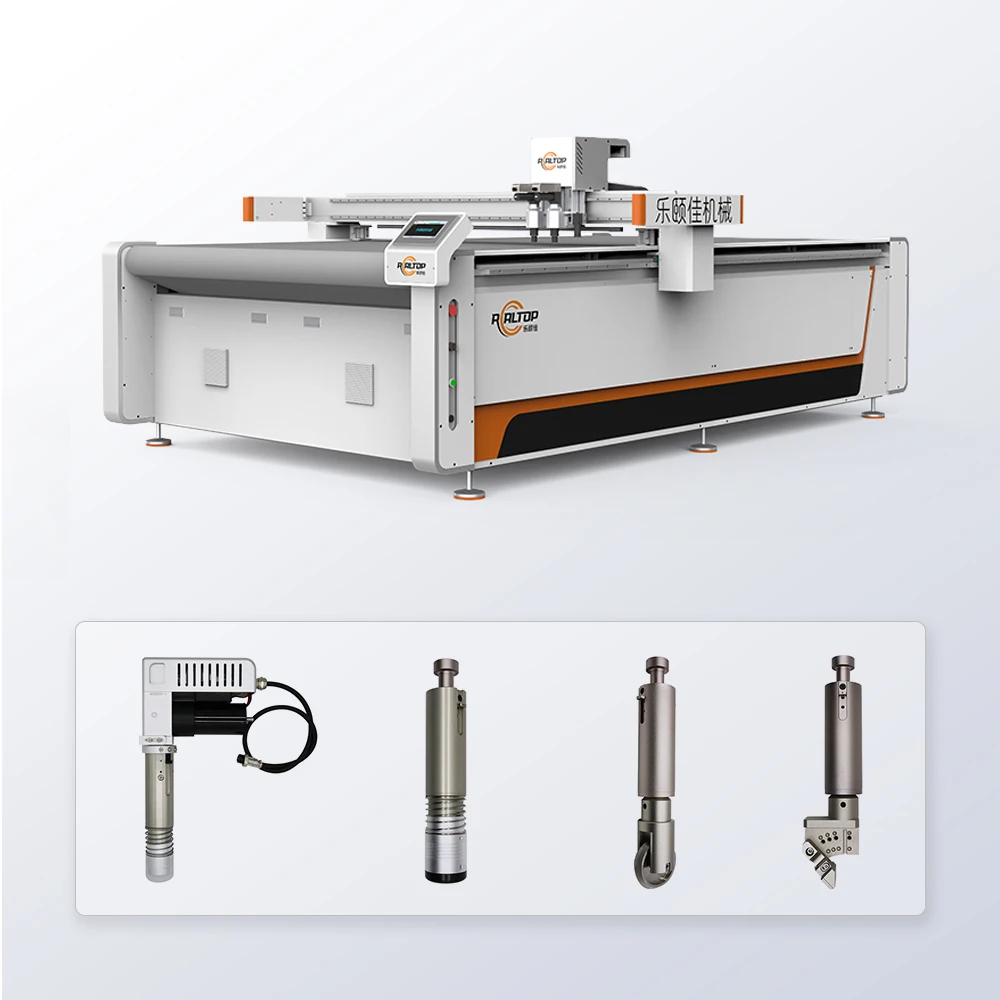
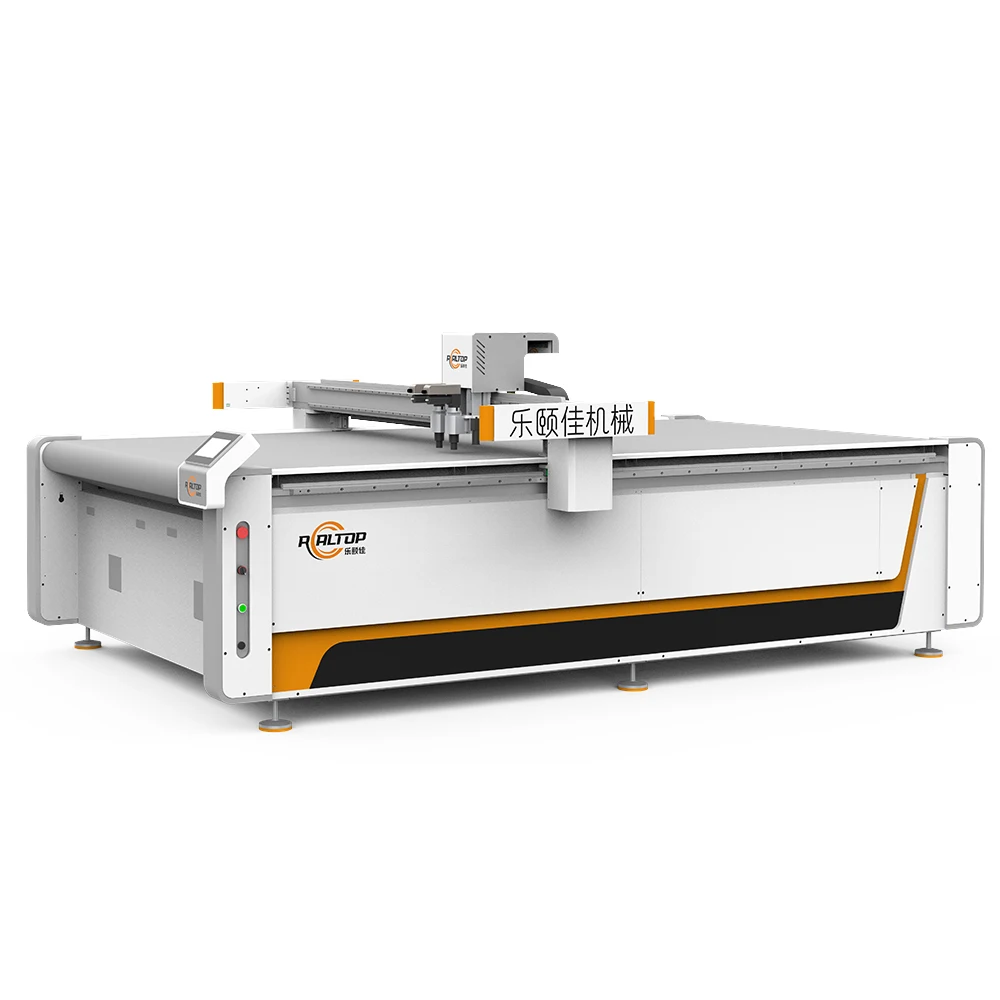
Complete Catalogue Range — The REALTOP RT-D2516 and RT-S2516 flatbed cutting systems cover oscillating knife, drag knife, creasing wheel and CCD positioning options mapped to packaging, signage and flexible material workflows, so buyers can survey the full configuration range before committing to a specific setup.
Technical Specifications
| Parameter | Value |
|---|---|
| Model | RT-D2516 / RT-S2516 |
| Product Type | CNC Flatbed Digital Cutting Machine |
| Working Area | 1600 × 2500 mm |
| Overall Dimensions (L×W×H) | 3450 × 2300 × 1250 mm |
| Rated Power | 9 kW |
| Voltage | 380V ±10% |
| Cutting Thickness | ≤100 mm (varies with material; basis to be confirmed) |
| Repeatability | ≤0.1 mm |
| Translational Velocity | 800–2000 mm/s |
| Transmission System | Digital servo motor, linear guide, synchronous belt, ball screw |
| Servo Motor Option | Delta (Taiwan) or Panasonic (Japan) |
| Control Panel | Touch screen with multi-language support (English, Russian, Italian, Chinese, custom) |
| Instruction System | HP-GL compatible format |
| Software & File Formats | Auto nesting and typesetting; supports PLT, DXF, AI |
| Tool Head Options | Swiss imported oscillating knife, pneumatic knife, high-power vibrating knife, circular knife, V-cutting knife, drag knife, creasing wheel, dotted line knife, punching tool, brush |
| Visual Positioning Options | Small CCD camera mark point, panoramic camera recognition, projection positioning |
| Vacuum Table | Magnesium-aluminum alloy with fluorocarbon PVDF powder spraying, anodic and hard oxidation treatment; integrated or split air box |
| Vacuum Pump | 7.5 kW, aviation aluminum shell, built-in silencer sponge |
| Safety Devices | Infrared induction blocking, anti-collision sensors on both sides of beam, emergency stop button |
| Fixed Model Options | Flat working table or auto feeding table |
| Key Features | Germany imported conveyor belt, Taiwan Hiwin rail, CE declaration where applicable |
Application Suitability
| Application | Material or Output |
|---|---|
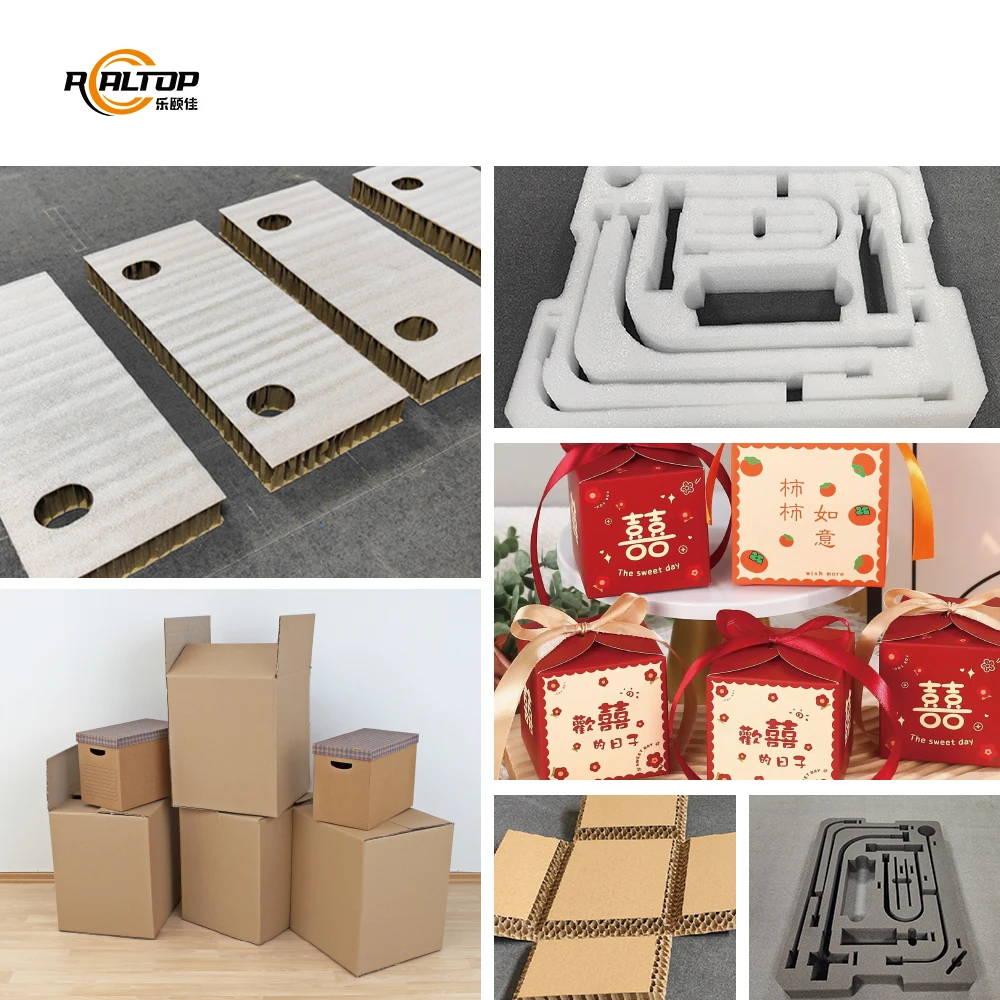
| Carton and packaging sample making | Corrugated cardboard, honeycomb cardboard, paper board with creasing wheel and V-cutting knife |
| Advertising and signage production | PVC sheet, vinyl, sticker, film with drag knife or oscillating knife |
| Garment and footwear cutting | Fabric, textile, leather, sponge composite materials in single or multi-layer layups |
| Automotive interior components | Gasket material, composite leather, foam board, carpet and floor mat stock |
| Composite and foam fabrication | Carbon fiber prepreg, fiberglass, EVA, XPE, EPTFE sheets |
| Industrial sealing and gaskets | Rubber, silicone, PTFE, ETFE and soft glass sheet |
Why the Wrong Tool Head Costs More Than the Machine Itself
A CNC flatbed cutting machine manufacturer quoting only working area and travel speed leaves the buyer guessing which tool head actually suits their material — and that mismatch shows up on the shop floor as ragged edges, crushed foam cores or incomplete crease lines on corrugated board.
The tool head must match the material, not the other way around.
I once worked with a packaging sample shop that ran everything on a single oscillating knife. Honeycomb board came out with delaminated edges, and their crease lines on 350 gsm card stock cracked during folding. They thought the machine was underpowered. The real issue was that no creasing wheel or V-cutting knife had been specified in the original order. Switching tool heads per job changed the output entirely [NEED_CITE: tool head selection criteria for corrugated and composite materials].
Tool Head Selection Across the REALTOP Range
The RT-D2516 and RT-S2516 support ten distinct tool head options, from Swiss imported oscillating knives for dense foam and composite panels to creasing wheels for folding carton sample work. Drag knives handle thin vinyl and sticker films without the vibration that causes edge chatter on flexible substrates. The punch tool and dotted line knife cover perforation and tear-line tasks that packaging proofing departments run daily.
Choosing the right tool head is the single largest variable in edge quality and throughput. A CNC flatbed cutting machine manufacturer that ships every unit with one oscillating knife forces the operator to compromise on half the materials they cut.
Vacuum Table Flatness and Zoning for Small Parts
The magnesium-aluminum alloy vacuum table on these models uses fluorocarbon PVDF powder spraying combined with anodic and hard oxidation treatment. This combination maintains flatness under repeated blade pressure and resists scoring marks that degrade suction over time. The integrated or split air box design lets the operator zone vacuum to the active cutting area, which matters when small gasket parts or nested carton blanks would otherwise lift at the edges during high-speed passes [NEED_CITE: vacuum adsorption flatness standards for digital cutting tables].
Reading the Specs That Actually Matter
The 1600 × 2500 mm working area accommodates full-size corrugated sheets and standard fabric rolls without re-positioning, which directly affects nesting yield on multi-layer fabric cutting. Translational velocity of 800–2000 mm/s is a travel speed, not a cutting speed — actual cutting velocity depends on material density, thickness and the chosen tool head. The ≤0.1 mm repeatability figure matters most on multi-pass creasing and perforation work where the tool must return to the same coordinate across hundreds of cycles. Servo motor selection between Delta and Panasonic affects long-term positioning consistency rather than peak speed.
What Happens When Voltage and Software Get Skipped
Buyers who confirm working area and skip the voltage and software conversation often discover problems after the crate arrives. A 380V machine wired for a 220V shop requires a transformer that adds cost and heat. Control panel language set to Chinese when the operator reads Russian means every parameter adjustment goes through translation. Software that does not accept the buyer’s existing PLT or DXF nesting files forces a complete workflow rebuild. These are not warranty issues — they are specification gaps that could have been closed before the order was placed [NEED_CITE: industrial equipment voltage and frequency compatibility standards by export market].
Why Buyers Source the Full Range Here
In-house design and production covering both knife cutting configurations means the RT-D2516 and RT-S2516 are built around material requirements rather than adapted from a single standard build. Tool head and table configuration are specified per material type and production volume, not selected from a fixed menu. CCD camera positioning and projection alignment options are confirmed against the buyer’s printed mark style before the order goes to production. Software compatibility with PLT, DXF and AI formats is verified with the buyer’s actual nesting files. Sample cutting on the buyer’s own material with a written report is offered before commitment, so the cutting result is documented rather than promised.
Documentation & Verification
- Machine specification sheet listing the exact tool head and vacuum table configuration for your material
- Electrical schematic and voltage confirmation matching your facility supply before production starts
- Tool head and table configuration list mapped to your cutting thickness and material type
- Sample cutting report on your own corrugated board, foam or fabric with edge quality photographs
- Software licence and file format compatibility note covering PLT, DXF and AI imports
- Factory test record showing repeatability measurement and vacuum pressure at your specified table zone
Installation, Commissioning & Support
- Requires a level concrete floor supporting the 3450 × 2300 mm footprint and 9 kW total power draw
- Dedicated 380V ±10% circuit with confirmed plug type before the machine leaves the factory
- Flat working table or auto feeding table configuration assembled and leveled on-site during commissioning
- First-run parameter setting includes vacuum zoning adjustment and tool head offset calibration for your material
- Touch screen control language set to operator preference — English, Russian, Italian, Chinese or custom
- Spare parts list covering oscillating knife blades, drag knife tips and vacuum pump filter elements
What to Prepare Before Requesting a Quote
Send the material type, thickness range and maximum sheet size you process daily. Confirm your facility voltage, frequency and the control language your operators need. If you run printed contour cutting, share the mark style and file format so the CCD or projection positioning option can be matched before the build starts.
Frequently Asked Questions
Q: How do I choose between oscillating knife, drag knife and creasing wheel for my material?
A: Oscillating knives handle thick foam, gasket and composite materials where blade vibration prevents drag. Drag knives suit thin vinyl, sticker and film where a clean pull-cut avoids edge fraying. Creasing wheels score fold lines on corrugated and paper board without cutting through. The correct choice depends on your material type, thickness and whether the cut is a profile, a score or a perforation.
Q: What working area size fits my sheet dimensions and nesting needs?
A: The 1600 × 2500 mm table on the RT-D2516 and RT-S2516 covers standard full-size corrugated sheets and fabric roll widths. Nesting software calculates material yield from your actual PLT or DXF files, so the usable area depends on part geometry and grain direction requirements rather than the table dimensions alone.
Q: Which visual positioning option suits printed contour cutting?
A: Small CCD camera mark point positioning works for jobs with consistent registration marks. Panoramic camera recognition handles large-format printed graphics with multiple reference points. Projection positioning overlays the cut path onto the material surface for manual alignment. The right option depends on your print registration style and production speed.
Q: Can the software integrate with my existing nesting workflow?
A: The control system accepts PLT, DXF and AI file formats and includes auto nesting and typesetting functions. Before the order is confirmed, your existing design files are tested for import compatibility so there are no format surprises when the machine arrives on your floor.
Complete Catalogue Range — The REALTOP RT-D2516 and RT-S2516 flatbed cutting systems cover oscillating knife, drag knife, creasing wheel and CCD positioning options mapped to packaging, signage and flexible material workflows, so buyers can survey the full configuration range before committing to a specific setup.
Technical Specifications
| Parameter | Value |
|---|---|
| Model | RT-D2516 / RT-S2516 |
| Product Type | CNC Flatbed Digital Cutting Machine |
| Working Area | 1600 × 2500 mm |
| Overall Dimensions (L×W×H) | 3450 × 2300 × 1250 mm |
| Rated Power | 9 kW |
| Voltage | 380V ±10% |
| Cutting Thickness | ≤100 mm (varies with material; basis to be confirmed) |
| Repeatability | ≤0.1 mm |
| Translational Velocity | 800–2000 mm/s |
| Transmission System | Digital servo motor, linear guide, synchronous belt, ball screw |
| Servo Motor Option | Delta (Taiwan) or Panasonic (Japan) |
| Control Panel | Touch screen with multi-language support (English, Russian, Italian, Chinese, custom) |
| Instruction System | HP-GL compatible format |
| Software & File Formats | Auto nesting and typesetting; supports PLT, DXF, AI |
| Tool Head Options | Swiss imported oscillating knife, pneumatic knife, high-power vibrating knife, circular knife, V-cutting knife, drag knife, creasing wheel, dotted line knife, punching tool, brush |
| Visual Positioning Options | Small CCD camera mark point, panoramic camera recognition, projection positioning |
| Vacuum Table | Magnesium-aluminum alloy with fluorocarbon PVDF powder spraying, anodic and hard oxidation treatment; integrated or split air box |
| Vacuum Pump | 7.5 kW, aviation aluminum shell, built-in silencer sponge |
| Safety Devices | Infrared induction blocking, anti-collision sensors on both sides of beam, emergency stop button |
| Fixed Model Options | Flat working table or auto feeding table |
| Key Features | Germany imported conveyor belt, Taiwan Hiwin rail, CE declaration where applicable |
Application Suitability
| Application | Material or Output |
|---|---|
| Carton and packaging sample making | Corrugated cardboard, honeycomb cardboard, paper board with creasing wheel and V-cutting knife |
| Advertising and signage production | PVC sheet, vinyl, sticker, film with drag knife or oscillating knife |
| Garment and footwear cutting | Fabric, textile, leather, sponge composite materials in single or multi-layer layups |
| Automotive interior components | Gasket material, composite leather, foam board, carpet and floor mat stock |
| Composite and foam fabrication | Carbon fiber prepreg, fiberglass, EVA, XPE, EPTFE sheets |
| Industrial sealing and gaskets | Rubber, silicone, PTFE, ETFE and soft glass sheet |
Why the Wrong Tool Head Costs More Than the Machine Itself
A CNC flatbed cutting machine manufacturer quoting only working area and travel speed leaves the buyer guessing which tool head actually suits their material — and that mismatch shows up on the shop floor as ragged edges, crushed foam cores or incomplete crease lines on corrugated board.
The tool head must match the material, not the other way around.
I once worked with a packaging sample shop that ran everything on a single oscillating knife. Honeycomb board came out with delaminated edges, and their crease lines on 350 gsm card stock cracked during folding. They thought the machine was underpowered. The real issue was that no creasing wheel or V-cutting knife had been specified in the original order. Switching tool heads per job changed the output entirely [NEED_CITE: tool head selection criteria for corrugated and composite materials].
Tool Head Selection Across the REALTOP Range
The RT-D2516 and RT-S2516 support ten distinct tool head options, from Swiss imported oscillating knives for dense foam and composite panels to creasing wheels for folding carton sample work. Drag knives handle thin vinyl and sticker films without the vibration that causes edge chatter on flexible substrates. The punch tool and dotted line knife cover perforation and tear-line tasks that packaging proofing departments run daily.
Choosing the right tool head is the single largest variable in edge quality and throughput. A CNC flatbed cutting machine manufacturer that ships every unit with one oscillating knife forces the operator to compromise on half the materials they cut.
Vacuum Table Flatness and Zoning for Small Parts
The magnesium-aluminum alloy vacuum table on these models uses fluorocarbon PVDF powder spraying combined with anodic and hard oxidation treatment. This combination maintains flatness under repeated blade pressure and resists scoring marks that degrade suction over time. The integrated or split air box design lets the operator zone vacuum to the active cutting area, which matters when small gasket parts or nested carton blanks would otherwise lift at the edges during high-speed passes [NEED_CITE: vacuum adsorption flatness standards for digital cutting tables].
Reading the Specs That Actually Matter
The 1600 × 2500 mm working area accommodates full-size corrugated sheets and standard fabric rolls without re-positioning, which directly affects nesting yield on multi-layer fabric cutting. Translational velocity of 800–2000 mm/s is a travel speed, not a cutting speed — actual cutting velocity depends on material density, thickness and the chosen tool head. The ≤0.1 mm repeatability figure matters most on multi-pass creasing and perforation work where the tool must return to the same coordinate across hundreds of cycles. Servo motor selection between Delta and Panasonic affects long-term positioning consistency rather than peak speed.
What Happens When Voltage and Software Get Skipped
Buyers who confirm working area and skip the voltage and software conversation often discover problems after the crate arrives. A 380V machine wired for a 220V shop requires a transformer that adds cost and heat. Control panel language set to Chinese when the operator reads Russian means every parameter adjustment goes through translation. Software that does not accept the buyer’s existing PLT or DXF nesting files forces a complete workflow rebuild. These are not warranty issues — they are specification gaps that could have been closed before the order was placed [NEED_CITE: industrial equipment voltage and frequency compatibility standards by export market].
Why Buyers Source the Full Range Here
In-house design and production covering both knife cutting configurations means the RT-D2516 and RT-S2516 are built around material requirements rather than adapted from a single standard build. Tool head and table configuration are specified per material type and production volume, not selected from a fixed menu. CCD camera positioning and projection alignment options are confirmed against the buyer’s printed mark style before the order goes to production. Software compatibility with PLT, DXF and AI formats is verified with the buyer’s actual nesting files. Sample cutting on the buyer’s own material with a written report is offered before commitment, so the cutting result is documented rather than promised.
Documentation & Verification
- Machine specification sheet listing the exact tool head and vacuum table configuration for your material
- Electrical schematic and voltage confirmation matching your facility supply before production starts
- Tool head and table configuration list mapped to your cutting thickness and material type
- Sample cutting report on your own corrugated board, foam or fabric with edge quality photographs
- Software licence and file format compatibility note covering PLT, DXF and AI imports
- Factory test record showing repeatability measurement and vacuum pressure at your specified table zone
Installation, Commissioning & Support
- Requires a level concrete floor supporting the 3450 × 2300 mm footprint and 9 kW total power draw
- Dedicated 380V ±10% circuit with confirmed plug type before the machine leaves the factory
- Flat working table or auto feeding table configuration assembled and leveled on-site during commissioning
- First-run parameter setting includes vacuum zoning adjustment and tool head offset calibration for your material
- Touch screen control language set to operator preference — English, Russian, Italian, Chinese or custom
- Spare parts list covering oscillating knife blades, drag knife tips and vacuum pump filter elements
What to Prepare Before Requesting a Quote
Send the material type, thickness range and maximum sheet size you process daily. Confirm your facility voltage, frequency and the control language your operators need. If you run printed contour cutting, share the mark style and file format so the CCD or projection positioning option can be matched before the build starts.
Frequently Asked Questions
Q: How do I choose between oscillating knife, drag knife and creasing wheel for my material?
A: Oscillating knives handle thick foam, gasket and composite materials where blade vibration prevents drag. Drag knives suit thin vinyl, sticker and film where a clean pull-cut avoids edge fraying. Creasing wheels score fold lines on corrugated and paper board without cutting through. The correct choice depends on your material type, thickness and whether the cut is a profile, a score or a perforation.
Q: What working area size fits my sheet dimensions and nesting needs?
A: The 1600 × 2500 mm table on the RT-D2516 and RT-S2516 covers standard full-size corrugated sheets and fabric roll widths. Nesting software calculates material yield from your actual PLT or DXF files, so the usable area depends on part geometry and grain direction requirements rather than the table dimensions alone.
Q: Which visual positioning option suits printed contour cutting?
A: Small CCD camera mark point positioning works for jobs with consistent registration marks. Panoramic camera recognition handles large-format printed graphics with multiple reference points. Projection positioning overlays the cut path onto the material surface for manual alignment. The right option depends on your print registration style and production speed.
Q: Can the software integrate with my existing nesting workflow?
A: The control system accepts PLT, DXF and AI file formats and includes auto nesting and typesetting functions. Before the order is confirmed, your existing design files are tested for import compatibility so there are no format surprises when the machine arrives on your floor.










商品评价
There are no reviews yet.