



Fast Delivery
Quick, reliable shipping to any location.

Free & easy returns
Return this item by mail or in store within 90 days for a full refund.
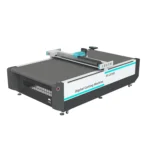
Full Catalogue Range — RT-D2516/RT-S2516 represents the mid-large format tier in a broader knife and laser cutting lineup, positioned for fabric, leather and composite processors comparing methods before committing.
Technical Specifications
| Parameter | Value |
|---|---|
| Model | RT-D2516 / RT-S2516 |
| Product Type | CNC Oscillating Knife Cutting Machine |
| Working Area | 1600 × 2500 mm |
| Machine Dimensions | 3450 × 2300 × 1250 mm |
| Rated Power | 9 kW |
| Vacuum Pump | 7.5 kW |
| Table Type | Flat vacuum table with auto-feeding conveyor |
| Tool Head | Swiss imported oscillating knife — full cut, half cut, cursor location |
| Translational Velocity | 800–1200 mm/s |
| Cutting Thickness | Up to 50 mm (varies by material density — confirm with sample) |
| Repeated Accuracy | ≤0.1 mm |
| Transmission | Digital servo motor, linear guide, synchronous belt, ball screw (imported) |
| Servo Motor | Panasonic (Delta option available) |
| Linear Rail | Taiwan Hiwin |
| Conveyor Belt | Germany imported |
| Table Surface | High-density felt |
| Bed Structure | Overall welding, milled on imported machining center |
| Instruction System | HP-GL compatible format |
| Safety Device | Infrared sensors |
| Voltage | 380V ±10% (50/60 Hz to be confirmed for target market) |
| Language Options | English, Russian, Italian, Chinese (customizable) |
| Standards | CE |
Application Suitability
| Application | Material or Output |
|---|---|
| Garment and fashion production | Single and multi-layer fabric, woven and knit textiles |
| Leather goods manufacturing | Natural and synthetic leather for bags, shoes, belts |
| Automotive interior trimming | Leather, sponge composite leather, PVC panels |
| Composite material fabrication | Sponge, foam, silicone, rubber gaskets |
| Signage and prototyping | Soft glass, PVC, flexible display substrates |
| Packaging sample making | Corrugated board, folding carton stock (with drag knife option) |
Why Working Area Alone Is Not Enough to Choose a CNC Oscillating Knife Cutting Machine
The cutting method must match the material before the table size is decided.
Too many buyers start with a working area figure and stop there. The result is a machine that fits the shop floor but fails on the material it was bought for — foam crushes under a drag knife, leather edges fray at the wrong oscillation frequency, and vacuum zones hold large sheets fine but let small pattern pieces lift during high-speed passes. I have walked through workshops where the machine sat idle because the tool head specified at order could not handle the actual material stack the production line runs daily [NEED_CITE: material and tool head mismatch as a leading cause of CNC cutting downtime]. The RT-D2516/RT-S2516 sits within a full range that includes both knife and laser systems, so the first question is always what you are cutting and how thick, not how big your sheets are.
Matching the Knife to the Material Stack
The Swiss imported oscillating knife head on the RT-D2516/RT-S2516 supports full cutting, half cutting and cursor location in a single tool station. Full cutting handles garment fabric and leather panels where through-cuts define the pattern piece. Half cutting scores PVC and composite sheets that fold into finished shapes without separating from the carrier. Cursor location anchors the cutting path to a physical reference point when printed registration marks are absent. The oscillation frequency interacts with material density — softer foams need faster strokes to avoid compression, while denser leather benefits from slower, more aggressive oscillation to keep the blade engaged through the full depth.
Continuous Feeding for Roll Goods and Long Panels
The auto-feeding conveyor paired with the 1600 × 2500 mm table allows roll-fed fabric and long leather hides to advance continuously without manual repositioning between cuts. The Germany imported belt maintains tension across the full width, which matters when cutting nested garment patterns where a lateral shift of even one millimeter wastes material across a long lay [NEED_CITE: nesting yield loss from belt drift in continuous feeding systems]. The 7.5 kW vacuum pump pulls through the high-density felt surface, and zoning across the flat table keeps suction effective whether the operator runs a full sheet or a smaller remnant.
What the Specification Sheet Actually Means for Your Production
The 9 kW rated power covers the servo drives, oscillation motor and control system — the vacuum pump runs on a separate 7.5 kW circuit, so total connected load must account for both when planning the workshop electrical supply. Panasonic servo motors paired with Taiwan Hiwin linear rails deliver the ≤0.1 mm repeated accuracy needed for garment grading where pattern pieces differ by only a few millimeters between sizes. The 800–1200 mm/s translational velocity range lets the operator slow down for tight curves on leather shoe uppers and speed up for long straight cuts on automotive door panel blanks. HP-GL compatibility means most existing nesting software can output cutting paths directly without a translation step that introduces errors.
The Cost of Skipping the Sample Cut
When a buyer specifies a machine on working area and price without testing their actual material, the problems surface after installation. A foam gasket producer may find the oscillating knife crushes the top layer before cutting through the bottom because the tool head pressure was set for a different density. A garment factory running multi-layer fabric lay-ups may discover the vacuum zoning holds the top layers but the bottom fabric shifts during the cut, ruining an entire lay [NEED_CITE: vacuum zoning requirements for multi-layer fabric cutting]. These are not machine defects — they are configuration mismatches that a sample cutting test on the buyer’s own material would have caught before the order shipped.
Why Buyers Source the Full Range Here
In-house design and production across both knife and laser cutting platforms means a buyer comparing methods gets a direct recommendation rather than a forced fit into whatever technology a single-method supplier sells. Tool head and table configuration are specified per material and production volume, so the RT-D2516/RT-S2516 is quoted with the oscillation frequency, knife type and vacuum zoning matched to the buyer’s documented material list. CCD camera positioning is available on models within the range for printed contour work, and the capability difference between models is stated clearly rather than promised generically. Software compatibility and file format import are confirmed before the order goes to production. Voltage, plug type and control language are locked in with a written confirmation sheet so there are no surprises when the crate arrives at the destination port [NEED_CITE: voltage and plug configuration standards for industrial machinery imports].
Documentation & Verification
- Machine specification sheet listing tool head, vacuum zoning and conveyor configuration matched to your material
- Electrical schematic with voltage and frequency confirmed for your local supply before production begins
- Sample cutting report on your own fabric or leather with edge quality photographs and dimensional check
- Factory test record showing repeated accuracy runs and vacuum pressure readings at each table zone
- Software licence and file format compatibility note confirming your nesting software output works with the HP-GL input
- Spare parts list with part numbers for blades, felt segments, belt sections and vacuum pump consumables
Installation, Commissioning & Support
- The 3450 × 2300 mm footprint and 9 kW total load require a dedicated 380V circuit with correct breaker sizing
- Machine ships fully assembled — confirm crane access and door clearance for the 3450 mm length at your facility
- First-run commissioning includes vacuum zoning calibration across the 1600 × 2500 mm table with your material loaded
- Operator training covers knife depth and oscillation settings for each material type in your production mix
- High-flexibility cables and fixed control box reduce cable wear during daily operation at full table travel
- Spare blade and felt inventory sized to your weekly cutting volume and shipped with the initial order
Before You Request a Quote
To recommend the correct configuration from the range, we need your material type and thickness, the maximum sheet or roll width you process, and your daily cutting volume. If your facility runs on a specific voltage or frequency, state that upfront along with your preferred control language. Buyers with existing nesting software should share a sample output file so compatibility is verified before the machine is built.
Frequently Asked Questions
Q: How do I decide between an oscillating knife and a laser for my material?
A: Knife cutting suits thicker, layered and fibrous materials like fabric stacks, leather and foam where a laser would seal or burn the edge. Laser suits thinner synthetics, acrylic and engraved substrates where edge sealing is an advantage. The full range covers both, so the recommendation depends on your material type, thickness and the edge finish your product requires.
Q: Which models in the range support CCD camera contour recognition?
A: CCD positioning is available on specific configurations within the catalogue, not on every model. The camera tracks printed marks to align cuts to pre-printed graphics. Tell us your print registration method, mark size and production speed so we can confirm which model supports reliable tracking at your required throughput.
Q: What voltage and language options are available for export?
A: The standard configuration runs on 380V ±10%, with 50 or 60 Hz to be confirmed for your market. Control interface languages include English, Russian, Italian and Chinese, with other languages customizable. Voltage, plug type and frequency are documented on a written confirmation sheet before production starts.
Q: Can I test my material on the machine before placing an order?
A: Yes. Send your actual fabric, leather, foam or composite material for a sample cutting test. The report includes edge quality photographs, dimensional accuracy measurements and the tool head and vacuum settings used, so you can evaluate the result before committing to a configuration.
Q: What documentation ships with the machine?
A: Every order includes the machine specification sheet, electrical schematic, tool head and table configuration list, factory test record, operation manual, software licence with file format compatibility note and a spare parts list. CE declaration is provided where applicable to your import requirements.










商品评价
There are no reviews yet.