



Fast Delivery
Quick, reliable shipping to any location.

Free & easy returns
Return this item by mail or in store within 90 days for a full refund.
Tool Head Matching Before Machine Commitment — Our configuration process starts with your material type, thickness, and daily volume to determine whether oscillating knife, drag knife, or other tooling produces the edge quality your product requires.
Technical Specifications
| Parameter | Value |
|---|---|
| Model | RT-D2516/RT-S2516 |
| Product Type | CNC Oscillating Knife Cutting Machine |
| Working Area | 1600×2500 mm |
| Machine Size | 3450×2300×1250 mm |
| Rated Power | 9 kW |
| Translational Velocity | 800-1200 mm/s |
| Cutting Thickness | 20-80 mm depending on material (basis not stated in source) |
| Repeated Accuracy | ≤0.1 mm |
| Transmission System | Digital servo motor, linear guide, synchronous belt, ball screw |
| Multifunctional Head | Swiss imported knife with vibration full cutting, vibration half cutting, and cursor location |
| Safety Device | Infrared sensors |
| Fixed Model | Flat working table with vacuum |
| Vacuum Pump | 7.5 kW |
| Voltage | 380V±10% |
| Other Configuration | Delta servo motor, Germany imported conveyor belt, auto feeding, Taiwan Hiwin rail |
| Instruction System | HP-GL compatible format |
Application Suitability
| Application | Material or Output |
|---|---|
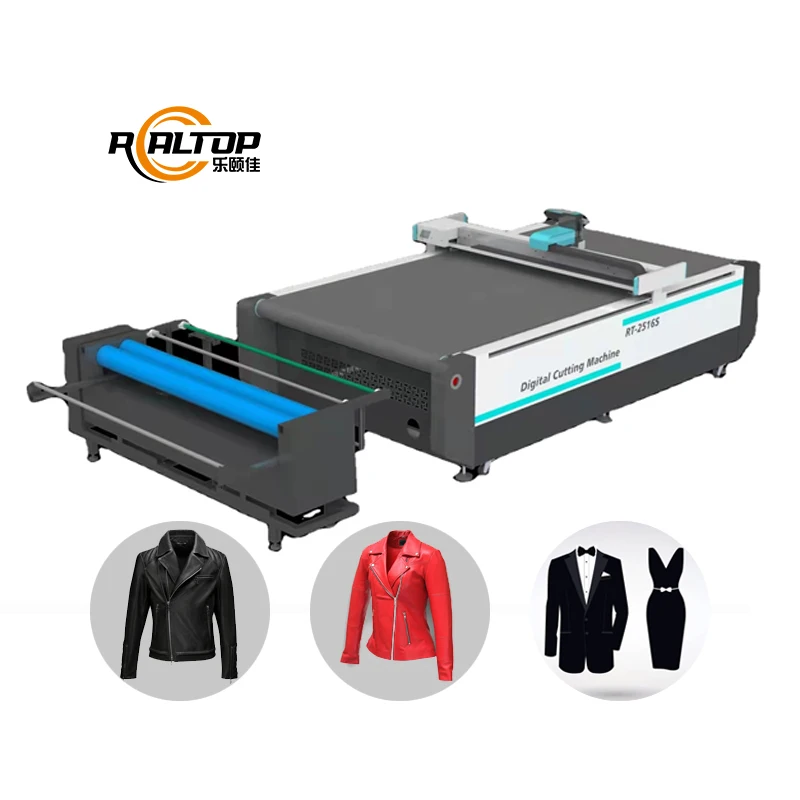
| Soft home furnishings and upholstery | Multi-layer fabric stacks and composite textiles |
| Automotive interiors and sealing pads | Sponge composite leather, rubber, and gasket materials |
| Footwear and bags | Leather and flexible synthetic sheets |
| Carpets and floor mats | Thick pile materials and foam composites |
| Graphic advertising and printing | PVC, soft glass, and vinyl media |
| Packaging and carton sampling | Corrugated and folding carton materials |
| Sports and outdoor products | Technical textiles and coated fabrics |
When "Working Area" Becomes the Wrong Starting Point
A machine specified on working area alone often arrives at the factory unable to handle the material thickness the buyer actually runs daily. The RT-D2516/RT-S2516 CNC oscillating knife cutting machine manufacturer approach begins with material behavior under the blade, not just table dimensions.
I once watched a garment factory accept delivery of a flatbed cutter that could span their largest pattern pieces but stalled on 12-layer denim stacks. The vacuum table lacked zoning, so smaller pattern pieces lifted during oscillating passes. The machine was dimensionally correct and functionally wrong. [NEED_CITE: vacuum table zoning requirements for multi-layer textile cutting]
Knife Frequency and Material Response
The Swiss-imported multifunctional head on this platform delivers vibration full cutting and half cutting modes. Oscillation frequency determines whether the blade slices cleanly through compressed foam or tears the cellular structure. Dense materials like rubber gaskets require higher frequency with shorter stroke, while open-cell foams need lower frequency to avoid crushing the material ahead of the blade. This CNC oscillating knife cutting machine manufacturer configures the head parameters based on sample cuts performed on your actual stock before the order is finalized.
Vacuum Hold-Down Across the Bed Surface
A 7.5 kW vacuum pump paired with a zoned table surface addresses the small-parts problem that plagues garment and footwear cutting. When cutting shoe uppers or collar pieces, the material around each nested part gets removed progressively, leaving isolated islands that lose suction if the entire table pulls from one plenum. Zoning allows the operator to activate only the sections where cutting is happening. [NEED_CITE: vacuum zoning effects on small part registration in digital cutting]
Servo Precision and Nesting Yield
The Delta servo motors driving the transmission system through Taiwan Hiwin rails maintain repeated accuracy within 0.1 mm across the full 1600×2500 mm working envelope. This precision matters when nesting software places pattern pieces with minimal kerf allowance to maximize material yield. Any positional drift accumulates across a long cutting run, pushing later pieces outside tolerance and generating waste that erodes the margin the nesting software was supposed to protect.
The Wrong Tool Head Produces Evidence the Buyer Cannot Hide
Selecting a drag knife for materials that require oscillating action produces ragged edges that downstream sewing operations cannot conceal. Foam cuts made with insufficient stroke length leave compressed ridges instead of clean faces. These defects show up immediately in assembly, and the cost of re-cutting pieces destroys whatever throughput advantage the machine was supposed to deliver. [NEED_CITE: tool head selection criteria by material type and thickness]
Why Source This Platform Through Our Configuration Process
In-house design covering both knife and laser technologies means we recommend the cutting method that suits your material rather than pushing one platform onto every application. Tool head and table configuration get specified per material and production volume before quotation. CCD camera positioning systems integrate for printed contour work when your job requires it. Software compatibility with HP-GL and nesting workflows gets confirmed before the order enters production. Sample cutting on your own material happens before commitment, not after delivery when adjustments become costly negotiations.
Documentation & Verification
- Machine specification sheet confirming tool head matched to your material thickness
- Electrical schematic with 380V±10% confirmation and frequency for your market
- Factory test record on your fabric or composite material before dispatch
- Sample cutting report documenting edge quality on your supplied stock
- Software licence and file format compatibility note for HP-GL workflows
- Operation and maintenance manual covering knife replacement intervals
Installation, Commissioning & Support
- Floor space allocation for 3450×2300 mm footprint plus operator access clearance
- Dedicated 380V±10% circuit rated for 9 kW continuous draw plus vacuum pump startup surge
- Machine arrives on flatbed with vacuum table and auto-feeding conveyor pre-assembled
- First-run parameter setting for your specific material thickness and cutting speed
- Operator training on tool head changeover between oscillating and drag knife modes
- Spare parts list including Swiss knife blades and vacuum table sealing strips
What We Need to Configure Your Machine
Send us the specific material types you cut daily, including thickness ranges and whether you process single plies or multi-layer stacks. Tell us your local voltage and frequency standards so the electrical system arrives ready to connect. If you run printed materials requiring contour recognition, share sample files so we can verify software compatibility with your existing workflow before production begins.
Frequently Asked Questions
Q: How do you determine the right tool head for my specific material and thickness?
A: We request sample material from your production floor and run test cuts using different oscillation frequencies and stroke lengths. The edge quality, compression marks, and cutting speed achievable on your actual stock determine which tool head configuration we specify. This sample cutting report ships with your machine documentation so you have a baseline for blade wear monitoring.
Q: Can I see sample cutting results on my own material before placing an order?
A: Yes, sample cutting on your supplied material happens before any order commitment. We document edge quality, achievable cutting speed, and any material-specific adjustments required. The sample report becomes part of your machine specification sheet, ensuring the configuration we quote matches what your material actually demands.
Q: What voltage, plug type, and control language options are available for my market?
A: The platform supports 380V±10% as standard with frequency confirmation for your regional grid. Plug types and control interface language get specified during the quotation phase. We provide electrical schematics confirming these choices before production starts, so there are no surprises when the machine arrives at your facility.
Q: How does the CCD camera positioning system work with printed marks at production speed?
A: The camera reads registration marks on printed material and adjusts the cutting path to compensate for stretch or skew introduced during printing. We test this on your actual printed samples to confirm the system tracks marks reliably at the translational speeds your production volume requires, documenting results before finalizing the configuration.
Q: What file formats does the software support, and can it integrate with my existing nesting workflow?
A: The instruction system accepts HP-GL compatible format as standard. We confirm compatibility with your existing nesting software and file export workflow before the order proceeds. If your current system outputs in a different format, we identify any conversion requirements and document them in the software compatibility note.










商品评价
There are no reviews yet.