



Fast Delivery
Quick, reliable shipping to any location.

Free & easy returns
Return this item by mail or in store within 90 days for a full refund.
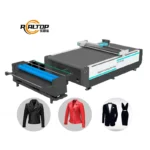
Precision tool head matching — every oscillating knife, drag knife and vacuum configuration is specified against your actual material sample before the RT-D2516/RT-S2516 leaves our Jinan workshop, so the cutting method fits the job rather than forcing a single setup.
Technical Specifications
| Parameter | Value |
|---|---|
| Model | RT-D2516 / RT-S2516 |
| Product Type | CNC Oscillating Knife Cutting Table |
| Working Area | 1600 × 2500 mm |
| Overall Dimensions | 3450 × 2300 × 1250 mm |
| Rated Power | 9 kW |
| Voltage | 380V ±10% |
| Table Type | Magnesium-aluminum alloy flat vacuum table |
| Translational Velocity | 800–1200 mm/s |
| Cutting Speed | 200–800 mm/s (basis to be confirmed with material, thickness and tool head) |
| Cutting Thickness | Up to 100 mm (varies with material density and tool selection) |
| Repeated Accuracy | ≤0.1 mm |
| Transmission System | Digital servo motor, linear guide, synchronous belt, imported ball screw |
| Rail | Taiwan Hiwin linear guide |
| Servo Motor | Delta |
| Vacuum Pump | 7.5 kW |
| Tool Head Options | Oscillating knife, pneumatic knife, high-power vibrating knife, circular knife, V-cutting knife, drag knife, creasing wheel, dotted line knife, punching, brush |
| Visual Positioning | Small CCD camera mark point positioning, panoramic camera recognition, projection positioning |
| Safety Device | Infrared sensors with auto-pause on obstacle detection |
| Instruction System | HP-GL compatible format |
| Conveyor Belt | Germany imported |
| Feeding System | Auto feeding |
Application Suitability
| Application | Material or Output |
|---|---|
| Garment and footwear cutting | Leather, fabric, textile, shoe materials, non-woven fabric |
| Automotive interior trimming | Sponge composite leather, PU, EVA, XPE, carpet, floor mats |
| Packaging and carton sample making | Corrugated cardboard, cardboard, film, sticker |
| Gasket and sealing pad production | Rubber, PTFE, ETFE, fiberglass, composite materials |
| Soft furnishing and upholstery | Cloth, sponge, foam board, PVC, soft glass, silicon |
| Graphic advertising and signage | Sticker, vinyl, PVC, PP, PE board |
Why Working Area Alone Never Tells the Whole Story
A machine specified on bed size alone, then found unable to handle your material thickness at production pace — the CNC Oscillating Knife Cutting Table for sale you evaluate must be matched on tooling, vacuum zoning and drive power before the working area matters.
Cutting capacity is a system of tool head, vacuum hold-down and servo drive, not a single dimension.
I have watched fabric shops buy a 2500 mm table because the price looked right, only to discover their multi-layer composite — the kind with a high-tack adhesive core — lifted off the vacuum bed on every inside corner. The oscillating knife dragged the top ply while the bottom shifted, and the operator spent more time re-aligning nests than cutting them. That is a vacuum zoning and tool head problem, not a bed size problem [NEED_CITE: vacuum table zoning for multi-layer flexible materials].
Matching the Knife Type to the Material Stack
The tool head list on this CNC Oscillating Knife Cutting Table for sale is long for a reason. An oscillating knife handles thick sponge and composite gasket stock by vibrating through the material in short strokes, while a drag knife suits thinner vinyl and sticker films where a clean drag produces a sealed edge. A circular knife is reserved for long straight runs on woven fabric where continuous rotation outpaces reciprocating cuts. Picking the wrong one means ragged edges on foam or melted film on vinyl, and neither fault shows up until the first full shift is underway.
Vacuum Zoning and What Happens When It Is Wrong
The 7.5 kW vacuum pump pulls air through the magnesium-aluminum alloy table in zones. Small parts — shoe upper pieces, gasket blanks, packaging corner samples — need tight zoning so suction concentrates under each nested shape. Without it, the oscillating knife lifts the material on the upstroke and the servo reads that lift as a position error. The result is a machine that technically holds 0.1 mm repeatability on paper but delivers mis-cut contours on the shop floor [NEED_CITE: vacuum hold-down requirements for small-part nesting on flatbed cutters].
Reading the Specs That Actually Matter
Translational velocity at 1200 mm/s sounds fast, but it is the unloaded travel speed between cuts. The cutting speed range of 200–800 mm/s is what governs output, and that range shifts depending on whether the Swiss imported oscillating knife is running through 2 mm leather or 30 mm EVA foam. The Delta servo motor and Taiwan Hiwin rail keep the carriage on track across the 1600 × 2500 mm envelope, but the real accuracy test is a repeated contour cut on your own printed material using the CCD mark point or panoramic camera recognition.
The Cost of Skipping the Material Trial
A buyer once sent us a spec sheet asking only for a 1600 × 2500 mm bed and a conveyor. We ran his automotive floor mat composite — a three-layer laminate with a high-glue core — and the standard oscillating knife wore out mid-sheet. Switching to the high-power vibrating knife with a reinforced blade and tightening the vacuum zone map solved it, but only because the trial happened before the machine shipped. Without that step, the machine would have arrived configured for a material it was never asked to cut [NEED_CITE: tool wear patterns on adhesive-heavy composite materials].
What We Build In Before the Crate Goes Shut
The RT-D2516/RT-S2516 is assembled around a core factory line in Jinan, Shandong, where both knife and laser cutting platforms are designed under one roof. That matters here because a buyer cutting acrylic signs alongside fabric upholstery can compare methods honestly instead of being steered toward whichever machine the salesperson prefers. Voltage, plug type and control language are confirmed against the destination market before the electrical cabinet is wired. The HP-GL instruction system is checked against the buyer’s existing nesting software so file format surprises do not surface at commissioning.
Documentation & Verification
- Machine specification sheet listing tool head and vacuum zone configuration per material
- Sample cutting report run on buyer-supplied material with measured edge quality
- Electrical schematic with confirmed voltage and frequency for target market
- Software licence and HP-GL file format compatibility note included before dispatch
- Factory test record with repeated accuracy measurement on buyer’s contour file
- Spare parts list matched to selected knife type and blade specification
Installation, Commissioning & Support
- Dedicated 380V ±10% circuit required to support the 9 kW rated load plus 7.5 kW vacuum pump
- Flat concrete floor with level tolerance to suit the 3450 × 2300 mm machine footprint
- Vacuum table zones configured and tested against buyer’s part nesting layout at commissioning
- Delta servo parameters tuned on-site for the confirmed material thickness range
- Tool head changeover training covering oscillating, drag and circular knife blade replacement
- Operator language set in the control interface before handover
What We Need From You Before Quoting
Send the material type, maximum thickness and the sheet or roll dimensions you run today. If your workflow already uses a nesting software, share a sample HP-GL or DXF file so we can verify format compatibility before anything else. Let us know your local voltage and frequency, and whether the control panel needs to run in a specific language. We will cut samples on your actual material and return them with a configuration recommendation — no commitment until you see your own stock come off the table clean.
Frequently Asked Questions
Q: How do I choose between oscillating knife, drag knife and circular knife for my materials?
A: Oscillating knife suits thick, compressible stock like foam, sponge and gasket material where a vibrating blade prevents edge crush. Drag knife works on thin films, vinyl and sticker where a continuous drag seals the edge. Circular knife handles long straight cuts on woven fabric at higher travel speed. We run your material on each head before recommending one.
Q: What working area and tool head combinations does the range cover?
A: The RT-D2516/RT-S2516 offers a 1600 × 2500 mm bed with auto feeding and a conveyor belt option. Tool heads are selectable from ten types including oscillating, pneumatic, V-cutting and punching. Larger and smaller working areas are available across the range, and multiple heads can be specified on a single carriage.
Q: How does CCD mark point positioning compare to panoramic camera recognition?
A: CCD mark point positioning reads printed registration marks on each sheet for contour cutting of pre-printed graphics. Panoramic camera recognition scans the entire sheet to locate multiple shapes regardless of mark placement. The choice depends on whether your print workflow places marks consistently or relies on edge detection.
Q: What vacuum zoning options are available for cutting small parts?
A: The magnesium-aluminum alloy table is divided into zones that can be opened or closed to concentrate suction under small nested shapes. This prevents material lift when the oscillating knife exits a cut. Zone layout is configured during commissioning based on your typical nesting pattern.
Q: Which file formats work with the nesting and layout workflow?
A: The instruction system accepts HP-GL compatible format. We verify compatibility with your existing nesting software before the order is finalized and document the confirmed file format in the software licence note shipped with the machine.










商品评价
There are no reviews yet.