


Fast Delivery
Quick, reliable shipping to any location.

Free & easy returns
Return this item by mail or in store within 90 days for a full refund.
Cutting method matched to material — we test your actual substrate on the RTT6080 or RTT6080 Pro before finalizing tool head and vacuum configuration, so the edge quality you see in the sample is what you get in production.
Technical Specifications
| Parameter | Value |
|---|---|
| Model | RTT6080 / RTT6080 Pro |
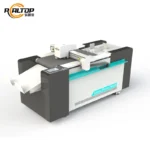
| Product Type | CNC Digital Cutting Machine |
| Max Working Area | 600 mm × 800 mm |
| Cutting Thickness | ≤ 2 mm (RTT6080); ≤ 5 mm (RTT6080 Pro) (basis not stated in source — confirm material type) |
| Tools Group | Cutting tool, kiss cutting tool, creasing tool, CCD camera; high speed oscillating knife (Pro model) |
| Max Cutting Speed | 1500 mm/s (according to the material) (basis not stated in source — confirm material type / thickness) |
| Positioning Accuracy | 0.05 mm |
| File Format Compatibility | DXF, PLT, PDF, AI |
| Transfer Method | Ethernet port |
| Rated Power | 3.2 kW |
| Voltage | 220 V / 380 V, 50 Hz |
Application Suitability
| Application | Material or Output |
|---|---|
| Photo puzzle and game board cutting | Printed cardboard and laminated chipboard with CCD contour registration |
| Packaging and carton sample making | Corrugated board, folding carton and greyboard up to configured thickness |
| Signage and display production | Self-adhesive vinyl, magnetic sheet, thin foam board and PP hollow sheet |
| Gasket and thin composite cutting | Non-asbestos fiber, cork-rubber and PTFE sheet within thickness limits |
Why "Max Working Area" Is Only the First Question for a CNC Digital Cutting Machine Manufacturer
A table size tells you what fits on the bed; it does not tell you what the knife can actually cut cleanly.
Buyers often shortlist a CNC digital cutting machine manufacturer based on the 600 × 800 mm envelope and then discover, after the machine arrives, that their 3 mm greyboard crushes under the drag knife or that the oscillating blade leaves a burr on their foam laminate. The mismatch is rarely visible in a brochure. It only shows up when your material is on the table and the clock is running [NEED_CITE: material-specific cutting tool selection for digital flatbed systems].
Matching the Tool Head to the Substrate, Not the Other Way Around
The RTT6080 series offers a modular tool group — cutting, kiss cutting, creasing, and CCD camera — while the Pro variant adds a high speed oscillating knife. This matters because a drag knife that works on 1 mm vinyl will fold or tear at 4 mm foam, and an oscillating blade set too aggressively will leave witness marks on thin magnetic sheet. Selecting the right CNC digital cutting machine manufacturer means confirming which tool head engages your specific material before the order is placed, not after.
CCD Contour Recognition at Actual Production Pace
Printed puzzle boards and game components shift slightly during lamination and printing, so the registration marks are never in exactly the same place twice. The CCD camera on this series reads those marks and adjusts the cut path on the fly [NEED_CITE: CCD camera contour recognition accuracy on printed substrates]. The real test is whether the system maintains 0.05 mm positioning accuracy when the sheet is moving through a full production run, not just on a single sample laid flat by hand.
Reading the Spec Sheet Against Your Own Workflow
The 3.2 kW rated power and 220 V / 380 V dual-voltage supply determine which workshop electrical circuits need upgrading before installation. The Ethernet transfer port and DXF / PLT / PDF / AI compatibility define how your existing prepress or nesting files reach the machine. If your design team works in Adobe Illustrator and exports PLT for nesting, confirming that import path avoids a bottleneck the day the crate is opened. The ≤ 2 mm cutting depth on the standard RTT6080 and ≤ 5 mm on the RTT6080 Pro (basis to be confirmed) should be validated against your thickest daily material, not your average one.
What Happens When the Wrong Configuration Ships
A creasing wheel specified for 300 gsm carton will score too shallow on 450 gsm board, producing cracked folds that your customer rejects. A vacuum table without adequate zoning for small puzzle pieces allows lift at the trailing edge, shifting the part mid-cut and scrapping the sheet. These are not warranty claims; they are production losses that accumulate quietly [NEED_CITE: vacuum table zoning requirements for small-part digital cutting]. Sending your actual material for a sample cut before the purchase order removes most of this risk.
Why Production Teams Source This Series Here
The design team and core factory cover both knife and CCD-based cutting under one roof, so configuration changes do not require cross-vendor coordination. Every RTT6080 or RTT6080 Pro is built with tool head and table setup specified per the buyer’s material sample report. Software file format compatibility is confirmed in writing before production starts. Voltage, plug type, and control panel language are locked in on the electrical schematic before the machine leaves the floor [NEED_CITE: CE machinery directive requirements for industrial export equipment]. Buyers can request a sample cutting report on their own substrate before committing to a production order.
Documentation & Verification
- Machine specification sheet listing confirmed tool head and vacuum zone layout for your material
- Electrical schematic with voltage and frequency matched to your facility before dispatch
- Sample cutting report on your actual substrate showing edge quality and cycle time
- Software licence and file format compatibility note covering your DXF or AI nesting workflow
- Factory test record documenting positioning accuracy across the full 600 × 800 mm working area
Installation, Commissioning & Support
- 3.2 kW rated power requires a dedicated circuit with confirmed 220 V or 380 V supply at your site
- Ethernet port setup verified during commissioning for stable file transfer from your prepress station
- First-run parameter tuning on your material thickness to set knife pressure and oscillating frequency
- Operator training covering CCD mark calibration, tool change procedure, and daily vacuum table cleaning
- Spare parts list covering oscillating knife blades, creasing wheels, and CCD replacement lamp
What We Need to Quote the Right Configuration
Send us the material type, exact thickness range, and maximum sheet size you run daily, along with your target output volume and the file formats your design team currently exports. If your facility runs a specific voltage or your operators need a particular control language, include that in the first inquiry so the electrical schematic and software note are prepared before production begins.
Frequently Asked Questions
Q: How do I decide between the standard RTT6080 and the Pro model for my material?
A: The standard model handles up to 2 mm while the Pro reaches 5 mm, but the real deciding factor is material density and whether you need the high speed oscillating knife for fibrous or layered substrates. Send your thickest daily material for a sample cut so the cutting report shows actual edge quality at your target thickness.
Q: Will the CCD camera track my printed registration marks during a full production run?
A: The camera reads standard printed marks and adjusts the cut path dynamically, maintaining 0.05 mm positioning accuracy. The critical variable is mark contrast and size on your specific printed sheet, which is verified during the sample cutting stage before the machine configuration is finalized.
Q: Which tool head gives the cleanest edge on my substrate?
A: It depends entirely on the material. A drag knife suits thin vinyl and film, the oscillating knife handles foam and laminated board, and the creasing wheel scores carton without cutting through. The sample cutting report compares edge quality across the available tool heads on your actual material.
Q: Can the software import my existing DXF or AI nesting files directly?
A: The system accepts DXF, PLT, PDF, and AI formats. Before the order is placed, we confirm your specific file version and nesting workflow import correctly, and this compatibility is documented in the software licence note shipped with the machine.
Q: What voltage and plug options are available, and how are they confirmed?
A: The machine supports 220 V and 380 V at 50 Hz. Your facility voltage, plug type, and required control panel language are locked in on the electrical schematic before production starts, so no field rewiring or translation is needed on arrival.










商品评价
There are no reviews yet.