


Fast Delivery
Quick, reliable shipping to any location.

Free & easy returns
Return this item by mail or in store within 90 days for a full refund.
Tool Head Matching by Material — Seven interchangeable cutting tools available for the 1625 allow buyers to specify oscillating knife, driven rotary, or pneumatic options based on actual fabric density and coating hardness rather than guessing from a catalogue.
Technical Specifications
| Parameter | Value |
|---|---|
| Product Type | CNC Oscillating Knife Cutting Machine |
| Model | 1625 |
| Working Area | 1600×2500 mm |
| Tools Available | Oscillating knife, Driven rotary knife, Creasing wheel, Kiss cutting tool, Pneumatic knife, Milling tool, V groove knife |
| Applicable Materials | Fabric, Cardboard, Carton, Mats, PVC, EVA, Leather, Acrylic, Foam, PTFE, Rubber |
| Cutting Speed | 0–2000 mm/s |
| Cutting Thickness | ≤30 mm (basis not stated in source — confirm material type / density / layer count) |
| Cutting Accuracy | ±0.1 mm |
| Vacuum Pump Power | 9 kW |
| Voltage Options | 110V, 220V, 380V |
| Supported File Formats | PLT, DXF, AI, PDF |
| Safety Device | Infrared sensor device and emergency stop device |
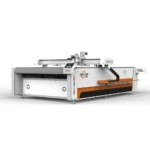
| Overall Dimensions (L×W×H) | 3300×2100×1350 mm |
| Machine Frame | Heavy-duty frame with precision-ground surface |
| Control Panel | PLC control panel with intuitive interface, optional display languages |
| Vacuum Table | Aluminum bellows vacuum table |
| Servo Motor Options | Panasonic, Delta, Dorna (source value — verify against manufacturer catalog) |
| Software | Dedicated packaging box structure design software included |
| Certification | CE |
Application Suitability
| Application | Material or Output |
|---|---|
| Inflatable boat and SUP hull panels | Drop stitch fabric with PVC coating, single and multi-layer |
| Apparel and fashion manufacturing | Suits, knitwear, lace, complex woven and technical fabrics |
| Automotive interior trimming | Seat cover fabrics, carpets, PVC floor mats |
| Home textile production | Sofa upholstery fabrics, curtains, area rugs |
| Composite material processing | Carbon fiber prepreg, aramid sheets, specialty laminates |
Why the Tool Head Choice Matters More Than the Working Area
A machine specified only on table size will produce ragged edges or crushed layers if the tool head does not match the material’s actual density and coating hardness.
I spent years on the assembly floor before moving to technical sales here in Shandong, and I have seen buyers focus on working area while leaving tool head selection as an afterthought. Last year, a customer making inflatable boats ordered a drop stitch fabric cutting machine configured for their stated sample thickness. When the real production material arrived — harder PVC coating, higher denier count — the edges came out frayed and their line stopped for two days. Since then, every order I handle starts with the buyer’s actual production material running on the machine before configuration is finalized. A CNC oscillating knife cutting machine for sale with seven tool options only delivers value when the correct tool is matched to your specific fabric construction. [NEED_CITE: drop stitch fabric construction and coating variations affecting cutting performance]
Matching Tool Head to Fabric Construction
The 1625 platform offers seven distinct tool head options, each designed for a different material behavior. Oscillating knife handles most woven and coated fabrics cleanly, while driven rotary knife suits continuous-cut applications on knits and non-wovens. Pneumatic knife is specified for dense multi-layer layups where blade deflection under load becomes a concern. Selecting the correct tool prevents edge fraying on drop stitch PVC and eliminates the need for secondary trimming downstream.
Vacuum Hold-Down for Flexible and Coated Textiles
Flexible fabrics such as drop stitch material tend to lift at the edges during high-speed cutting, especially when the vacuum zone is oversized relative to the part footprint. The aluminum bellows vacuum table on this CNC oscillating knife cutting machine for sale provides full-surface adsorption with high flatness across the 1600×2500 mm bed. Proper zoning keeps small inflatable boat panels held firmly without requiring mechanical clamping that could distort coated surfaces. [NEED_CITE: vacuum table zoning strategies for flexible textile cutting]
Reading the Specs Beyond the Headline Numbers
Cutting accuracy of ±0.1 mm means nested panels for inflatable hulls stay within tolerance for welded seam alignment, reducing rework at the bonding station. The 9 kW vacuum pump is sized to maintain suction across the full bed even when cutting multiple small parts simultaneously — undersized pumps lose hold-down on zones farthest from the manifold. PLC control with optional display languages ensures operators in different export markets can run the machine without translation errors in parameter settings. Supported file formats including DXF, PLT, AI, and PDF cover the workflows used by most garment and inflatable goods pattern makers.
What Happens When Configuration Is Skipped
Choosing a driven rotary knife for heavily coated drop stitch fabric often produces melted PVC residue on the blade and dragged edges that compromise welded seam integrity. Running thin lace on a pneumatic knife set for thick layups crushes the weave and creates irregular nesting yields. These mismatches typically surface only after the machine is installed and production begins, when changeover costs are highest. Buyers who skip the sample-cutting validation step frequently discover the problem during their first full production run. [NEED_CITE: tool head and material mismatch consequences in textile cutting operations]
Why Buyers Specify the 1625 Platform Here
In-house design and production covering both knife and laser technologies means the cutting method is matched to the material rather than forcing one approach. Tool head and table configuration is specified per material type and production volume, not selected from a fixed menu. Software compatibility with the buyer’s existing nesting workflow is confirmed before the order is placed, avoiding file format surprises at commissioning. Voltage, plug type, and control language are customized to the destination facility. Sample cutting on the buyer’s own drop stitch fabric or technical textile is performed before commitment, providing a physical edge-quality reference.
Documentation & Verification
- Machine specification sheet listing tool head and vacuum table configuration for your fabric type
- Electrical schematic with voltage and frequency confirmed for your facility before build
- Sample cutting report on your actual drop stitch material showing edge quality and dimensional accuracy
- CE declaration covering machinery directive compliance for European import markets
- Factory test record documenting cutting speed and accuracy on your specified material before dispatch
- Software licence and file format compatibility note matching your existing DXF or PLT nesting workflow
Installation, Commissioning & Support
- Foundation must support the 3300×2100 mm footprint and 9 kW vacuum pump vibration load
- Dedicated electrical circuit required matching confirmed 110V, 220V, or 380V supply specification
- Machine ships partially assembled with vacuum table and frame requiring on-site alignment
- First-run parameter setting includes vacuum zoning calibration for your specific panel size range
- Operator training covers tool head changeover procedure across all seven available tool options
- Spare parts list includes oscillating knife blades and vacuum table seals specific to your configuration
Before You Send an Inquiry
To configure the 1625 correctly for your production line, we need your material type with coating specification and layer count, your typical sheet size and daily panel volume, and your facility voltage and frequency. If you are replacing an existing cutter, share your current nesting software and file format so compatibility can be verified before quotation. Sending a sample roll of your actual drop stitch fabric allows us to run a cutting test and confirm tool head selection against real edge quality requirements.
Frequently Asked Questions
Q: How do I choose between oscillating knife, rotary knife, and pneumatic knife for my fabric?
A: Oscillating knife handles most woven and coated textiles including drop stitch PVC. Driven rotary knife suits continuous cuts on knits and non-wovens where clean edge separation matters. Pneumatic knife is reserved for dense multi-layer layups that cause blade deflection. The correct choice depends on your fabric density, coating hardness, and layer count — confirmed through sample cutting on your actual material.
Q: What cutting speed is realistic for drop stitch fabric on this machine?
A: The system supports speeds up to 2000 mm/s, but achievable speed depends on fabric thickness, coating rigidity, and part geometry complexity. Heavily coated drop stitch material for inflatable boats typically runs at moderate speeds to maintain ±0.1 mm accuracy and clean edges. Sample cutting on your production material establishes the realistic speed for your quality standard.
Q: How is the vacuum table configured for small inflatable boat panels versus full-sheet cutting?
A: The aluminum bellows vacuum table provides full-surface adsorption across the 1600×2500 mm bed. For small parts, zoning concentrates suction under the active cutting area to prevent lift without requiring the entire table to be covered. Zone configuration is set during commissioning based on your typical part footprint range and production nesting layout.
Q: Will my existing DXF or PLT nesting files work with the included software?
A: The system supports PLT, DXF, AI, and PDF import natively. Before order confirmation, we verify compatibility with your specific nesting software output and test file import on your pattern geometry. If your workflow uses proprietary nesting platforms, file format testing is included in the sample cutting validation step.
Q: What electrical and facility preparations are needed before delivery?
A: You need a dedicated circuit matching the confirmed voltage option (110V, 220V, or 380V) and sufficient floor space for the 3300×2100×1350 mm overall dimensions plus operator access. The 9 kW vacuum pump requires appropriate breaker sizing. Voltage, plug type, and control panel language are configured at the factory to match your facility specification.










商品评价
There are no reviews yet.