


Fast Delivery
Quick, reliable shipping to any location.

Free & easy returns
Return this item by mail or in store within 90 days for a full refund.
In-house design across knife and laser cutting technologies — our engineering team specifies the exact cutting method, tool head, and vacuum table configuration matched to your fabric type and daily volume before any commitment is made.
Technical Specifications
| Parameter | Value |
|---|---|
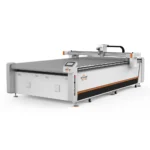
| Product Type | CNC Oscillating Knife Cutting Machine |
| Working Area | 1600 × 2500 mm |
| Cutting Speed | 0 – 2000 mm/s |
| Cutting Thickness | ≤ 30 mm |
| Cutting Accuracy | ±0.1 mm |
| Tools Available | Oscillating knife, Driven rotary knife, Creasing wheel, Kiss cutting tool, Pneumatic knife, Milling tool, V-groove knife |
| Vacuum Pump | 9 kW |
| Vacuum Table | Aluminum bellows vacuum table |
| Control System | PLC control panel |
| Servo Motors | Panasonic, Delta, or Dorna options |
| Voltage | Configurable at 110V, 220V, or 380V |
| Profile Formats | PLT, DXF, AI, PDF |
| Safety Devices | Infrared sensor device and emergency stop |
| Machine Size | 3300 × 2100 × 1350 mm |
| Language Options | English, Russian, Italian, Chinese (customizable) |
Application Suitability
| Application | Material or Output |
|---|---|
| Apparel manufacturing | Suits, knitwear, lace, and complex multi-layer fabrics |
| Automotive interiors | Seat fabrics, carpets, and PVC floor mats |
| Home textiles | Sofa fabrics, curtains, and heavy rugs |
| Composite material processing | Carbon fiber prepreg, aramid, and specialty technical materials |
Why "Working Area Alone" Is Not Enough When Sourcing a Cloth CNC Cutting Machine Manufacturer
A flatbed size tells you nothing about whether the machine will hold your fabric flat or cut through your specific ply height without fraying the edges.
I learned this the hard way on a project for an automotive floor mat producer in Shandong. The buyer asked for a large-format table, and we quoted based on that. When the material arrived for trial — a three-layer sandwich with a dense rubber core — the standard oscillating knife could not push through cleanly at production speed. The vacuum zones were too broad to grip the smaller pattern pieces, and edges showed compression marks. We had to reconfigure the tool head and rezone the vacuum table before the line could run. That is why I never finalize a cloth CNC cutting machine manufacturer recommendation without seeing the buyer’s actual material stack [NEED_CITE: material thickness and ply density effects on oscillating knife performance].
Matching the Tool Head to the Fabric Construction
A cloth CNC cutting machine manufacturer worth working with will ask what you are cutting before proposing a tool configuration. For single-layer woven suit fabrics, the driven rotary knife delivers a clean seal-free edge at high traversal speed. For multi-layer knitwear stacks, the oscillating knife with a higher stroke frequency keeps the blade cool and prevents ply shifting. Kiss cutting tools handle adhesive-backed textiles where only the top layer must be scored without damaging the backing liner.
Vacuum Hold-Down and Pattern Nesting Reality
The aluminum bellows vacuum table on this system provides continuous adsorption across the working surface, which matters when cutting small garment pattern pieces that tend to lift under knife pressure. The 9 kW vacuum pump generates sufficient negative pressure for dense woven fabrics and heavier rug materials. CCD camera contour recognition, available as an option, tracks printed registration marks on pre-printed textiles so that pattern pieces align to the print rather than to the fabric edge [NEED_CITE: CCD contour recognition accuracy on printed textiles at production speed].
Reading the Specs That Actually Matter for Fabric Cutting
Cutting accuracy at ±0.1 mm determines how well nested pattern pieces align when assembled into a finished garment — any drift compounds across dozens of pieces in a single lay. The 0 – 2000 mm/s speed range is only achievable on lighter single-layer materials; heavier multi-layer stacks require slower traversal to maintain edge quality and prevent blade deflection. The PLC control panel with servo motors from Panasonic, Delta, or Dorna governs acceleration and deceleration curves, which directly affects corner accuracy on intricate lace or collar patterns. File format compatibility with PLT, DXF, AI, and PDF means most pattern-making and nesting software outputs can be imported without intermediate conversion steps that introduce dimensional errors.
The Hidden Cost of Skipping Material Trials
When a buyer commits to a cloth CNC cutting machine manufacturer based on catalog specifications alone, the most common failure shows up in the first week of production. Edges on foam-backed automotive carpets come out crushed rather than sheared. Small sleeve pattern pieces drift because the vacuum zoning does not concentrate suction under narrow parts. Software refuses to import the nesting layout from the buyer’s existing CAD system, forcing manual re-drawing that introduces tolerance errors [NEED_CITE: software interoperability issues in CNC textile cutting workflows].
What This Purchase Path Looks Like in Practice
Our design team handles both knife and laser cutting technologies, so the recommendation starts with the material rather than pushing one method onto every application. Tool head and vacuum table configuration are specified against the buyer’s actual fabric type, ply count, and daily volume rather than selected from a default menu. Software compatibility with the buyer’s nesting workflow is confirmed before the order is finalized. Voltage, plug type, and control panel language are locked in to match the destination workshop [NEED_CITE: voltage and plug standards for industrial machinery by export destination]. Sample cutting on the buyer’s own material runs before commitment, producing a report that documents edge quality, achievable speed, and tool wear.
Documentation & Verification
- Machine specification sheet covering working area, cutting thickness, and tool options
- Electrical schematic with voltage and frequency confirmation for destination market
- Tool head and vacuum table configuration list matched to buyer material
- Sample cutting report on buyer-supplied fabric before order confirmation
- Software licence documentation and file format compatibility note for PLT, DXF, AI, PDF
Installation, Commissioning & Support
- Floor space allocation for 3300 × 2100 mm footprint with clearance for material loading
- Dedicated circuit matching confirmed voltage option (110V, 220V, or 380V) and pump draw
- Assembly of aluminum bellows vacuum table and belt alignment on site
- PLC parameter tuning for buyer fabric type during first production run
- Operator training on tool head changeover and emergency stop procedures
- Spare blade inventory and maintenance schedule based on cutting hours
What to Prepare Before Requesting a Quote
Share the fabric type, construction (woven, knit, nonwoven, or composite), single-ply thickness, and the number of layers you plan to cut simultaneously. Provide your target daily output in linear meters or pattern pieces, along with the available floor space and ceiling height in your workshop. Confirm the local voltage and frequency, the preferred control panel language, and whether your existing nesting software outputs PLT, DXF, AI, or PDF files. If the material is unusual — coated, heavily textured, or reinforced with scrim — send a sample roll so we can run a cutting trial before finalizing the configuration.
Frequently Asked Questions
Q: How do I choose the right tool head for my specific fabric type and thickness?
A: The selection depends on fabric construction and ply count. Woven single-layer materials typically use the driven rotary knife for speed. Multi-layer knits require the oscillating knife to prevent ply shift. Foam-backed or composite fabrics may need the pneumatic knife for greater downward force. We confirm the tool head recommendation by running a sample cut on your actual material.
Q: Can the vacuum table hold small garment pattern pieces securely during cutting?
A: The aluminum bellows vacuum table provides continuous adsorption across the full 1600 × 2500 mm surface. For very small or narrow pieces, vacuum zoning concentrates suction under the active cutting zone. The configuration is adjusted based on the smallest pattern piece in your production mix, confirmed during the material trial before order.
Q: Does the CCD camera track printed marks reliably at production cutting speeds?
A: CCD contour recognition is available as an option and is tuned to the contrast and size of the printed registration marks on your textile. Tracking performance depends on mark quality, fabric surface texture, and cutting speed. We test this on your printed material during the sample phase to confirm reliable detection before finalizing the order.
Q: Will the machine accept files from my existing nesting and pattern-making software?
A: The control system accepts PLT, DXF, AI, and PDF profile formats, which covers most commercial pattern-making and nesting platforms. Software licence and file format compatibility are documented and confirmed before the order is placed. If your software outputs a different format, we verify conversion accuracy during the pre-order sample cutting phase.










商品评价
There are no reviews yet.