


Fast Delivery
Quick, reliable shipping to any location.

Free & easy returns
Return this item by mail or in store within 90 days for a full refund.
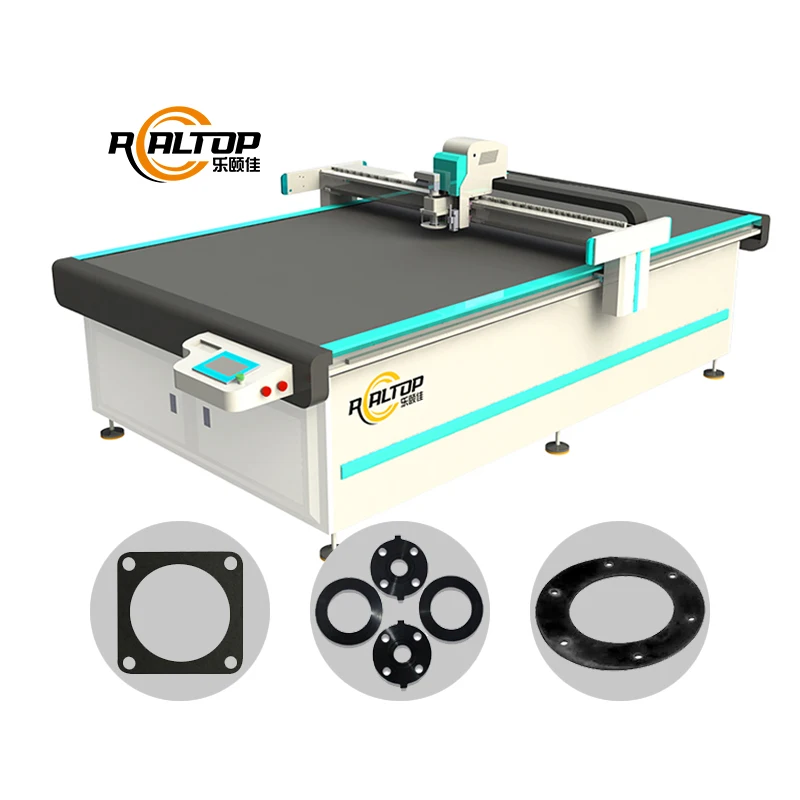
Material-matched tooling strategy — each RT-D2516/RT-S2516 is configured around the buyer’s actual gasket stock rather than a default head, verified on sample cuts before order confirmation.
Technical Specifications
| Parameter | Value |
|---|---|
| Model | RT-D2516 / RT-S2516 |
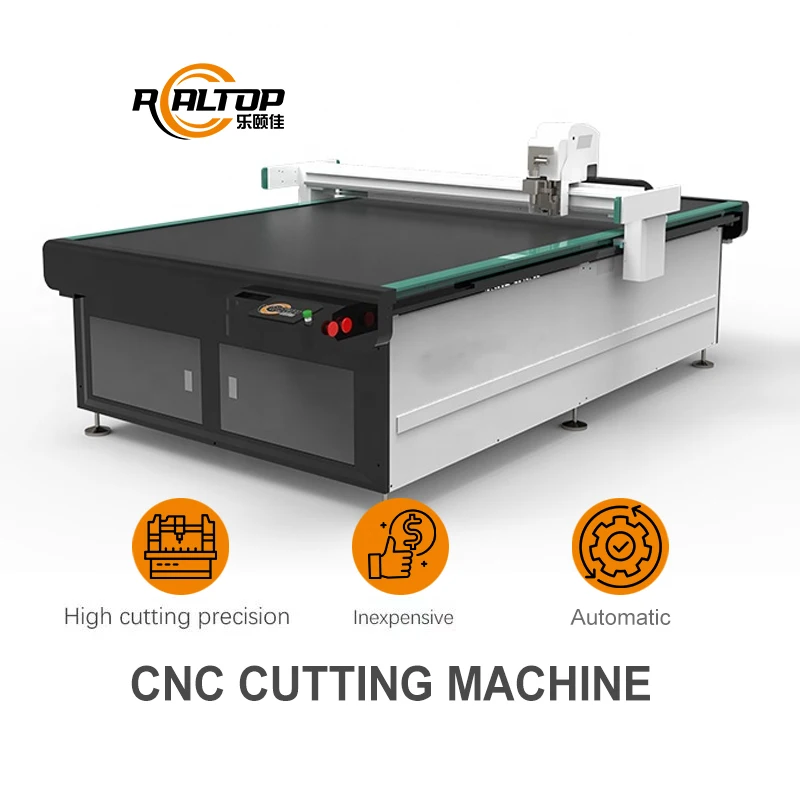
| Product Type | CNC Oscillating Knife Cutting Machine |
| Working Area | 1600 × 2500 mm |
| Machine Size (L×W×H) | 3450 × 2300 × 1250 mm |
| Rated Power | 9 kW |
| Voltage | 380V ±10% |
| Control System | CNC (HP-GL compatible format) |
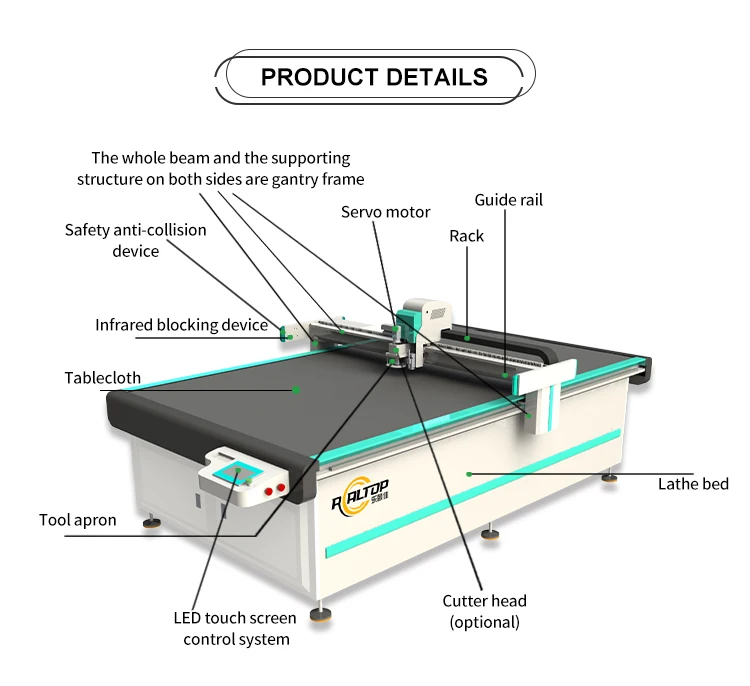
| Tool Head Options | Swiss imported oscillating knife, pneumatic knife, high-power vibrating knife, circular knife, V-cutting knife, drag knife, creasing wheel, punching, brush |
| Cutting Thickness | 20–80 mm (varies by material type and density — basis to be confirmed) |
| Translational Velocity | 800–1200 mm/s |
| Repeated Accuracy | ≤0.1 mm |
| Transmission System | Delta digital servo motor, Taiwan Hiwin linear guide, synchronous belt, ball screw |
| Vacuum Table | Magnesium-aluminum alloy with fluorocarbon PVDF powder spraying, anodic and hard oxidation; 7.5 kW vacuum pump |
| Safety Devices | Infrared sensor stop, beam anti-collision on both sides, emergency stop button |
| Visual Positioning | Small CCD camera mark point, panoramic camera recognition, projection positioning (availability per configuration) |
| Working Table Type | Flat working table (conveyor belt option available) |
| Language Options | English, Russian, Italian, Chinese; special languages customizable |
| Assembly State | Fully assembled |
| Standards | CE declaration where applicable |
Application Suitability
| Application | Material or Output |
|---|---|
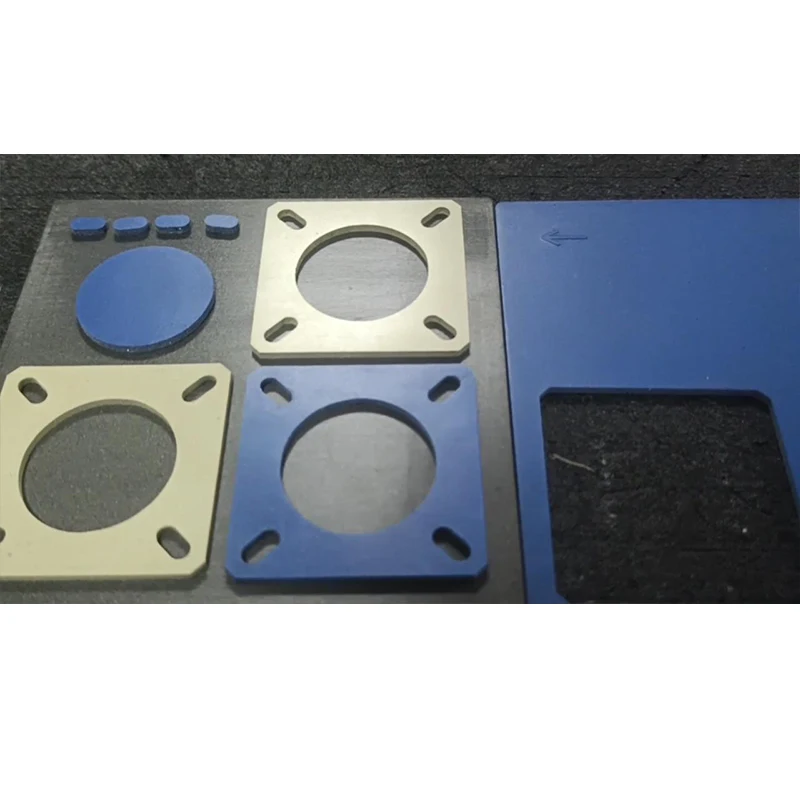
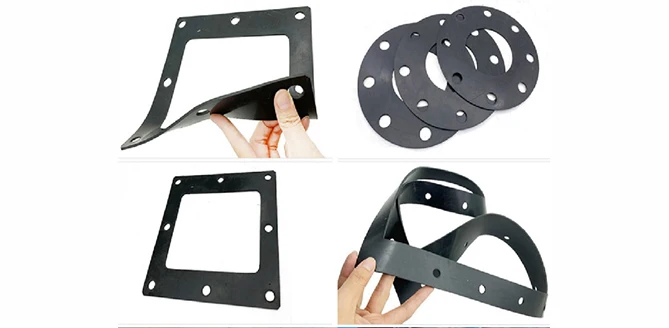
| Gasket and sealing pad production | Nitrile rubber, neoprene, PTFE, silicone, cork-rubber composites |
| Automotive interior components | EVA foam, XPE, PU composites, carpet and floor mats |
| Industrial rubber sheet fabrication | EPDM, Viton, fiber-reinforced elastomer sheets |
| Packaging and carton sample making | Corrugated board, greyboard, folding carton stock |
| PVC and soft glass processing | Flexible PVC sheets, soft transparent panels |
| Shoe and luggage material cutting | Synthetic leather, PU, textile uppers and linings |
| Composite foam fabricators | Sponge composites, multi-layer bonded foam panels |
What "Cutting Thickness" on a Spec Sheet Actually Means for Gaskets
A CNC oscillating knife cutting machine for sale that lists 20–80 mm thickness without material context can mislead a gasket shop running dense nitrile or filled PTFE.
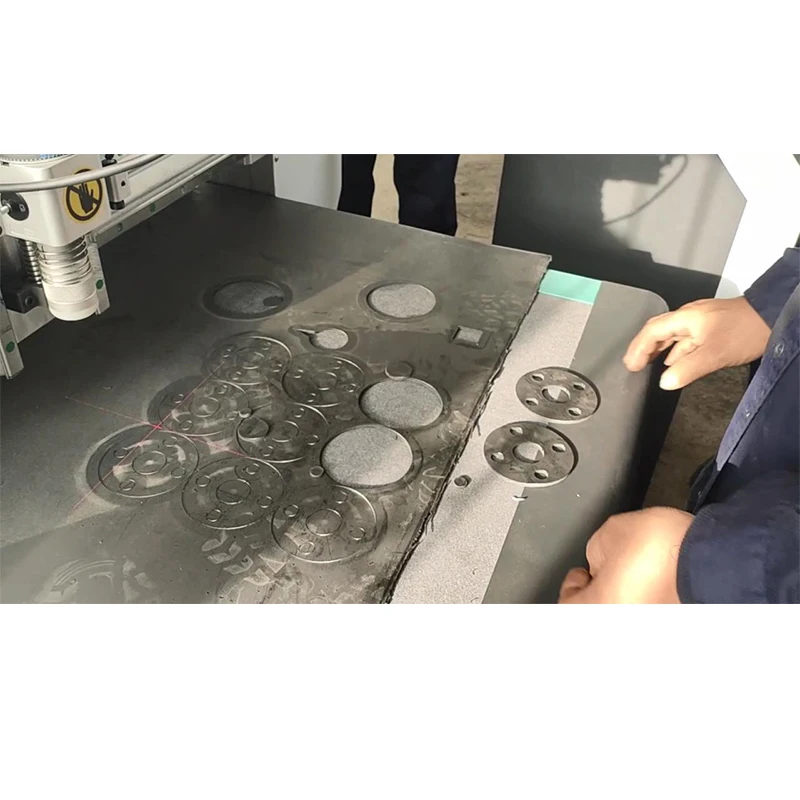
The headline thickness range assumes soft, low-density foam in the best case. When I worked with a rubber sealing pad producer last year, their nitrile stock at 65 Shore A was tearing at the edges on a standard oscillating head that handled softer materials fine. The knife frequency, blade geometry, vacuum hold-down and feed rate all interact. A material sample cut under production conditions is the only honest way to confirm real throughput and edge quality [NEED_CITE: material density and Shore hardness effects on oscillating knife cutting performance].
How Knife and Blade Options Change What You Can Cut
The RT-D2516/RT-S2516 carries a wide tool head menu because no single blade handles rubber, PTFE and foam equally. The Swiss imported oscillating knife suits mid-range gasket materials with clean vertical edges, while the high-power vibrating knife takes on denser filled compounds that would stall a standard head. Pneumatic and drag knife options cover thinner sealing sheets and scoring tasks. Choosing the wrong head for your stock is one of the most common reasons buyers report ragged edges or crushed layers after delivery.
Why Vacuum Zoning Decides Whether Small Gaskets Stay Flat
A 7.5 kW pump on a 1600 × 2500 mm table sounds capable, but gasket nests often contain small rings and thin flange seals that sit between vacuum zones. Without zoning matched to the typical part footprint, those pieces lift during the final cut pass and the blade drags them across the table. The magnesium-aluminum alloy table with PVDF coating provides a flat, chemical-resistant surface, and the zoning layout should be confirmed against your most common nesting pattern before the machine ships [NEED_CITE: vacuum table zoning strategies for small-part digital cutting].
Reading the Drive and Accuracy Numbers in Gasket Terms
The Delta digital servo motors paired with Taiwan Hiwin linear guides deliver ≤0.1 mm repeated accuracy, which matters when gasket bolt holes must align within tight flange tolerances. Translational velocity of 800–1200 mm/s is the travel speed, not the cutting speed — dense rubber forces the head to slow considerably to maintain edge quality. The synchronous belt and ball screw transmission keeps positional drift low across the full 2500 mm stroke, so a long gasket strip cut at one end of the table matches the profile cut at the other.
What Happens When the Configuration Guess Is Wrong
A gasket shop that ordered on working area alone once received a flat table with a single vacuum zone and a standard oscillating head. Their small O-ring profiles lifted off the table at every corner, producing scrap rates that wiped out any speed advantage. Another buyer found their HP-GL nesting files would not import without a software workaround that added minutes per job. These mismatches do not show up in a brochure comparison — they appear only after the first production shift [NEED_CITE: common configuration mismatches in industrial CNC cutting procurement].
Why Source This Machine from Our Workshop
In-house design and production covers both knife and laser cutting platforms, so we recommend the method that fits the material rather than pushing one technology onto every job. Tool head and vacuum table configuration is specified against your actual stock list, not a generic chart. CCD camera positioning is confirmed for printed contour work if your gaskets carry registration marks. Software file format compatibility is verified against your nesting workflow before the order is finalized. Sample cutting on your own material runs before you commit to a configuration.
Documentation & Verification
- Machine specification sheet listing your confirmed tool head, vacuum zoning and voltage
- Sample cutting report produced on your gasket material before order sign-off
- Electrical schematic with 380V ±10% circuit and breaker requirements marked
- Software licence and file format compatibility note matching your nesting system
- Factory test record documenting repeated accuracy and cutting pass on your stock
- Spare parts list covering blades, belts and vacuum seals for your configuration
Installation, Commissioning & Support
- Flat concrete floor with level tolerance to suit the 3450 × 2300 × 1250 mm footprint
- Dedicated 380V ±10% circuit sized for the 9 kW rated draw plus 7.5 kW vacuum pump
- Machine ships fully assembled; rigging plan required for workshop door clearance
- First-run parameter tuning on your gasket stock during commissioning visit
- Operator training covering tool head changeover, vacuum zoning setup and blade replacement
- Spare blade and belt kit shipped with machine to cover early production months
What to Send Before Requesting a Quote
To size the RT-D2516/RT-S2516 correctly for a CNC oscillating knife cutting machine for sale in your gasket operation, send the material types, Shore hardness or density, maximum sheet dimensions and typical nesting patterns. Confirm your local voltage and frequency, preferred control language, and whether your files come from a specific nesting software. If printed contour recognition is needed, provide sample printed sheets so the camera system can be matched to your mark style.
Frequently Asked Questions
Q: How do I know if oscillating knife or laser is better for my gasket material?
A: Oscillating knife suits most rubber, PTFE and compressed fiber gaskets where a sealed edge is not required and material thickness exceeds a few millimeters. Laser works on thinner non-metal sheets where edge sealing helps. We run sample cuts on your actual stock using both methods where applicable and let the edge quality and cycle time decide.
Q: Does the working area alone determine which model I need?
A: Working area is only one variable. Tool head type, vacuum table zoning, blade stroke and the CCD positioning option all change based on your material and nesting layout. A 1600 × 2500 mm table with the wrong head for dense nitrile rubber will underperform compared to a smaller machine configured correctly for that stock.
Q: What camera option fits printed gasket contour cutting?
A: The small CCD camera handles single mark point positioning for standard printed outlines, while the panoramic camera recognizes multiple marks across a large sheet for high-accuracy contour work. Projection positioning assists manual placement. The right option depends on your print registration style and the tolerance your gasket profile demands.
Q: Which documentation confirms the machine will cut my material as quoted?
A: Before shipment you receive a sample cutting report on your own material, a factory test record with measured accuracy, a software compatibility note matching your nesting format, and an electrical schematic confirming voltage and plug type. These documents close the gap between catalogue claims and your production reality.
Material-matched tooling strategy — each RT-D2516/RT-S2516 is configured around the buyer’s actual gasket stock rather than a default head, verified on sample cuts before order confirmation.
Technical Specifications
| Parameter | Value |
|---|---|
| Model | RT-D2516 / RT-S2516 |
| Product Type | CNC Oscillating Knife Cutting Machine |
| Working Area | 1600 × 2500 mm |
| Machine Size (L×W×H) | 3450 × 2300 × 1250 mm |
| Rated Power | 9 kW |
| Voltage | 380V ±10% |
| Control System | CNC (HP-GL compatible format) |
| Tool Head Options | Swiss imported oscillating knife, pneumatic knife, high-power vibrating knife, circular knife, V-cutting knife, drag knife, creasing wheel, punching, brush |
| Cutting Thickness | 20–80 mm (varies by material type and density — basis to be confirmed) |
| Translational Velocity | 800–1200 mm/s |
| Repeated Accuracy | ≤0.1 mm |
| Transmission System | Delta digital servo motor, Taiwan Hiwin linear guide, synchronous belt, ball screw |
| Vacuum Table | Magnesium-aluminum alloy with fluorocarbon PVDF powder spraying, anodic and hard oxidation; 7.5 kW vacuum pump |
| Safety Devices | Infrared sensor stop, beam anti-collision on both sides, emergency stop button |
| Visual Positioning | Small CCD camera mark point, panoramic camera recognition, projection positioning (availability per configuration) |
| Working Table Type | Flat working table (conveyor belt option available) |
| Language Options | English, Russian, Italian, Chinese; special languages customizable |
| Assembly State | Fully assembled |
| Standards | CE declaration where applicable |
Application Suitability
| Application | Material or Output |
|---|---|
| Gasket and sealing pad production | Nitrile rubber, neoprene, PTFE, silicone, cork-rubber composites |
| Automotive interior components | EVA foam, XPE, PU composites, carpet and floor mats |
| Industrial rubber sheet fabrication | EPDM, Viton, fiber-reinforced elastomer sheets |
| Packaging and carton sample making | Corrugated board, greyboard, folding carton stock |
| PVC and soft glass processing | Flexible PVC sheets, soft transparent panels |
| Shoe and luggage material cutting | Synthetic leather, PU, textile uppers and linings |
| Composite foam fabricators | Sponge composites, multi-layer bonded foam panels |
What "Cutting Thickness" on a Spec Sheet Actually Means for Gaskets
A CNC oscillating knife cutting machine for sale that lists 20–80 mm thickness without material context can mislead a gasket shop running dense nitrile or filled PTFE.
The headline thickness range assumes soft, low-density foam in the best case. When I worked with a rubber sealing pad producer last year, their nitrile stock at 65 Shore A was tearing at the edges on a standard oscillating head that handled softer materials fine. The knife frequency, blade geometry, vacuum hold-down and feed rate all interact. A material sample cut under production conditions is the only honest way to confirm real throughput and edge quality [NEED_CITE: material density and Shore hardness effects on oscillating knife cutting performance].
How Knife and Blade Options Change What You Can Cut
The RT-D2516/RT-S2516 carries a wide tool head menu because no single blade handles rubber, PTFE and foam equally. The Swiss imported oscillating knife suits mid-range gasket materials with clean vertical edges, while the high-power vibrating knife takes on denser filled compounds that would stall a standard head. Pneumatic and drag knife options cover thinner sealing sheets and scoring tasks. Choosing the wrong head for your stock is one of the most common reasons buyers report ragged edges or crushed layers after delivery.
Why Vacuum Zoning Decides Whether Small Gaskets Stay Flat
A 7.5 kW pump on a 1600 × 2500 mm table sounds capable, but gasket nests often contain small rings and thin flange seals that sit between vacuum zones. Without zoning matched to the typical part footprint, those pieces lift during the final cut pass and the blade drags them across the table. The magnesium-aluminum alloy table with PVDF coating provides a flat, chemical-resistant surface, and the zoning layout should be confirmed against your most common nesting pattern before the machine ships [NEED_CITE: vacuum table zoning strategies for small-part digital cutting].
Reading the Drive and Accuracy Numbers in Gasket Terms
The Delta digital servo motors paired with Taiwan Hiwin linear guides deliver ≤0.1 mm repeated accuracy, which matters when gasket bolt holes must align within tight flange tolerances. Translational velocity of 800–1200 mm/s is the travel speed, not the cutting speed — dense rubber forces the head to slow considerably to maintain edge quality. The synchronous belt and ball screw transmission keeps positional drift low across the full 2500 mm stroke, so a long gasket strip cut at one end of the table matches the profile cut at the other.
What Happens When the Configuration Guess Is Wrong
A gasket shop that ordered on working area alone once received a flat table with a single vacuum zone and a standard oscillating head. Their small O-ring profiles lifted off the table at every corner, producing scrap rates that wiped out any speed advantage. Another buyer found their HP-GL nesting files would not import without a software workaround that added minutes per job. These mismatches do not show up in a brochure comparison — they appear only after the first production shift [NEED_CITE: common configuration mismatches in industrial CNC cutting procurement].
Why Source This Machine from Our Workshop
In-house design and production covers both knife and laser cutting platforms, so we recommend the method that fits the material rather than pushing one technology onto every job. Tool head and vacuum table configuration is specified against your actual stock list, not a generic chart. CCD camera positioning is confirmed for printed contour work if your gaskets carry registration marks. Software file format compatibility is verified against your nesting workflow before the order is finalized. Sample cutting on your own material runs before you commit to a configuration.
Documentation & Verification
- Machine specification sheet listing your confirmed tool head, vacuum zoning and voltage
- Sample cutting report produced on your gasket material before order sign-off
- Electrical schematic with 380V ±10% circuit and breaker requirements marked
- Software licence and file format compatibility note matching your nesting system
- Factory test record documenting repeated accuracy and cutting pass on your stock
- Spare parts list covering blades, belts and vacuum seals for your configuration
Installation, Commissioning & Support
- Flat concrete floor with level tolerance to suit the 3450 × 2300 × 1250 mm footprint
- Dedicated 380V ±10% circuit sized for the 9 kW rated draw plus 7.5 kW vacuum pump
- Machine ships fully assembled; rigging plan required for workshop door clearance
- First-run parameter tuning on your gasket stock during commissioning visit
- Operator training covering tool head changeover, vacuum zoning setup and blade replacement
- Spare blade and belt kit shipped with machine to cover early production months
What to Send Before Requesting a Quote
To size the RT-D2516/RT-S2516 correctly for a CNC oscillating knife cutting machine for sale in your gasket operation, send the material types, Shore hardness or density, maximum sheet dimensions and typical nesting patterns. Confirm your local voltage and frequency, preferred control language, and whether your files come from a specific nesting software. If printed contour recognition is needed, provide sample printed sheets so the camera system can be matched to your mark style.
Frequently Asked Questions
Q: How do I know if oscillating knife or laser is better for my gasket material?
A: Oscillating knife suits most rubber, PTFE and compressed fiber gaskets where a sealed edge is not required and material thickness exceeds a few millimeters. Laser works on thinner non-metal sheets where edge sealing helps. We run sample cuts on your actual stock using both methods where applicable and let the edge quality and cycle time decide.
Q: Does the working area alone determine which model I need?
A: Working area is only one variable. Tool head type, vacuum table zoning, blade stroke and the CCD positioning option all change based on your material and nesting layout. A 1600 × 2500 mm table with the wrong head for dense nitrile rubber will underperform compared to a smaller machine configured correctly for that stock.
Q: What camera option fits printed gasket contour cutting?
A: The small CCD camera handles single mark point positioning for standard printed outlines, while the panoramic camera recognizes multiple marks across a large sheet for high-accuracy contour work. Projection positioning assists manual placement. The right option depends on your print registration style and the tolerance your gasket profile demands.
Q: Which documentation confirms the machine will cut my material as quoted?
A: Before shipment you receive a sample cutting report on your own material, a factory test record with measured accuracy, a software compatibility note matching your nesting format, and an electrical schematic confirming voltage and plug type. These documents close the gap between catalogue claims and your production reality.










商品评价
There are no reviews yet.