



Fast Delivery
Quick, reliable shipping to any location.

Free & easy returns
Return this item by mail or in store within 90 days for a full refund.
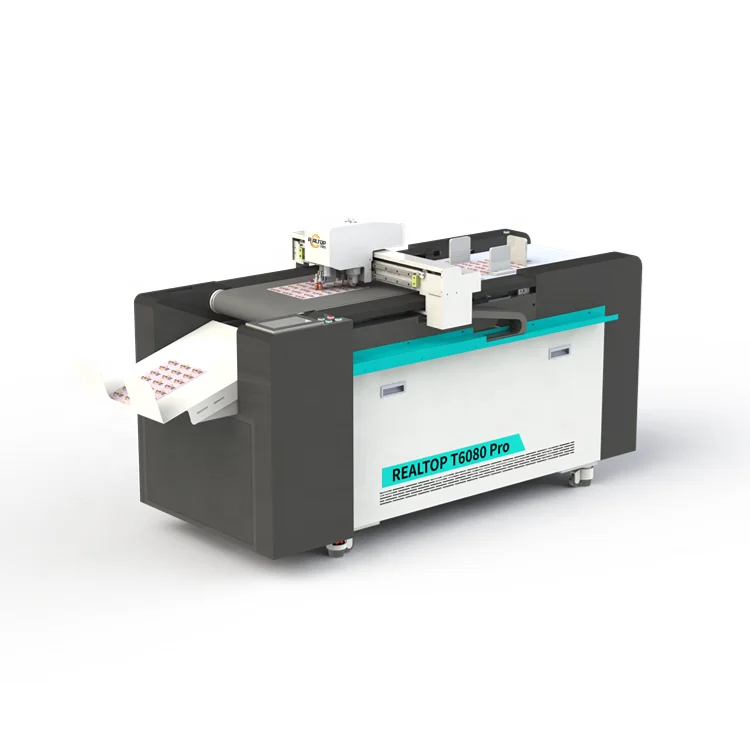
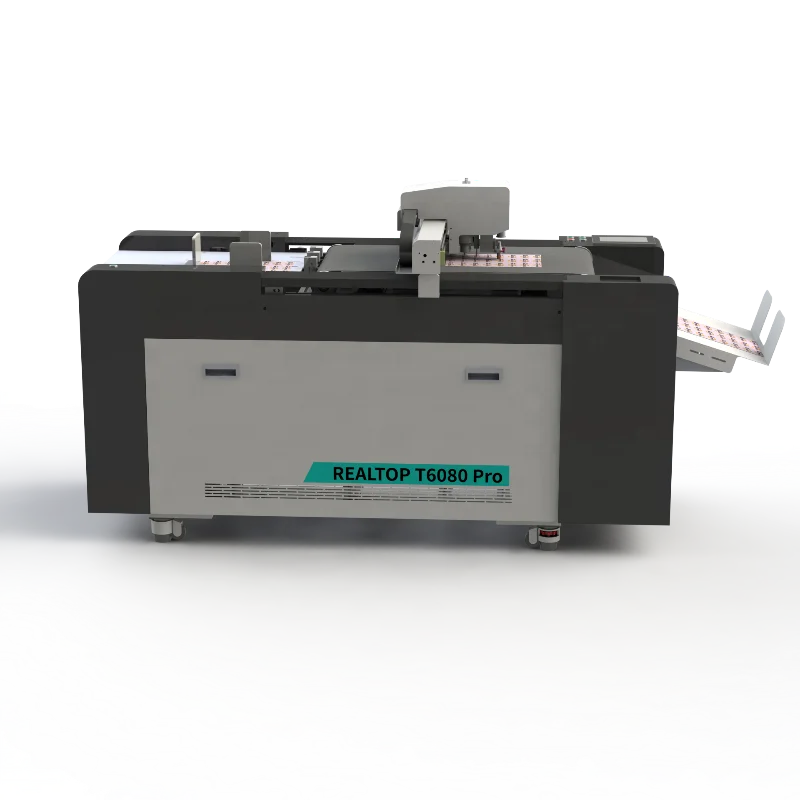
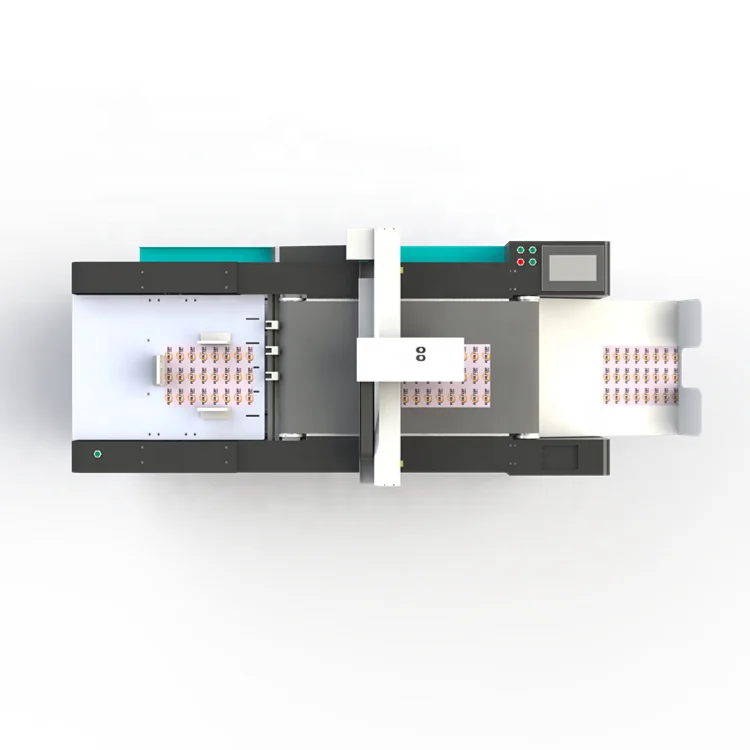
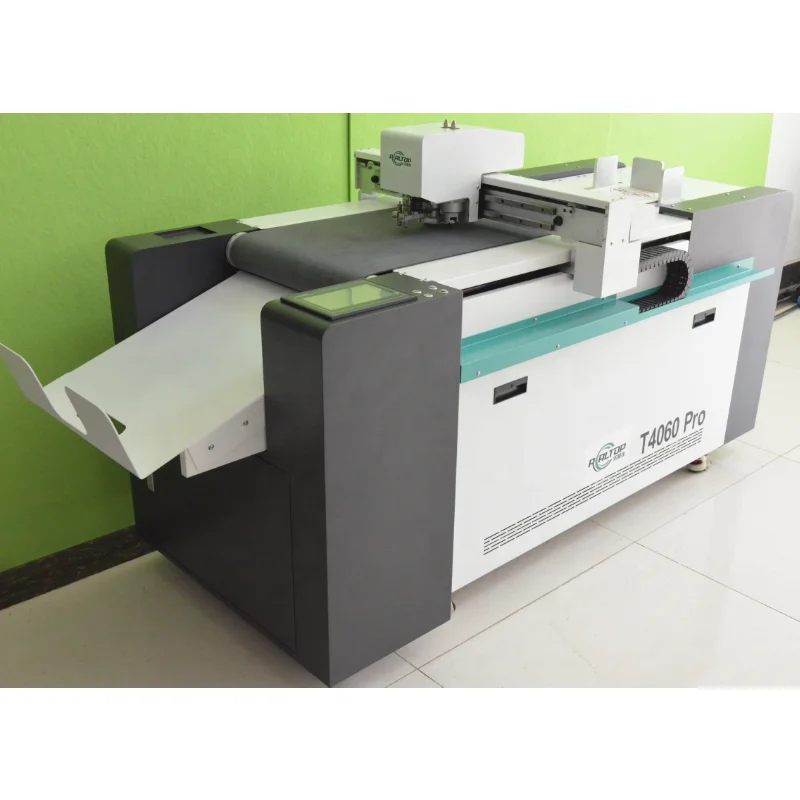
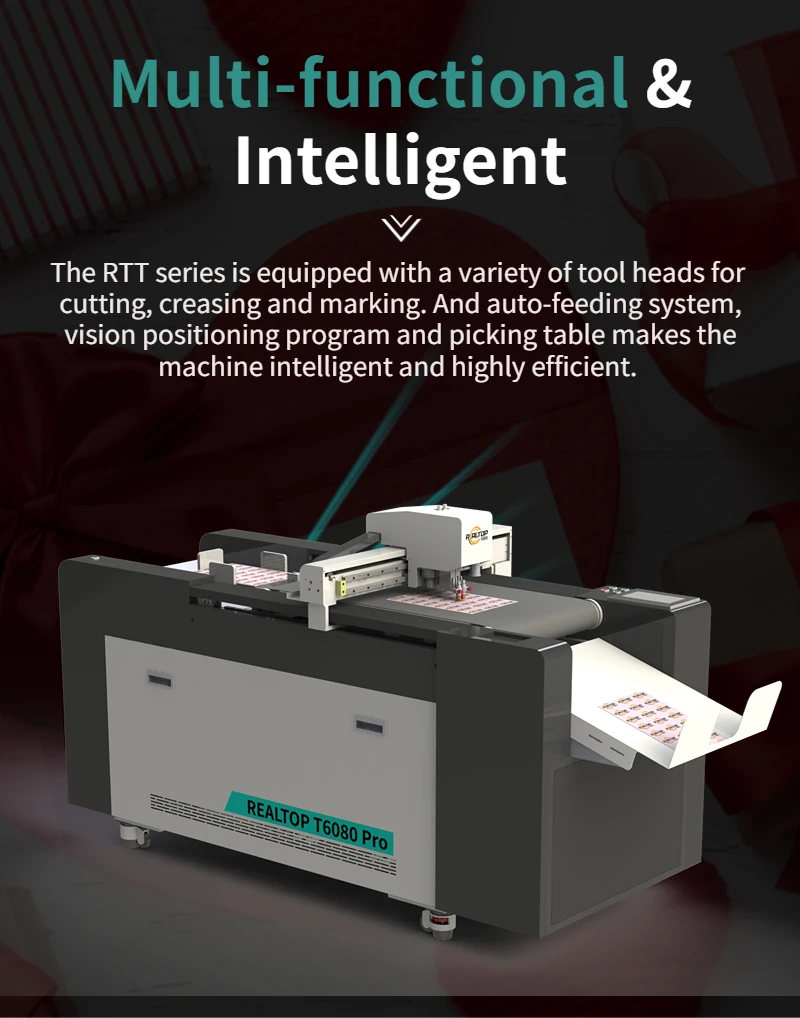
Multi-tool head configuration — The RTT6080 pairs oscillating knife, kiss cutting, creasing, and CCD camera on one table, letting sticker and label shops switch between contour cutting and half-cutting without changing machines.
Technical Specifications
| Parameter | Value |
|---|---|
| Model | RTT6080 / RTT6080 Pro |
| Product Type | CNC Oscillating Knife Cutting Machine |
| Working Area | 600mm × 800mm |
| Tool Group | Cutting tool, kiss cutting tool, creasing tool, CCD camera (Pro adds high speed oscillating knife) |
| Max Cutting Speed | 1500 mm/s (basis not stated in source — confirm material / thickness) |
| Cutting Thickness | ≤2mm (RTT6080); ≤5mm (RTT6080 Pro) (basis not stated in source — confirm material type) |
| Positioning Accuracy | 0.05mm |
| File Formats | DXF, PLT, PDF, AI |
| Transfer Method | Ethernet port |
| Rated Power | 3.2KW (rated or peak not specified in source) |
| Voltage & Frequency | 220V/380V, 50Hz |
Application Suitability
| Application | Material or Output |
|---|---|
| Sticker and self-adhesive label cutting | Printed vinyl, glossy PP, clear BOPP on release liner |
| Packaging sample making | Folding carton stock, kraft liner, corrugated E-flute |
| Card and craft product cutting | Thin flexible stock, craft foam, magnetic sheet |
| Adhesive film contour work | Reflective film, heat transfer vinyl, sandblast resist |
What "Contour Cutting at Full Speed" Really Demands From a CNC Knife Cutting Machine Manufacturer
Printed marks must be read on the fly, not after the head stops.
A sticker run with 0.5mm registration tolerance is manageable when the machine pauses at each mark. But most label shops need continuous throughput, and the moment the CCD camera cannot track a printed crosshair at production speed, you end up with mis-cut sheets and material waste that adds up across every shift [NEED_CITE: registration tolerance expectations in digital finishing]. This CNC knife cutting machine manufacturer specifies the RTT6080 with a camera system intended for real-time contour capture, but the only way to verify that claim is by running your actual printed stock at your intended speed before signing anything.
Matching the Tool Head to the Label Stock
Every adhesive label has a face stock, an adhesive layer, and a release liner. Cutting through the face stock without scoring the liner requires a kiss cutting tool with precise depth control, while full-contour stickers need the oscillating or drag knife to penetrate cleanly through the entire laminate. The RTT6080 offers cutting, kiss cutting, creasing, and CCD camera tools in one tool group, and the Pro version adds a high speed oscillating knife for denser materials up to 5mm. Selecting the right combination prevents adhesive bleed on kiss-cut labels and ragged edges on through-cut contours.
CCD Camera Registration Beyond Static Accuracy
A camera that reads a printed mark perfectly on a stationary sheet behaves differently when the table or gantry is moving. For sticker producers running nested layouts with dozens of contours per sheet, the camera must register each mark in sequence without the head decelerating to a halt. The 0.05mm positioning accuracy of the RTT6080 matters only if the software and camera loop can maintain that tolerance across an entire 600mm × 800mm work area at speed [NEED_CITE: CCD contour recognition performance under motion].
Specs That Determine Edge Quality on Thin Films
Why File Format Compatibility Dictates Your Daily Workflow
Label designers typically work in Adobe Illustrator or a dedicated nesting application, exporting DXF, PLT, PDF, or AI files. The RTT6080 accepts all four formats and transfers them via Ethernet, which avoids the bottleneck of USB drives in a production environment. However, the real test is whether your existing nesting software output imports without requiring manual re-drawing of cut lines or contour offsets. Confirming this before order prevents a situation where operators spend more time fixing file geometry than running jobs.
Cutting Thickness, Vacuum Hold-Down, and Small Part Behavior
What Happens When the Tool Head Spec Does Not Match the Material
The cutting thickness figures of ≤2mm on the RTT6080 and ≤5mm on the RTT6080 Pro carry a note that material type should be confirmed. Dense gasket material at 4mm behaves very differently from 4mm craft foam under the same knife stroke. When a buyer assumes thickness capacity covers all materials equally, the result is incomplete cuts on dense stock or crushed edges on soft composites [NEED_CITE: material density effect on oscillating knife cutting depth]. The 3.2KW power rating also does not specify whether it is rated or peak, which affects sustained cutting ability on thicker runs.
Why Buyers Choose This Source
In-house design covers both the mechanical table and the CCD recognition system, meaning contour accuracy is tuned as one integrated unit rather than bolted on after assembly. Tool head combinations are specified per the buyer’s actual material stack, not quoted as a one-size-fits-all package. Software compatibility is verified against the buyer’s existing DXF or AI workflow before the order is locked. Voltage options of 220V or 380V at 50Hz are confirmed to match the buyer’s facility supply before shipment. Sample cutting on the buyer’s own sticker or label stock is completed before any commitment is made.
Documentation & Verification
- Machine specification sheet confirming tool head and working area configuration
- Electrical schematic with 220V/380V voltage confirmation for your facility
- Sample cutting report on your sticker and label material with edge photos
- Tool head and table configuration list matched to your material stack
- Software licence and file format compatibility note for DXF, PLT, PDF, AI
- Operation and maintenance manual with tool change and CCD calibration steps
Installation, Commissioning & Support
- 3.2KW power supply requires a dedicated circuit matched to 220V or 380V input
- 600mm × 800mm footprint fits standard workshop floors without special foundation work
- Ethernet port connection verified during commissioning for file transfer to your network
- CCD camera calibration performed on your printed stock during first-run setup
- Tool head depth setting adjusted for your specific face stock and liner combination
- Spare parts list covers oscillating knife blades, kiss cutting tips, and creasing wheels
What to Share Before Requesting a Quote
Send the exact face stock and liner combination you run most often, along with the adhesive type and total laminate thickness. Include a sample layout file in your preferred format so file import can be tested against the RTT6080 software. Confirm your facility voltage and frequency, and whether your operators need the control interface in a specific language. If you run both kiss-cut and through-cut labels, specify which job represents the majority of your daily volume.
Frequently Asked Questions
Q: How is CCD contour recognition verified at production speed for printed stickers?
A: The CCD camera is tested on your printed material running at your intended cutting speed, not just stationary registration. We run a full nested sheet and measure offset on each contour to confirm 0.05mm positioning accuracy holds across the entire work area under motion, and share the sample cutting report before you commit.
Q: Which tool head is specified for kiss-cutting versus through-cutting adhesive labels?
A: Kiss-cut labels use a dedicated kiss cutting tool with depth control to cut the face stock without scoring the release liner. Through-cut stickers use the standard cutting tool or the high speed oscillating knife on the Pro model. Tool head selection is confirmed based on your actual material stack before the machine ships.
Q: Is the software compatible with my existing DXF/AI nesting and design workflow?
A: The RTT6080 accepts DXF, PLT, PDF, and AI files via Ethernet transfer. Before order, we test import with your actual output files to confirm cut lines, contour offsets, and nesting layouts transfer without manual correction. A software licence and file format compatibility note is included in the documentation package.
Q: Can I send my own sticker material for sample cutting before placing the order?
A: Yes. Send your face stock with liner, and we run it on the RTT6080 with the recommended tool head. The sample cutting report includes edge quality photos, contour accuracy measurements, and cutting speed achieved, so you can evaluate performance on your actual production material before any purchase commitment.
Multi-tool head configuration — The RTT6080 pairs oscillating knife, kiss cutting, creasing, and CCD camera on one table, letting sticker and label shops switch between contour cutting and half-cutting without changing machines.
Technical Specifications
| Parameter | Value |
|---|---|
| Model | RTT6080 / RTT6080 Pro |
| Product Type | CNC Oscillating Knife Cutting Machine |
| Working Area | 600mm × 800mm |
| Tool Group | Cutting tool, kiss cutting tool, creasing tool, CCD camera (Pro adds high speed oscillating knife) |
| Max Cutting Speed | 1500 mm/s (basis not stated in source — confirm material / thickness) |
| Cutting Thickness | ≤2mm (RTT6080); ≤5mm (RTT6080 Pro) (basis not stated in source — confirm material type) |
| Positioning Accuracy | 0.05mm |
| File Formats | DXF, PLT, PDF, AI |
| Transfer Method | Ethernet port |
| Rated Power | 3.2KW (rated or peak not specified in source) |
| Voltage & Frequency | 220V/380V, 50Hz |
Application Suitability
| Application | Material or Output |
|---|---|
| Sticker and self-adhesive label cutting | Printed vinyl, glossy PP, clear BOPP on release liner |
| Packaging sample making | Folding carton stock, kraft liner, corrugated E-flute |
| Card and craft product cutting | Thin flexible stock, craft foam, magnetic sheet |
| Adhesive film contour work | Reflective film, heat transfer vinyl, sandblast resist |
What "Contour Cutting at Full Speed" Really Demands From a CNC Knife Cutting Machine Manufacturer
Printed marks must be read on the fly, not after the head stops.
A sticker run with 0.5mm registration tolerance is manageable when the machine pauses at each mark. But most label shops need continuous throughput, and the moment the CCD camera cannot track a printed crosshair at production speed, you end up with mis-cut sheets and material waste that adds up across every shift [NEED_CITE: registration tolerance expectations in digital finishing]. This CNC knife cutting machine manufacturer specifies the RTT6080 with a camera system intended for real-time contour capture, but the only way to verify that claim is by running your actual printed stock at your intended speed before signing anything.
Matching the Tool Head to the Label Stock
Every adhesive label has a face stock, an adhesive layer, and a release liner. Cutting through the face stock without scoring the liner requires a kiss cutting tool with precise depth control, while full-contour stickers need the oscillating or drag knife to penetrate cleanly through the entire laminate. The RTT6080 offers cutting, kiss cutting, creasing, and CCD camera tools in one tool group, and the Pro version adds a high speed oscillating knife for denser materials up to 5mm. Selecting the right combination prevents adhesive bleed on kiss-cut labels and ragged edges on through-cut contours.
CCD Camera Registration Beyond Static Accuracy
A camera that reads a printed mark perfectly on a stationary sheet behaves differently when the table or gantry is moving. For sticker producers running nested layouts with dozens of contours per sheet, the camera must register each mark in sequence without the head decelerating to a halt. The 0.05mm positioning accuracy of the RTT6080 matters only if the software and camera loop can maintain that tolerance across an entire 600mm × 800mm work area at speed [NEED_CITE: CCD contour recognition performance under motion].
Specs That Determine Edge Quality on Thin Films
Why File Format Compatibility Dictates Your Daily Workflow
Label designers typically work in Adobe Illustrator or a dedicated nesting application, exporting DXF, PLT, PDF, or AI files. The RTT6080 accepts all four formats and transfers them via Ethernet, which avoids the bottleneck of USB drives in a production environment. However, the real test is whether your existing nesting software output imports without requiring manual re-drawing of cut lines or contour offsets. Confirming this before order prevents a situation where operators spend more time fixing file geometry than running jobs.
Cutting Thickness, Vacuum Hold-Down, and Small Part Behavior
What Happens When the Tool Head Spec Does Not Match the Material
The cutting thickness figures of ≤2mm on the RTT6080 and ≤5mm on the RTT6080 Pro carry a note that material type should be confirmed. Dense gasket material at 4mm behaves very differently from 4mm craft foam under the same knife stroke. When a buyer assumes thickness capacity covers all materials equally, the result is incomplete cuts on dense stock or crushed edges on soft composites [NEED_CITE: material density effect on oscillating knife cutting depth]. The 3.2KW power rating also does not specify whether it is rated or peak, which affects sustained cutting ability on thicker runs.
Why Buyers Choose This Source
In-house design covers both the mechanical table and the CCD recognition system, meaning contour accuracy is tuned as one integrated unit rather than bolted on after assembly. Tool head combinations are specified per the buyer’s actual material stack, not quoted as a one-size-fits-all package. Software compatibility is verified against the buyer’s existing DXF or AI workflow before the order is locked. Voltage options of 220V or 380V at 50Hz are confirmed to match the buyer’s facility supply before shipment. Sample cutting on the buyer’s own sticker or label stock is completed before any commitment is made.
Documentation & Verification
- Machine specification sheet confirming tool head and working area configuration
- Electrical schematic with 220V/380V voltage confirmation for your facility
- Sample cutting report on your sticker and label material with edge photos
- Tool head and table configuration list matched to your material stack
- Software licence and file format compatibility note for DXF, PLT, PDF, AI
- Operation and maintenance manual with tool change and CCD calibration steps
Installation, Commissioning & Support
- 3.2KW power supply requires a dedicated circuit matched to 220V or 380V input
- 600mm × 800mm footprint fits standard workshop floors without special foundation work
- Ethernet port connection verified during commissioning for file transfer to your network
- CCD camera calibration performed on your printed stock during first-run setup
- Tool head depth setting adjusted for your specific face stock and liner combination
- Spare parts list covers oscillating knife blades, kiss cutting tips, and creasing wheels
What to Share Before Requesting a Quote
Send the exact face stock and liner combination you run most often, along with the adhesive type and total laminate thickness. Include a sample layout file in your preferred format so file import can be tested against the RTT6080 software. Confirm your facility voltage and frequency, and whether your operators need the control interface in a specific language. If you run both kiss-cut and through-cut labels, specify which job represents the majority of your daily volume.
Frequently Asked Questions
Q: How is CCD contour recognition verified at production speed for printed stickers?
A: The CCD camera is tested on your printed material running at your intended cutting speed, not just stationary registration. We run a full nested sheet and measure offset on each contour to confirm 0.05mm positioning accuracy holds across the entire work area under motion, and share the sample cutting report before you commit.
Q: Which tool head is specified for kiss-cutting versus through-cutting adhesive labels?
A: Kiss-cut labels use a dedicated kiss cutting tool with depth control to cut the face stock without scoring the release liner. Through-cut stickers use the standard cutting tool or the high speed oscillating knife on the Pro model. Tool head selection is confirmed based on your actual material stack before the machine ships.
Q: Is the software compatible with my existing DXF/AI nesting and design workflow?
A: The RTT6080 accepts DXF, PLT, PDF, and AI files via Ethernet transfer. Before order, we test import with your actual output files to confirm cut lines, contour offsets, and nesting layouts transfer without manual correction. A software licence and file format compatibility note is included in the documentation package.
Q: Can I send my own sticker material for sample cutting before placing the order?
A: Yes. Send your face stock with liner, and we run it on the RTT6080 with the recommended tool head. The sample cutting report includes edge quality photos, contour accuracy measurements, and cutting speed achieved, so you can evaluate performance on your actual production material before any purchase commitment.










商品评价
There are no reviews yet.