



Fast Delivery
Quick, reliable shipping to any location.

Free & easy returns
Return this item by mail or in store within 90 days for a full refund.
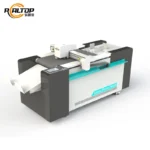
Mixed Tool Carriage — the RTT-6080 / 6080 Pro carries cutting, kiss cutting, creasing and CCD in one head so label converters switch tools by job instead of swapping machines.
Technical Specifications
| Parameter | Value |
|---|---|
| Model | RTT-6080 / RTT-6080 Pro |
| Product Type | Digital Flatbed Cutter Plotter |
| Max Working Area | 600 mm × 800 mm |
| Tool Group | Cutting tool, kiss cutting tool, creasing tool, CCD camera; High-speed oscillating knife (RTT6080 Pro only) |
| Max Cutting Speed | 1500 mm/s (according to material — basis not stated in source) |
| Cutting Thickness | ≤2 mm (RTT6080); ≤5 mm (RTT6080 Pro) |
| Positioning Accuracy | 0.05 mm |
| Supported File Formats | DXF, PLT, PDF, AI |
| Data Transfer | Ethernet port |
| Rated Power | 3.2 kW (both models) |
| CCD Camera Contour Recognition | Included |
| Key Features | Mixed tool carriage, vacuum table, CCD mark tracking, multi-format file import |
Application Suitability
| Application | Material or Output |
|---|---|
| Label and sticker die-cutting | Self-adhesive vinyl, PET, PP label stock on release liner |
| Cardstock packaging mock-ups | Folding carton board up to 5 mm with crease lines |
| Printed contour decals | Pre-printed sheets tracked by CCD registration marks |
| Small-format sample making | Corrugated E-flute, greyboard, art card for prototype boxes |
Why Material Thickness Decides the Model Before Price Enters the Room
A 600 × 800 mm working area means nothing if the stock you run daily sits above the machine’s cutting-depth ceiling.
I have watched buyers pick the base RTT6080 because the footprint and budget fit, only to discover mid-production that their 3 mm magnetic label stock chokes the drag knife. The RTT6080 tops out at 2 mm while the RTT6080 Pro reaches 5 mm thanks to its oscillating knife head. Once a buyer ships thicker material than the tool can penetrate, ragged edges and crushed cores follow — and no amount of parameter tuning fixes a physics problem. Matching a Digital Flatbed Cutter Plotter manufacturer to the actual stock thickness eliminates the most common post-delivery dispute I see in this format range. [NEED_CITE: typical cutting depth limits for oscillating versus drag knife tooling on label substrates]
Where the RTT-6080 Series Sits in the Catalogue
Buyers surveying a full cutting equipment range need to see where compact-format knife tables end and large-format or laser systems begin. The RTT-6080 and RTT6080 Pro occupy the small-footprint slot for label converters and packaging sample rooms that process sheet sizes under 600 × 800 mm. Anything larger in area or volume pushes toward oscillating-knife flatbeds or CO2 laser cutters. Keeping this Digital Flatbed Cutter Plotter family clearly bounded helps buyers avoid forcing one technology to cover jobs it was never sized for.
Kiss Cut Versus Through Cut on the Same Press Sheet
Label runs often demand kiss cutting the face stock while leaving the silicone release liner intact, then switching to a full through cut for the matrix waste. The RTT-6080 series carries both a dedicated kiss-cutting tool and a through-cutting blade on the same carriage, so the head swaps by file command rather than by manual changeover. Crease wheels sit alongside these knives, letting sample makers score fold lines on cardstock without swapping carriages. [NEED_CITE: kiss cutting depth tolerance requirements on self-adhesive label stock]
Reading the Specs That Actually Affect Edge Quality
Cutting thickness separates the two models: 2 mm on the RTT6080 and 5 mm on the RTT6080 Pro, driven by the oscillating knife available only on the Pro. Positioning accuracy at 0.05 mm keeps CCD-tracked contour cuts aligned with printed registration marks, which matters when label artwork leaves a narrow bleed margin. File format support across DXF, PLT, PDF and AI means most artwork from Adobe Illustrator or packaging CAD systems imports without conversion. The 3.2 kW rated power on both models covers vacuum pump, servo drives and spindle — a single-circuit requirement that simplifies workshop electrical planning.
The Cost of Skipping the Sample Cut
I once supplied a cutter plotter to a label shop that confirmed only the working area by email. When the machine arrived, their 2.5 mm foam-backed gasket material jammed the standard drag knife. Edge tearing climbed to roughly one rejected sheet in three until we shipped an oscillating knife retrofit and recalibrated Z-depth. Had we received a material swatch before the order, the RTT6080 Pro would have left the factory configured correctly. Skipping sample-cut validation on the buyer’s own stock is the single most expensive shortcut in small-format cutting procurement. [NEED_CITE: material sample testing before CNC cutting equipment dispatch]
What Buying Direct From the Factory Changes
In-house design covers both knife and laser cutting paths, so the cutting method matches the material instead of forcing one head to do every job. Tool head and vacuum table zoning get specified per the buyer’s stock and daily volume, not pulled from a default build list. CCD camera positioning is tuned to the registration mark size the buyer actually prints. Software compatibility is confirmed against the buyer’s file workflow before the order locks. Voltage, plug type and control language are set to the destination market before the crate closes. Sample cutting on the buyer’s own material runs before commitment, not after delivery.
Documentation & Verification
- Machine specification sheet listing RTT6080 and RTT6080 Pro tool groups and thickness limits
- Electrical schematic confirming voltage and frequency for destination market
- Sample cutting report on buyer’s label stock and cardstock before dispatch
- Tool head and vacuum table configuration list matched to material type
- Software licence and DXF / PLT / PDF / AI file format compatibility note
Installation, Commissioning & Support
- Dedicated 3.2 kW circuit with correct breaker rating for the RTT-6080 series
- Vacuum table levelling on a flat floor to maintain 0.05 mm positioning accuracy
- Ethernet port connection to the workshop LAN for file transfer from design stations
- CCD camera calibration using the buyer’s printed registration mark size and contrast
- Oscillating knife Z-depth tuning on actual stock thickness for RTT6080 Pro units
- Spare knife blades, creasing wheels and CCD lens covers included in the parts kit
What We Need to Quote Accurately
Send the exact label stock or cardstock you run daily, including thickness and whether kiss cutting or through cutting is required. Confirm your local voltage and frequency, the plug type, and the language you need on the control interface. If your artwork arrives in a specific file format from your existing design workflow, let us know so we verify import compatibility before the order.
Frequently Asked Questions
Q: How do I know whether the RTT6080 or RTT6080 Pro fits my material?
A: Measure the thickest stock you plan to cut. The RTT6080 handles up to 2 mm with a drag knife, while the RTT6080 Pro reaches 5 mm using its oscillating knife. If your daily mix includes materials above 2 mm, the Pro variant is the safer choice. We confirm this with a sample cut on your actual stock before the order is finalized.
Q: Can the CCD camera track my printed registration marks at running speed?
A: The CCD system reads contrast-based marks within the camera’s field of view. Mark size, ink density and background contrast all affect read reliability. We test your printed sheet on the machine to confirm tracking accuracy at production speed before recommending the configuration.
Q: Which tool head handles kiss cutting without damaging the release liner?
A: The dedicated kiss-cutting tool controls Z-depth to slice the face stock while leaving the liner intact. Depth calibration depends on face stock thickness and adhesive layer. A sample cut on your label material verifies liner integrity before we lock the tool configuration.
Q: Do my existing DXF and AI files import directly?
A: The control software accepts DXF, PLT, PDF and AI formats. Layer naming and line-type conventions may need minor adjustment for tool-path assignment. We run a file-import test using your actual artwork to confirm compatibility before shipment.
Q: How is voltage and language configuration handled for export?
A: Voltage, frequency, plug type and control interface language are confirmed during the order stage. The RTT-6080 series ships with electrical components matched to the destination market standard. We provide the wiring schematic and a voltage confirmation document with every shipment.










商品评价
There are no reviews yet.