



Fast Delivery
Quick, reliable shipping to any location.

Free & easy returns
Return this item by mail or in store within 90 days for a full refund.
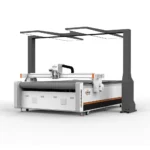
Tool head selection per material — RT-D2516/RT-S2516 supports oscillating, pneumatic, drag knife, creasing wheel and punching heads so the cutting method matches the hide type rather than forcing one blade through everything.
Technical Specifications
| Parameter | Value |
|---|---|
| Model | RT-D2516 / RT-S2516 |
| Product Type | CNC Oscillating Knife Cutting Machine with Auto Feeding |
| Working Area | 1600 × 2500 mm |
| Machine Size | 3450 × 2300 × 1250 mm |
| Rated Power | 9 kW |
| Table Type | Flat working table or auto feeding table (configurable) |
| Translational Velocity | 800–2000 mm/s |
| Cutting Speed | 200–800 mm/s (varies with material) |
| Cutting Thickness | Up to 100 mm (material dependent) |
| Repeated Accuracy | ≤ 0.1 mm |
| Vacuum Pump | 7.5 kW, aviation aluminum shell with built-in silencer |
| Vacuum Table Surface | Magnesium-aluminum alloy, PVDF powder spraying, anodic and hard oxidation |
| Transmission System | Digital servo motor, linear guide, synchronous belt, ball screw |
| Linear Guide | Taiwan Hiwin rail |
| Control Panel | Touch screen, multi-language support |
| Voltage | 380V ± 10% |
| Instruction Format | HP-GL compatible |
| Visual Positioning | Small CCD mark point, panoramic camera recognition, or projection positioning |
| Software File Support | PLT, DXF, AI |
| Conveyor Belt | Germany imported |
| Servo Motor | Delta (Taiwan) or Panasonic (Japan) |
Application Suitability
| Application | Material or Output |
|---|---|
| Genuine leather cutting for footwear and luggage | Full-grain, split and corrected hides up to moderate thickness |
| Automotive interior trim panels | Synthetic leather, PVC and PU composite with foam backing |
| Shoe upper and insole production | PU, EVA, sponge, non-woven fabric, textile layers |
| Soft furnishing and upholstery panels | Multi-layer fabric, carpet, composite foam |
| Gasket and sealing pad fabrication | Rubber, PTFE, ETFE, fiberglass sheet |
| Packaging sample and carton prototyping | Corrugated cardboard, sticker film, thin board |
Why Material Thickness Changes the Entire Specification
A buyer selects a machine based on working area, then discovers the oscillating knife cannot push through a multi-layer composite at production speed — the edge tears, the vacuum loses grip, and the line stops.
The cutting method and tool head must be matched to the actual material stack, not just the sheet dimensions.
I have seen automotive interior shops order a flat table for synthetic leather, only to find the hide was bonded to a 5 mm foam layer. The standard oscillating knife compressed the foam instead of slicing it, leaving ragged edges that failed downstream quality checks. Swapping to a high-power vibrating knife with adjusted downforce solved the problem, but only after two days of downtime [NEED_CITE: common causes of cutting edge defects in multi-layer composites]. The same pattern repeats with genuine leather — a drag knife handles thin upholstery hides cleanly, but thicker saddle leather needs a pneumatic knife with deeper stroke. This is why we insist on sample cutting before confirming the configuration.
Matching the Cutting Method to the Hide
Leather is not a single material. Full-grain hides behave differently from corrected grain, and synthetic PU革 cuts nothing like bonded leather with a foam core. The RT-D2516/RT-S2516 offers oscillating, pneumatic, drag knife, circular knife and V-cutting heads that can be selected individually or combined on the multifunctional head. A footwear producer cutting thin garment leather might run a drag knife for speed, while a luggage manufacturer working 4 mm cowhide needs the pneumatic option for clean penetration. The CNC oscillating knife cutting machine for sale here does not assume one blade fits all.
Vacuum Zoning and Small Part Fixing
When cutting small leather components like shoe vamp pieces or bag hardware tabs, the vacuum must hold each part independently. The magnesium-aluminum alloy table on this machine uses PVDF coating and hard oxidation to maintain flatness across the full 1600 × 2500 mm surface. Zoned vacuum channels let the operator activate suction only under active cutting zones, preventing small pieces from lifting or shifting mid-cut [NEED_CITE: vacuum table zoning principles for small-part digital cutting]. Without proper zoning, even the best knife produces dimensional drift on parts under 50 mm across.
Reading the Specs Against Real Production
Cutting speed is listed at 200–800 mm/s, but the actual throughput depends on material density, layer count and contour complexity. A straight cut through thin PU runs at the upper end; a curved contour through multi-layer composite leather drops toward the lower boundary. The digital servo motor and Hiwin linear guide maintain ≤ 0.1 mm repeatability regardless of speed, which matters when nesting dozens of shoe pattern pieces on a single hide where cumulative error wastes expensive material. The 7.5 kW vacuum pump with integrated silencer keeps suction stable without adding workshop noise — a detail that matters during full-shift operation. Touch screen control with selectable languages means the operator does not need to memorize parameter codes.
What Wrong Tool Head Selection Costs on the Floor
Choosing an oscillating knife for a material that actually needs a pneumatic or high-power vibrating head does not just produce bad edges. The blade chatters through foam-backed composites, generating dust that clogs the vacuum channels and reduces holding force across the table. Operators compensate by slowing the feed rate, which drops throughput below the line’s target output. Over weeks, the incorrect downforce wears the knife holder bearings prematurely [NEED_CITE: tool head wear patterns under incorrect load conditions]. I have walked into workshops where the machine was blamed, when the real issue was a configuration decided before anyone saw the actual material.
Why Procurement Starts With the Material Sample
REALTOP designs and builds both knife and laser cutting systems in-house, so the decision between oscillating knife and CO2 laser for edge-sealed synthetics is made on material behavior, not product catalog convenience. Every configuration — from knife type to vacuum table zoning to conveyor versus flat table — is specified against the buyer’s actual material sample. The sample cutting report documents edge quality, cutting speed and achievable accuracy on that specific hide or composite before any commercial commitment. Voltage, plug type and control language are confirmed to match the destination market. This avoids the situation where a machine arrives and the operator cannot read the interface or the electrical panel does not match the workshop supply [NEED_CITE: voltage mismatch incidents in exported industrial machinery].
Documentation & Verification
- Machine specification sheet confirming working area, tool head list and voltage for your market
- Sample cutting report on your leather or composite material with edge quality photographs
- Electrical schematic and voltage confirmation document before shipment
- Software licence with PLT/DXF/AI file format compatibility note for your nesting workflow
- Factory test record documenting repeatability and vacuum performance on your material thickness
Installation, Commissioning & Support
- 9 kW rated power requires a dedicated 380V ± 10% circuit with appropriate breaker sizing
- Machine footprint of 3450 × 2300 mm needs level concrete floor with clearance for auto feeding conveyor
- Touch screen control configured to operator language before commissioning on site
- First-run parameter tuning on your leather type to establish cutting speed and vacuum zone settings
- Tool head changeover training covering oscillating, pneumatic and drag knife swap procedures
- Spare knife blade and vacuum seal kit supplied for initial production period
What to Include With Your Inquiry
Send the leather type — genuine, synthetic, bonded or composite — along with thickness range and typical sheet dimensions. If you run printed contour work, specify whether you need CCD mark point or panoramic camera recognition. Confirm your workshop voltage and frequency so the electrical configuration matches before dispatch.
Frequently Asked Questions
Q: How do I choose between oscillating knife and laser for my leather application?
A: Knife cutting handles thick hides and multi-layer composites without burning or discoloring edges, which matters for visible surfaces on footwear and automotive interiors. Laser works for thin synthetic leather where edge sealing prevents fraying. The right choice depends on your specific material and the downstream finish requirement, which is why sample cutting on your actual stock comes first.
Q: What working area and table options are available?
A: The RT-D2516/RT-S2516 provides a 1600 × 2500 mm working area on either a flat table for batch cutting or an auto feeding conveyor for roll and continuous sheet processing. The choice depends on whether your material arrives as individual hides or rolls, and your daily volume target.
Q: How do I match the right tool head to my material?
A: Send a sample of your actual material — including any backing layers — for test cutting. We run your stock through the candidate tool heads and document which one produces the cleanest edge at production speed. This report confirms the configuration before you commit to the order.
Q: What voltage and language options are supported?
A: The standard voltage is 380V ± 10%, configurable for destination market requirements. The touch screen control panel supports English, Russian, Italian and Chinese, with other languages available on request. Electrical schematics and plug type are confirmed during the specification stage before production begins.
Q: Can I test my material before ordering?
A: Yes. Send your leather, composite or foam sample to our facility and we run it on the configured machine. You receive a cutting report showing edge quality, achievable speed and accuracy on your specific material, so the specification is proven before the machine is built.










商品评价
There are no reviews yet.