

Fast Delivery
Quick, reliable shipping to any location.

Free & easy returns
Return this item by mail or in store within 90 days for a full refund.
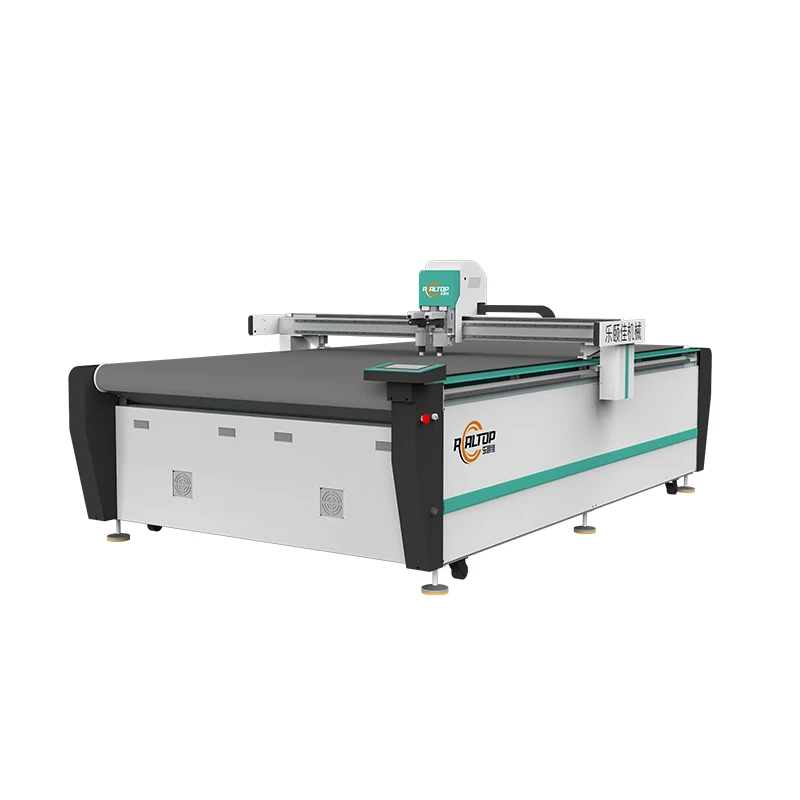
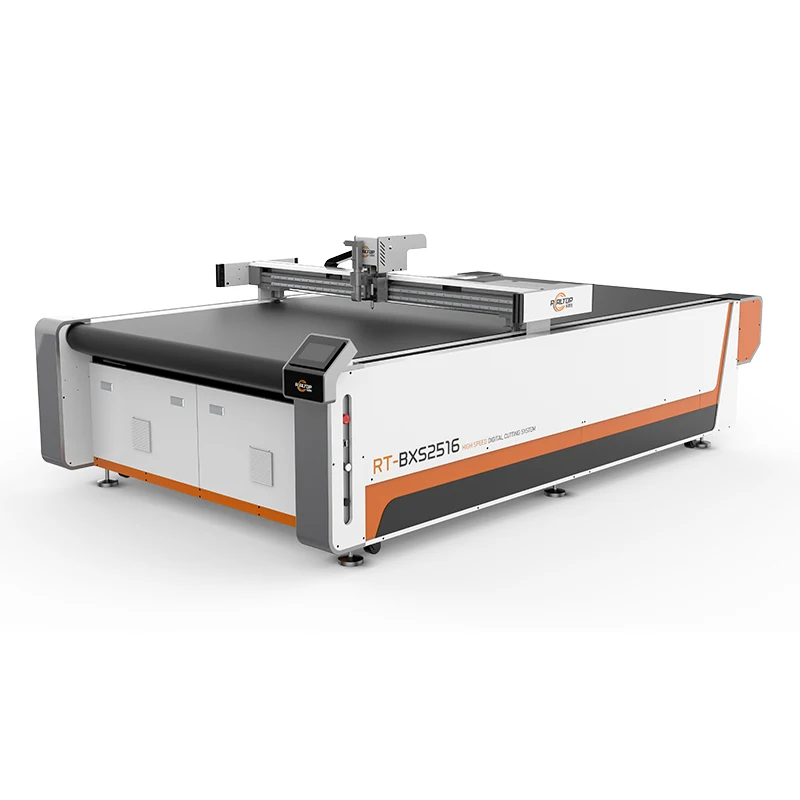
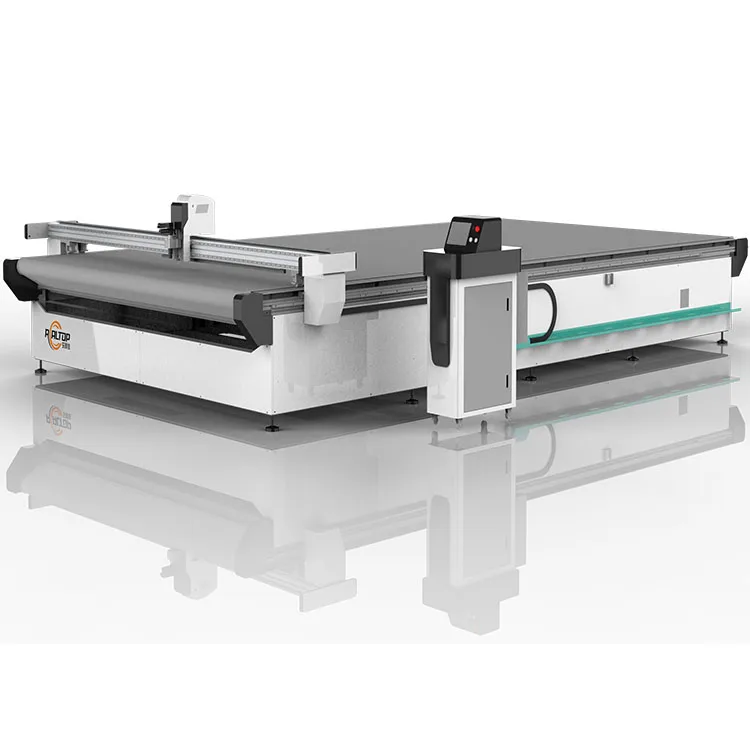
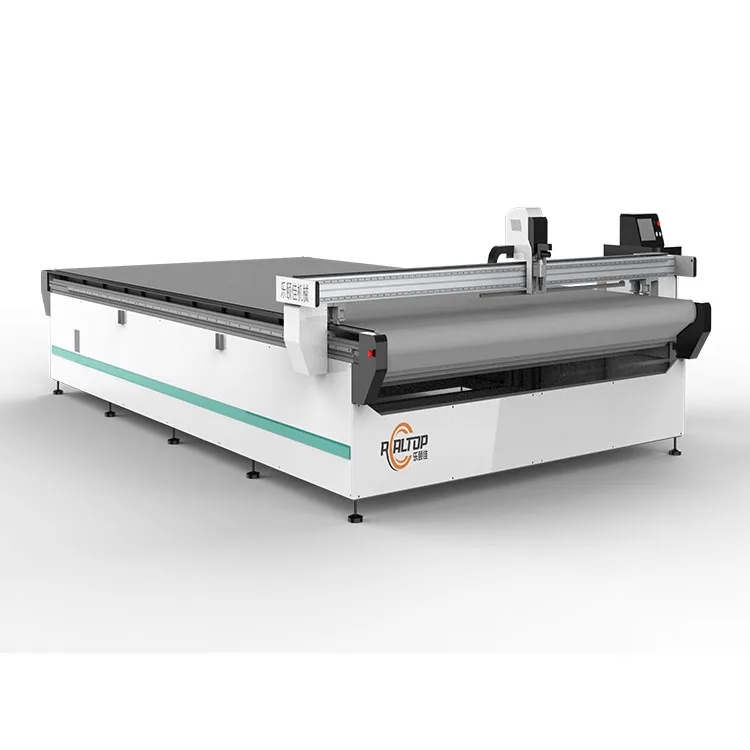
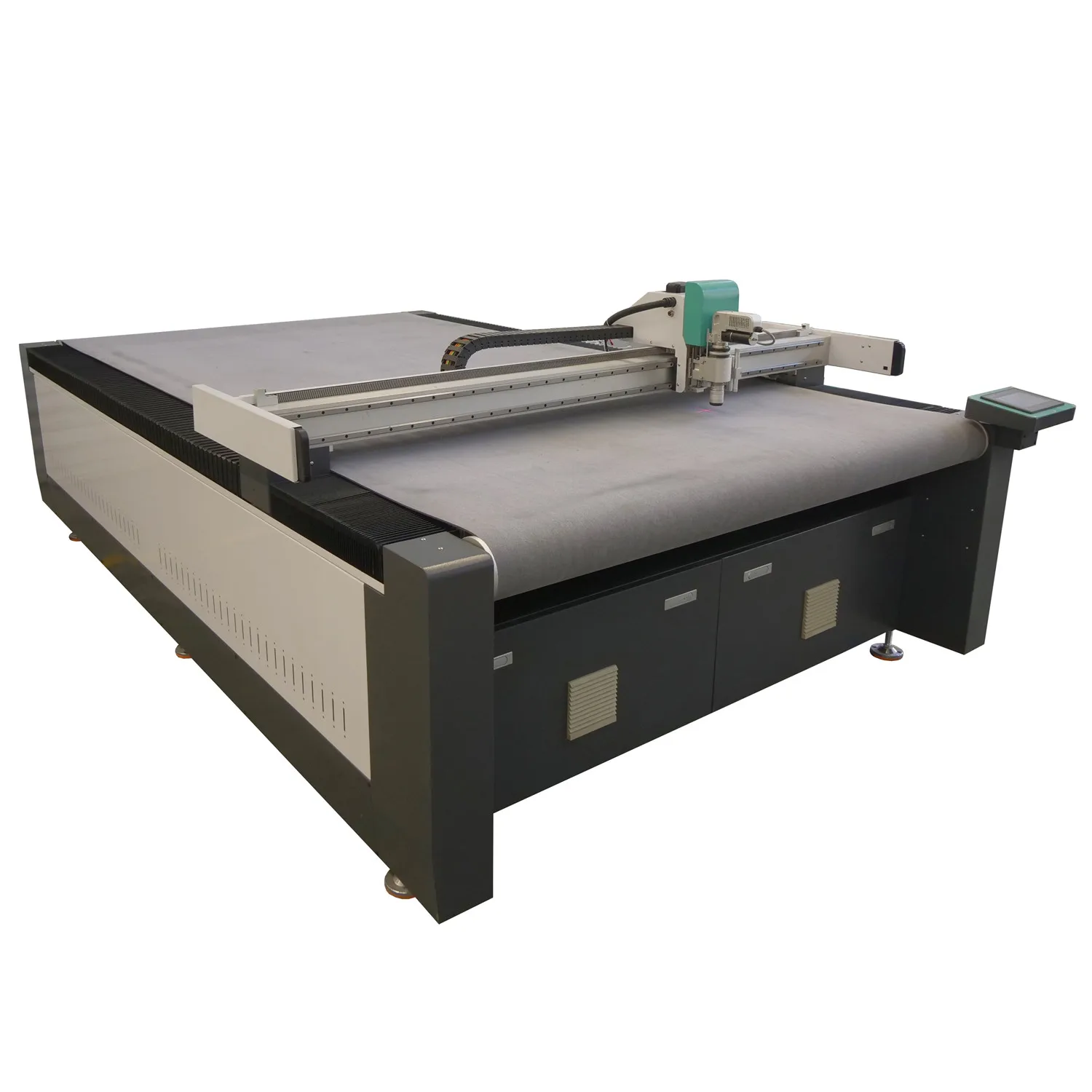
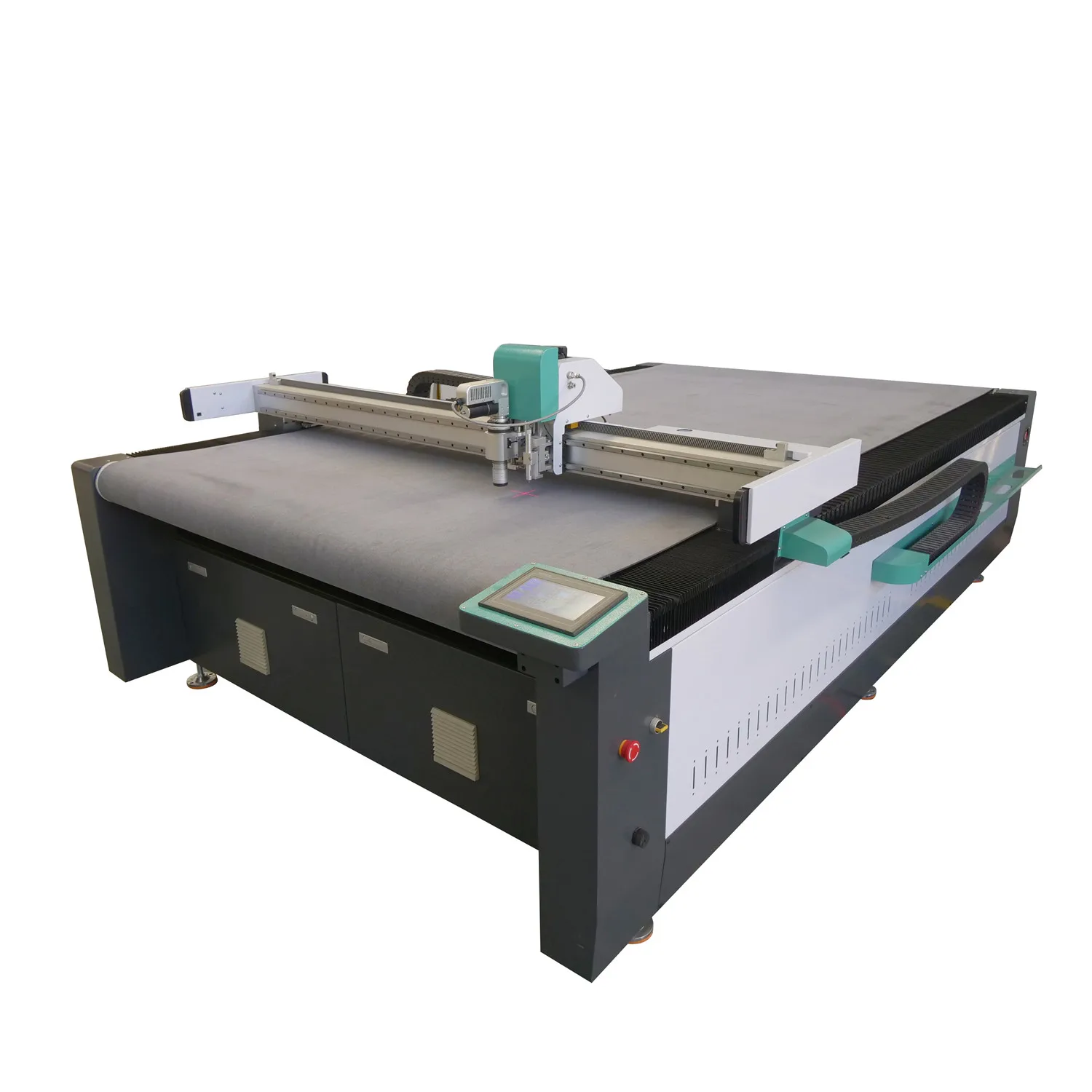
Precision cutting starts with matching the tool head to your material — we test your actual fabric or composite sample on the RT-D2516/RT-S2516 before any configuration is locked in, so you never pay for a capability that fails at production speed.
Technical Specifications
| Parameter | Value |
|---|---|
| Model | RT-D2516/RT-S2516 |
| Product Type | CNC Oscillating Knife Cutting Machine |
| Working Area | 1600×2500mm |
| Machine Size (Overall Dimensions) | 3450×2300×1250mm |
| Rated Power | 9kW |
| Voltage | 380V±10% |
| Translational Velocity | 800-2000mm/s |
| Cutting Speed | 200-800mm/s (varies with material) |
| Cutting Thickness | ≤100mm (varies with the material) |
| Repeatability | ≤0.1mm |
| Transmission System | Digital servo motor, linear guide, synchronous belt, ball screw (imported) |
| Servo Motor Options | Delta (China) or Panasonic (Japan) |
| Safety Device | Infrared sensors, anti-collision, emergency stop |
| Table Type | Flat working table or auto feeding table |
| Tool Head Options | Swiss imported knife, oscillating knife, pneumatic knife, high-power vibrating knife, circular knife, V-cutting knife, drag knife, creasing wheel, dotted line knife, punching, brush |
| Visual Positioning Options | Small CCD camera mark point positioning, panoramic camera recognition, projection positioning |
| Software File Formats | PLT, DXF, AI |
| Instruction System | HP-GL compatible format |
| Vacuum Table | Magnesium-aluminum alloy with PVDF powder spraying, anodic oxidation, hard oxidation |
| Vacuum Pump | 7.5kW, integrated aviation aluminum shell with built-in silencer sponge |
| Control Panel | Touch screen, multiple language support |
| Linear Rail | Taiwan Hiwin |
| Conveyor Belt | Germany imported (auto feeding version) |
| Assembly State | Fully assembled (split box supported for transportation) |
| Certification | CE |
| Warranty | One year free warranty |
Application Suitability
| Application | Material or Output |
|---|---|
| Garment and footwear cutting | Clothing cloth, shoe material, non-woven fabric, multi-layer fabric layups |
| Leather goods production | Genuine leather, PU, EVA, synthetic leather hides |
| Automotive interior fabrication | Automotive carpet, floor mats, headliner material, gasket composites |
| Packaging and carton sample making | Corrugated cardboard, sticker, plastic box, film |
| Soft furnishing and carpet cutting | Carpet, sponge, XPE foam, soft home textile composites |
| Sealing and gasket fabrication | PTFE, ETFE, rubber, rubber sheet, composite gasket stock |
| Advertising and signage | PVC, foam board, corrugated board, vinyl sheet |
Why "It Cuts Up to 100mm" Can Still Mean the Wrong CNC Oscillating Knife Cutting Machine
Cutting thickness is material-dependent — the same blade that slices cleanly through 80mm sponge will crush layered automotive leather at that depth.
I once walked into a factory where the owner had purchased a flatbed cutter purely on working area. The machine could handle the 1600×2500mm sheet size, but when they ran thick composite gasket material at full speed, the oscillating knife left ragged edges and the vacuum table could not hold the smaller offcuts flat. That mismatch between the spec sheet and the shop floor reality is something a CNC Oscillating Knife Cutting Machine manufacturer must help you avoid before the order is placed [NEED_CITE: material-specific cutting performance varies with density and fiber structure]. The RT-D2516/RT-S2516 line addresses this by offering multiple tool head types and vacuum zoning that can be matched to your actual stock, not just a generic thickness claim.
Surveying the Full Cutter Range: Knife Versus Laser for Fabric and Composites
Not every soft material should be cut with a blade, and not every synthetic should be cut with a laser. The RT-D2516/RT-S2516 is one part of a complete cutting equipment range that spans oscillating knife, drag knife, CO2 laser, and fiber laser technologies. The advantage of sourcing from a single CNC Oscillating Knife Cutting Machine manufacturer with in-house design capability is that you can compare the edge quality, sealing effect, and throughput of each method on your actual material — rather than being locked into a single process because that is all a supplier offers.
Working Area, Table Type, and Daily Volume Alignment
The 1600×2500mm working area covers most standard sheet goods in apparel, automotive interiors, and signage. The flat working table suits batch operations where sheets are loaded manually, while the auto feeding table with its Germany-imported conveyor belt supports continuous roll-fed cutting for high-volume textile or non-woven fabric runs. Choosing between them depends on your daily cut volume and whether your upstream material arrives in rolls or flat sheets [NEED_CITE: production volume thresholds for automated material feeding systems].
Reading the Spec Sheet: What the Numbers Actually Mean on the Shop Floor
The 9kW rated power accounts for the servo drives, vacuum pump, and control electronics running simultaneously — this matters when sizing your workshop electrical supply. The 7.5kW vacuum pump with its integrated aviation aluminum shell and built-in silencer sponge keeps noise contained, which is practical in mixed-use factory environments. Taiwan Hiwin linear rails paired with imported ball screws deliver the ≤0.1mm repeatability needed when nesting dozens of garment pattern pieces from a single hide. The Delta or Panasonic servo motor options let buyers choose between cost-efficient domestic supply and Japanese motion control, depending on how much precision the target material demands. Translational velocity of 800-2000mm/s refers to non-cutting travel, while actual cutting speed of 200-800mm/s shifts with material hardness and thickness — a dense composite gasket will sit at the lower end, while single-layer polyester fabric runs closer to the upper limit.
The Cost of Choosing the Wrong Tool Head for Your Material
Selecting a drag knife for thick foam produces compressed, torn edges instead of the clean slice an oscillating knife delivers. Conversely, running an oscillating head on thin vinyl film can overcut and leave micro-tears. Buyers who skip the sample-cutting step often discover these mismatches only after installation, when re-tooling means a new knife assembly, re-calibration, and potentially a new vacuum table zone map [NEED_CITE: tool head material compatibility in digital flatbed cutting]. The RT-D2516/RT-S2516 range mitigates this by making the Swiss imported knife, pneumatic knife, circular knife, V-cutting knife, and punching tools available as selectable configurations tied to the material you send us for testing.
Why Source This Equipment From REALTOP
In-house design covers both knife and laser technologies, so the RT-D2516/RT-S2516 is positioned against laser alternatives on real cutting data — not marketing claims. Every tool head and table configuration is specified per material sample, meaning your quotation reflects actual test results on the fabric, foam, or composite you will run daily. CCD camera positioning, panoramic recognition, and projection positioning are available as options, selected only if your production involves printed contour work that needs it. Software file format compatibility with PLT, DXF, and AI is confirmed before the order is signed, not discovered during commissioning. Voltage at 380V±10% is adjustable, and control language is selectable from English, Russian, Italian, Chinese, or custom languages — all verified before shipment.
Documentation & Verification
- Machine specification sheet listing your selected tool heads and table type for the RT-D2516/RT-S2516
- Sample cutting report on your exact material with photos of edge quality achieved
- Electrical schematic and voltage confirmation matching your local power grid standard
- Software licence and file format compatibility note confirming PLT, DXF, and AI import
- Factory test record showing repeatability measurement on your target material before dispatch
- Packing photographs documenting the machine condition prior to container loading
Installation, Commissioning & Support
- Overall dimensions of 3450×2300×1250mm require clear floor space plus service access on three sides
- The 9kW rated power draw and 380V±100% supply need a dedicated circuit with proper earthing
- Split-box transport supported; full reassembly and leveling completed at your site
- First-run parameter setting for your specific material thickness and cutting speed during commissioning
- Operator training on the touch screen control panel in your chosen language (English, Russian, Italian, Chinese, or custom)
- Spare parts list provided, covering consumable blades, vacuum seals, and belt sections
- One-year free warranty covering both domestic and overseas installations
What to Include in Your Inquiry
Send us the exact material type, thickness range, and maximum sheet or roll width you plan to cut. Include your estimated daily volume and whether your stock arrives flat or on rolls so we can recommend the flat table or auto feeding configuration. Let us know your local voltage and frequency standard, preferred control language, and whether you want us to run a sample cut on your own material before the quotation is finalized.
Frequently Asked Questions
Q: How do I decide between knife cutting and laser cutting for my fabric or composite material?
A: Knife cutting suits materials where a sealed edge is not required and where multi-layer stacking is needed. Laser cutting works better for synthetics that benefit from edge sealing and fine detail. We test your actual material with both methods and provide sample reports so the decision is based on edge quality and throughput, not assumption.
Q: Should I choose the flat table or auto feeding table for my production volume?
A: The flat working table fits batch-style cutting of pre-cut sheets or hides. The auto feeding table with its Germany-imported conveyor belt is suited to continuous roll-fed runs of fabric or non-woven material. Your daily volume and material format determine which table type gives better material yield and operator efficiency.
Q: Which tool head should I specify for my material and thickness?
A: Tool head selection depends on material density and the cut profile you need. Oscillating knives handle foam and thick composites, drag knives suit thin vinyl and sticker, and creasing wheels score corrugated board. We run your material on multiple heads and recommend the configuration that delivers the cleanest edge at production speed.
Q: How are voltage, plug type, and control language confirmed before shipment?
A: We collect your local voltage and frequency standard, plug type, and preferred interface language during the quotation stage. The control panel supports English, Russian, Italian, Chinese, and custom languages. An electrical schematic confirming all settings is shared for approval before the machine leaves the factory.
Q: How does sample cutting on my own material work before I commit to an order?
A: You send us a representative sample of your material — including any lamination or backing layers. We run it on the RT-D2516/RT-S2516 with the tool heads under consideration, document edge quality and cutting speed, and deliver a sample cutting report. You approve the configuration before the final quotation is issued.
Precision cutting starts with matching the tool head to your material — we test your actual fabric or composite sample on the RT-D2516/RT-S2516 before any configuration is locked in, so you never pay for a capability that fails at production speed.
Technical Specifications
| Parameter | Value |
|---|---|
| Model | RT-D2516/RT-S2516 |
| Product Type | CNC Oscillating Knife Cutting Machine |
| Working Area | 1600×2500mm |
| Machine Size (Overall Dimensions) | 3450×2300×1250mm |
| Rated Power | 9kW |
| Voltage | 380V±10% |
| Translational Velocity | 800-2000mm/s |
| Cutting Speed | 200-800mm/s (varies with material) |
| Cutting Thickness | ≤100mm (varies with the material) |
| Repeatability | ≤0.1mm |
| Transmission System | Digital servo motor, linear guide, synchronous belt, ball screw (imported) |
| Servo Motor Options | Delta (China) or Panasonic (Japan) |
| Safety Device | Infrared sensors, anti-collision, emergency stop |
| Table Type | Flat working table or auto feeding table |
| Tool Head Options | Swiss imported knife, oscillating knife, pneumatic knife, high-power vibrating knife, circular knife, V-cutting knife, drag knife, creasing wheel, dotted line knife, punching, brush |
| Visual Positioning Options | Small CCD camera mark point positioning, panoramic camera recognition, projection positioning |
| Software File Formats | PLT, DXF, AI |
| Instruction System | HP-GL compatible format |
| Vacuum Table | Magnesium-aluminum alloy with PVDF powder spraying, anodic oxidation, hard oxidation |
| Vacuum Pump | 7.5kW, integrated aviation aluminum shell with built-in silencer sponge |
| Control Panel | Touch screen, multiple language support |
| Linear Rail | Taiwan Hiwin |
| Conveyor Belt | Germany imported (auto feeding version) |
| Assembly State | Fully assembled (split box supported for transportation) |
| Certification | CE |
| Warranty | One year free warranty |
Application Suitability
| Application | Material or Output |
|---|---|
| Garment and footwear cutting | Clothing cloth, shoe material, non-woven fabric, multi-layer fabric layups |
| Leather goods production | Genuine leather, PU, EVA, synthetic leather hides |
| Automotive interior fabrication | Automotive carpet, floor mats, headliner material, gasket composites |
| Packaging and carton sample making | Corrugated cardboard, sticker, plastic box, film |
| Soft furnishing and carpet cutting | Carpet, sponge, XPE foam, soft home textile composites |
| Sealing and gasket fabrication | PTFE, ETFE, rubber, rubber sheet, composite gasket stock |
| Advertising and signage | PVC, foam board, corrugated board, vinyl sheet |
Why "It Cuts Up to 100mm" Can Still Mean the Wrong CNC Oscillating Knife Cutting Machine
Cutting thickness is material-dependent — the same blade that slices cleanly through 80mm sponge will crush layered automotive leather at that depth.
I once walked into a factory where the owner had purchased a flatbed cutter purely on working area. The machine could handle the 1600×2500mm sheet size, but when they ran thick composite gasket material at full speed, the oscillating knife left ragged edges and the vacuum table could not hold the smaller offcuts flat. That mismatch between the spec sheet and the shop floor reality is something a CNC Oscillating Knife Cutting Machine manufacturer must help you avoid before the order is placed [NEED_CITE: material-specific cutting performance varies with density and fiber structure]. The RT-D2516/RT-S2516 line addresses this by offering multiple tool head types and vacuum zoning that can be matched to your actual stock, not just a generic thickness claim.
Surveying the Full Cutter Range: Knife Versus Laser for Fabric and Composites
Not every soft material should be cut with a blade, and not every synthetic should be cut with a laser. The RT-D2516/RT-S2516 is one part of a complete cutting equipment range that spans oscillating knife, drag knife, CO2 laser, and fiber laser technologies. The advantage of sourcing from a single CNC Oscillating Knife Cutting Machine manufacturer with in-house design capability is that you can compare the edge quality, sealing effect, and throughput of each method on your actual material — rather than being locked into a single process because that is all a supplier offers.
Working Area, Table Type, and Daily Volume Alignment
The 1600×2500mm working area covers most standard sheet goods in apparel, automotive interiors, and signage. The flat working table suits batch operations where sheets are loaded manually, while the auto feeding table with its Germany-imported conveyor belt supports continuous roll-fed cutting for high-volume textile or non-woven fabric runs. Choosing between them depends on your daily cut volume and whether your upstream material arrives in rolls or flat sheets [NEED_CITE: production volume thresholds for automated material feeding systems].
Reading the Spec Sheet: What the Numbers Actually Mean on the Shop Floor
The 9kW rated power accounts for the servo drives, vacuum pump, and control electronics running simultaneously — this matters when sizing your workshop electrical supply. The 7.5kW vacuum pump with its integrated aviation aluminum shell and built-in silencer sponge keeps noise contained, which is practical in mixed-use factory environments. Taiwan Hiwin linear rails paired with imported ball screws deliver the ≤0.1mm repeatability needed when nesting dozens of garment pattern pieces from a single hide. The Delta or Panasonic servo motor options let buyers choose between cost-efficient domestic supply and Japanese motion control, depending on how much precision the target material demands. Translational velocity of 800-2000mm/s refers to non-cutting travel, while actual cutting speed of 200-800mm/s shifts with material hardness and thickness — a dense composite gasket will sit at the lower end, while single-layer polyester fabric runs closer to the upper limit.
The Cost of Choosing the Wrong Tool Head for Your Material
Selecting a drag knife for thick foam produces compressed, torn edges instead of the clean slice an oscillating knife delivers. Conversely, running an oscillating head on thin vinyl film can overcut and leave micro-tears. Buyers who skip the sample-cutting step often discover these mismatches only after installation, when re-tooling means a new knife assembly, re-calibration, and potentially a new vacuum table zone map [NEED_CITE: tool head material compatibility in digital flatbed cutting]. The RT-D2516/RT-S2516 range mitigates this by making the Swiss imported knife, pneumatic knife, circular knife, V-cutting knife, and punching tools available as selectable configurations tied to the material you send us for testing.
Why Source This Equipment From REALTOP
In-house design covers both knife and laser technologies, so the RT-D2516/RT-S2516 is positioned against laser alternatives on real cutting data — not marketing claims. Every tool head and table configuration is specified per material sample, meaning your quotation reflects actual test results on the fabric, foam, or composite you will run daily. CCD camera positioning, panoramic recognition, and projection positioning are available as options, selected only if your production involves printed contour work that needs it. Software file format compatibility with PLT, DXF, and AI is confirmed before the order is signed, not discovered during commissioning. Voltage at 380V±10% is adjustable, and control language is selectable from English, Russian, Italian, Chinese, or custom languages — all verified before shipment.
Documentation & Verification
- Machine specification sheet listing your selected tool heads and table type for the RT-D2516/RT-S2516
- Sample cutting report on your exact material with photos of edge quality achieved
- Electrical schematic and voltage confirmation matching your local power grid standard
- Software licence and file format compatibility note confirming PLT, DXF, and AI import
- Factory test record showing repeatability measurement on your target material before dispatch
- Packing photographs documenting the machine condition prior to container loading
Installation, Commissioning & Support
- Overall dimensions of 3450×2300×1250mm require clear floor space plus service access on three sides
- The 9kW rated power draw and 380V±100% supply need a dedicated circuit with proper earthing
- Split-box transport supported; full reassembly and leveling completed at your site
- First-run parameter setting for your specific material thickness and cutting speed during commissioning
- Operator training on the touch screen control panel in your chosen language (English, Russian, Italian, Chinese, or custom)
- Spare parts list provided, covering consumable blades, vacuum seals, and belt sections
- One-year free warranty covering both domestic and overseas installations
What to Include in Your Inquiry
Send us the exact material type, thickness range, and maximum sheet or roll width you plan to cut. Include your estimated daily volume and whether your stock arrives flat or on rolls so we can recommend the flat table or auto feeding configuration. Let us know your local voltage and frequency standard, preferred control language, and whether you want us to run a sample cut on your own material before the quotation is finalized.
Frequently Asked Questions
Q: How do I decide between knife cutting and laser cutting for my fabric or composite material?
A: Knife cutting suits materials where a sealed edge is not required and where multi-layer stacking is needed. Laser cutting works better for synthetics that benefit from edge sealing and fine detail. We test your actual material with both methods and provide sample reports so the decision is based on edge quality and throughput, not assumption.
Q: Should I choose the flat table or auto feeding table for my production volume?
A: The flat working table fits batch-style cutting of pre-cut sheets or hides. The auto feeding table with its Germany-imported conveyor belt is suited to continuous roll-fed runs of fabric or non-woven material. Your daily volume and material format determine which table type gives better material yield and operator efficiency.
Q: Which tool head should I specify for my material and thickness?
A: Tool head selection depends on material density and the cut profile you need. Oscillating knives handle foam and thick composites, drag knives suit thin vinyl and sticker, and creasing wheels score corrugated board. We run your material on multiple heads and recommend the configuration that delivers the cleanest edge at production speed.
Q: How are voltage, plug type, and control language confirmed before shipment?
A: We collect your local voltage and frequency standard, plug type, and preferred interface language during the quotation stage. The control panel supports English, Russian, Italian, Chinese, and custom languages. An electrical schematic confirming all settings is shared for approval before the machine leaves the factory.
Q: How does sample cutting on my own material work before I commit to an order?
A: You send us a representative sample of your material — including any lamination or backing layers. We run it on the RT-D2516/RT-S2516 with the tool heads under consideration, document edge quality and cutting speed, and deliver a sample cutting report. You approve the configuration before the final quotation is issued.










商品评价
There are no reviews yet.