

Fast Delivery
Quick, reliable shipping to any location.

Free & easy returns
Return this item by mail or in store within 90 days for a full refund.
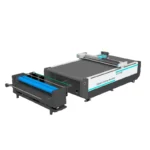
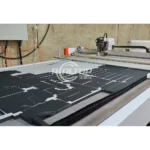
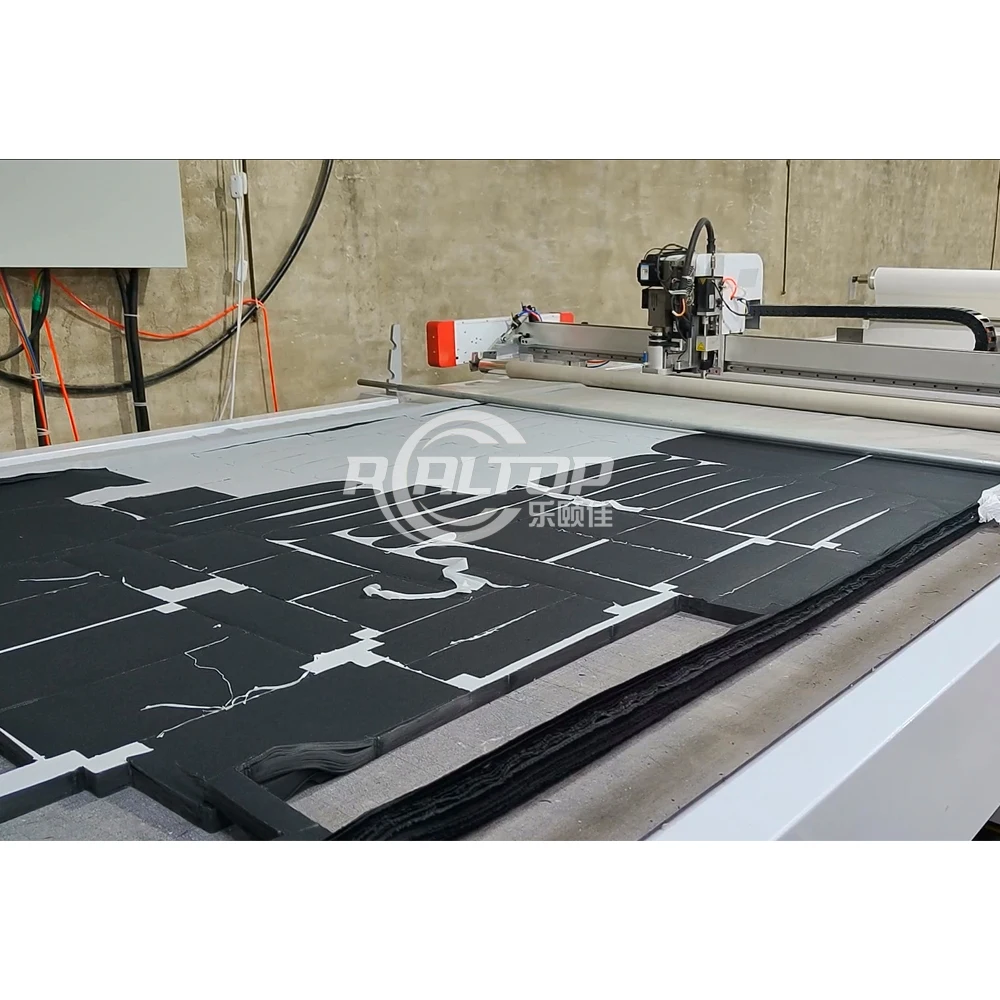
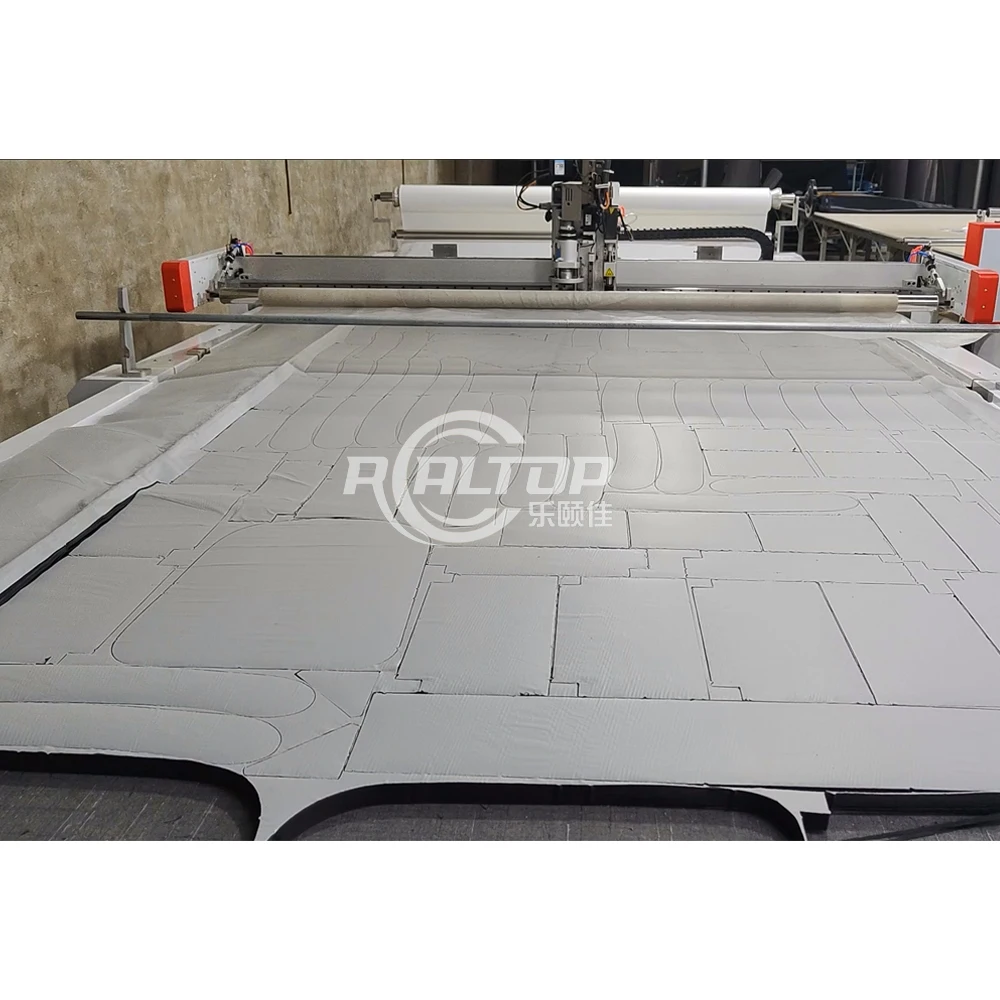
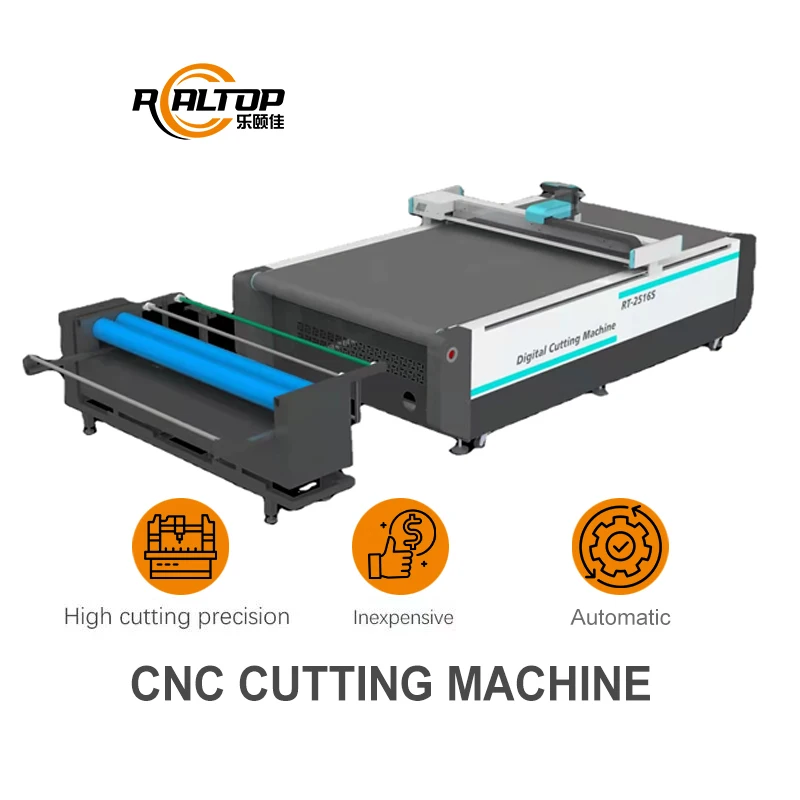
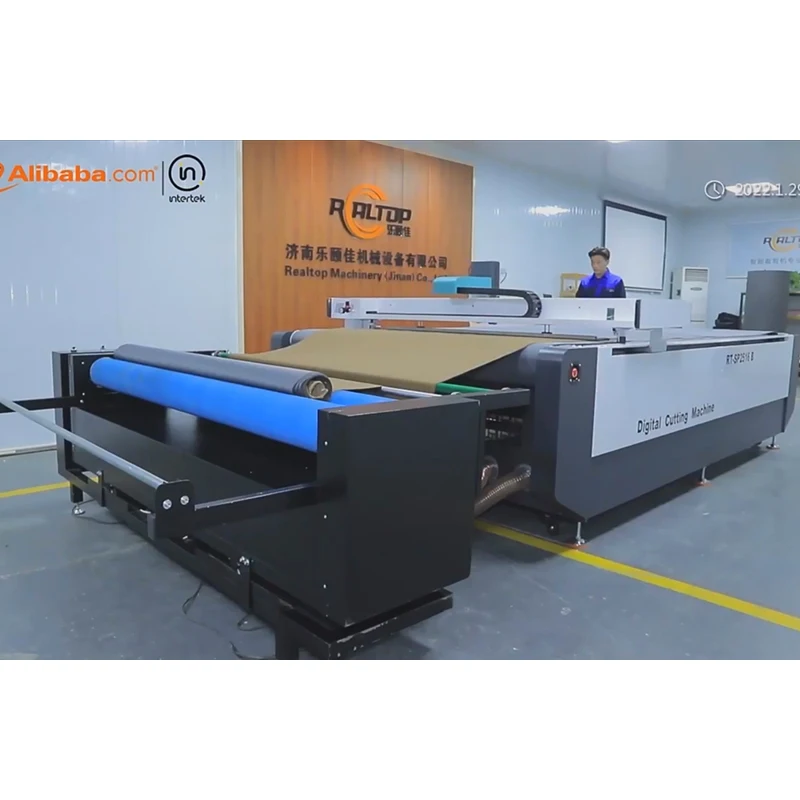
Modular cutting configuration — The RT-D2516/RT-S2516 platform supports interchangeable tool heads including vibration full cut, half cut, round knife and marking pen, allowing fabric and composite producers to match the cutting method to their specific material rather than force a single tooling solution across incompatible fabrics.
Technical Specifications
| Parameter | Value |
|---|---|
| Product Type | CNC Oscillating Knife Fabric Cutting Machine |
| Model | RT-D2516 / RT-S2516 |
| Working Area | 1600 × 2500 mm |
| Machine Size | 3450 × 2300 × 1250 mm |
| Rated Power | 9 kW |
| Working Table | Flat working table with high-density felt surface |
| Tool Head | Swiss imported knife with vibration full cutting, vibration half cutting and cursor location |
| Cutting Thickness | Up to 50 mm depending on material (basis to be confirmed) |
| Translational Velocity | 800 – 1200 mm/s |
| Repeated Accuracy | ≤ 0.1 mm |
| Transmission System | Digital servo motor, linear guide, synchronous belt, ball screw |
| Servo Motor | Panasonic (Delta option available) |
| Guide Rail | Taiwan Hiwin |
| Vacuum Pump | 7.5 kW |
| Conveyor Belt | Germany imported |
| Instruction System | HP-GL compatible format |
| Voltage | 380 V ± 10 % |
| Safety Device | Infrared sensors |
| Modular Tool Holder | Compatible with round knife, marking pen, auto feeder |
| Software Language | English, Russian, Italian, Chinese (other languages configurable) |
| Certification | CE |
Application Suitability
| Application | Material or Output |
|---|---|
| Garment and fashion production | Single and multi-layer woven, knit and technical textiles |
| Leather goods manufacturing | Natural leather, synthetic leather, sponge composite leather |
| Automotive interior fabrication | Upholstery fabrics, headliner materials, sound-deadening composites |
| Soft gasket and seal production | PVC, soft glass, silicon, rubber sheets |
| Footwear component cutting | Upper materials, lining fabrics, insole composites |
| Interior design material processing | Flexible decorative laminates, curtain and upholstery textiles |
What Buyers Overlook When Specifying a CNC Fabric Cutting Machine by Working Area Alone
A working area tells you the maximum sheet size, not whether the machine can hold your material flat and cut it cleanly at production speed.
I have watched production managers in Dubai workshops specify a flatbed cutter purely on table dimensions, only to discover during commissioning that their thick denim or multi-layer sponge composite shifts under the knife head. The vacuum zoning was designed for large panels, not small gasket pieces, and the oscillating frequency was too low for the material density. A CNC fabric cutting machine manufacturer that asks about your material type, thickness and daily volume before quoting a configuration is the one you want building your line [NEED_CITE: material hold-down requirements by fabric density and layer count].
Matching the Knife Head to Your Material Stack
The RT-D2516/RT-S2516 platform uses a modular tool holder that accepts vibration full-cut, vibration half-cut, round knife and marking pen attachments. A vibration knife suits dense woven textiles and sponge composites where the oscillation separates fibres cleanly without crushing the stack. A round knife handles single-ply technical fabrics and thin linings at higher travel speeds. Selecting the wrong tool head is one of the most common reasons buyers see ragged edges or delaminated composite layers after installation.
Vacuum Hold-Down and Small-Part Behaviour
The 7.5 kW vacuum pump paired with the high-density felt table surface provides consistent suction across the 1600 × 2500 mm bed. For garment nests with many small pattern pieces, vacuum zoning determines whether offcuts lift during the final passes. If your production mix includes both large automotive panels and small gasket profiles, confirming the table zoning layout before order prevents rework downstream [NEED_CITE: vacuum zoning design for mixed-part nesting on flatbed cutters].
Reading the Drive Train Against Your Tolerance Needs
The transmission combines Taiwan Hiwin linear guides with Panasonic digital servo motors and ball screws, delivering repeated accuracy within 0.1 mm. For fashion and leather goods, that tolerance keeps notch marks and drill points aligned across hundreds of nested pieces. The translational velocity range of 800 to 1200 mm/s means the control system can slow for intricate contours and accelerate on long straight runs. A servo-driven system of this specification outperforms stepper-based alternatives on repeat registration over a full shift.
The Hidden Cost of Confirming Configuration After Shipment
When voltage, software language and file format compatibility are left until the machine arrives, commissioning delays compound. I have seen garment workshops lose weeks because the control software could not import their existing DXF nesting files, and the electrical cabinet was wired for a 380 V supply when the facility runs on a different standard. Each of these oversights is preventable if the CNC fabric cutting machine manufacturer confirms specifications against your site conditions before production begins [NEED_CITE: electrical and software integration delays in imported CNC equipment].
Why Sourcing This CNC Fabric Cutting Machine Manufacturer Matters
The design team covers both knife and laser cutting technologies in-house, so the recommendation starts with your material rather than a single machine family. Tool head and table configuration are specified per material and production volume, not pulled from a default list. The HP-GL compatible instruction system with multi-language software support integrates with established nesting workflows without forcing a software change. Sample cutting on the buyer’s own material is completed before order commitment, providing a physical record of edge quality and cutting speed. Voltage, plug type and control language are confirmed in writing before the machine enters production.
Documentation & Verification
- Machine specification sheet listing the exact tool head, vacuum pump rating and table zoning for your material
- Electrical schematic confirming 380 V ± 10 % supply requirements and cabinet wiring layout
- Software licence and HP-GL file format compatibility note matched to your nesting workflow
- Sample cutting report produced on your fabric or composite before order confirmation
- Factory test record documenting repeated accuracy and translational velocity under load
- Operation and maintenance manual with spare parts list for the modular tool holder assembly
Installation, Commissioning & Support
- Floor space must accommodate the 3450 × 2300 × 1250 mm footprint plus operator access on three sides
- Dedicated 380 V ± 10 % circuit required to supply the combined 9 kW machine and 7.5 kW vacuum pump loads
- Machine ships as a single welded frame; table surface felt and conveyor belt are fitted during on-site assembly
- First-run calibration covers servo zeroing, vacuum zoning verification and knife depth setting for your material
- Operator training addresses tool head changeover between vibration, round knife and marking pen configurations
- Spare knife blades and felt replacement schedule provided based on your daily cutting volume
What to Include in Your Inquiry
To size the right configuration, provide your material type, maximum thickness, sheet dimensions and daily cutting volume. Note your local voltage standard and preferred control language. If you run an existing nesting software, share the file format so compatibility can be confirmed before the order is placed. Requesting sample cutting on your own material gives you a physical benchmark to evaluate before committing to a build.
Frequently Asked Questions
Q: How do I decide between oscillating knife, round knife and laser for my fabric?
A: Oscillating knife suits multi-layer woven textiles and sponge composites where clean separation without crushing is critical. Round knife handles single-ply linings and thin technical fabrics at higher speeds. Laser cuts synthetics with a sealed edge but produces burn marks on natural fibres. Share your material samples so the correct method is identified before configuration.
Q: What working area should I choose for my garment nesting workflow?
A: The 1600 × 2500 mm bed handles standard garment marker lengths efficiently. If your patterns include extended pieces such as curtain panels or automotive upholstery, a larger format table may reduce repositioning. Your daily volume and nesting software output determine whether a single large bed or dual smaller tables suit your throughput better.
Q: Which voltage and software language options can I specify?
A: Standard supply is 380 V ± 10 %, with other voltages configurable for your market. The control interface supports English, Russian, Italian and Chinese, with additional languages available on request. Confirm your site voltage and operator language before production so the electrical cabinet and HMI match your facility.
Q: Can I verify file format compatibility before ordering?
A: Yes. The HP-GL compatible instruction system accepts common nesting file formats. Provide sample files from your existing workflow, and a compatibility check is completed before the order is finalised. This prevents post-delivery delays caused by format conversion or nesting software replacement.
Q: Is sample cutting on my own material available before commitment?
A: Sample cutting is completed on your fabric, leather or composite before order confirmation. The sample report documents edge quality, cutting speed and material behaviour under the selected tool head, giving you a physical record to evaluate against your production standards.
Modular cutting configuration — The RT-D2516/RT-S2516 platform supports interchangeable tool heads including vibration full cut, half cut, round knife and marking pen, allowing fabric and composite producers to match the cutting method to their specific material rather than force a single tooling solution across incompatible fabrics.
Technical Specifications
| Parameter | Value |
|---|---|
| Product Type | CNC Oscillating Knife Fabric Cutting Machine |
| Model | RT-D2516 / RT-S2516 |
| Working Area | 1600 × 2500 mm |
| Machine Size | 3450 × 2300 × 1250 mm |
| Rated Power | 9 kW |
| Working Table | Flat working table with high-density felt surface |
| Tool Head | Swiss imported knife with vibration full cutting, vibration half cutting and cursor location |
| Cutting Thickness | Up to 50 mm depending on material (basis to be confirmed) |
| Translational Velocity | 800 – 1200 mm/s |
| Repeated Accuracy | ≤ 0.1 mm |
| Transmission System | Digital servo motor, linear guide, synchronous belt, ball screw |
| Servo Motor | Panasonic (Delta option available) |
| Guide Rail | Taiwan Hiwin |
| Vacuum Pump | 7.5 kW |
| Conveyor Belt | Germany imported |
| Instruction System | HP-GL compatible format |
| Voltage | 380 V ± 10 % |
| Safety Device | Infrared sensors |
| Modular Tool Holder | Compatible with round knife, marking pen, auto feeder |
| Software Language | English, Russian, Italian, Chinese (other languages configurable) |
| Certification | CE |
Application Suitability
| Application | Material or Output |
|---|---|
| Garment and fashion production | Single and multi-layer woven, knit and technical textiles |
| Leather goods manufacturing | Natural leather, synthetic leather, sponge composite leather |
| Automotive interior fabrication | Upholstery fabrics, headliner materials, sound-deadening composites |
| Soft gasket and seal production | PVC, soft glass, silicon, rubber sheets |
| Footwear component cutting | Upper materials, lining fabrics, insole composites |
| Interior design material processing | Flexible decorative laminates, curtain and upholstery textiles |
What Buyers Overlook When Specifying a CNC Fabric Cutting Machine by Working Area Alone
A working area tells you the maximum sheet size, not whether the machine can hold your material flat and cut it cleanly at production speed.
I have watched production managers in Dubai workshops specify a flatbed cutter purely on table dimensions, only to discover during commissioning that their thick denim or multi-layer sponge composite shifts under the knife head. The vacuum zoning was designed for large panels, not small gasket pieces, and the oscillating frequency was too low for the material density. A CNC fabric cutting machine manufacturer that asks about your material type, thickness and daily volume before quoting a configuration is the one you want building your line [NEED_CITE: material hold-down requirements by fabric density and layer count].
Matching the Knife Head to Your Material Stack
The RT-D2516/RT-S2516 platform uses a modular tool holder that accepts vibration full-cut, vibration half-cut, round knife and marking pen attachments. A vibration knife suits dense woven textiles and sponge composites where the oscillation separates fibres cleanly without crushing the stack. A round knife handles single-ply technical fabrics and thin linings at higher travel speeds. Selecting the wrong tool head is one of the most common reasons buyers see ragged edges or delaminated composite layers after installation.
Vacuum Hold-Down and Small-Part Behaviour
The 7.5 kW vacuum pump paired with the high-density felt table surface provides consistent suction across the 1600 × 2500 mm bed. For garment nests with many small pattern pieces, vacuum zoning determines whether offcuts lift during the final passes. If your production mix includes both large automotive panels and small gasket profiles, confirming the table zoning layout before order prevents rework downstream [NEED_CITE: vacuum zoning design for mixed-part nesting on flatbed cutters].
Reading the Drive Train Against Your Tolerance Needs
The transmission combines Taiwan Hiwin linear guides with Panasonic digital servo motors and ball screws, delivering repeated accuracy within 0.1 mm. For fashion and leather goods, that tolerance keeps notch marks and drill points aligned across hundreds of nested pieces. The translational velocity range of 800 to 1200 mm/s means the control system can slow for intricate contours and accelerate on long straight runs. A servo-driven system of this specification outperforms stepper-based alternatives on repeat registration over a full shift.
The Hidden Cost of Confirming Configuration After Shipment
When voltage, software language and file format compatibility are left until the machine arrives, commissioning delays compound. I have seen garment workshops lose weeks because the control software could not import their existing DXF nesting files, and the electrical cabinet was wired for a 380 V supply when the facility runs on a different standard. Each of these oversights is preventable if the CNC fabric cutting machine manufacturer confirms specifications against your site conditions before production begins [NEED_CITE: electrical and software integration delays in imported CNC equipment].
Why Sourcing This CNC Fabric Cutting Machine Manufacturer Matters
The design team covers both knife and laser cutting technologies in-house, so the recommendation starts with your material rather than a single machine family. Tool head and table configuration are specified per material and production volume, not pulled from a default list. The HP-GL compatible instruction system with multi-language software support integrates with established nesting workflows without forcing a software change. Sample cutting on the buyer’s own material is completed before order commitment, providing a physical record of edge quality and cutting speed. Voltage, plug type and control language are confirmed in writing before the machine enters production.
Documentation & Verification
- Machine specification sheet listing the exact tool head, vacuum pump rating and table zoning for your material
- Electrical schematic confirming 380 V ± 10 % supply requirements and cabinet wiring layout
- Software licence and HP-GL file format compatibility note matched to your nesting workflow
- Sample cutting report produced on your fabric or composite before order confirmation
- Factory test record documenting repeated accuracy and translational velocity under load
- Operation and maintenance manual with spare parts list for the modular tool holder assembly
Installation, Commissioning & Support
- Floor space must accommodate the 3450 × 2300 × 1250 mm footprint plus operator access on three sides
- Dedicated 380 V ± 10 % circuit required to supply the combined 9 kW machine and 7.5 kW vacuum pump loads
- Machine ships as a single welded frame; table surface felt and conveyor belt are fitted during on-site assembly
- First-run calibration covers servo zeroing, vacuum zoning verification and knife depth setting for your material
- Operator training addresses tool head changeover between vibration, round knife and marking pen configurations
- Spare knife blades and felt replacement schedule provided based on your daily cutting volume
What to Include in Your Inquiry
To size the right configuration, provide your material type, maximum thickness, sheet dimensions and daily cutting volume. Note your local voltage standard and preferred control language. If you run an existing nesting software, share the file format so compatibility can be confirmed before the order is placed. Requesting sample cutting on your own material gives you a physical benchmark to evaluate before committing to a build.
Frequently Asked Questions
Q: How do I decide between oscillating knife, round knife and laser for my fabric?
A: Oscillating knife suits multi-layer woven textiles and sponge composites where clean separation without crushing is critical. Round knife handles single-ply linings and thin technical fabrics at higher speeds. Laser cuts synthetics with a sealed edge but produces burn marks on natural fibres. Share your material samples so the correct method is identified before configuration.
Q: What working area should I choose for my garment nesting workflow?
A: The 1600 × 2500 mm bed handles standard garment marker lengths efficiently. If your patterns include extended pieces such as curtain panels or automotive upholstery, a larger format table may reduce repositioning. Your daily volume and nesting software output determine whether a single large bed or dual smaller tables suit your throughput better.
Q: Which voltage and software language options can I specify?
A: Standard supply is 380 V ± 10 %, with other voltages configurable for your market. The control interface supports English, Russian, Italian and Chinese, with additional languages available on request. Confirm your site voltage and operator language before production so the electrical cabinet and HMI match your facility.
Q: Can I verify file format compatibility before ordering?
A: Yes. The HP-GL compatible instruction system accepts common nesting file formats. Provide sample files from your existing workflow, and a compatibility check is completed before the order is finalised. This prevents post-delivery delays caused by format conversion or nesting software replacement.
Q: Is sample cutting on my own material available before commitment?
A: Sample cutting is completed on your fabric, leather or composite before order confirmation. The sample report documents edge quality, cutting speed and material behaviour under the selected tool head, giving you a physical record to evaluate against your production standards.










商品评价
There are no reviews yet.