


Fast Delivery
Quick, reliable shipping to any location.

Free & easy returns
Return this item by mail or in store within 90 days for a full refund.
Complete range mapping — Knife and laser platforms positioned by material and production volume, so packaging and signage buyers select the cutting method rather than force one technology across every job.
Technical Specifications
| Parameter | Value |
|---|---|
| Model | RT-D2516 / RT-S2516 |
| Working Area | 1600 × 2500 mm |
| Machine Size | 3450 × 2300 × 1250 mm |
| Rated Power | 9 kW |
| Vacuum Pump Power | 7.5 kW |
| Translational Velocity | 800–1200 mm/s |
| Repeated Accuracy | ≤0.1 mm |
| Voltage | 380V ± 10% |
| Servo Motor | Taiwan Delta |
| Linear Rail | Taiwan Hiwin |
| Tool Head | Swiss imported oscillating knife (full cut, half cut, cursor positioning) |
| Vacuum Table | Aluminum alloy honeycomb with automatic zone adsorption |
| Control Language Options | English, Russian, Italian, Chinese, special languages customizable |
| Instruction Format | HP-GL compatible |
| Conveyor Belt | Germany imported |
| Felt Belt | Wear-resistant anti-pull composite fiber |
| Frame | Welded thick square seamless steel with high temperature treatment |
| Safety Device | Infrared sensors |
Application Suitability
| Application | Material or Output |
|---|---|
| Corrugated carton sample making | Single, double and triple flute board up to rated knife stroke |
| Folding carton and gift box prototyping | Coated board, greyboard, kraft |
| Sticker and label contour cutting | Vinyl, self-adhesive film on release liner |
| Advertising and billboard production | Foam board, corrugated plastic, lightweight signage substrates |
| Flexible material blanking | Leather, PVC, sponge composite, silicon, rubber |
Why "Cutting Thickness" Without a Flute Profile Is Meaningless
A 5 mm spec on a datasheet tells you nothing until it is verified against your actual board grade at production speed.
When a buyer sources a CNC oscillating knife cutting machine manufacturer based on working area alone, the first problem rarely shows up on day one. It appears when a high-fibre, high-hardness corrugated grade hits the table and the knife chatters through the flute instead of slicing it clean. The edge looks torn under the light, the half-cut crease cracks on the folding jig, and the production manager is left explaining why the quoted throughput dropped by half. That gap between the brochure number and the workshop reality is where most flatbed knife table purchases fail [NEED_CITE: corrugated board cutting edge quality standards].
Matching the Knife Head to the Board Grade
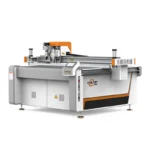
The Swiss imported oscillating knife on the RT-D2516/RT-S2516 supports full cut, half cut and cursor positioning within a single tool setup. For corrugated carton sample work, the distinction matters because a flute crushes differently under drag pressure than under high-frequency oscillation. Oscillation slices the fibre cleanly across the flute wall, preserving the structural rigidity of the sample. The multifunctional head configuration allows a packaging sample maker to switch between full cut for outline separation and half cut for fold lines without a tool change, reducing setup time between sample iterations.
Vacuum Zoning and Small-Part Hold-Down
The aluminum honeycomb table with automatic zone adsorption addresses a specific failure mode in packaging sample cutting: small carton flaps and internal dividers lifting under the knife at high translational velocity. When the vacuum is distributed across a single undivided plenum, airflow takes the path of least resistance through uncovered areas, and small parts starve for suction. Zoned adsorption lets the operator activate only the sectors covered by the nested sheet, concentrating the 7.5 kW vacuum pump capacity where the material actually sits. This is particularly relevant for carton sample makers running mixed-size layouts on the 1600 × 2500 mm working area [NEED_CITE: vacuum table zoning practices for flatbed digital cutters].
Reading the Specification Sheet as an Engineer
The 9 kW rated power covers the servo drives, oscillating knife motor and control electronics but does not include the 7.5 kW vacuum pump, which runs on a separate circuit. Buyers planning electrical infrastructure should provision two dedicated breakers rather than a single combined supply. The Taiwan Delta servo motors paired with Hiwin linear rails and synchronous belt transmission deliver ≤0.1 mm repeatability, which in packaging sample work translates to consistent crease alignment across a run of identical carton prototypes. The HP-GL compatible instruction system and included carton cutting software accept multiple file formats, but the practical question is whether your existing CAD output imports without conversion — something to verify on a test file before committing to an order. The 380V ± 10% voltage is standard for industrial three-phase supply in most export markets, though certain regions require transformer adaptation or a different incoming specification.
The Hidden Cost of Skipping a Material Test
I once worked with a packaging sample shop that ordered a flatbed cutter based on table size and price. Their standard stock was a long-fibre kraft-flute laminate that sat at the harder end of the corrugated range. The machine arrived, the knife oscillated at the quoted frequency, but the edge on their actual board came out frayed instead of clean. The half-cut crease depth was inconsistent because the vacuum zones were not mapped to their typical nest layout, and small insert pieces drifted during the cut. They spent weeks recalibrating before the machine produced saleable samples. A sample cutting report on the buyer’s own board grade and flute profile would have surfaced those issues before the machine left the factory [NEED_CITE: material-specific cutting validation before equipment purchase].
Why the Full Range Matters for Packaging Buyers
Realtop maintains both knife and laser platforms under one design team, which means the cutting method is matched to the material rather than forced. Corrugated board cuts cleanly with an oscillating knife; acrylic signage faces seal better under a CO2 laser. A buyer evaluating both carton sample work and acrylic letter production can source both machines from the same factory with a single point of accountability for software compatibility and spare parts.
The in-house design team configures the tool head, vacuum zone map and felt specification per the buyer’s material stack rather than shipping a generic build. Every unit goes through a factory test on the buyer’s actual substrate before dispatch, with a documented sample cutting report covering edge quality, crease depth and dimensional accuracy.
Voltage, plug type and control language are confirmed on the electrical schematic before production starts, avoiding the situation where a 380V machine arrives at a workshop running a different supply standard. The control interface is configurable across English, Russian, Italian, Chinese and other languages on request, reducing operator training time in non-Chinese-speaking markets.
Software licence and file format compatibility are documented before order, so the buyer knows whether their existing nesting workflow and packaging CAD files will import directly or require conversion. This avoids the post-delivery discovery that a proprietary file format locks the buyer into a specific design pipeline.
Documentation & Verification
- Machine specification sheet listing confirmed tool head and vacuum zone configuration
- Electrical schematic with voltage, plug type and breaker rating matched to destination market
- Sample cutting report produced on buyer’s own corrugated grade and flute profile
- Software licence documentation with supported file format list and nesting compatibility note
- Factory test record with dimensional accuracy measurement on production-speed sample run
- Operation and maintenance manual in confirmed control language
Installation, Commissioning & Support
- Machine footprint of 3450 × 2300 mm requires level concrete floor with clearance for sheet loading on all sides
- 380V ± 10% three-phase supply with separate dedicated circuits for 9 kW machine power and 7.5 kW vacuum pump
- Frame arrives as a single welded unit; table, gantry and tool head assembled and aligned during commissioning
- First-run parameter setting includes knife oscillation frequency, vacuum zone mapping and crease depth calibration on buyer’s board
- Operator training covers carton software layout, HP-GL file import and tool head changeover procedure
- Spare parts list includes oscillating knife blades, felt belt segments and vacuum seals sized to the ordered configuration
What to Include With Your Enquiry
Provide your corrugated board grades by flute profile and GSM, your typical maximum sheet size, and your daily sample volume so the configuration can be matched to your actual workflow rather than a generic build. Confirm your workshop voltage and frequency, your preferred control language, and whether your existing CAD files export in HP-GL or a proprietary format that needs compatibility testing. If you are cutting materials beyond corrugated — leather, foam board, PVC — include those substrates with thickness ranges so the tool head selection covers the full scope of your production.
Frequently Asked Questions
Q: Should I choose an oscillating knife or a laser for corrugated cardboard and foam board?
A: Oscillating knife cuts corrugated and foam board without burning the flute edges or producing discolouration, which is the priority for packaging samples that need a clean presentation finish. Laser is better suited to acrylic, wood and textile sealing where edge fusion is an advantage. If your workload spans both categories, sourcing knife and laser from the same manufacturer keeps software and spare parts under one account.
Q: Can I send my own corrugated board for a sample cut before ordering?
A: Yes. The standard process requires sample cutting on the buyer’s actual board grade and flute profile before the order is confirmed. The output is a sample cutting report documenting edge quality, crease depth and dimensional accuracy at production translational velocity, so the buyer can evaluate results against their own quality standard before committing.
Q: What vacuum zone options are available for small carton parts that lift during cutting?
A: The aluminum honeycomb table supports automatic zone adsorption, meaning the operator activates only the vacuum sectors covered by the nested sheet. This concentrates the 7.5 kW pump capacity on the material area rather than distributing it across the full 1600 × 2500 mm table. The zone map is configured during commissioning based on the buyer’s typical nest layout.
Q: Will my existing packaging CAD files import into the included software?
A: The included carton cutting software supports HP-GL compatible format and multiple file imports with automatic layout and calculation. Compatibility with specific third-party packaging CAD systems should be confirmed before order by exchanging test files. A file format compatibility note is issued with the software licence documentation.
Q: How does the RT-D2516/RT-S2516 fit within the broader machine range?
A: The RT-D2516/RT-S2516 sits in the mid-format flatbed knife cutting family, covering packaging sample and signage work up to 1600 × 2500 mm. Larger-format and multi-head configurations are available for higher-volume fabric and composite cutting. The full range includes both knife and laser platforms, allowing buyers to match the cutting method to each material in their production mix.










商品评价
There are no reviews yet.