


Fast Delivery
Quick, reliable shipping to any location.

Free & easy returns
Return this item by mail or in store within 90 days for a full refund.
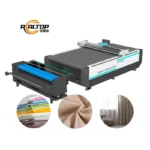
Multi-Method Cutting Coverage — one factory floor builds both knife and laser systems, so the RT-D2516/RT-S2516 is specified by material behavior rather than by a single technology limitation.
Technical Specifications
| Parameter | Value |
|---|---|
| Model | RT-D2516/RT-S2516 |
| Product Type | CNC Oscillating Knife Cutting Machine |
| Working Area | 1600×2500 mm |
| Machine Size | 3450×2300×1250 mm |
| Rated Power | 9 kW |
| Voltage | 380V ±10% |
| Control System | CNC (HP-GL compatible format) |
| Servo Motor | Delta (IP67 waterproof protection) |
| Transmission System | Digital servo motor, linear guide, synchronous belt, ball screw (Taiwan Hiwin rail) |
| Translational Velocity | 800–1200 mm/s |
| Cutting Thickness | 20–80 mm (varies by material — confirm material type and density) |
| Repeated Accuracy | ≤0.1 mm |
| Tool Head Options | Swiss imported knife, oscillating knife, pneumatic knife, high-power vibrating knife, circular knife, V cutting knife, drag knife, creasing wheel, dotted line knife, punching, brush |
| Visual Positioning | Small CCD camera mark point, panoramic camera recognition, projection positioning |
| Vacuum Table | Magnesium-aluminum alloy with PVDF powder spraying, anodic oxidation, hard oxidation; flat type; 7.5 kW vacuum pump |
| Auto Feeding | Germany imported conveyor belt |
| Safety Device | Infrared induction blocking, anti-collision, emergency stop |
| Language Options | English, Russian, Italian, Chinese (other languages customizable) |
| Key Features | Fully assembled delivery, 1-year warranty, lifetime technical support |
Application Suitability
| Application | Material or Output |
|---|---|
| Garment and Footwear Production | Fabric, leather, shoe material, luggage material, clothing cloth, non-woven fabric |
| Packaging and Sample Making | Corrugated cardboard, cardboard, sticker, film, plastic box |
| Automotive Interior and Gasket | Foam board, rubber, gasket material, PU, EVA, XPE, composite materials |
| Soft Furnishings and Carpets | Carpet, sponge, cloth, textile, soft home furnishing materials |
| Advertising and Printing | PVC, PP, PE, sticker, film, printed graphics |
| Sealing and Industrial Gaskets | PTFE, ETFE, fiberglass, rubber, composite sealing materials |
Why Specified Cutting Thickness Ranges Matter More Than Working Area
A cutting depth rating is only valid when paired with the exact material type and density being processed.
I have seen buyers focus entirely on table size, assuming a 1600×2500 mm bed automatically means the machine handles every soft material they throw at it. The reality on the shop floor is different. A 40 mm foam sheet behaves nothing like a 40 mm stack of woven fabric, and an oscillating knife that slices cleanly through sponge may crush the edges of a dense composite gasket. Before confirming a CNC oscillating knife cutting machine for sale, the conversation must start with the actual material stack, not just the sheet dimensions [NEED_CITE: material density and compressibility effects on knife cutting depth].
Matching Knife Technology to the Full Material Range
The complete equipment range from this production line spans both knife and laser cutting technologies, which means the decision between an oscillating blade and a CO2 beam is made based on what the material actually requires. Synthetic textiles that need sealed edges go to laser, while layered composites that cannot tolerate heat distortion stay on the knife table. The RT-D2516/RT-S2516 sits squarely in the knife cutting segment, covering fabric, leather, foam, rubber, and corrugated board without thermal damage to the cut edge.
Tool Head Configuration Across Production Tasks
This flatbed system does not lock a buyer into a single cutting approach. The tool head list spans oscillating knife, drag knife, pneumatic knife, creasing wheel, V cutting knife, circular knife, and punching tools, meaning one table can score a cardboard sample, perforate a gasket, and contour-cut a leather piece in the same shift. The Swiss imported knife option handles high-precision full and half cuts, while the high-power vibrating knife takes on thicker foam and composite stacks. Buyers surveying the full catalogue can see exactly where each tool head sits within the broader equipment families.
Reading the Specs That Determine Real Output
The Delta IP67 servo motors paired with Taiwan Hiwin linear guides deliver a repeated accuracy of ≤0.1 mm across the full 1600×2500 mm working area. In oscillating knife cutting, positional drift accumulates over long nested layouts, so this tolerance level keeps pattern pieces within assembly specs for garment and automotive interior applications. The 7.5 kW vacuum pump on a magnesium-aluminum alloy table with PVDF and anodic oxidation treatment maintains flatness and suction uniformity — critical when small cut parts would otherwise lift off the bed mid-cycle. Translational velocity reaches 800–1200 mm/s, though actual cutting speed depends on material resistance and the selected tool head. The 9 kW rated power draw and 380V ±10% supply requirement mean a dedicated circuit is necessary; voltage confirmation before shipment prevents on-site rewiring delays.
What Happens When the Wrong Configuration Ships
Choosing a machine based on working area alone, then discovering it cannot handle the material thickness on the first production day, is a pattern I have witnessed more than once. The vacuum table zoning may be insufficient for small nested parts, causing lift and ragged cuts. A tool head mismatch produces crushed foam edges or delaminated composite layers. Software incompatibility surfaces only when the buyer tries to import their existing nesting files and the format is not supported [NEED_CITE: CNC cutting file format compatibility issues in production environments].
Why Source This Equipment Range Here
In-house design and production cover both knife and laser cutting technologies under one roof, allowing the cutting method to match the material instead of forcing a single approach. Tool head and table configuration are specified per material and production volume, not pulled from a generic brochure. CCD camera positioning — available as mark point, panoramic, or projection — is verified for printed contour work before the machine leaves the floor. Software compatibility is confirmed against the buyer’s file formats during the ordering stage. Sample cutting on the buyer’s own material is standard practice before commitment, so edge quality and cutting depth are documented, not promised.
Documentation & Verification
- Machine specification sheet listing all confirmed tool head and table options for your material
- Electrical schematic and voltage confirmation matching your facility power supply before dispatch
- Sample cutting report on your own material showing edge quality and achieved cutting depth
- Factory test record documenting repeatability and vacuum suction across the full table area
- Software licence and file format compatibility note verifying your nesting workflow imports correctly
- Spare parts list with recommended consumables for your selected tool head configuration
Installation, Commissioning & Support
- Fully assembled 3450×2300×1250 mm frame requires floor space clearance and level concrete base preparation
- 9 kW rated power and 380V ±10% supply needs a dedicated circuit with appropriate breaker rating
- 7.5 kW vacuum pump requires separate exhaust routing and periodic filter inspection
- Delta IP67 servo motors and Hiwin rails are pre-calibrated at factory; on-site verification run included
- Control system language configurable to English, Russian, Italian, Chinese or other languages before shipment
- First-shift operation training covers tool head changeover, vacuum zoning, and CCD camera calibration
Before You Request a Quote
Provide the exact material type, thickness, and density you will be cutting most often, along with your typical sheet size and daily volume targets. Confirm your facility voltage and frequency, and let us know which file format your current nesting software exports. If your material is a composite or layered substrate, send a sample so we can run a cutting test and document the results before any configuration is finalized.
Frequently Asked Questions
Q: Should I choose a knife cutter or a laser for my material?
A: Knife cutting avoids thermal damage and is suited to foam, composites, fabric, and gasket materials where heat would melt or discolor the edge. Laser cutting seals edges on synthetics and handles detailed engraving. This equipment range covers both methods, so the selection is driven by material behavior rather than forcing one technology across every job.
Q: How do I confirm the RT-D2516/RT-S2516 handles my material thickness?
A: The listed 20–80 mm cutting thickness varies by material type and density. Request a sample cutting test on your exact substrate before ordering. The test documents edge quality, achievable depth, and cycle speed, giving you verified data rather than a general range.
Q: Which tool head should I use for my specific substrate?
A: Oscillating knives suit foam and soft composites, drag knives handle thin vinyl and sticker films, creasing wheels score corrugated cardboard, and pneumatic knives cut thicker rubber or dense gasket stock. The configuration list is finalized after reviewing your material samples and production requirements.
Q: Will the CCD camera keep up with my production speed?
A: Three visual positioning options are available: small CCD mark point, panoramic camera recognition, and projection positioning. The right choice depends on your print registration mark size and conveyor feed speed. Camera performance is verified on your printed material during the sample cutting stage.
Q: What electrical and language details must be confirmed before shipment?
A: The machine runs on 380V ±10%, but frequency and plug type vary by market. Confirm your facility voltage, frequency, and required control language — options include English, Russian, Italian, Chinese, or other customizable languages — so the electrical schematic and interface are correct before the machine leaves the factory [NEED_CITE: voltage and frequency standards by export market].










商品评价
There are no reviews yet.