


Fast Delivery
Quick, reliable shipping to any location.

Free & easy returns
Return this item by mail or in store within 90 days for a full refund.
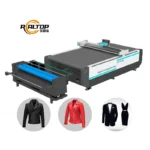
Large-Format Auto-Feeding Table — The RT-D2516/RT-S2516 is positioned within the full catalogue as a high-throughput oscillating knife platform for roll-fed soft materials, sitting alongside flatbed and laser options so buyers match method to material.
Technical Specifications
| Parameter | Value |
|---|---|
| Model | RT-D2516/RT-S2516 |
| Working Area | 1600 × 2500 mm |
| Machine Size (L × W × H) | 3450 × 2300 × 1250 mm |
| Rated Power | 9 kW |
| Table Type | Flat working table with conveyor belt and auto feeding |
| Multifunctional Head | Swiss imported knife with vibration full cutting, vibration half cutting, and cursor location |
| Safety Device | Infrared sensors |
| Translational Velocity | 800–1200 mm/s |
| Cutting Speed | 200–800 mm/s (basis not stated in source — confirm material and thickness) |
| Repeatability | ≤0.1 mm |
| Servo Motor | Japanese Yaskawa |
| Linear Guide | Taiwan Hiwin rail |
| Conveyor Belt | Germany imported |
| Vacuum Pump | 7.5 kW |
| Instruction System | HP-GL compatible format |
| Voltage | 380V ±10% |
| Standards | CE (verify certificate availability) |
Application Suitability
| Application | Material or Output |
|---|---|
| Automotive interior carpet and floor mat production | PVC carpet, XPE composite, EVA foam layers |
| Leather goods and footwear cutting | Natural hides, synthetic PU leather, sponge composite leather |
| Soft gasket and seal fabrication | Rubber sheet, silicon, soft glass |
| Signage and flexible packaging sample making | Vinyl, corrugated board, flexible composite panels |
| Textile and garment panel processing | Clothing flexible material, multi-layer fabric |
Why Material Thickness Decides the Configuration
A cutting machine specified only by working area will underperform the day a thicker composite enters the feed.
I have watched automotive interior producers order a machine based on table size, then discover their actual daily stock is a denser XPE foam laminate rather than the thin PVC sample they first tested. The knife head struggles, edge quality degrades, and throughput drops sharply. Before any CNC oscillating knife cutting machine manufacturer quotes a configuration, the exact material stack — including thickness, density, and backing layer — must be confirmed through a physical sample cut [NEED_CITE: material density effect on oscillating knife cutting force].
Where This Model Sits in the Full Cutting Range
The RT-D2516/RT-S2516 occupies the large-format, roll-fed segment of the catalogue. Its 1600 × 2500 mm conveyor-equipped table is built for continuous feeding of PVC carpet rolls and wide-format composite sheets, distinguishing it from smaller flatbed units that handle cut-to-size sheets manually. Buyers comparing across the range should weigh daily roll volume against per-sheet handling labor.
Knife Versus Laser Across the Catalogue
Oscillating knife cutting handles compressible, layered materials — foam, sponge composite leather, multi-layer fabric — where a laser beam would melt or seal edges that need to remain open for downstream stitching or bonding. Laser machines in the same catalogue cover acrylic, wood, and sheet metal where thermal edge sealing is an advantage. The decision between the two methods is material-driven, and this CNC oscillating knife cutting machine manufacturer offers both so buyers are not forced into one process [NEED_CITE: oscillating knife versus laser edge quality on composites].
Reading the Drive and Motion Specs
A Yaskawa digital servo paired with Hiwin linear rails and a synchronous belt transmission holds repeatability to ≤0.1 mm across the full 2500 mm travel. In automotive carpet cutting, where nested patterns leave minimal margin between parts, that tolerance determines whether a floor mat fits its vehicle mold or requires manual trimming. The 7.5 kW vacuum pump must be zoned correctly; without adequate zoning, small offcut pieces lift during high-speed passes and jam the conveyor. The Swiss imported oscillating knife supports both full cut and half cut, meaning a single head can kiss-cut a crease line and then through-cut the perimeter without a tool change, reducing cycle interruptions on complex mat geometries.
The Cost of Skipping the Sample Cut
When a buyer commits without sending their production material, the tool head selection is a guess. A drag knife meant for thin vinyl will tear through sponge composite leather, leaving ragged edges that fail quality inspection. Vacuum hold-down that works for a full hide may leave small gasket pieces drifting, forcing the operator to stop and reposition, eroding any throughput advantage the auto-feeder was supposed to deliver [NEED_CITE: vacuum table zoning requirements for small-part cutting].
Why Buyers Source This Range Here
In-house design covers both knife and laser platforms, so a buyer processing PVC carpet today and acrylic signage tomorrow can specify each method correctly instead of forcing one technology to cover both. Tool head and table configuration are matched per material and production volume, not sold as a fixed package. Software compatibility — including HP-GL import and nesting workflow — is confirmed before order entry. Voltage, control language, and plug type are locked down during the specification stage, avoiding costly rewiring on arrival. Sample cutting on the buyer’s own material is standard, producing a physical report rather than a catalog promise.
Documentation & Verification
- Machine specification sheet confirming RT-D2516/RT-S2516 working area and power rating
- Electrical schematic with 380V ±10% voltage and frequency confirmation for destination market
- Tool head and conveyor table configuration list matched to your material stack
- Sample cutting report produced on your PVC carpet or composite leather before commitment
- Factory test record documenting repeatability and edge quality at operating speed
Installation, Commissioning & Support
- Requires a level concrete floor with clearance for the 3450 × 2300 mm footprint and roll feed space
- Dedicated 380V circuit rated for the 9 kW machine load plus 7.5 kW vacuum pump
- Arrives partially assembled; table frame and conveyor belt require on-site alignment
- First-run parameter setting includes vacuum zone mapping for your smallest mat pattern piece
- Operator training covers Swiss knife blade replacement and oscillation frequency adjustment
- Spare parts list includes consumable blades, conveyor belt sections, and vacuum seals
What to Share With Your Inquiry
Send the exact material type, thickness, and roll width you run daily, along with your target shift output in linear meters or pieces. Confirm your facility voltage and frequency, preferred control language, and whether your existing nesting software exports HP-GL. If you are cutting multiple materials across a season, list each one so the tool head package covers the full range rather than just the first sample.
Frequently Asked Questions
Q: Knife or laser — which method fits my automotive interior material?
A: Oscillating knife handles compressible, layered materials like PVC carpet, XPE foam, and sponge composite leather where clean mechanical edges are needed. Laser suits acrylic, wood, and sheet metal where thermal sealing is acceptable. Material composition and downstream assembly requirements determine the correct method.
Q: How does auto-feeding compare to manual flatbed loading?
A: The conveyor system on this model supports continuous roll feeding for high-volume carpet and mat production, reducing per-piece handling time. Manual flatbed tables suit sheet-fed materials where each piece varies in size or shape. Daily volume and material format decide the right table type.
Q: What tool head options are available for different soft materials?
A: The multifunctional head supports Swiss imported oscillating knife blades in full-cut and half-cut modes, plus cursor positioning. Drag knife, creasing wheel, and milling tools are available across the range. Tool selection is confirmed against your specific material during the sample cutting stage.
Q: Where does this model sit among other CNC and laser machines in the catalogue?
A: The RT-D2516/RT-S2516 covers large-format roll-fed soft material cutting. Smaller flatbed knife tables handle sheet-fed work, while CO2 and fiber laser machines cover non-metal engraving and sheet metal processing. The full range lets buyers match each production task to the appropriate technology.
Q: What sample and documentation do I receive before committing?
A: A sample cutting report on your own material confirms edge quality, cutting depth, and speed. Documentation includes the specification sheet, electrical schematic, tool head configuration list, and software compatibility note, all reviewed before the order is finalized.










商品评价
There are no reviews yet.