


Fast Delivery
Quick, reliable shipping to any location.

Free & easy returns
Return this item by mail or in store within 90 days for a full refund.
In-house knife and laser design capability — a single engineering team covers both oscillating knife and laser cutting, letting buyers match the process to the material instead of forcing one method across every job.
Technical Specifications
| Parameter | Value |
|---|---|
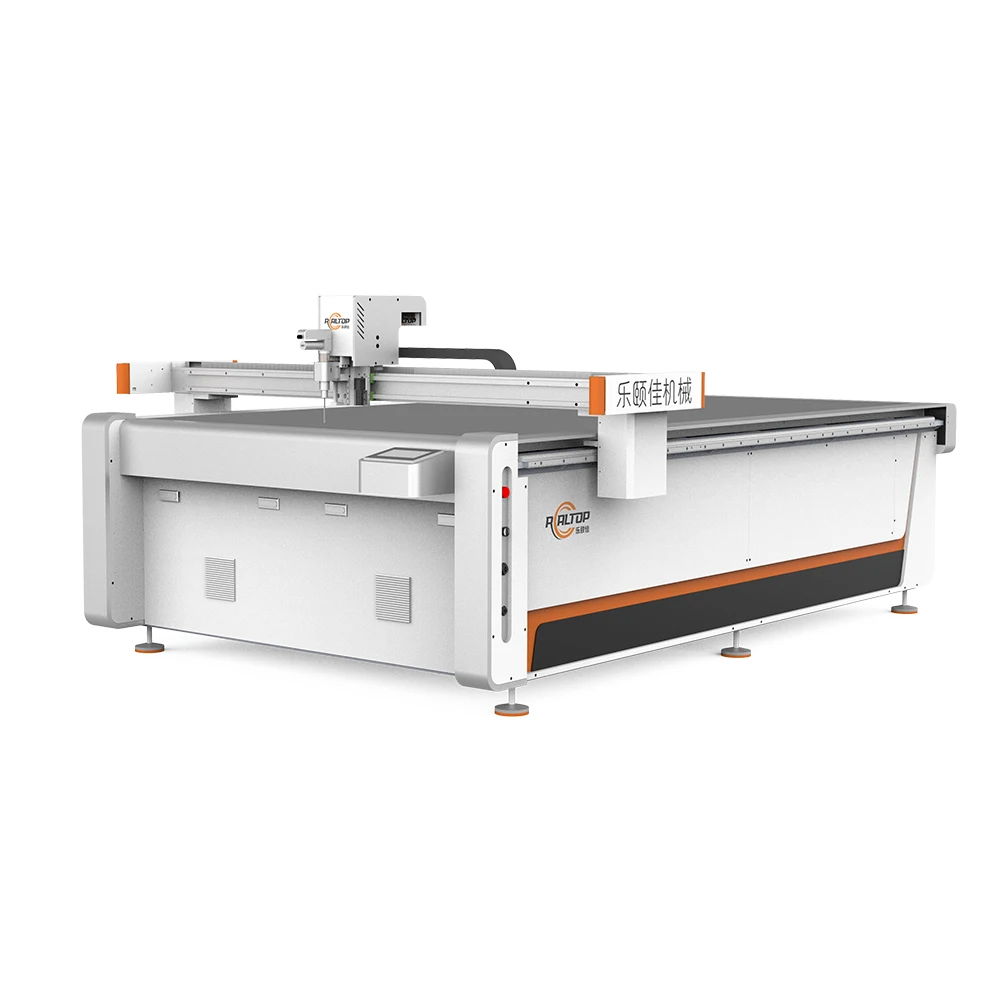
| Product Type | CNC Vibrating Knife Cutting Machine |
| Model | RT-D2516 / RT-S2516 |
| Working Area | 1600 × 2500 mm |
| Machine Size | 3450 × 2300 × 1250 mm |
| Rated Power | 9 kW |
| Vacuum Pump | 7.5 kW |
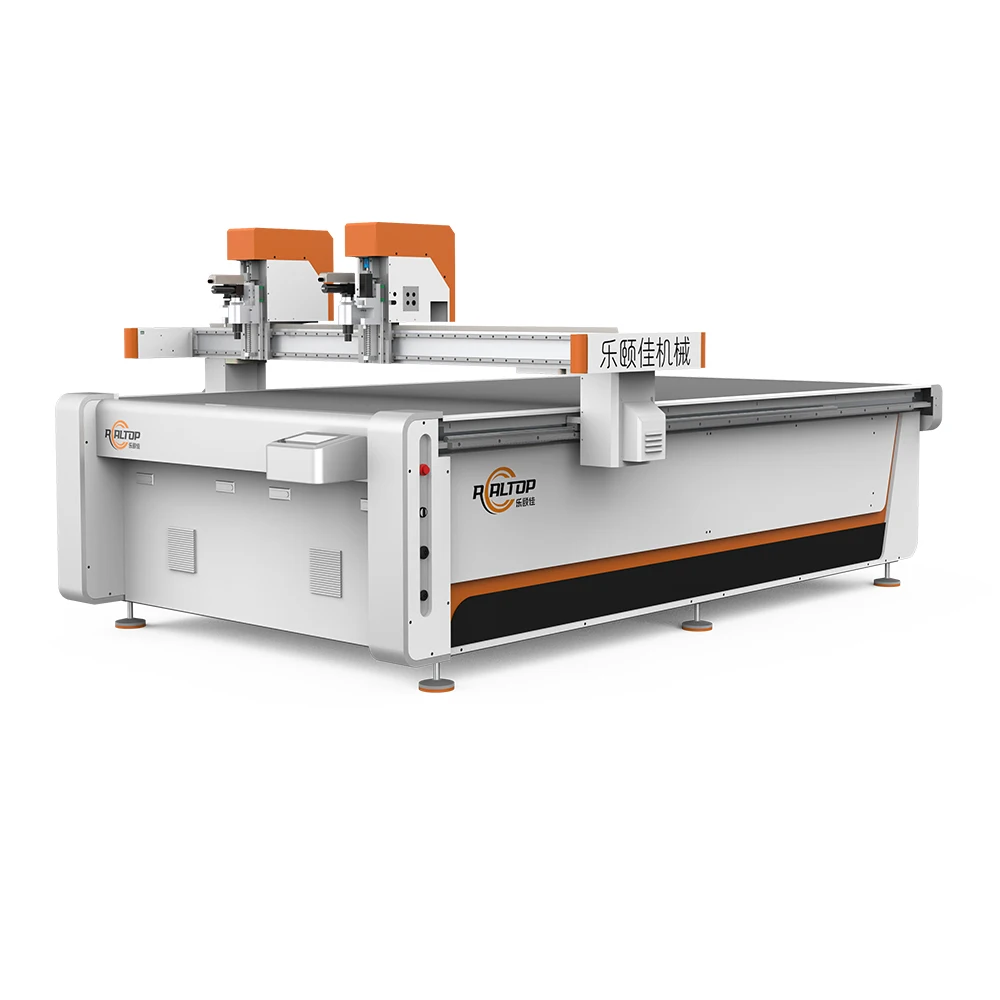
| Table Type Options | Flat working table / Auto-feeding conveyor table |
| Multifunctional Head | Swiss-imported knife (vibration full-cut, half-cut, cursor location) |
| Tool Head Options | Oscillating knife, pneumatic knife, high-power vibrating knife, circular knife, V-cutting knife, drag knife, creasing wheel, dotted-line knife, punching, brush |
| Translational Velocity | 800–2000 mm/s |
| Cutting Speed | 200–800 mm/s (basis to be confirmed by material type and density) |
| Cutting Thickness | ≤100 mm (basis to be confirmed by material type and density) |
| Repeated Accuracy | ≤0.1 mm |
| Transmission System | Digital servo motor, linear guide, synchronous belt, ball screw |
| Servo Motor Brand | Delta (Panasonic or domestic brand optional) |
| Guide Rail | Taiwan Hiwin |
| Conveyor Belt | Germany-imported |
| Vacuum Table Material | Magnesium-aluminum alloy, fluorocarbon PVDF powder spray, anodic and hard oxidation |
| Vacuum Pump Housing | Integrated aviation aluminum shell, built-in silencer sponge (noise reduction 35%) |
| Control Panel | Touch screen, multi-language (English, Russian, Italian, Chinese, customizable) |
| Instruction System | HP-GL compatible format |
| Software Compatibility | PLT, DXF, AI |
| Visual Positioning Options | Small CCD camera mark-point, panoramic camera recognition, projection positioning |
| Safety Devices | Infrared sensors, anti-collision, emergency stop |
| Voltage | 380V ±10% |
| Frame Construction | Thick-walled seamless steel structure, high-temperature tempering, CNC machining center finished |
| Certification | CE (where applicable) |
Application Suitability
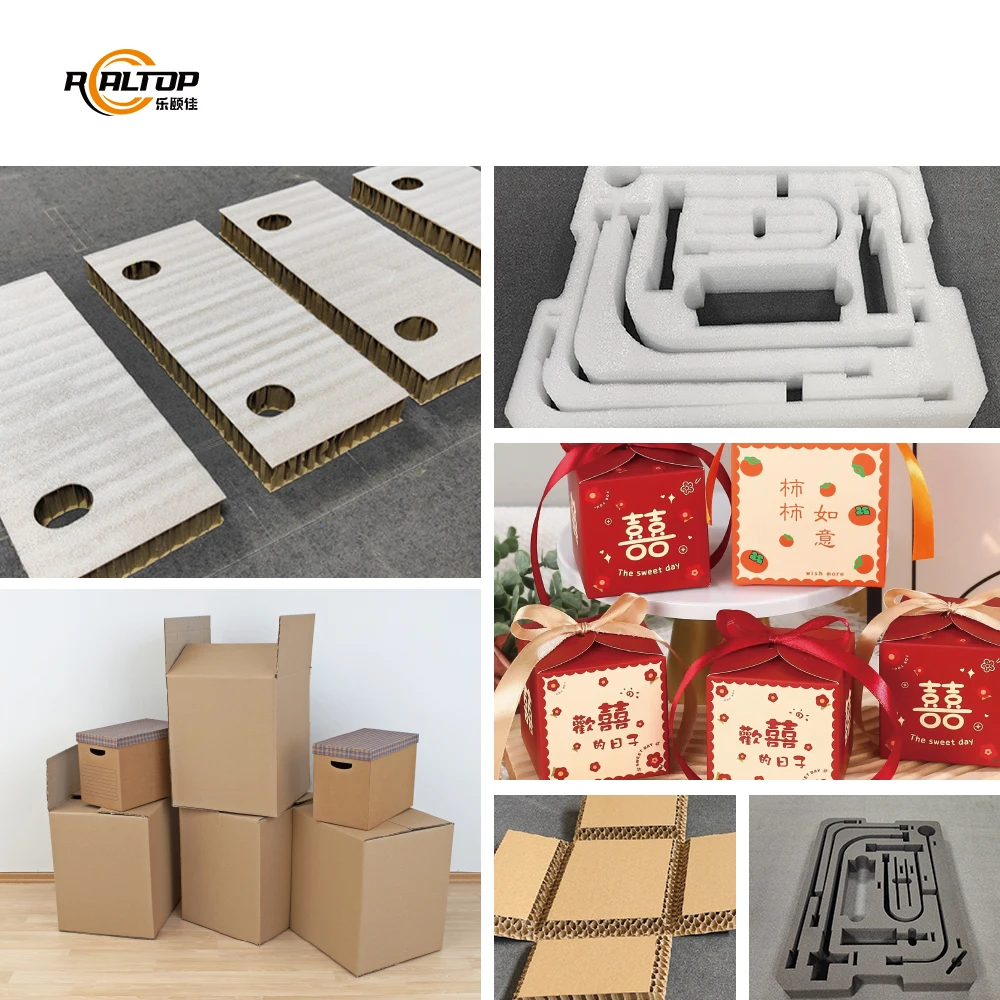
| Application | Material or Output |
|---|---|
| Carton and packaging sample making | Cardboard, honeycomb cardboard, corrugated board |
| Signage and advertising production | Foam board, PVC, sticker, film |
| Garment and footwear prototyping | Leather, fabric, textile, non-woven fabric, shoe material |
| Automotive interior cutting | Leather, PU, EVA, carpet, floor mat material |
| Gasket and seal fabrication | Rubber, PTFE, ETFE, composite gasket material |
| Foam and sponge processing | Foam board, sponge, XPE, EPE |
| Plastic box and thermoform trimming | PP, PE, PVC sheet |
| Composite material shaping | Fiberglass, PU, EVA, multi-layer composites |
Why the Voltage Question Must Come Before the CNC Oscillating Knife Cutting Table for Sale Price Tag
Confirming your workshop voltage and frequency before selecting a configuration prevents costly on-site electrical rework.
A machine built for 380V 50Hz will trip breakers or burn motors if plugged into a 220V 60Hz supply. I once saw a carton sample maker in the Middle East wait three weeks for a transformer retrofit because the voltage standard was never discussed during ordering [NEED_CITE: voltage and frequency standards by export market]. The servo motors, vacuum pump, and control panel all depend on the correct electrical supply being locked in before production starts.
Matching the Complete Equipment Range to Your Material and Volume
The full catalogue approach means a buyer evaluating packaging carton sample making can compare a flat-table CNC oscillating knife cutting table for short-run prototypes against an auto-feeding conveyor version for higher daily volumes. Each configuration addresses a different workflow. Short-run work with frequent material changes favors the flat table’s easy sheet loading, while roll stock or long sheet runs benefit from the conveyor’s continuous feed cycle. The choice between knife and laser cutting also sits inside this same decision: corrugated board and foam respond well to oscillating knife edges, while acrylic signage blanks may need a CO2 laser for sealed edges.
Tool Head Selection That Follows the Material, Not the Other Way Around
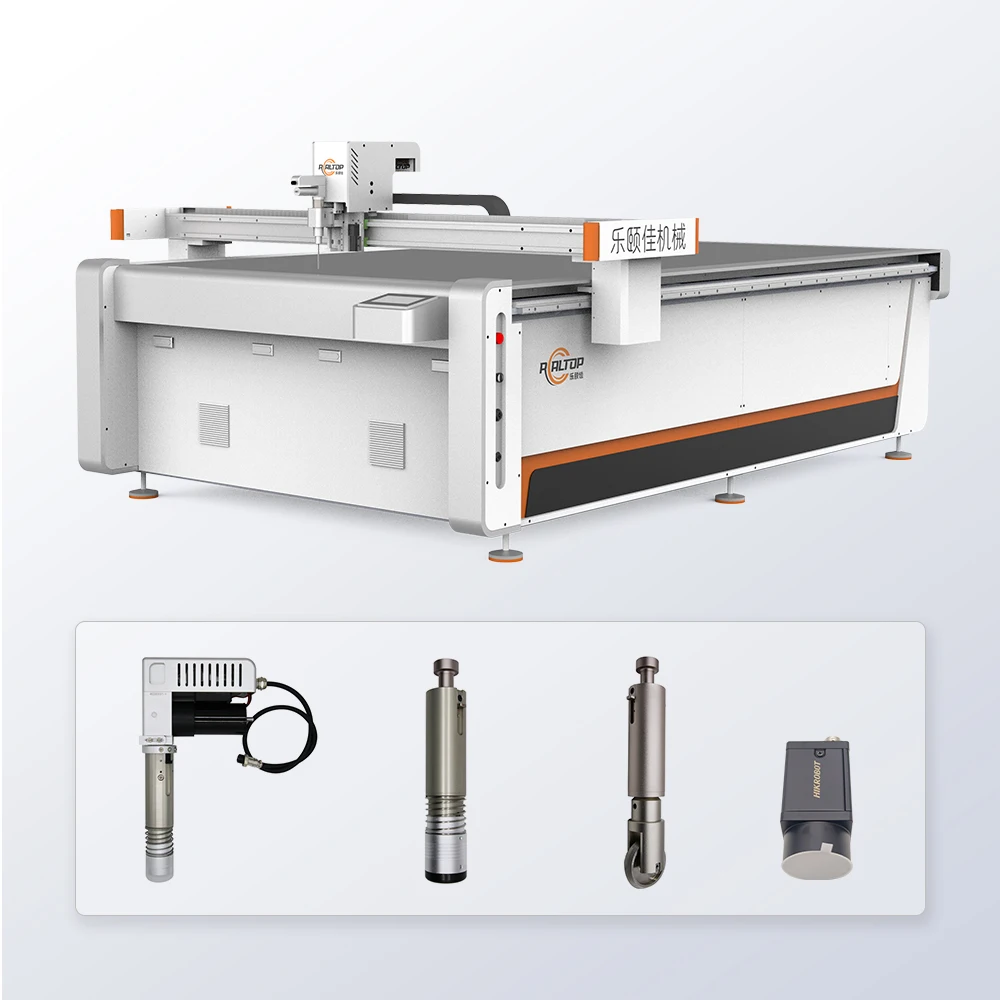
An oscillating knife handles corrugated cardboard and dense foam cleanly, but creasing wheels are needed for fold lines on carton samples. V-cutting knives produce mitre joints in thick board, while a drag knife suits thin vinyl and sticker films. Specifying the correct tool head before order means the buyer avoids the common situation where the machine arrives with a single knife and then cannot produce the full range of edges and creases the production job demands [NEED_CITE: CE machinery directive requirements for industrial equipment]. The multifunctional head on this unit accepts the full tool head range, so swapping between jobs stays a matter of minutes rather than hours.
How Key Specifications Translate on the Production Floor
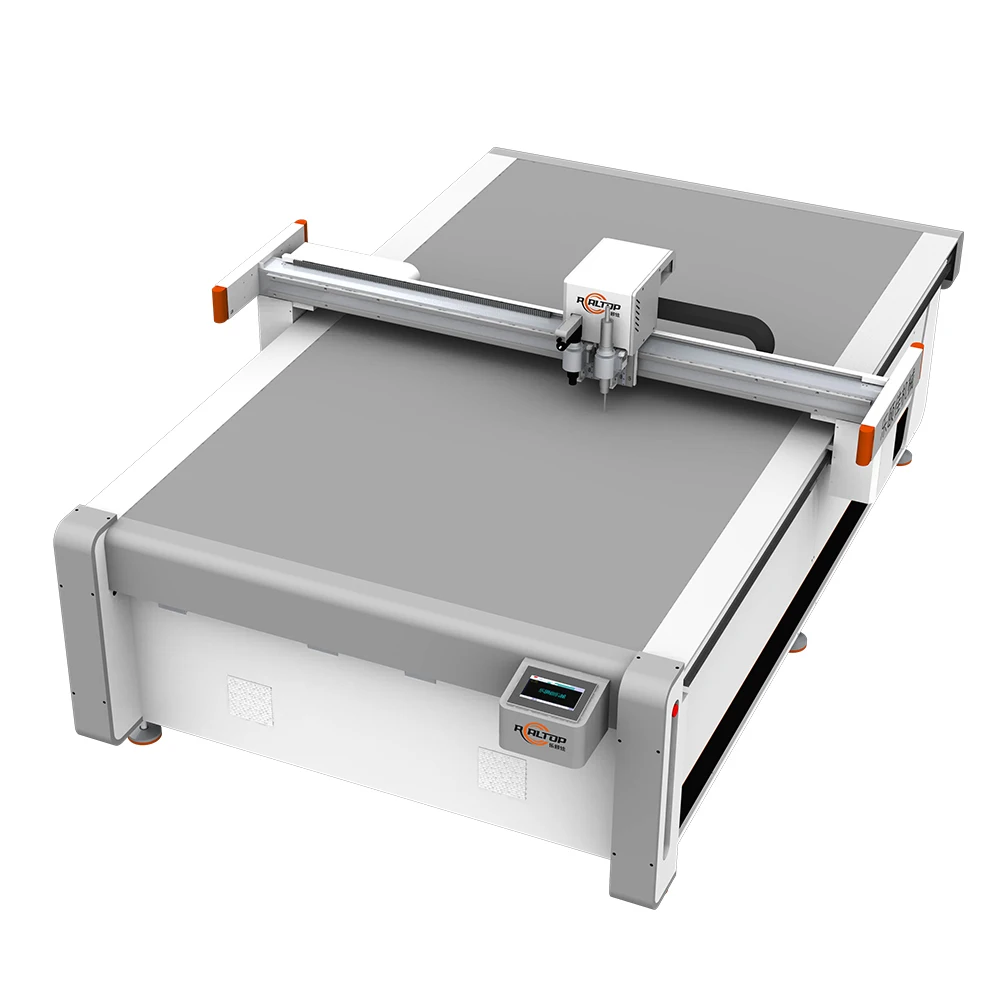
The 1600 × 2500 mm working area accommodates standard carton sample sheets and large-format signage boards without repositioning. The Taiwan Hiwin linear guide and ball screw transmission maintain repeated accuracy within 0.1 mm, which matters when registration marks must align with CCD camera positioning for printed contour cutting. The 7.5 kW vacuum pump provides enough holding force to keep thin films and light cardboard flat during high-speed knife passes, while the magnesium-aluminum vacuum table with PVDF coating resists the adhesive residue that accumulates during sticker and label work. Translational velocity of up to 2000 mm/s reduces non-cutting travel time between shapes, and the HP-GL compatible instruction system accepts PLT, DXF, and AI files directly, keeping the nesting workflow inside the buyer’s existing design software.
What Happens When the Wrong Configuration Ships
Selecting a flat table for roll-stock film means manually unrolling and repositioning after every sheet, adding downtime that erodes throughput. Choosing an oscillating knife without a creasing wheel forces the operator to score fold lines by hand, introducing inconsistency into carton sample output. Overlooking vacuum zone sizing leaves small die-cut parts lifting off the table mid-cut, producing ragged edges that must be trimmed again [NEED_CITE: vacuum adsorption requirements for small-part CNC cutting].
Reasons Buyers Source This CNC Vibrating Knife Cutting Machine Here
The design team covers both knife and laser cutting in-house, so a packaging producer can evaluate which process fits the material before committing to one machine type. Tool head and table configurations are specified per material and daily volume rather than offered as a single default build. CCD camera positioning options — small mark-point, panoramic, or projection — let printed contour work be matched to the production speed required. Software format compatibility (PLT, DXF, AI) is confirmed before the order is released. Voltage, plug type, and control language are locked in during the quotation stage, eliminating on-site electrical surprises. Sample cutting on the buyer’s own material takes place before shipment, so edge quality and cutting depth are verified against actual stock.
Documentation & Verification
- Machine specification sheet listing every tool head and table option confirmed for your material
- Electrical schematic and voltage confirmation document matching your workshop supply
- Sample cutting report produced on your actual corrugated board or foam before dispatch
- Software licence and file format compatibility note covering PLT, DXF, and AI workflows
- Factory test record showing cutting accuracy and vacuum holding performance on your sheet size
- Packing photographs documenting machine condition at the point of crate closure
Installation, Commissioning & Support
- Floor space planning for 3450 × 2300 × 1250 mm footprint plus operator access clearance
- Dedicated 380V ±10% circuit with correct breaker rating for the 9 kW rated power and 7.5 kW vacuum pump
- Machine arrives fully assembled; only conveyor belt tensioning and vacuum hose connections required on site
- First-run parameter tuning on your material thickness and density, adjusting knife frequency and feed rate
- Touch-screen control language set to your operator preference during commissioning visit
- Spare parts list covering Swiss-imported knife blades, conveyor belt segments, and vacuum seal strips
What to Share with Your Inquiry
Send a sample or specification of the material you intend to cut — type, thickness, and whether it arrives as sheet or roll. Note your workshop voltage and frequency, along with the control language your operators prefer. If your existing design workflow uses a specific nesting software, confirm the file format so compatibility can be verified before the quotation is finalized.
Frequently Asked Questions
Q: How do I choose between oscillating knife and laser cutting for my material?
A: Oscillating knife cutting suits fibrous and layered materials like corrugated board, foam, and fabric where a clean mechanical edge is needed. Laser cutting fits acrylic, wood, and textile where edge sealing is desirable. The same engineering team covers both methods, so the recommendation follows the material and production volume rather than a single default process.
Q: Which table configuration fits my workflow — flat table or auto-feeding conveyor?
A: Flat tables work well for short-run carton samples and single-sheet prototypes where material changes frequently. Auto-feeding conveyors suit roll stock and high-volume sheet runs where continuous feed reduces handling time. Both options are available on the same model family, so the choice follows your daily throughput and material format.
Q: What CCD camera positioning system should I select for printed contour work?
A: Small CCD camera mark-point positioning tracks discrete registration marks at standard production speed. Panoramic camera recognition handles dense mark arrays on large-format prints. Projection positioning assists manual alignment for one-off samples. The correct option depends on your print format, mark density, and required cutting throughput.
Q: Can the machine handle my existing design file formats without additional conversion?
A: The control system accepts PLT, DXF, and AI files natively through the HP-GL compatible instruction system. If your nesting workflow uses a different format, share a sample file during the inquiry stage so software compatibility can be confirmed before the order is released, avoiding conversion errors at the production stage.
Q: What electrical preparation does my workshop need before the machine arrives?
A: The unit requires a 380V ±10% supply with a dedicated circuit rated for the combined load of the 9 kW machine and 7.5 kW vacuum pump. Voltage, plug type, and frequency must be confirmed during the quotation stage. If your workshop runs a different standard, a transformer or electrical modification plan should be arranged before shipment.
In-house knife and laser design capability — a single engineering team covers both oscillating knife and laser cutting, letting buyers match the process to the material instead of forcing one method across every job.
Technical Specifications
| Parameter | Value |
|---|---|
| Product Type | CNC Vibrating Knife Cutting Machine |
| Model | RT-D2516 / RT-S2516 |
| Working Area | 1600 × 2500 mm |
| Machine Size | 3450 × 2300 × 1250 mm |
| Rated Power | 9 kW |
| Vacuum Pump | 7.5 kW |
| Table Type Options | Flat working table / Auto-feeding conveyor table |
| Multifunctional Head | Swiss-imported knife (vibration full-cut, half-cut, cursor location) |
| Tool Head Options | Oscillating knife, pneumatic knife, high-power vibrating knife, circular knife, V-cutting knife, drag knife, creasing wheel, dotted-line knife, punching, brush |
| Translational Velocity | 800–2000 mm/s |
| Cutting Speed | 200–800 mm/s (basis to be confirmed by material type and density) |
| Cutting Thickness | ≤100 mm (basis to be confirmed by material type and density) |
| Repeated Accuracy | ≤0.1 mm |
| Transmission System | Digital servo motor, linear guide, synchronous belt, ball screw |
| Servo Motor Brand | Delta (Panasonic or domestic brand optional) |
| Guide Rail | Taiwan Hiwin |
| Conveyor Belt | Germany-imported |
| Vacuum Table Material | Magnesium-aluminum alloy, fluorocarbon PVDF powder spray, anodic and hard oxidation |
| Vacuum Pump Housing | Integrated aviation aluminum shell, built-in silencer sponge (noise reduction 35%) |
| Control Panel | Touch screen, multi-language (English, Russian, Italian, Chinese, customizable) |
| Instruction System | HP-GL compatible format |
| Software Compatibility | PLT, DXF, AI |
| Visual Positioning Options | Small CCD camera mark-point, panoramic camera recognition, projection positioning |
| Safety Devices | Infrared sensors, anti-collision, emergency stop |
| Voltage | 380V ±10% |
| Frame Construction | Thick-walled seamless steel structure, high-temperature tempering, CNC machining center finished |
| Certification | CE (where applicable) |
Application Suitability
| Application | Material or Output |
|---|---|
| Carton and packaging sample making | Cardboard, honeycomb cardboard, corrugated board |
| Signage and advertising production | Foam board, PVC, sticker, film |
| Garment and footwear prototyping | Leather, fabric, textile, non-woven fabric, shoe material |
| Automotive interior cutting | Leather, PU, EVA, carpet, floor mat material |
| Gasket and seal fabrication | Rubber, PTFE, ETFE, composite gasket material |
| Foam and sponge processing | Foam board, sponge, XPE, EPE |
| Plastic box and thermoform trimming | PP, PE, PVC sheet |
| Composite material shaping | Fiberglass, PU, EVA, multi-layer composites |
Why the Voltage Question Must Come Before the CNC Oscillating Knife Cutting Table for Sale Price Tag
Confirming your workshop voltage and frequency before selecting a configuration prevents costly on-site electrical rework.
A machine built for 380V 50Hz will trip breakers or burn motors if plugged into a 220V 60Hz supply. I once saw a carton sample maker in the Middle East wait three weeks for a transformer retrofit because the voltage standard was never discussed during ordering [NEED_CITE: voltage and frequency standards by export market]. The servo motors, vacuum pump, and control panel all depend on the correct electrical supply being locked in before production starts.
Matching the Complete Equipment Range to Your Material and Volume
The full catalogue approach means a buyer evaluating packaging carton sample making can compare a flat-table CNC oscillating knife cutting table for short-run prototypes against an auto-feeding conveyor version for higher daily volumes. Each configuration addresses a different workflow. Short-run work with frequent material changes favors the flat table’s easy sheet loading, while roll stock or long sheet runs benefit from the conveyor’s continuous feed cycle. The choice between knife and laser cutting also sits inside this same decision: corrugated board and foam respond well to oscillating knife edges, while acrylic signage blanks may need a CO2 laser for sealed edges.
Tool Head Selection That Follows the Material, Not the Other Way Around
An oscillating knife handles corrugated cardboard and dense foam cleanly, but creasing wheels are needed for fold lines on carton samples. V-cutting knives produce mitre joints in thick board, while a drag knife suits thin vinyl and sticker films. Specifying the correct tool head before order means the buyer avoids the common situation where the machine arrives with a single knife and then cannot produce the full range of edges and creases the production job demands [NEED_CITE: CE machinery directive requirements for industrial equipment]. The multifunctional head on this unit accepts the full tool head range, so swapping between jobs stays a matter of minutes rather than hours.
How Key Specifications Translate on the Production Floor
The 1600 × 2500 mm working area accommodates standard carton sample sheets and large-format signage boards without repositioning. The Taiwan Hiwin linear guide and ball screw transmission maintain repeated accuracy within 0.1 mm, which matters when registration marks must align with CCD camera positioning for printed contour cutting. The 7.5 kW vacuum pump provides enough holding force to keep thin films and light cardboard flat during high-speed knife passes, while the magnesium-aluminum vacuum table with PVDF coating resists the adhesive residue that accumulates during sticker and label work. Translational velocity of up to 2000 mm/s reduces non-cutting travel time between shapes, and the HP-GL compatible instruction system accepts PLT, DXF, and AI files directly, keeping the nesting workflow inside the buyer’s existing design software.
What Happens When the Wrong Configuration Ships
Selecting a flat table for roll-stock film means manually unrolling and repositioning after every sheet, adding downtime that erodes throughput. Choosing an oscillating knife without a creasing wheel forces the operator to score fold lines by hand, introducing inconsistency into carton sample output. Overlooking vacuum zone sizing leaves small die-cut parts lifting off the table mid-cut, producing ragged edges that must be trimmed again [NEED_CITE: vacuum adsorption requirements for small-part CNC cutting].
Reasons Buyers Source This CNC Vibrating Knife Cutting Machine Here
The design team covers both knife and laser cutting in-house, so a packaging producer can evaluate which process fits the material before committing to one machine type. Tool head and table configurations are specified per material and daily volume rather than offered as a single default build. CCD camera positioning options — small mark-point, panoramic, or projection — let printed contour work be matched to the production speed required. Software format compatibility (PLT, DXF, AI) is confirmed before the order is released. Voltage, plug type, and control language are locked in during the quotation stage, eliminating on-site electrical surprises. Sample cutting on the buyer’s own material takes place before shipment, so edge quality and cutting depth are verified against actual stock.
Documentation & Verification
- Machine specification sheet listing every tool head and table option confirmed for your material
- Electrical schematic and voltage confirmation document matching your workshop supply
- Sample cutting report produced on your actual corrugated board or foam before dispatch
- Software licence and file format compatibility note covering PLT, DXF, and AI workflows
- Factory test record showing cutting accuracy and vacuum holding performance on your sheet size
- Packing photographs documenting machine condition at the point of crate closure
Installation, Commissioning & Support
- Floor space planning for 3450 × 2300 × 1250 mm footprint plus operator access clearance
- Dedicated 380V ±10% circuit with correct breaker rating for the 9 kW rated power and 7.5 kW vacuum pump
- Machine arrives fully assembled; only conveyor belt tensioning and vacuum hose connections required on site
- First-run parameter tuning on your material thickness and density, adjusting knife frequency and feed rate
- Touch-screen control language set to your operator preference during commissioning visit
- Spare parts list covering Swiss-imported knife blades, conveyor belt segments, and vacuum seal strips
What to Share with Your Inquiry
Send a sample or specification of the material you intend to cut — type, thickness, and whether it arrives as sheet or roll. Note your workshop voltage and frequency, along with the control language your operators prefer. If your existing design workflow uses a specific nesting software, confirm the file format so compatibility can be verified before the quotation is finalized.
Frequently Asked Questions
Q: How do I choose between oscillating knife and laser cutting for my material?
A: Oscillating knife cutting suits fibrous and layered materials like corrugated board, foam, and fabric where a clean mechanical edge is needed. Laser cutting fits acrylic, wood, and textile where edge sealing is desirable. The same engineering team covers both methods, so the recommendation follows the material and production volume rather than a single default process.
Q: Which table configuration fits my workflow — flat table or auto-feeding conveyor?
A: Flat tables work well for short-run carton samples and single-sheet prototypes where material changes frequently. Auto-feeding conveyors suit roll stock and high-volume sheet runs where continuous feed reduces handling time. Both options are available on the same model family, so the choice follows your daily throughput and material format.
Q: What CCD camera positioning system should I select for printed contour work?
A: Small CCD camera mark-point positioning tracks discrete registration marks at standard production speed. Panoramic camera recognition handles dense mark arrays on large-format prints. Projection positioning assists manual alignment for one-off samples. The correct option depends on your print format, mark density, and required cutting throughput.
Q: Can the machine handle my existing design file formats without additional conversion?
A: The control system accepts PLT, DXF, and AI files natively through the HP-GL compatible instruction system. If your nesting workflow uses a different format, share a sample file during the inquiry stage so software compatibility can be confirmed before the order is released, avoiding conversion errors at the production stage.
Q: What electrical preparation does my workshop need before the machine arrives?
A: The unit requires a 380V ±10% supply with a dedicated circuit rated for the combined load of the 9 kW machine and 7.5 kW vacuum pump. Voltage, plug type, and frequency must be confirmed during the quotation stage. If your workshop runs a different standard, a transformer or electrical modification plan should be arranged before shipment.










商品评价
There are no reviews yet.