



Fast Delivery
Quick, reliable shipping to any location.

Free & easy returns
Return this item by mail or in store within 90 days for a full refund.
In-house knife and laser integration — a single design team covers both cutting methods, so the RT-D2516 and RT-S2516 are matched to your material rather than forced into one technology path.
Technical Specifications
| Parameter | Value |
|---|---|
| Model | RT-D2516 / RT-S2516 |
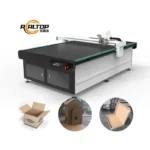
| Product Type | CNC Oscillating Knife Cutting Machine |
| Working Area | 1600 × 2500 mm |
| Machine Size | 3450 × 2300 × 1250 mm |
| Rated Power | 9 kW |
| Voltage | 380V ±10% |
| Table Type | Aluminum alloy honeycomb vacuum adsorption flatbed |
| Tool Head | Multifunctional head with Swiss imported knife (vibration full-cut, half-cut, cursor location) |
| Translational Velocity | 800–1200 mm/s |
| Cutting Speed | 200–800 mm/s (varies by material type and thickness) |
| Repeatability | ≤0.1 mm |
| Transmission System | Digital servo motor, linear guide, synchronous belt, ball screw |
| Servo Motor | Taiwan Delta servo motors and drivers |
| Linear Guide | Taiwan Hiwin rail |
| Vacuum Pump | 7.5 kW |
| Conveyor Belt | Germany imported felt belt |
| Safety Device | Infrared sensors and emergency stop |
| Instruction System | HP-GL compatible format |
| Software | Professional carton cutting and nesting software (free, multi-format import) |
| Language Options | English, Russian, Italian, Chinese; custom languages available |
| Frame | Welded thick square seamless steel structure, high-temperature treated |
| Cutting Thickness | ≤100 mm (basis not stated in source — confirm with material type and density) |
| Assembly State | Fully assembled before shipment |
Application Suitability
| Application | Material or Output |
|---|---|
| Carton and packaging sample making | Corrugated board, grey board, white card stock, coated board |
| Large-format signage and billboard production | PVC foam board, KT board, honeycomb cardboard, vinyl |
| Sticker and label contour cutting | Self-adhesive vinyl, reflective film, printed label stock |
| Leather and footwear component cutting | Genuine leather, PU synthetic, sponge composite leather |
| Gasket and sealing production | Rubber sheet, silicone, soft glass, PVC flexible sheet |
| Short-run packaging production | Express boxes, snack food cartons, high-end gift boxes |
Why Working Area Alone Does Not Define a CNC Knife Cutting Machine for Sale
Cutting depth and edge quality depend on the tool head, vacuum zoning, and material density — not just table size.
Many buyers filter their search by working area and assume any machine within that envelope will handle their stock. On corrugated board or dense grey board, the wrong oscillating frequency or an undersized vacuum zone leads to material shift mid-cut, ragged edges on small parts, and scrapped sheets. A CNC knife cutting machine for sale at this format must be evaluated against the actual material stack and part geometry you run daily [NEED_CITE: flatbed cutting evaluation criteria for packaging and signage materials]. I have watched a packaging shop lose an entire batch of laminated grey board samples because the vacuum zoning was set for large sheets while they were cutting small nesting parts — the corners lifted before the knife finished the contour.
Where Oscillating Knife Sits in the Full Cutting Equipment Range
The RT-D2516 and RT-S2516 occupy the flatbed knife segment of the catalogue, positioned for buyers who need mechanical cutting without thermal edge effects. Unlike CO2 laser systems that seal synthetic edges through heat, an oscillating knife leaves a clean, uncompressed edge on corrugated board, foam, and multi-layer textile stacks. This matters when the downstream process involves folding, gluing, or stitching — heat-sealed edges on cardboard turn brittle and crack at the crease line.
Matching the Knife Head to Your Material Stack
The multifunctional head on these models carries a Swiss imported knife that handles vibration full-cutting for through-cuts, half-cutting for kiss-cut applications on sticker stock, and cursor location for manual alignment. Switching between these modes is a configuration choice made during setup, not a mid-job adjustment. For buyers running both corrugated packaging samples and self-adhesive vinyl on the same table, this means one machine covers both workflows without a second tool head purchase. The cutting speed range of 200–800 mm/s reflects the gap between dense, thick board and thin flexible films [NEED_CITE: oscillating knife cutting speed variables across material densities].
Reading the Spec Sheet Against Your Production Reality
The 7.5 kW vacuum pump paired with the aluminum alloy honeycomb table is designed to hold flat stock across the full 1600 × 2500 mm area, but vacuum effectiveness drops when parts are small and the surrounding zone is not masked. Taiwan Hiwin linear guides and Delta servo motors deliver ≤0.1 mm repeatability, which keeps contour cuts aligned with printed registration marks on pre-printed board. The 9 kW rated power covers the servo drives, oscillating motor, and control system — the vacuum pump draws additional load, so your electrical supply must account for both circuits independently. High-temperature treatment on the welded steel frame relieves internal stress from welding, keeping the bed flat across seasonal temperature swings in unheated workshops.
The Hidden Cost of Skipping Material Trials
Specifying a machine from a brochure without running your own stock on the table is the most common cause of post-delivery disputes. A knife that slices cleanly through single-wall corrugated may crush double-wall or leave fiber tear on coated grey board. Half-cutting on self-adhesive vinyl requires precise depth control — too shallow and the liner remains uncut, too deep and the backing is scored, making weeding impossible. These failures show up in week one, not month six [NEED_CITE: common causes of flatbed cutting quality failures in first production run].
Why Source This Range Here
The design team covers both knife and laser cutting systems in-house, which means the recommendation starts with your material rather than pushing one technology. Tool head and table configurations are specified per material type and daily volume before an order is placed. Software compatibility — including nesting workflows and file format imports — is confirmed during the inquiry stage, not after delivery. Sample cutting on your own material is standard practice, producing a cutting report you can evaluate before commitment. Voltage, plug type, and control language are locked in before production begins, avoiding the common problem of a machine arriving with the wrong electrical configuration [NEED_CITE: voltage and plug configuration verification for exported CNC equipment].
Documentation & Verification
- Machine specification sheet with confirmed tool head and table configuration for your material
- Electrical schematic showing 380V circuit layout and vacuum pump load separation
- Sample cutting report run on your actual cardboard grade or flexible material stock
- Software licence documentation with confirmed file format and nesting compatibility
- Factory test record capturing repeatability and cutting speed on your specified materials
- Packing photographs documenting assembly state and protective measures before dispatch
Installation, Commissioning & Support
- Floor space must accommodate 3450 × 2300 mm footprint plus operator access on three sides
- Dedicated 380V circuit required for the 9 kW machine load plus separate vacuum pump supply
- Machine ships fully assembled — rigging and positioning require appropriate lift equipment for the 1600 × 2500 mm bed
- First-run commissioning includes vacuum zone mapping for your specific part sizes and nesting layouts
- Operator training covers tool head changeover between full-cut, half-cut, and cursor modes
- Wear-resistant composite fiber felt belt and oscillating knife blades listed as consumable spare parts
Before You Request a Quote
To get an accurate configuration, share the material type, thickness, and maximum sheet size you process. Confirm your local voltage and frequency so the electrical system is built to match. If you run specific nesting software or design file formats, provide a sample file so compatibility is verified before the order [NEED_CITE: file format and nesting workflow compatibility in CNC cutting procurement].
Frequently Asked Questions
Q: How do I decide between oscillating knife and laser for my cardboard and sticker work?
A: Oscillating knife cutting produces no heat, leaving uncompressed edges on corrugated board that fold and glue cleanly. Laser cuts seal synthetic edges, which suits textile and acrylic but can scorch cardboard and leave residue on adhesive vinyl. Your material mix and downstream process determine the method — sample cutting on your stock confirms the result.
Q: How is cutting thickness validated for my specific board grade?
A: The ≤100 mm cutting thickness rating depends on material density and composition. We run your actual stock — corrugated flute type, grey board density, or foam composition — and document cutting speed, edge quality, and blade wear in a sample report before you commit to the order.
Q: What working area and configuration options exist across the full range?
A: The RT-D2516 and RT-S2516 offer a 1600 × 2500 mm bed. Other models in the catalogue cover compact through large-format sizes, with single or multi-head setups and tool head options including oscillating knife, drag knife, creasing wheel, and milling — each matched to your material and volume requirement.
Q: How are voltage, plug type, and control language confirmed?
A: Your local voltage and frequency are confirmed during the inquiry stage and written into the specification sheet. Plug type matches your regional standard. The control interface is set to your preferred language from the available options — English, Russian, Italian, Chinese — or customized before the machine enters production.
Q: Will the nesting software work with my current design files?
A: The included professional carton cutting and nesting software supports multi-format import and is HP-GL compatible. We verify your specific file format and nesting workflow against the software before the order is placed, so there are no surprises at installation.










商品评价
There are no reviews yet.