





Fast Delivery
Quick, reliable shipping to any location.

Free & easy returns
Return this item by mail or in store within 90 days for a full refund.
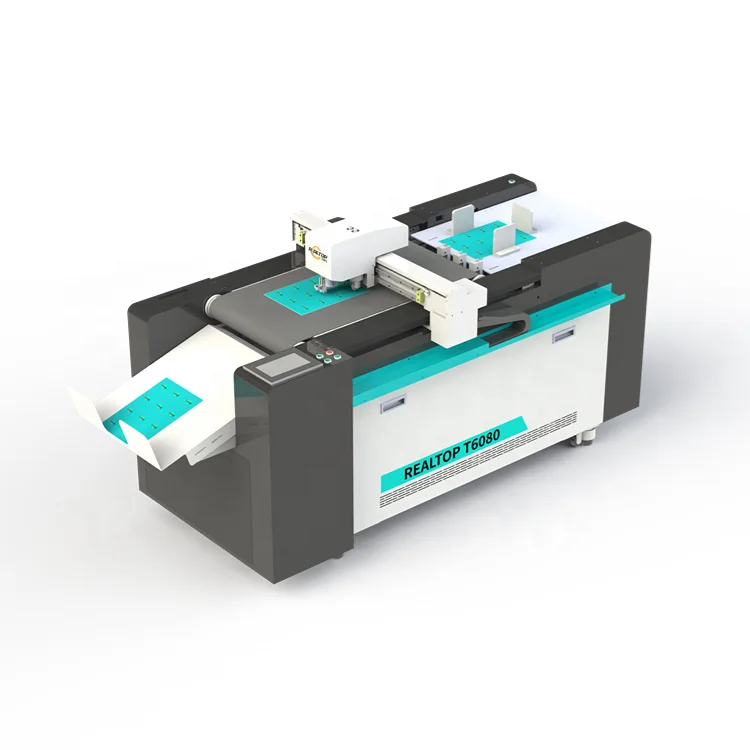
Tool Head Flexibility — matching oscillating, drag, and creasing tools to thin flexible materials rather than forcing a single cutting method across every job.
Technical Specifications
| Parameter | Value |
|---|---|
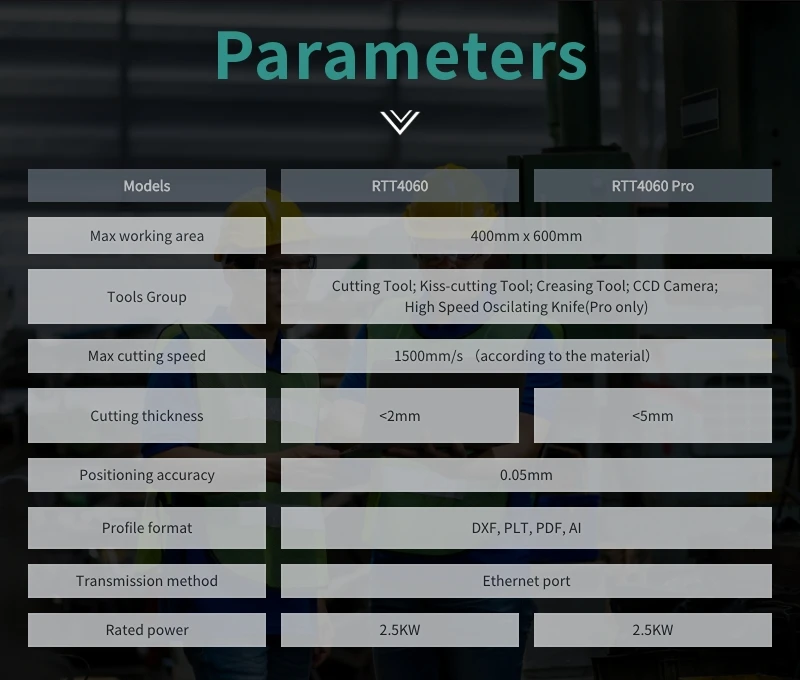
| Model | RTT4060 / RTT4060 Pro |
| Product Type | CNC Flatbed Digital Cutting Machine |
| Working Area | 400mm x 600mm |
| Tool Head Options | Cutting Tool; Kiss-cutting Tool; Creasing Tool; CCD Camera; High Speed Oscillating Knife (Pro only) |
| Max Cutting Speed | 1500mm/s (according to the material) |
| Cutting Thickness | <2mm (RTT4060); <5mm (RTT4060 Pro) |
| Positioning Accuracy | 0.05mm |
| Supported File Formats | DXF, OLT, PDF, AI |
| Transmission Method | Ethernet port |
| Rated Power | 2.5kW |
| Voltage & Frequency | Configurable per destination market (basis to be confirmed) |
| Vacuum Table Zoning | Multi-zone configuration for small-part retention (basis to be confirmed) |
| Standards | CE declaration where applicable |
Application Suitability
| Application | Material or Output |
|---|---|
| Sticker and decal production | Adhesive vinyl, polyester label stock, reflective film on release liner |
| Printed contour cutting | Laminated PP/PET sheets, digitally printed card stock, magnetic sheeting |
| Packaging sample making | Folding carton board, corrugated E-flute, kraft paper with crease lines |
| Signage and display graphics | Self-adhesive acrylic film, thin PVC foam board, translucent diffusion sheet |
| Gasket and seal prototyping | Non-asbestos fiber sheet, cork-rubber composite, PTFE membrane under 5mm |
Why the Material Thickness Question Must Come Before the Working Area
A 400x600mm table is only useful if the tool head can actually shear through the material at the quoted speed.
Too many buyers specify a CNC flatbed digital cutting table manufacturer based on footprint alone, then discover on the shop floor that a standard drag knife tears through 3mm acrylic foam or that a kiss-cutting tool cannot hold tolerance on multi-layer label stock. The cutting thickness envelope — under 2mm on the RTT4060, under 5mm on the RTT4060 Pro — defines what this machine actually processes day in and day out. Push past that envelope and edge quality collapses, vacuum hold-down loses grip, and scrap rates climb [NEED_CITE: material thickness versus tool head selection in digital flatbed cutting]. I have watched small-format decal shops run adhesive vinyl all week without issue, then load 4mm gasket rubber and wonder why the oscillating knife stalls and the edge delaminates. The fix is never a software patch. It is a conversation about what you actually cut, measured with calipers, before the order is placed.
Knife and Tool Configuration for Thin-Film Work
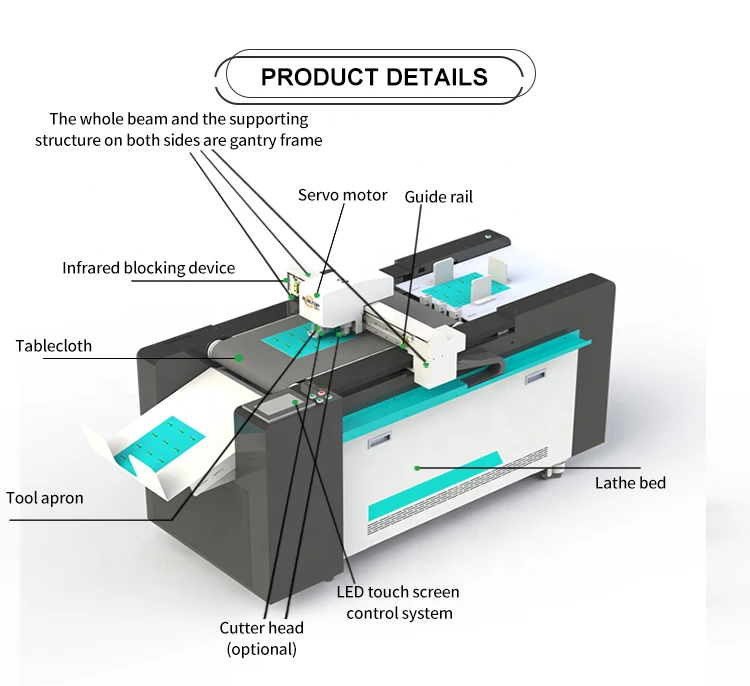
A flatbed cutting table at this format size lives or dies by its tool head selection. The RTT4060 series offers a cutting tool for through-cuts, a kiss-cutting tool for label stock where the release liner must stay intact, and a creasing tool for folding carton sample work — all configurable on the same gantry. This means a packaging sample maker can score and cut a carton blank in one pass without swapping machines or re-fixturing the sheet. The CCD camera option registers against printed fiducial marks, allowing contour cuts that track slight stretch or skew from the lamination process. For buyers evaluating a CNC flatbed digital cutting table manufacturer, the question is not whether the machine has a camera, but whether the camera maintains registration at production speed across a full 400x600mm field.
Ethernet Transmission and File Format Compatibility
Data flow in a small-format cutting room is deceptively demanding. Sticker nests often contain hundreds of contour paths with tight bezier curves, and any hiccup in transmission shows up as a dwell mark or a jagged corner on the finished decal. The Ethernet port on this machine provides a stable, hardwired link from the nesting workstation to the controller, sidestepping the dropouts that plague USB-dependent setups in electrically noisy workshop environments. Supported file formats — DXF, OLT, PDF, AI — cover the export paths most buyers already use from their existing RIP or vector design software [NEED_CITE: common vector file interoperability in digital finishing workflows]. Confirming format compatibility before order placement avoids the situation where a buyer’s preferred nesting application outputs a proprietary file type the machine controller cannot parse.
Reading the Specs That Actually Matter on the Shop Floor
Cutting speed is quoted at 1500mm/s, but that figure is material-dependent — it applies to thin, low-resistance films, not to dense gasket stock or multi-layer adhesive stacks. Positioning accuracy of 0.05mm matters most when you are kiss-cutting small barcode labels where a 0.2mm drift puts the cut line into the printed data field. Rated power at 2.5kW covers the servo drives, vacuum pump draw, and controller overhead for a machine at this scale; buyers should confirm their workshop circuit can supply clean single-phase or three-phase power matching the destination voltage. The cutting thickness split between the RTT4060 and the RTT4060 Pro — under 2mm versus under 5mm — reflects the high-speed oscillating knife available exclusively on the Pro model, which delivers the stroke frequency needed to shear denser composites cleanly. Selecting between the two models is less about budget and more about the thickest material you plan to run in a typical week.
What Happens When the Wrong Tool Head Meets the Wrong Material
A kiss-cutting tool pressed into through-cut duty on 3mm foam board will score the surface without penetrating, leaving the operator to finish each piece by hand — and hand-trimming a contour-cut sticker defeats the purpose of owning the machine. Conversely, running a full-depth oscillating knife on thin adhesive vinyl without adjusting stroke amplitude can punch through the release liner, damaging the vacuum table surface and ruining the entire nest. On small parts like individual decals, insufficient vacuum zoning allows the cut piece to lift under the knife, producing a ragged tail on the trailing edge [NEED_CITE: vacuum hold-down requirements for small-format digital cutting]. These failures are not machine defects. They are configuration mismatches that a material sample test before shipment would have caught.
Why Source This Machine From This Range
The design team covers both knife and laser cutting processes in-house, so a buyer cutting thin acrylic decals can get an honest recommendation on whether a knife or a CO2 beam produces the better edge for their specific film — rather than being pushed toward whichever technology a single-process vendor happens to build. Tool head and table configuration are specified per material and production volume, not pulled from a fixed catalogue page. CCD camera positioning is verified against the buyer’s actual printed sheet, not just demonstrated on a perfect test card. Software compatibility is confirmed against the buyer’s existing DXF or AI file output before the order advances to production. Sample cutting on the buyer’s own material runs before commitment, so edge quality, kiss-cut depth, and crease definition are documented in a cutting report, not promised in a brochure.
Documentation & Verification
- Machine specification sheet listing every tool head and table option selected for your material range
- Electrical schematic confirming voltage, frequency, and plug type for your facility before build
- Tool head and table configuration list matched to your stated material thicknesses
- Sample cutting report produced on your actual sticker stock or carton board before dispatch
- CE declaration documentation where applicable to your import market
- Software licence and file format compatibility note confirming DXF, AI, PDF, or OLT support
Installation, Commissioning & Support
- 2.5kW rated power requires a dedicated circuit matching your confirmed voltage and frequency specification
- Compact 400x600mm working area fits standard workshop doorways without special rigging equipment
- Ethernet port connection tested on-site against your nesting workstation during commissioning
- CCD camera calibrated to your printed fiducial marks and verified at running speed during training
- Oscillating knife and drag knife blade replacement demonstrated with your spare parts kit
- Vacuum table zoning adjusted to your typical sticker or decal sheet size during first production run
What We Need From You to Quote Accurately
Send us the material type, measured thickness, and maximum sheet size you plan to run. Tell us your daily volume target and whether you need kiss-cut, through-cut, or creasing capability — or all three in a single job. Confirm your local voltage and frequency, the control language your operators prefer, and which design software you currently use so we can verify file format compatibility before the quotation is finalised.
Frequently Asked Questions
Q: How do I choose between the standard cutting tool and the high-speed oscillating knife on the Pro model?
A: The standard cutting tool handles thin films, vinyl, and label stock under 2mm. The high-speed oscillating knife on the RTT4060 Pro adds stroke frequency for denser materials up to 5mm, such as gasket fiber, foam composites, and multi-layer adhesive stacks. Selection depends on your thickest regular material, not your occasional sample request.
Q: Does the CCD camera track printed marks effectively at maximum cutting speed?
A: The camera registers fiducial marks across the 400x600mm field, but effective tracking speed depends on mark contrast, print quality, and lamination gloss. We verify registration accuracy on your actual printed sheet during the sample cutting stage, documenting hold tolerance before the machine ships.
Q: What file formats does the controller accept natively for nesting workflows?
A: The system supports DXF, OLT, PDF, and AI files directly. If your current nesting software exports in a different vector format, we confirm compatibility or identify a conversion step before the order is placed, avoiding workflow disruption on delivery.
Q: How is vacuum zoning configured for very small parts like individual stickers?
A: The vacuum table uses zone segmentation so suction concentrates under the active cutting area rather than spreading across the full 400x600mm bed. This keeps small decals and labels pinned during the final contour pass, preventing lift and edge ragging on trailing cuts.
Tool Head Flexibility — matching oscillating, drag, and creasing tools to thin flexible materials rather than forcing a single cutting method across every job.
Technical Specifications
| Parameter | Value |
|---|---|
| Model | RTT4060 / RTT4060 Pro |
| Product Type | CNC Flatbed Digital Cutting Machine |
| Working Area | 400mm x 600mm |
| Tool Head Options | Cutting Tool; Kiss-cutting Tool; Creasing Tool; CCD Camera; High Speed Oscillating Knife (Pro only) |
| Max Cutting Speed | 1500mm/s (according to the material) |
| Cutting Thickness | <2mm (RTT4060); <5mm (RTT4060 Pro) |
| Positioning Accuracy | 0.05mm |
| Supported File Formats | DXF, OLT, PDF, AI |
| Transmission Method | Ethernet port |
| Rated Power | 2.5kW |
| Voltage & Frequency | Configurable per destination market (basis to be confirmed) |
| Vacuum Table Zoning | Multi-zone configuration for small-part retention (basis to be confirmed) |
| Standards | CE declaration where applicable |
Application Suitability
| Application | Material or Output |
|---|---|
| Sticker and decal production | Adhesive vinyl, polyester label stock, reflective film on release liner |
| Printed contour cutting | Laminated PP/PET sheets, digitally printed card stock, magnetic sheeting |
| Packaging sample making | Folding carton board, corrugated E-flute, kraft paper with crease lines |
| Signage and display graphics | Self-adhesive acrylic film, thin PVC foam board, translucent diffusion sheet |
| Gasket and seal prototyping | Non-asbestos fiber sheet, cork-rubber composite, PTFE membrane under 5mm |
Why the Material Thickness Question Must Come Before the Working Area
A 400x600mm table is only useful if the tool head can actually shear through the material at the quoted speed.
Too many buyers specify a CNC flatbed digital cutting table manufacturer based on footprint alone, then discover on the shop floor that a standard drag knife tears through 3mm acrylic foam or that a kiss-cutting tool cannot hold tolerance on multi-layer label stock. The cutting thickness envelope — under 2mm on the RTT4060, under 5mm on the RTT4060 Pro — defines what this machine actually processes day in and day out. Push past that envelope and edge quality collapses, vacuum hold-down loses grip, and scrap rates climb [NEED_CITE: material thickness versus tool head selection in digital flatbed cutting]. I have watched small-format decal shops run adhesive vinyl all week without issue, then load 4mm gasket rubber and wonder why the oscillating knife stalls and the edge delaminates. The fix is never a software patch. It is a conversation about what you actually cut, measured with calipers, before the order is placed.
Knife and Tool Configuration for Thin-Film Work
A flatbed cutting table at this format size lives or dies by its tool head selection. The RTT4060 series offers a cutting tool for through-cuts, a kiss-cutting tool for label stock where the release liner must stay intact, and a creasing tool for folding carton sample work — all configurable on the same gantry. This means a packaging sample maker can score and cut a carton blank in one pass without swapping machines or re-fixturing the sheet. The CCD camera option registers against printed fiducial marks, allowing contour cuts that track slight stretch or skew from the lamination process. For buyers evaluating a CNC flatbed digital cutting table manufacturer, the question is not whether the machine has a camera, but whether the camera maintains registration at production speed across a full 400x600mm field.
Ethernet Transmission and File Format Compatibility
Data flow in a small-format cutting room is deceptively demanding. Sticker nests often contain hundreds of contour paths with tight bezier curves, and any hiccup in transmission shows up as a dwell mark or a jagged corner on the finished decal. The Ethernet port on this machine provides a stable, hardwired link from the nesting workstation to the controller, sidestepping the dropouts that plague USB-dependent setups in electrically noisy workshop environments. Supported file formats — DXF, OLT, PDF, AI — cover the export paths most buyers already use from their existing RIP or vector design software [NEED_CITE: common vector file interoperability in digital finishing workflows]. Confirming format compatibility before order placement avoids the situation where a buyer’s preferred nesting application outputs a proprietary file type the machine controller cannot parse.
Reading the Specs That Actually Matter on the Shop Floor
Cutting speed is quoted at 1500mm/s, but that figure is material-dependent — it applies to thin, low-resistance films, not to dense gasket stock or multi-layer adhesive stacks. Positioning accuracy of 0.05mm matters most when you are kiss-cutting small barcode labels where a 0.2mm drift puts the cut line into the printed data field. Rated power at 2.5kW covers the servo drives, vacuum pump draw, and controller overhead for a machine at this scale; buyers should confirm their workshop circuit can supply clean single-phase or three-phase power matching the destination voltage. The cutting thickness split between the RTT4060 and the RTT4060 Pro — under 2mm versus under 5mm — reflects the high-speed oscillating knife available exclusively on the Pro model, which delivers the stroke frequency needed to shear denser composites cleanly. Selecting between the two models is less about budget and more about the thickest material you plan to run in a typical week.
What Happens When the Wrong Tool Head Meets the Wrong Material
A kiss-cutting tool pressed into through-cut duty on 3mm foam board will score the surface without penetrating, leaving the operator to finish each piece by hand — and hand-trimming a contour-cut sticker defeats the purpose of owning the machine. Conversely, running a full-depth oscillating knife on thin adhesive vinyl without adjusting stroke amplitude can punch through the release liner, damaging the vacuum table surface and ruining the entire nest. On small parts like individual decals, insufficient vacuum zoning allows the cut piece to lift under the knife, producing a ragged tail on the trailing edge [NEED_CITE: vacuum hold-down requirements for small-format digital cutting]. These failures are not machine defects. They are configuration mismatches that a material sample test before shipment would have caught.
Why Source This Machine From This Range
The design team covers both knife and laser cutting processes in-house, so a buyer cutting thin acrylic decals can get an honest recommendation on whether a knife or a CO2 beam produces the better edge for their specific film — rather than being pushed toward whichever technology a single-process vendor happens to build. Tool head and table configuration are specified per material and production volume, not pulled from a fixed catalogue page. CCD camera positioning is verified against the buyer’s actual printed sheet, not just demonstrated on a perfect test card. Software compatibility is confirmed against the buyer’s existing DXF or AI file output before the order advances to production. Sample cutting on the buyer’s own material runs before commitment, so edge quality, kiss-cut depth, and crease definition are documented in a cutting report, not promised in a brochure.
Documentation & Verification
- Machine specification sheet listing every tool head and table option selected for your material range
- Electrical schematic confirming voltage, frequency, and plug type for your facility before build
- Tool head and table configuration list matched to your stated material thicknesses
- Sample cutting report produced on your actual sticker stock or carton board before dispatch
- CE declaration documentation where applicable to your import market
- Software licence and file format compatibility note confirming DXF, AI, PDF, or OLT support
Installation, Commissioning & Support
- 2.5kW rated power requires a dedicated circuit matching your confirmed voltage and frequency specification
- Compact 400x600mm working area fits standard workshop doorways without special rigging equipment
- Ethernet port connection tested on-site against your nesting workstation during commissioning
- CCD camera calibrated to your printed fiducial marks and verified at running speed during training
- Oscillating knife and drag knife blade replacement demonstrated with your spare parts kit
- Vacuum table zoning adjusted to your typical sticker or decal sheet size during first production run
What We Need From You to Quote Accurately
Send us the material type, measured thickness, and maximum sheet size you plan to run. Tell us your daily volume target and whether you need kiss-cut, through-cut, or creasing capability — or all three in a single job. Confirm your local voltage and frequency, the control language your operators prefer, and which design software you currently use so we can verify file format compatibility before the quotation is finalised.
Frequently Asked Questions
Q: How do I choose between the standard cutting tool and the high-speed oscillating knife on the Pro model?
A: The standard cutting tool handles thin films, vinyl, and label stock under 2mm. The high-speed oscillating knife on the RTT4060 Pro adds stroke frequency for denser materials up to 5mm, such as gasket fiber, foam composites, and multi-layer adhesive stacks. Selection depends on your thickest regular material, not your occasional sample request.
Q: Does the CCD camera track printed marks effectively at maximum cutting speed?
A: The camera registers fiducial marks across the 400x600mm field, but effective tracking speed depends on mark contrast, print quality, and lamination gloss. We verify registration accuracy on your actual printed sheet during the sample cutting stage, documenting hold tolerance before the machine ships.
Q: What file formats does the controller accept natively for nesting workflows?
A: The system supports DXF, OLT, PDF, and AI files directly. If your current nesting software exports in a different vector format, we confirm compatibility or identify a conversion step before the order is placed, avoiding workflow disruption on delivery.
Q: How is vacuum zoning configured for very small parts like individual stickers?
A: The vacuum table uses zone segmentation so suction concentrates under the active cutting area rather than spreading across the full 400x600mm bed. This keeps small decals and labels pinned during the final contour pass, preventing lift and edge ragging on trailing cuts.










商品评价
There are no reviews yet.