


Fast Delivery
Quick, reliable shipping to any location.

Free & easy returns
Return this item by mail or in store within 90 days for a full refund.
Tool Head and Table Configuration — matched per corrugated board thickness and sheet size before a packaging order is confirmed, so the machine cuts the actual material rather than a generic spec.
Technical Specifications
| Parameter | Value |
|---|---|
| Model | RT–R2513 / RT-D2516 / RT-S2516 |
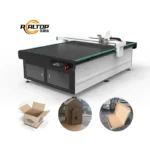
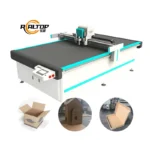
| Product Type | CNC Oscillating Knife Cutting Machine for Packaging |
| Working Area | 2500×1300mm (RT–R2513) / 1600×2500mm (RT-D2516 / RT-S2516) |
| Overall Dimensions (L×W×H) | 3550×1910×1400mm (RT–R2513) / 3450×2300×1250mm (RT-D2516 / RT-S2516) |
| Cutting Tools | Oscillating knife, creasing tool, kiss-cut knife tool, round punch |
| Cutting Thickness | Up to 18mm (basis not stated in source — confirm material type and density) |
| Repeatability | <0.05mm |
| Rated Power | 9 kW |
| Voltage | 380V (frequency to be confirmed per market) |
| Servo System | Dongling servo (Delta servo motor available as alternative configuration) |
| Transmission Method | Ethernet port |
| File Formats | DXF, OLT, PDF, AI |
| Fixing Method | Vacuum adsorption on aluminum alloy honeycomb platform |
| Vacuum Pump | 7.5 kW |
| Guide Rail | Taiwan Hiwin rail |
| Safety Device | Infrared sensors, emergency stop |
| Blade Supply | 10 oscillating blades included |
| Warranty | 1 year (excluding felt and knife blades) |
| Delivery Time | Under 30 working days |
| Language Options | English, Russian, Italian, Chinese; special languages customizable |
| Control System | CNC with professional carton cutting software |
| Frame | Welded thick square seamless steel structure, high temperature treated |
| Key Features | Auto feeding available, conveyor belt configurable, CE declaration where applicable |
Application Suitability
| Application | Material or Output |
|---|---|
| Carton and corrugated box sample making | Single and double-wall corrugated board, grey board |
| Gift box and premium packaging prototyping | Rigid cardboard, specialty paper stock |
| Sticker and label contour cutting | Adhesive vinyl, coated paper, PP film |
| Express paper box packaging | Lightweight corrugated and kraft board |
| Paper box short-run production | Corrugated board, cardboard, PP paper |
Why the Working Area Alone Is Not Enough for Corrugated Board
A CNC oscillating knife cutting machine manufacturer must specify tool head, vacuum zoning and blade oscillation rate together with the table size, because corrugated board behaves completely differently from flat cardboard under the knife.
I once saw a buyer order a machine based purely on a 2500mm table length, then discover their triple-wall flute crushed under standard oscillation pressure. The vacuum hold-down was set as a single zone, so smaller die-cut shapes lifted during the cut, producing ragged edges and forcing the operator to tape the board down manually. That line spent its first three weeks on rework instead of sample output. A packaging CNC cutting machine must be matched to the flute profile, board density and smallest part size in the actual job queue, not just the largest sheet dimension [NEED_CITE: corrugated flute profiles and crushing thresholds under oscillating knife pressure].
Matching the Tool Head to the Flute Profile
The RT–R2513, RT-D2516 and RT-S2516 ship with oscillating knife, creasing tool, kiss-cut knife and round punch options. Corrugated board requires an oscillating knife that slices cleanly through the flute without crushing the internal structure, while rigid cardboard for gift boxes responds better to a drag knife or creasing wheel combination. A CNC oscillating knife cutting machine manufacturer that only offers one tool head forces the buyer to compromise on edge quality across different board types.
Vacuum Zoning and Small Part Hold-Down
The aluminum alloy honeycomb vacuum platform paired with a 7.5 kW pump provides uniform adsorption across the full working area. But for packaging sample makers cutting small partition inserts or narrow divider strips, the table must be zoned so that vacuum concentrates under the smaller part rather than bleeding across empty space. Without zoning, lightweight corrugated offcuts lift at production speed, and the blade catches the lifted edge. This detail is usually discovered only after the first week of operation [NEED_CITE: vacuum table zoning requirements for small packaging parts].
Reading the Specs That Actually Matter on the Shop Floor
Repeatability of <0.05mm, driven by Taiwan Hiwin linear guide rails and a servo-controlled rack transmission, means that creasing lines land in the same position across a fifty-sheet sample run — critical when a packaging designer checks fold accuracy by hand. The 9 kW rated power covers the oscillating knife motor, vacuum pump and servo system simultaneously without tripping a standard workshop breaker. Frame construction uses a welded thick square seamless steel tube structure with high-temperature treatment, which resists the vibration introduced by high-frequency blade oscillation on dense double-wall flute. File format support across DXF, OLT, PDF and AI lets the machine accept artwork directly from common packaging design suites without manual re-drawing, reducing the gap between a designer’s screen and the first physical sample.
What Happens When the Software Cannot Import Your Files
A carton sample maker running an established nesting workflow will lose hours per job if the machine software refuses to read their existing AI or PDF artwork and forces a DXF re-export through a third-party converter. Conversion strips crease line attributes and layer names, so the operator reassigns cut and crease paths manually for every new sample. This bottleneck does not show up on a spec sheet — it appears on the second day of production when the design team realizes their entire file library needs reformatting [NEED_CITE: file format compatibility issues in carton sample cutting software].
Why Source This Machine Here
The design team covers both knife and laser cutting technologies, so a packaging producer can match the cutting method to the material — corrugated board by oscillating knife, acrylic signage inserts by laser — rather than forcing one method across every job. Each tool head and table configuration is specified per the buyer’s material type and daily sample volume before the order is placed. The CCD camera positioning option is available for printed contour work on sticker and label stock, and software compatibility with the buyer’s existing file formats is confirmed before production starts. Voltage, plug type and control language are locked in at quotation stage, not left for the packing department to guess. Sample cutting runs on the buyer’s own corrugated board or cardboard are completed and documented before the buyer commits to the purchase.
Documentation & Verification
- Machine specification sheet with tool head and table configuration listed per corrugated board type
- Electrical schematic and voltage confirmation matched to the buyer’s local grid standard
- Sample cutting report on the buyer’s own corrugated board or cardboard stock before shipment
- Software licence and file format compatibility note covering DXF, OLT, PDF and AI workflows
- Factory test record documenting repeatability and creasing accuracy on the specified material
- Operation and maintenance manual in the confirmed control language with spare parts list
Installation, Commissioning & Support
- Requires a level concrete floor with clearance for the 3550×1910mm footprint (RT–R2513) and operator access on three sides
- Dedicated 380V circuit with capacity for the 9 kW rated power plus the 7.5 kW vacuum pump running simultaneously
- Machine ships as a single frame assembly; the vacuum table and tool head carriage are aligned during factory test and re-checked on site
- First-run commissioning includes setting oscillation frequency and vacuum zone mapping for the buyer’s specific flute profile
- Operator training covers creasing wheel pressure adjustment, blade replacement from the included 10-blade supply and nesting software workflow
- Felt and knife blades are consumables excluded from the 1-year warranty; a recommended reorder schedule is provided at handover
Starting the Conversation
Send the corrugated board flute type, maximum sheet size and the smallest part dimension you cut on a regular day. Let us know your workshop voltage and frequency, the control language your operators prefer, and whether your current design workflow runs on DXF, AI or another format. If you can ship a few sheets of your actual board stock, we will run a sample cut and return the physical pieces with a configuration report before any commercial commitment is made.
Frequently Asked Questions
Q: How do I choose between oscillating knife and laser for my packaging material?
A: Corrugated board and thick cardboard cut cleanly with an oscillating knife because the blade slices through the flute without burning the liner. Laser suits thinner sticker stock and acrylic inserts where a sealed edge is needed. The right choice depends on the material density and thickness you run most often, so sample testing on your actual stock is the reliable method.
Q: What working area should I specify for packaging sample making?
A: Measure your largest flat sheet and your most common die-cut layout. The RT–R2513 covers 2500×1300mm while the RT-D2516 and RT-S2516 offer 1600×2500mm. Choosing purely on length can leave you short on width for landscape-oriented gift box layouts, so confirm both axes against your actual board sizes.
Q: How does vacuum table zoning affect small packaging parts?
A: Without proper zoning, the vacuum spreads across the entire honeycomb platform and loses grip under small parts like dividers or narrow inserts. Zoned vacuum concentrates suction under the cutting area, keeping lightweight corrugated pieces flat so the blade does not catch a lifted edge during the cut.
Q: Will the software work with my existing carton design files?
A: The control system accepts DXF, OLT, PDF and AI formats. Before the order is confirmed, we verify that your specific file version and nesting workflow import correctly, so crease lines and cut paths transfer without manual re-drawing on the machine software.
Q: What electrical and language details need confirming before shipment?
A: The standard configuration is 380V, but frequency and plug type vary by market. Control language is selectable from English, Russian, Italian, Chinese or a custom language. These details are documented at quotation stage to avoid mismatches when the machine arrives on your floor.










商品评价
There are no reviews yet.