

Fast Delivery
Quick, reliable shipping to any location.

Free & easy returns
Return this item by mail or in store within 90 days for a full refund.
Cutting Method Matched to Material — our in-house design covers both knife and laser technologies, so the RT-D2516/RT-S2516 is specified by fabric density and coating rather than forced into one cutting method.
Technical Specifications
| Parameter | Value |
|---|---|
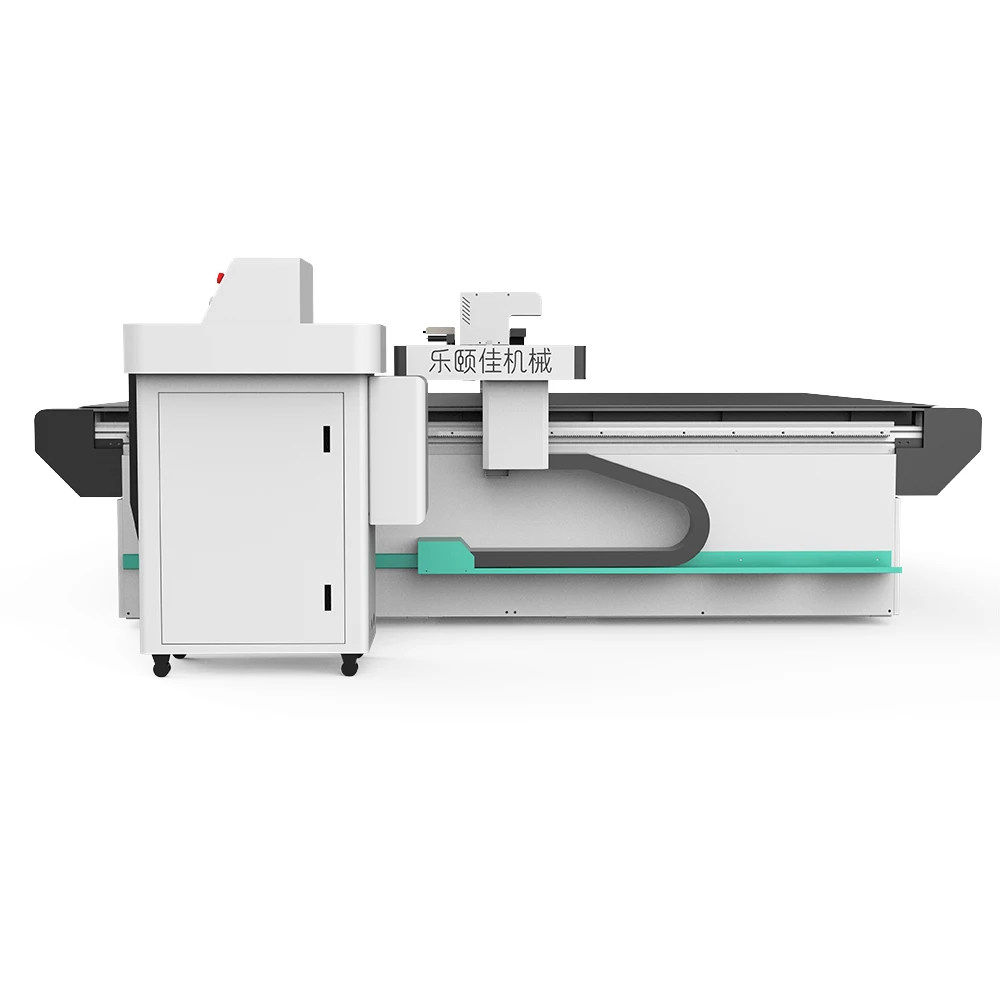
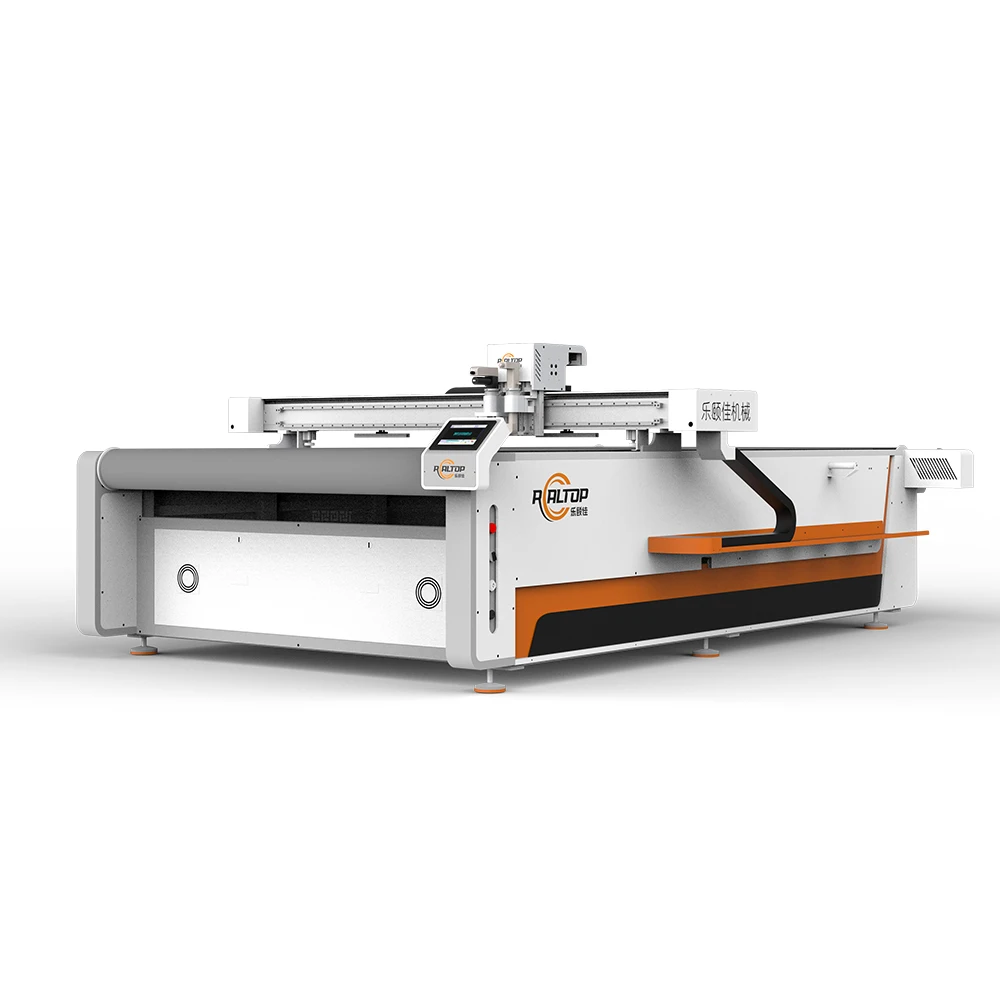
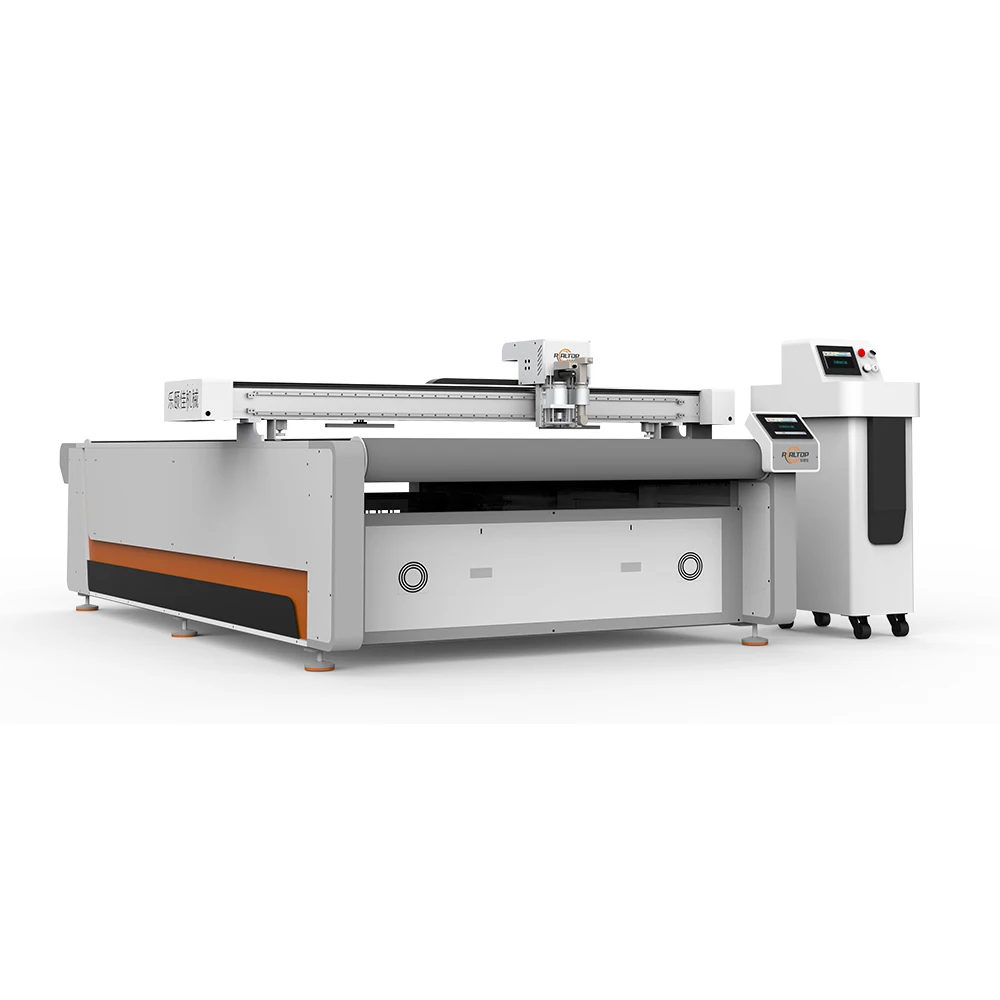
| Product Type | CNC Oscillating Knife Cutting Machine |
| Model | RT-D2516/RT-S2516 |
| Working Area | 1600×2500 mm |
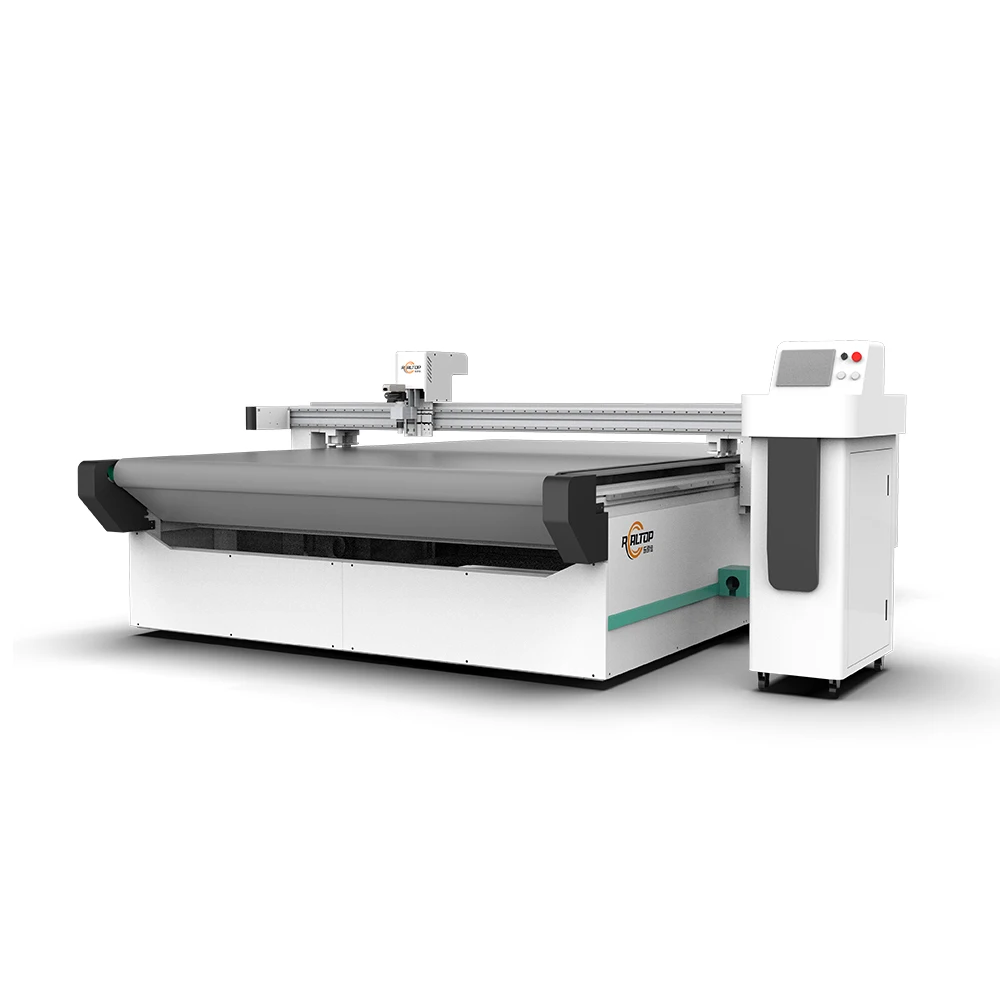
| Machine Size (L×W×H) | 3450×2300×1250 mm |
| Rated Power | 9 kW |
| Voltage | 380V ±10% |
| Vacuum Pump Power | 7.5 kW |
| Transmission System | Digital servo motor, linear guide, synchronous belt, ball screw |
| Servo Motor Brand Options | Delta or Panasonic |
| Repeatability | ≤0.1 mm |
| Translational Velocity | 800–2000 mm/s |
| Maximum Cutting Thickness | ≤100 mm (varies with material) |
| Linear Guide | Taiwan Hiwin rail |
| Conveyor Belt | Germany imported conveyor belt |
| Vacuum Table | Magnesium-aluminum alloy with fluorocarbon PVDF coating, anodic and hard oxidation |
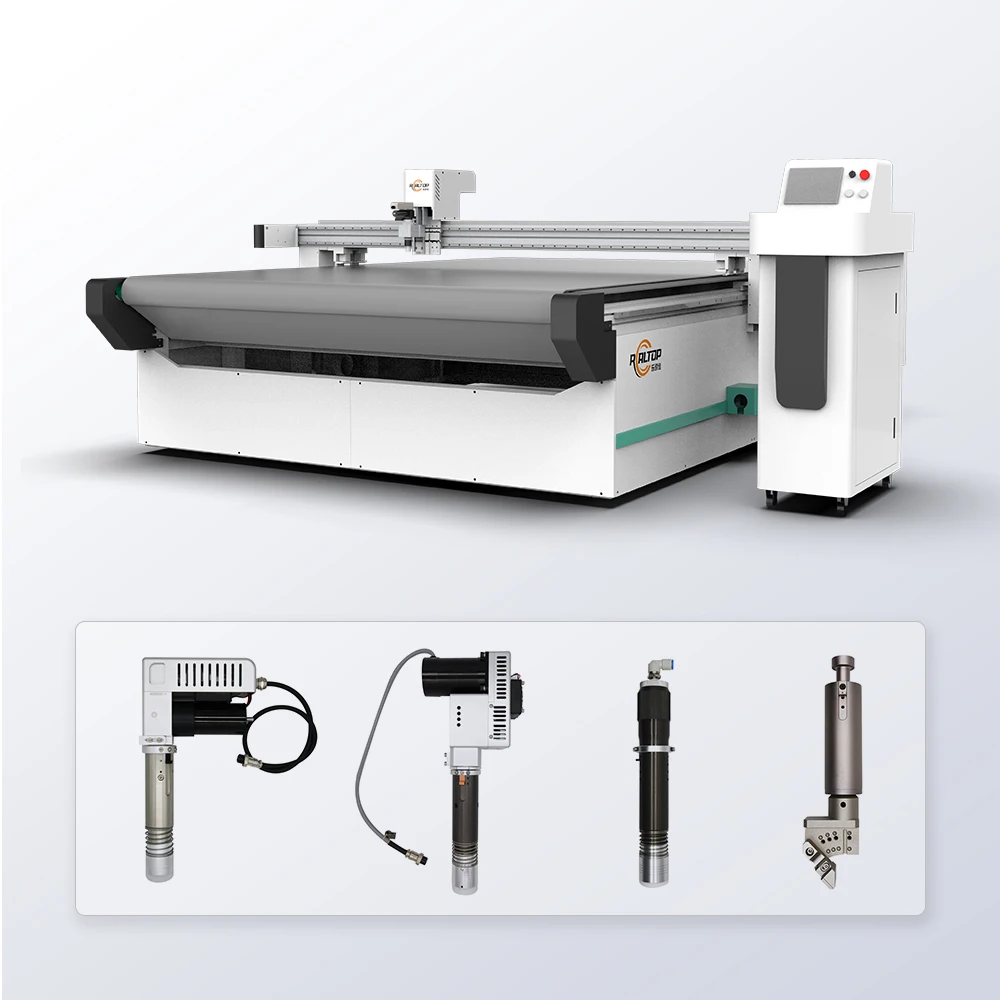
| Tool Head Options | Oscillating knife, pneumatic knife, high-power vibrating knife, circular knife, V-cutting knife, drag knife, creasing wheel, dotted line knife, punching, brush |
| Visual Positioning Options | Small CCD camera mark point, panoramic camera recognition, projection positioning |
| Table Options | Flat working table, auto feeding table |
| Instruction System | HP-GL compatible format |
| Software File Formats | PLT, DXF, AI |
| Safety Devices | Infrared induction blocking, anti-collision on both sides of beam, emergency stop button |
| Control Panel | Touch screen, multiple languages supported |
| Language Options | English, Russian, Italian, Chinese; special languages customizable |
| Assembly State | Fully assembled |
Application Suitability
| Application | Material or Output |
|---|---|
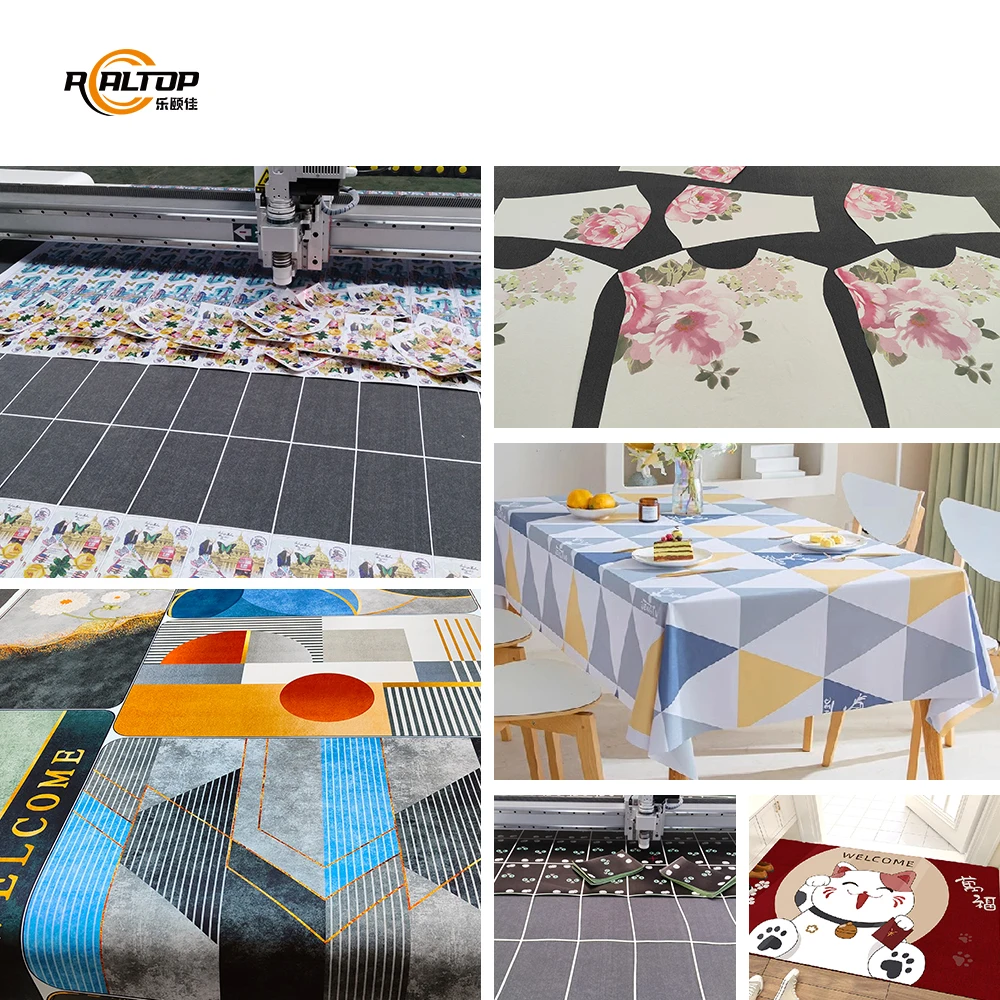
| Surgical gown and medical protective wear production | Non-woven fabric, coated composite materials, SMS fabric |
| Garment and footwear manufacturing | Multi-ply cloth, leather, shoe material, luggage material |
| Automotive interior trimming | Composite materials, foam board, PU, EVA, XPE |
| Soft home furnishings and carpet cutting | Carpet, sponge, textile, fiberglass, silicon |
| Gasket and sealing pad fabrication | Rubber, PTFE, ETFE, soft glass, carbon fiber |
| Graphic advertising and printing finishing | Sticker, film, PVC, PP, PE, corrugated cardboard |
Why Material Thickness Alone Is Not Enough to Pick a CNC Cutting Machine
A 100 mm maximum cutting depth means nothing if the tool head cannot shear through coated layers cleanly at production speed.
Buyers often specify a CNC oscillating knife cutting machine for sale based on working area and maximum thickness, then discover the standard oscillating blade tears through non-woven surgical gown fabric but leaves ragged edges on coated composite laminates. The knife that slices cleanly through three plies of cotton cannot handle a 2 mm PVC-backed textile without crushing the foam core underneath. I once saw a Middle East customer lose three full production days because the sample cuts were done on standard non-woven, while the actual run used a coated medical barrier fabric that required an entirely different blade profile and oscillation frequency. [NEED_CITE: tool head selection criteria for composite medical textiles]
Navigating the Full Cutting Equipment Range
This catalogue positions the RT-D2516/RT-S2516 within the broader REALTOP lineup, where CNC oscillating knife cutting machines sit alongside CO2 and fiber laser systems. The distinction matters: blade cutting produces no heat-affected zone, making it the default for synthetic surgical gown materials that would melt or seal under a laser beam. Buyers surveying options before narrowing to a method need to see working areas, tool head compatibility, and cutting capacity side by side to avoid committing to the wrong process.
Matching Machine Families to Production Volume
The 1600×2500 mm working area handles both flat-bed sheet layup and continuous roll-fed fabric when paired with the auto-feeding conveyor option. For high-volume surgical gown factories running multiple shifts, the Germany imported conveyor belt and 7.5 kW vacuum pump maintain consistent material feed and hold-down without manual repositioning. Smaller workshops producing custom medical wear in batch runs typically select the flat working table configuration, where the magnesium-aluminum alloy surface with PVDF fluorocarbon coating resists adhesive residue from layered composite fabrics. [NEED_CITE: vacuum adsorption requirements for multi-ply non-woven cutting]
How Blade Selection and Vacuum Zoning Shape Cut Quality
The Swiss imported knife with vibration full cutting, half cutting, and cursor location functions handles the range from single-ply non-woven to 100 mm stacked composite, but the oscillation frequency and blade geometry must be matched to each material. A high-power vibrating knife shears through dense foam gaskets that a standard oscillating blade would compress rather than cut. The Taiwan Hiwin linear guides and Delta or Panasonic servo motors maintain ≤0.1 mm repeatability across the full 2500 mm travel, which is critical when cutting interlocking pattern pieces where a 0.5 mm drift wastes an entire nest layout. The zoned vacuum table with integrated aviation aluminum shell vacuum pump prevents small pattern pieces from lifting during high-speed traverses at up to 2000 mm/s translational velocity, a common failure point on machines with single-zone suction that only grips the center of the sheet.
The Hidden Cost of Skipping the Sample Cut
When a CNC oscillating knife cutting machine for sale is selected purely from a specification sheet, the buyer often discovers incompatibilities only after installation. Software that cannot import existing PLT or DXF nesting files forces operators to redraw every pattern, adding hours to each production changeover. A control panel locked to a single language creates dependence on one trained operator, and a voltage mismatch discovered after shipment requires a transformer that adds cost and occupies floor space. [NEED_CITE: post-shipment voltage mismatch resolution costs in industrial equipment]
Why Buyers Source This Range Here
The in-house design team covers both knife and laser technologies, so a buyer comparing methods for surgical gown fabric gets a recommendation based on material behavior, not on which machine needs to move off the showroom floor. Tool head and table configurations are specified per material and production volume rather than sold as a fixed package. CCD camera positioning options — mark point, panoramic, and projection — are confirmed against the buyer’s actual printed contour work before the order is finalized. Software compatibility with existing nesting workflows is verified, not assumed. Sample cutting on the buyer’s own coated composite material runs before commitment, catching the problems that standard non-woven test pieces hide.
Documentation & Verification
- Machine specification sheet confirming working area, tool head list, and vacuum zone layout
- Electrical schematic with 380V ±10% voltage and servo motor brand confirmed per order
- Tool head and table configuration list matched to your surgical gown material stack
- Sample cutting report on your actual coated composite fabric before shipment
- Software licence and file format compatibility note for PLT, DXF, and AI workflows
- Factory test record with repeatability measurement at ≤0.1 mm across full travel
Installation, Commissioning & Support
- 3450×2300×1250 mm machine footprint requires level concrete floor with clearance for conveyor feed
- Dedicated 380V ±10% circuit rated for 9 kW main drive plus 7.5 kW vacuum pump
- Fully assembled delivery — no on-site frame welding or rail alignment required
- First-run parameter tuning on your specific non-woven or coated composite material
- Touch screen operator training in your selected language from English, Russian, Italian, Chinese, or custom
- Spare parts list covering Swiss knife blades, conveyor belt sections, and vacuum pump filters
What We Need to Size Your Configuration
Send us the exact fabric types you cut — non-woven, coated composite, laminated SMS — along with ply count and daily output targets. Confirm your facility voltage and frequency, the nesting software your team currently uses, and whether you run from rolls or flat sheets. If your material has a coating or laminate layer, ship a sample roll so we can run test cuts on the actual production stock before finalizing the tool head and vacuum zone layout.
Frequently Asked Questions
Q: How do I choose between oscillating knife and laser cutting for surgical gown fabric?
A: Oscillating knife cutting produces no heat, so synthetic non-woven and coated composite materials used in surgical gowns do not melt or develop sealed edges. Laser cutting seals edges on some synthetics but can burn or discolor medical-grade fabrics. We recommend sample cuts on your actual material using both methods to compare edge quality, then matching the CNC cutting machine manufacturer to the process that produces acceptable results.
Q: What working area and table configuration fits my production setup?
A: The 1600×2500 mm area accommodates standard fabric rolls and sheet layup. If you run continuous roll-fed production at volume, the auto-feeding conveyor table with Germany imported belt maintains consistent feed. For batch cutting from pre-cut sheets, the flat magnesium-aluminum vacuum table provides secure hold-down without conveyor complexity.
Q: Which tool head should I specify for coated composite medical fabrics?
A: Standard oscillating knives handle single-ply non-woven cleanly, but coated composites often require a high-power vibrating knife or pneumatic knife to shear through laminate layers without crushing. We run your actual material sample with multiple tool heads and provide a cutting report before final configuration.
Q: Can the control panel and software integrate with our existing workflow?
A: The touch screen supports English, Russian, Italian, Chinese, and custom languages. The instruction system accepts HP-GL compatible format with PLT, DXF, and AI file imports. We verify compatibility with your existing nesting software before the order and document file format support in the delivery package.
Q: What does the CCD camera positioning system actually do at production speed?
A: The small CCD camera tracks printed mark points for contour cutting, while the panoramic camera option recognizes full-pattern registration marks across the working area. Both systems function at standard cutting speeds, but tracking accuracy depends on print contrast and mark size. We test with your actual printed fabric to confirm reliable recognition before shipment.
Cutting Method Matched to Material — our in-house design covers both knife and laser technologies, so the RT-D2516/RT-S2516 is specified by fabric density and coating rather than forced into one cutting method.
Technical Specifications
| Parameter | Value |
|---|---|
| Product Type | CNC Oscillating Knife Cutting Machine |
| Model | RT-D2516/RT-S2516 |
| Working Area | 1600×2500 mm |
| Machine Size (L×W×H) | 3450×2300×1250 mm |
| Rated Power | 9 kW |
| Voltage | 380V ±10% |
| Vacuum Pump Power | 7.5 kW |
| Transmission System | Digital servo motor, linear guide, synchronous belt, ball screw |
| Servo Motor Brand Options | Delta or Panasonic |
| Repeatability | ≤0.1 mm |
| Translational Velocity | 800–2000 mm/s |
| Maximum Cutting Thickness | ≤100 mm (varies with material) |
| Linear Guide | Taiwan Hiwin rail |
| Conveyor Belt | Germany imported conveyor belt |
| Vacuum Table | Magnesium-aluminum alloy with fluorocarbon PVDF coating, anodic and hard oxidation |
| Tool Head Options | Oscillating knife, pneumatic knife, high-power vibrating knife, circular knife, V-cutting knife, drag knife, creasing wheel, dotted line knife, punching, brush |
| Visual Positioning Options | Small CCD camera mark point, panoramic camera recognition, projection positioning |
| Table Options | Flat working table, auto feeding table |
| Instruction System | HP-GL compatible format |
| Software File Formats | PLT, DXF, AI |
| Safety Devices | Infrared induction blocking, anti-collision on both sides of beam, emergency stop button |
| Control Panel | Touch screen, multiple languages supported |
| Language Options | English, Russian, Italian, Chinese; special languages customizable |
| Assembly State | Fully assembled |
Application Suitability
| Application | Material or Output |
|---|---|
| Surgical gown and medical protective wear production | Non-woven fabric, coated composite materials, SMS fabric |
| Garment and footwear manufacturing | Multi-ply cloth, leather, shoe material, luggage material |
| Automotive interior trimming | Composite materials, foam board, PU, EVA, XPE |
| Soft home furnishings and carpet cutting | Carpet, sponge, textile, fiberglass, silicon |
| Gasket and sealing pad fabrication | Rubber, PTFE, ETFE, soft glass, carbon fiber |
| Graphic advertising and printing finishing | Sticker, film, PVC, PP, PE, corrugated cardboard |
Why Material Thickness Alone Is Not Enough to Pick a CNC Cutting Machine
A 100 mm maximum cutting depth means nothing if the tool head cannot shear through coated layers cleanly at production speed.
Buyers often specify a CNC oscillating knife cutting machine for sale based on working area and maximum thickness, then discover the standard oscillating blade tears through non-woven surgical gown fabric but leaves ragged edges on coated composite laminates. The knife that slices cleanly through three plies of cotton cannot handle a 2 mm PVC-backed textile without crushing the foam core underneath. I once saw a Middle East customer lose three full production days because the sample cuts were done on standard non-woven, while the actual run used a coated medical barrier fabric that required an entirely different blade profile and oscillation frequency. [NEED_CITE: tool head selection criteria for composite medical textiles]
Navigating the Full Cutting Equipment Range
This catalogue positions the RT-D2516/RT-S2516 within the broader REALTOP lineup, where CNC oscillating knife cutting machines sit alongside CO2 and fiber laser systems. The distinction matters: blade cutting produces no heat-affected zone, making it the default for synthetic surgical gown materials that would melt or seal under a laser beam. Buyers surveying options before narrowing to a method need to see working areas, tool head compatibility, and cutting capacity side by side to avoid committing to the wrong process.
Matching Machine Families to Production Volume
The 1600×2500 mm working area handles both flat-bed sheet layup and continuous roll-fed fabric when paired with the auto-feeding conveyor option. For high-volume surgical gown factories running multiple shifts, the Germany imported conveyor belt and 7.5 kW vacuum pump maintain consistent material feed and hold-down without manual repositioning. Smaller workshops producing custom medical wear in batch runs typically select the flat working table configuration, where the magnesium-aluminum alloy surface with PVDF fluorocarbon coating resists adhesive residue from layered composite fabrics. [NEED_CITE: vacuum adsorption requirements for multi-ply non-woven cutting]
How Blade Selection and Vacuum Zoning Shape Cut Quality
The Swiss imported knife with vibration full cutting, half cutting, and cursor location functions handles the range from single-ply non-woven to 100 mm stacked composite, but the oscillation frequency and blade geometry must be matched to each material. A high-power vibrating knife shears through dense foam gaskets that a standard oscillating blade would compress rather than cut. The Taiwan Hiwin linear guides and Delta or Panasonic servo motors maintain ≤0.1 mm repeatability across the full 2500 mm travel, which is critical when cutting interlocking pattern pieces where a 0.5 mm drift wastes an entire nest layout. The zoned vacuum table with integrated aviation aluminum shell vacuum pump prevents small pattern pieces from lifting during high-speed traverses at up to 2000 mm/s translational velocity, a common failure point on machines with single-zone suction that only grips the center of the sheet.
The Hidden Cost of Skipping the Sample Cut
When a CNC oscillating knife cutting machine for sale is selected purely from a specification sheet, the buyer often discovers incompatibilities only after installation. Software that cannot import existing PLT or DXF nesting files forces operators to redraw every pattern, adding hours to each production changeover. A control panel locked to a single language creates dependence on one trained operator, and a voltage mismatch discovered after shipment requires a transformer that adds cost and occupies floor space. [NEED_CITE: post-shipment voltage mismatch resolution costs in industrial equipment]
Why Buyers Source This Range Here
The in-house design team covers both knife and laser technologies, so a buyer comparing methods for surgical gown fabric gets a recommendation based on material behavior, not on which machine needs to move off the showroom floor. Tool head and table configurations are specified per material and production volume rather than sold as a fixed package. CCD camera positioning options — mark point, panoramic, and projection — are confirmed against the buyer’s actual printed contour work before the order is finalized. Software compatibility with existing nesting workflows is verified, not assumed. Sample cutting on the buyer’s own coated composite material runs before commitment, catching the problems that standard non-woven test pieces hide.
Documentation & Verification
- Machine specification sheet confirming working area, tool head list, and vacuum zone layout
- Electrical schematic with 380V ±10% voltage and servo motor brand confirmed per order
- Tool head and table configuration list matched to your surgical gown material stack
- Sample cutting report on your actual coated composite fabric before shipment
- Software licence and file format compatibility note for PLT, DXF, and AI workflows
- Factory test record with repeatability measurement at ≤0.1 mm across full travel
Installation, Commissioning & Support
- 3450×2300×1250 mm machine footprint requires level concrete floor with clearance for conveyor feed
- Dedicated 380V ±10% circuit rated for 9 kW main drive plus 7.5 kW vacuum pump
- Fully assembled delivery — no on-site frame welding or rail alignment required
- First-run parameter tuning on your specific non-woven or coated composite material
- Touch screen operator training in your selected language from English, Russian, Italian, Chinese, or custom
- Spare parts list covering Swiss knife blades, conveyor belt sections, and vacuum pump filters
What We Need to Size Your Configuration
Send us the exact fabric types you cut — non-woven, coated composite, laminated SMS — along with ply count and daily output targets. Confirm your facility voltage and frequency, the nesting software your team currently uses, and whether you run from rolls or flat sheets. If your material has a coating or laminate layer, ship a sample roll so we can run test cuts on the actual production stock before finalizing the tool head and vacuum zone layout.
Frequently Asked Questions
Q: How do I choose between oscillating knife and laser cutting for surgical gown fabric?
A: Oscillating knife cutting produces no heat, so synthetic non-woven and coated composite materials used in surgical gowns do not melt or develop sealed edges. Laser cutting seals edges on some synthetics but can burn or discolor medical-grade fabrics. We recommend sample cuts on your actual material using both methods to compare edge quality, then matching the CNC cutting machine manufacturer to the process that produces acceptable results.
Q: What working area and table configuration fits my production setup?
A: The 1600×2500 mm area accommodates standard fabric rolls and sheet layup. If you run continuous roll-fed production at volume, the auto-feeding conveyor table with Germany imported belt maintains consistent feed. For batch cutting from pre-cut sheets, the flat magnesium-aluminum vacuum table provides secure hold-down without conveyor complexity.
Q: Which tool head should I specify for coated composite medical fabrics?
A: Standard oscillating knives handle single-ply non-woven cleanly, but coated composites often require a high-power vibrating knife or pneumatic knife to shear through laminate layers without crushing. We run your actual material sample with multiple tool heads and provide a cutting report before final configuration.
Q: Can the control panel and software integrate with our existing workflow?
A: The touch screen supports English, Russian, Italian, Chinese, and custom languages. The instruction system accepts HP-GL compatible format with PLT, DXF, and AI file imports. We verify compatibility with your existing nesting software before the order and document file format support in the delivery package.
Q: What does the CCD camera positioning system actually do at production speed?
A: The small CCD camera tracks printed mark points for contour cutting, while the panoramic camera option recognizes full-pattern registration marks across the working area. Both systems function at standard cutting speeds, but tracking accuracy depends on print contrast and mark size. We test with your actual printed fabric to confirm reliable recognition before shipment.










商品评价
There are no reviews yet.