

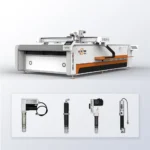


Cloth CNC Cutting Machine for Fabric and Apparel – Full Range
RT-D2516/RT-S2516 CNC Oscillating Knife Cutting Machine, 1600×2500mm Working Area, 9kW — engineered for precise fabric, leather and composite material processing.
- Compare working areas, tool head options and CCD positioning variants across the full range to match your material envelope and daily volume before selecting a cutting method
- Multifunctional tool head supports oscillating knife, drag knife, creasing wheel and punching for flexible configuration per material type
- Magnesium-aluminum vacuum table with zoned suction ensures reliable small-part hold-down during high-speed operation
Sample cutting on your own material is available before commitment to verify edge quality, cutting speed and vacuum performance.
You’re now subscribed to price tracking for this product. We’ll notify you if the price drops.

Fast Delivery
Quick, reliable shipping to any location.

Free & easy returns
Return this item by mail or in store within 90 days for a full refund.
Material-to-Model Mapping — Every RT-D2516/RT-S2516 configuration is specified against the buyer’s actual fabric type, ply count, and thickness rather than working area alone.
Technical Specifications
| Parameter | Value |
|---|---|
| Model | RT-D2516 / RT-S2516 |
| Product Type | CNC Oscillating Knife Cutting Machine |
| Working Area | 1600 × 2500 mm |
| Machine Size | 3450 × 2300 × 1250 mm |
| Rated Power | 9 kW |
| Voltage | 380V ± 10% (customizable) |
| Working Table | Flat vacuum adsorption table — magnesium-aluminum alloy, fluorocarbon PVDF powder sprayed, anodic and hard oxidation treated |
| Vacuum Pump | 7.5 kW, integrated aviation aluminum shell with built-in silencer sponge |
| Multifunctional Tool Head | Swiss imported knife (vibration full cutting, vibration half cutting, cursor location); options: pneumatic knife, high-power vibrating knife, circular knife, V cutting knife, drag knife, creasing wheel, dotted line knife, punching tool, brush |
| Visual Positioning | Small CCD camera mark point positioning, panoramic camera recognition positioning, projection positioning |
| Translational Velocity | 800 – 1200 mm/s |
| Cutting Speed | 200 – 800 mm/s (basis not stated in source — confirm material, thickness, ply count) |
| Repeated Accuracy | ≤ 0.1 mm |
| Transmission System | Digital servo motor, linear guide, synchronous belt, ball screw (imported) |
| Servo Motor Brand | Delta (Panasonic optional) |
| Guide Rail | Taiwan Hiwin |
| Conveyor Belt | Germany imported |
| Safety Devices | Infrared induction blocking, anti-collision sensors on both sides of beam, emergency stop button with in-situ resume |
| Instruction System | HP-GL compatible format |
| Cutting Thickness | ≤ 100 mm (varies by material) |
| Language Options | English, Russian, Italian, Chinese (special languages customizable) |
| Software Features | Automatic nesting and layout calculation |
| Frame Construction | Thick-walled seamless steel structure, high-temperature tempered, CNC machining center finished |
| Assembly State | Fully assembled |
Application Suitability
| Application | Material or Output |
|---|---|
| Garment and footwear production | Multi-layer woven fabric, knitted textile, denim, cotton-linen blends, shoe uppers in leather and synthetic |
| Automotive interior trimming | Composite leather, PU and PVC foam laminates, non-woven acoustic insulation, headliner fabric |
| Soft home furnishings | Upholstery velvet, curtain textile, mattress ticking, carpet and rug substrates |
| Bags and luggage manufacturing | Nylon, canvas, PU leather, EVA foam stiffeners, woven polypropylene |
| Sports and outdoor products | Neoprene, technical mesh, coated nylon, laminated softshell fabric |
| Packaging sample making | Corrugated cardboard, folding carton stock, sticker and film overlays |
Why Specifying by Working Area Alone Leads to Cutting Failures
A machine chosen on table size without matching tool head, vacuum zoning, and cutting stroke to the actual fabric stack will underperform from day one.
I spent years on the assembly floor before moving into technical sales, and the most common failure I see in cloth cutting operations is not a broken part — it is a machine that was never asked the right questions before it shipped. A buyer orders a large-format table expecting it to slice through multi-layer composite leather the same way it cuts single-ply cotton sample swatches. The oscillating knife deflects, the vacuum table cannot hold small pattern pieces flat, and edge quality collapses. The CNC Oscillating Knife Cutting Machine manufacturer should confirm every configuration variable — stroke length, blade type, vacuum zone count, and feed method — against the real material stack, not just the sheet dimensions [NEED_CITE: cutting force requirements for multi-layer textile versus single-ply fabric].

Comparing Knife Cutting Methods Across the Range
The choice between an oscillating knife and a drag knife depends on what the fabric does under load. Woven textiles with loose weave tend to fray when dragged, while dense non-wovens respond well to drag cutting at lower cost. Within the REALTOP knife cutting family, each model is mapped to a material envelope so that buyers surveying options can see where oscillating action is necessary and where simpler tooling suffices. This mapping prevents the common mistake of over-specifying tooling for materials that do not require it.
Where Each Model Sits by Volume and Ply Count
Production volume determines whether a single-head flat table or a conveyor-fed multi-ply system is appropriate. For sample rooms and short-run apparel workshops, a fixed table with manual lay-up handles the throughput. For continuous garment cutting where fabric rolls feed automatically and nesting runs unattended, the conveyor system with Germany-imported belt material becomes necessary. A CNC Oscillating Knife Cutting Machine manufacturer should present these tiers side by side so the buyer selects based on actual daily volume, not a guess at future growth [NEED_CITE: production planning methodology for garment cutting departments].
Reading the Specifications Against Your Material
The 7.5 kW vacuum pump paired with the magnesium-aluminum alloy table provides the hold-down force, but that force is only useful if the table zoning matches the smallest pattern piece in the nesting layout. A table with broad undivided suction will lose grip on collar pieces and pocket flaps while holding the main body panel perfectly. The ≤ 0.1 mm repeated accuracy of the Delta servo and Hiwin linear guide combination ensures that contour-following on printed fabric stays within tolerance, provided the CCD camera has been specified and calibrated for the actual print contrast. The 9 kW rated power covers the vacuum pump, servo drives, and oscillating head simultaneously — a figure worth checking against the available circuit capacity in the target workshop before confirming voltage.

The Cost of a Wrong Tool Head Decision
I once watched a workshop run an entire shift with a standard oscillating blade on a laminated automotive headliner. The top fabric layer cut cleanly, but the foam core compressed and tore, leaving ragged edges that failed the customer’s quality inspection. Swapping to a high-power vibrating knife with a longer stroke solved the edge problem but required a slower feed rate. Neither outcome would have been predictable from the machine brochure alone — it required a sample cut on the actual composite stack. When tool head selection is left to default settings, the cost appears as scrap rate and rework time, not as a line item on the purchase order [NEED_CITE: tool wear and edge quality correlation in composite textile cutting].
Why Buyers Source This Range Here
In-house design covers both knife and laser cutting technologies, so a buyer comparing methods for the same fabric can evaluate both without contacting separate vendors. Every tool head and table configuration is specified per material sample rather than selected from a generic dropdown. CCD camera positioning is tested with the buyer’s own printed fabric to confirm mark tracking at production speed. Software compatibility is verified before the order — HP-GL file import, nesting workflow integration, and language settings are confirmed, not assumed. Voltage, control language, and plug type are documented on the electrical schematic before the machine leaves the factory, eliminating on-site wiring surprises.
Documentation & Verification
- Machine specification sheet listing confirmed tool head, table zoning, and cutting thickness per fabric type
- Electrical schematic with voltage, frequency, and plug type matched to buyer facility supply
- Sample cutting report on buyer-supplied fabric showing edge quality, speed, and vacuum hold-down result
- Software licence note confirming HP-GL compatibility and nesting file format acceptance
- Factory test record documenting repeated accuracy and servo calibration before dispatch
- CE declaration where applicable for the configured machine variant
Installation, Commissioning & Support
- Dedicated 380V ± 10% circuit required; confirm frequency and phase with local supply before wiring the 9 kW system
- Machine ships fully assembled — verify workshop door clearance against 3450 × 2300 mm footprint and overhead height
- Vacuum pump commissioning includes zone-by-zone suction test on buyer’s smallest pattern piece
- CCD camera calibration performed on-site using buyer’s printed fabric roll for contour recognition verification
- Operator training covers tool head changeover procedure across oscillating, drag, and creasing wheel configurations
- Spare parts list includes Swiss knife blades, conveyor belt segments, and vacuum seal strips matched to the table specification
What to Include in Your Inquiry
To receive a configuration that matches the production floor, provide the fabric type with thickness and ply count, the largest and smallest pattern piece dimensions, and the daily cutting volume target. Include the workshop voltage and frequency so the electrical package is confirmed before production. If the fabric carries printed registration marks, send a sample roll section so the CCD positioning system can be tested for contrast and tracking reliability before the machine ships.
Frequently Asked Questions
Q: How do I match the right CNC knife cutting machine model to my fabric type and daily volume?
A: Start with the material — provide fabric type, thickness, ply count, and whether it includes laminated layers. Then state the daily cutting volume and the range of pattern piece sizes. A CNC Oscillating Knife Cutting Machine manufacturer uses these inputs to recommend table size, tool head type, vacuum zoning, and whether a conveyor feed is necessary. Sample cutting on the actual material confirms the recommendation before order.
Q: What is the difference between knife cutting and laser cutting for fabric, and when should I choose one over the other?
A: Knife cutting produces no heat, so synthetic fabrics do not melt or seal at the edge — this is important for garment pieces that require subsequent sewing. Laser cutting seals edges automatically, which suits materials that fray easily. For multi-ply stacks, knife cutting maintains consistent edge quality through the full depth, while laser penetration varies with ply density and thickness.
Q: Which tool head do I need for my specific fabric — oscillating knife, drag knife, or a combination?
A: Dense woven fabrics and multi-layer stacks require an oscillating knife to prevent material shift and fraying. Single-ply vinyl, sticker, and thin non-wovens often work with a drag knife at higher speed. Creasing wheels are added when carton or packaging sample work shares the same table. The correct combination is determined by sample cutting on the buyer’s actual material.
Q: Can the CCD camera track printed marks reliably at full production speed?
A: Yes, provided the camera type is matched to the print format. Small CCD mark-point positioning suits registration marks at known intervals. Panoramic camera recognition handles full-contour printed patterns. The system must be tested with the buyer’s actual printed fabric to confirm that ink contrast, mark size, and surface texture allow reliable tracking at the configured cutting speed.
Q: What software file formats and nesting workflows are compatible, and how is this confirmed before order?
A: The system accepts HP-GL compatible formats and includes automatic nesting and layout calculation. Before the order is finalized, the buyer’s existing design files are imported into the software to confirm format acceptance, nesting behavior, and output compatibility. Any required conversion steps are documented in the software licence and file format compatibility note provided with the machine.










商品评价
There are no reviews yet.