


Fast Delivery
Quick, reliable shipping to any location.

Free & easy returns
Return this item by mail or in store within 90 days for a full refund.
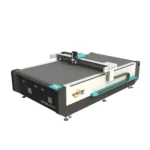
Swiss Knife Precision — The RT-D2516/RT-S2516 uses a Swiss-imported oscillating head that handles full cuts, half cuts, and cursor location on multi-layer denim and composites without crushing fibers.
Technical Specifications
| Parameter | Value |
|---|---|
| Model | RT-D2516/RT-S2516 |
| Product Type | CNC Oscillating Knife Cutting Machine |
| Working Area | 1600×2500mm |
| Machine Dimensions | 3450×2300×1250mm |
| Rated Power | 9kW |
| Voltage | 380V±10% |
| Control System | CNC (HP-GL compatible) |
| Tool Head | Swiss imported oscillating knife (full cut, half cut, cursor location) |
| Translational Velocity | 800–1200mm/s |
| Maximum Cutting Thickness | ≤50mm (varies by material) |
| Repeated Accuracy | ≤0.1mm |
| Transmission | Digital servo motor, linear guide, synchronous belt, imported ball screw |
| Vacuum System | 7.5kW vacuum pump, vacuum table |
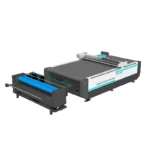
| Feeding | Auto feeding with Germany-imported conveyor belt |
| Guide Rail | Taiwan Hiwin linear rail |
| Safety | Infrared sensors |
| Language Options | English, Russian, Italian, Chinese (customizable) |
| Standard | CE |
Application Suitability
| Application | Material or Output |
|---|---|
| Multi-layer garment cutting | Denim, cotton, polyester, technical fabrics stacked to 50mm |
| Leather goods production | Natural and synthetic leather for footwear and bags |
| Automotive interior trimming | Composite leather, sponge-backed fabrics, headliner materials |
| Signage and flexible graphics | PVC sheets, vinyl, soft glass, silicon rubber |
| Gasket and seal fabrication | Rubber, silicone, and soft composite sheets |
Why Cutting Thickness Claims Fail on Actual Fabric Stacks
Real cutting depth depends on material density, not just the blade stroke. A machine rated for 50mm on soft foam may stall or produce ragged edges when that same thickness is densely woven denim or multi-layer PVC. The RT-D2516/RT-S2516 lists its maximum cutting thickness with the qualifier "according to different cutting materials," which is the only honest way to present this figure. Buyers who specify equipment based on a single thickness number without testing their actual stack composition regularly discover the problem after installation [NEED_CITE: material density effects on oscillating knife penetration]. The Swiss-imported oscillating head and Delta servo motor on this unit maintain blade frequency under load, but the practical cutting depth on your specific fabric must be confirmed by sample testing before the configuration is locked in.
Matching the Full Equipment Range to Your Material
The RT-D2516/RT-S2516 sits within a broader catalogue that spans oscillating knife, drag knife, CO2 laser, and fiber laser platforms. Each method suits different material families — knife cutting handles compressible and layered fabrics cleanly, while laser seals edges on synthetics and cuts rigid non-metals. As a CNC oscillating knife cutting machine manufacturer offering both technologies under one roof, the recommendation starts with the material itself rather than pushing one method across all applications. A buyer cutting sponge composite leather for automotive seats needs knife precision; the same buyer cutting acrylic templates for those seats needs CO2 laser.
Surveying Options Before Committing to a Method
Before narrowing to a single machine, buyers benefit from seeing where each platform sits by material type and daily volume. The RT-D2516/RT-S2516 with its 1600×2500mm working area and auto-feeding conveyor suits mid-to-high volume garment and leather operations running full fabric rolls. Smaller studios doing short-run packaging samples may find a compact flatbed configuration more practical, while heavy-duty composite fabricators might need a multi-layer digital cutting system. Comparing the complete range prevents the common mistake of over-specifying one machine to cover tasks that two smaller, dedicated units would handle more efficiently [NEED_CITE: production volume matching for digital cutting equipment].
Reading the Specs That Actually Matter on the Shop Floor
The 7.5kW vacuum pump paired with the flat table and conveyor belt holds multi-layer fabric flat during high-speed traversal at up to 1200mm/s — without adequate suction, top layers shift and the bottom layers buckle, producing miscut pieces that waste entire stacks. The Taiwan Hiwin linear rails and imported ball screws maintain the ≤0.1mm repeated accuracy needed for pattern matching across hundreds of plies. The HP-GL compatible control system integrates with common garment CAD and nesting software, so existing design files transfer without manual re-drawing. Voltage is set at 380V±10%, which must be confirmed against the buyer’s local supply before production begins — a 50Hz versus 60Hz mismatch affects servo timing and vacuum pump performance.
What Happens When Tool Head and Material Are Mismatched
Selecting a drag knife instead of an oscillating head on dense multi-layer denim produces crushed edges and frayed plies that fail quality inspection. A vacuum table without sufficient zoning leaves small pattern pieces lifting off the surface mid-cut, forcing operators to tape workpieces down manually and destroy throughput. When the control software cannot import the buyer’s nesting files, hours are lost converting formats and re-checking dimensions — a problem that surfaces only after the machine arrives [NEED_CITE: CNC cutting software file format compatibility issues]. These mismatches are avoidable when the cutting method and tool head are matched to the actual material during the sample testing stage.
Why Buyers Source the Complete Range Here
In-house design covers both knife and laser platforms, so a single facility can evaluate which cutting method fits each material rather than being steered toward one technology. The tool head and table configuration on the RT-D2516/RT-S2516 are specified per material type and production volume, not sold as a fixed package. CCD camera positioning is available for printed contour work when the application requires it. Software compatibility and file format support are confirmed before the order is placed, eliminating post-delivery integration failures. Every unit runs a sample cut on the buyer’s own material before shipment, so cutting depth and edge quality are verified against real production conditions.
Documentation & Verification
- Machine specification sheet listing working area, tool head type, and cutting thickness by material
- Electrical schematic confirming 380V±10% and frequency matched to destination country
- Tool head and vacuum table configuration record for your specific fabric stack
- Sample cutting report produced on your own material before order confirmation
- Software licence and HP-GL file format compatibility note for your nesting workflow
- Spare parts list covering oscillating knife blades, conveyor belt segments, and vacuum seals
Installation, Commissioning & Support
- Floor space of at least 3450×2300mm with level concrete and clearance for material roll loading
- Dedicated 380V±10% circuit rated for the 9kW total draw plus the 7.5kW vacuum pump
- Machine ships fully assembled; verify door and passage dimensions for workshop entry
- First-run parameter tuning on your fabric stack to set oscillation frequency and feed rate
- Operator training covering blade change, vacuum zone setup, and HP-GL file loading
- Spare oscillating blades and conveyor belt sections included for initial production period
What to Share When Requesting a Quote
Provide the specific fabric types, layer count, and sheet dimensions you run in daily production, along with your target daily output. Confirm your workshop’s voltage, frequency, and preferred control language so the electrical and interface configuration is set before build. If you use a particular CAD or nesting software, share a sample file so format compatibility is tested before the order is finalized.
Frequently Asked Questions
Q: Should I choose an oscillating knife or a laser for cutting multi-layer denim?
A: Oscillating knife cutting handles stacked denim cleanly without burning or sealing edges, which is important for garment sewing downstream. Laser cutting fuses synthetic fibers and is better suited for single-layer synthetics or non-metal rigid materials. The choice depends on your material composition and whether edge sealing is desired or harmful to the next production step.
Q: How is the working area and tool head configured for different applications?
A: The 1600×2500mm table accommodates standard fabric roll widths with the auto-feeding conveyor. The Swiss oscillating head supports full cut, half cut, and cursor location. Tool head selection and vacuum zone layout are matched to your material thickness and part size during the sample testing phase.
Q: Can the control system work with my existing nesting software?
A: The CNC system accepts HP-GL compatible formats used by most garment and leather CAD platforms. Before order confirmation, a sample file from your software is tested on the machine to verify import, nesting, and cutting path accuracy so no conversion work is needed after delivery.
Q: What voltage and language options are available for export?
A: Standard voltage is 380V±10%, configurable for destination markets with confirmed frequency requirements. Control interface languages include English, Russian, Italian, and Chinese, with additional languages available on request. Electrical schematics are provided to verify compatibility before production begins.
Q: Can I visit the factory to evaluate the full equipment range?
A: Factory visits allow buyers to see both knife and laser platforms in production, review build quality and motion components, and discuss OEM requirements. Sample cutting on your own material can be arranged during the visit to validate configuration choices before any commitment is made.










商品评价
There are no reviews yet.