


Fast Delivery
Quick, reliable shipping to any location.

Free & easy returns
Return this item by mail or in store within 90 days for a full refund.
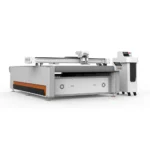
In-house design and production covering both knife and laser cutting technologies — the RT-D2516/RT-S2516 platform lets fabric and composite processors match the cutting method to their specific material stack rather than forcing a single approach across every production run.
Technical Specifications
| Parameter | Value |
|---|---|
| Model | RT-D2516/RT-S2516 |
| Product Type | CNC Oscillating Knife Cutting Machine |
| Working Area | 1600×2500 mm |
| Machine Size | 3450×2300×1250 mm |
| Rated Power | 9 kW |
| Cutting Thickness | Up to 100 mm (varies with material density and composition) |
| Translational Velocity | 800–2000 mm/s |
| Cutting Speed | 200–800 mm/s (basis not stated in source — confirm block format / material / thickness) |
| Repeated Accuracy | ≤0.1 mm |
| Multifunctional Head | Swiss imported knife: vibration full cutting, vibration half cutting, cursor location |
| Table Type | Flat working table or auto feeding table with aluminum air box vacuum platform |
| Vacuum Pump | 7.5 kW |
| Conveyor Belt | Germany imported |
| Transmission System | Digital servo motor, linear guide, synchronous belt, ball screw |
| Servo Motor | Delta (optional Panasonic) |
| Guide Rail | Taiwan Hiwin |
| Control Panel | Touch screen, multiple language supported |
| Software | Auto typesetting, supports PLT, DXF, AI formats |
| Instruction System | HP-GL compatible format |
| Voltage | 380V±10% |
| Safety Device | Infrared sensors |
Application Suitability
| Application | Material or Output |
|---|---|
| Garment and footwear production | Clothing cloth, non-woven fabric, shoe material, luggage material |
| Automotive interior trimming | Leather, sponge composite leather, PU, EVA, XPE |
| Sealing and gasket fabrication | PTFE, ETFE, rubber, gasket material |
| Soft home furnishings | Carpet, sponge, textile, composite materials |
| Graphic advertising and printing | Sticker, film, PVC sheet, soft glass |
| Sports and outdoor products | Carbon fiber, fiberglass, PP, PE |
| Packaging sample making | Cardboard, corrugated cardboard, plastic box |
Why Working Area Alone Cannot Define a Cloth CNC Cutting Machine
A machine ordered on bed size without confirming tool head and vacuum zoning will underperform the moment real production material hits the table.
Buyers often specify a cutting bed based on their largest sheet dimension and assume everything else follows. I have watched fabric producers receive a machine that handled single-layer polyester perfectly during the sample test, then choked on the multi-layer coated textiles they actually run daily. The oscillating frequency and knife amplitude needed for a 30-layer laminate stack are fundamentally different from those used for a single ply of woven cloth. When the tool head is not matched to the actual material thickness and composition, you get frayed edges, incomplete cuts, and production stops that last until the correct tooling arrives [NEED_CITE: oscillating knife frequency and amplitude requirements by material type].
Cutting Method Selection Across the Full Equipment Range
Choosing between oscillating knife and laser cutting depends on the material and the edge requirement. Synthetic fabrics that melt and seal cleanly under a CO2 beam are poor candidates for knife cutting when edge sealing is needed. Conversely, multi-layer natural fabrics and composite materials that char or discolor under laser heat require the mechanical action of an oscillating knife. The RT-D2516/RT-S2516 platform is built around the knife cutting method, while the manufacturer’s laser range covers the thermal cutting applications. A CNC Oscillating Knife Cutting Machine manufacturer that builds both systems can recommend the correct process without bias toward one technology.
Vacuum Zoning and Material Holding for Fabric Stacks
The aluminum air box vacuum platform on this machine supports both integrated and split box configurations. Split zoning matters when cutting small pattern pieces from a large sheet — without it, vacuum concentrates under covered areas and small parts lift during high-speed traverse. For garment producers nesting dozens of pieces across a 1600×2500 mm bed, proper zoning keeps every piece flat through the final cut [NEED_CITE: vacuum table zoning principles for small part retention on CNC cutting tables]. The 7.5 kW vacuum pump provides sufficient draw for breathable and semi-porous fabrics when paired with the correct zone configuration.
Reading the Specification Sheet Against Your Actual Production
The Swiss imported knife head supports vibration full cutting, half cutting, and cursor location — three functions that cover through-cutting of thick stacks, kiss-cutting of laminates, and mark registration. The cutting speed range of 200–800 mm/s is material-dependent; dense composites and multi-layer foam will push you toward the lower end, while single-layer woven fabrics allow faster traverse. Repeated accuracy of ≤0.1 mm is maintained through Taiwan Hiwin guide rails and Delta or Panasonic digital servo motors. The control system accepts PLT, DXF, and AI file formats through auto typesetting software, which must be verified against your existing nesting workflow before order confirmation.
What Happens When the Wrong Tool Head Meets Your Material
Selecting a drag knife where an oscillating knife is needed produces crushed edges on foam and ragged cuts on layered textiles. I recall a composite fabricator who specified their machine based on table size and assumed the standard tool head would handle their carbon fiber prepreg. The material demanded a specific oscillation frequency and blade geometry. The resulting delamination along cut lines meant two weeks of halted production while the correct Swiss knife assembly was sourced and shipped [NEED_CITE: tool head selection errors and their impact on composite material cutting quality].
Why Buyers Source the Full Range Here
The manufacturer designs and builds both knife and laser systems in-house, so the cutting method recommendation is based on material behavior rather than pushing a single product line. Tool head and table configurations are specified per material and production volume, not sold as a default package. Sample cutting on your own material is completed before commitment, not after delivery. Voltage, control language, and software settings are confirmed and documented before the machine leaves the factory. CCD camera positioning is available for printed contour work when your application requires registration to printed marks.
Documentation & Verification
- Machine specification sheet confirming RT-D2516/RT-S2516 working area and tool head configuration for your material
- Electrical schematic with voltage and frequency confirmation matching your facility supply
- Sample cutting report produced on your actual fabric or composite material before order commitment
- Software licence and file format compatibility note for PLT, DXF, and AI nesting workflows
- Factory test record documenting cutting accuracy and vacuum holding performance before dispatch
- Operation and maintenance manual with multi-language control panel instructions
Installation, Commissioning & Support
- Floor space allocation for 3450×2300×1250 mm machine footprint plus material staging and operator access clearance
- Dedicated 380V±10% circuit rated for 9 kW machine load plus 7.5 kW vacuum pump on separate breaker
- Machine arrives with tool head and vacuum table pre-assembled; conveyor belt tensioned and aligned on site
- First-run calibration of servo motors and guide rails against your material thickness and cutting speed parameters
- Touch screen control panel configured to your operator language during commissioning
- Spare parts list covering Swiss knife blades, conveyor belt segments, and vacuum seals for first-year maintenance
What We Need to Specify Your Configuration
Send us your primary material type, maximum thickness, and whether you run single-layer or multi-layer stacks. Confirm your daily volume and the largest sheet dimension you process. Let us know your facility voltage and frequency, and which language your operators require on the control panel. If you have an existing nesting workflow, share the file format so we verify software compatibility before quoting.
Frequently Asked Questions
Q: How do I decide between oscillating knife and laser cutting for my fabric?
A: Knife cutting suits multi-layer natural fabrics, composites, and materials that char under laser heat. Laser cutting works for synthetics that benefit from edge sealing. The correct choice depends on your specific material composition and edge quality requirement, which is why sample testing on your actual fabric should precede any equipment commitment.
Q: What configuration options exist across the CNC cutting machine range?
A: Working areas range from compact to large format. Tool head options include oscillating knife, drag knife, creasing wheel, milling, and pen. Tables are available with flat or auto feeding configurations, and vacuum platforms support integrated or split zoning. Each combination is matched to your material and production volume.
Q: Can voltage and control language be customized for my market?
A: Yes. Voltage and frequency are confirmed against your facility supply before production. The touch screen control panel supports English, Russian, Italian, Chinese, and other languages, with special language customization available. Plug type and electrical standards are matched to your target market.
Q: Will the software accept my existing nesting files?
A: The auto typesetting software supports PLT, DXF, and AI formats through an HP-GL compatible instruction system. Compatibility with your existing nesting workflow is confirmed during the specification stage, not after delivery. Share your sample files so we verify import and processing before order.
Q: Is sample cutting available before I commit to an order?
A: Yes. We run your actual material on the configured machine and produce a sample cutting report documenting edge quality, cutting depth, and cycle time. This report is reviewed and approved before production begins, ensuring the tool head and vacuum configuration match your real production requirements.










商品评价
There are no reviews yet.