


Fast Delivery
Quick, reliable shipping to any location.

Free & easy returns
Return this item by mail or in store within 90 days for a full refund.
Integrated Tooling Design — oscillating knife and laser methods available from one production line, matched to the buyer’s material rather than forced into a single process.
Technical Specifications
| Parameter | Value |
|---|---|
| Model | 1625(Standard) |
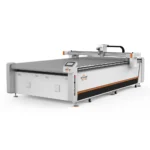
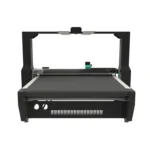
| Product Type | CNC Oscillating Knife Cutting Machine |
| Working Area | 1600 × 2500 mm |
| Cutting Speed | 0–2000 mm/s |
| Cutting Thickness | ≤ 30 mm (basis not stated in source — confirm material and block format) |
| Cutting Accuracy | ±0.1 mm |
| Tools Available | Oscillating knife, Driven rotary knife, Creasing wheel, Kiss cutting tool, Pneumatic knife, Milling tool, V-groove knife |
| Vacuum Pump | 9 kW |
| Vacuum Table | Aluminum bellows vacuum table with high flatness |
| Control System | PLC control panel with optional display languages |
| Servo Motors | Panasonic, Delta, or Dorna options |
| Voltage | 110V, 220V, 380V (frequency to be confirmed) |
| Profile Format | PLT, DXF, AI, PDF |
| Safety Device | Infrared sensor and emergency stop |
| Machine Size | 3300 × 2100 × 1350 mm |
| Standards | CE |
Application Suitability
| Application | Material or Output |
|---|---|
| Automotive seat covers and interiors | Genuine and synthetic leather, composite-backed hides |
| Footwear and leather goods | Shoe uppers, bag panels, belt blanks |
| Car floor mats and trunk liners | Rolled carpet, rubber-backed mat stock |
| Upholstery and soft furnishings | Sofa fabrics, curtain panels, cushion covers |
| Packaging sample making | Corrugated carton, folding box board, foam inserts |
| Signage and vehicle wraps | Vinyl sheets, adhesive films, PVC boards |
Why "2000 mm/s Cutting Speed" Does Not Tell You Everything
Travel speed means nothing if the tool head cannot penetrate your specific leather composite at that rate.
A buyer once specified a flatbed cutter purely on working area and headline speed. When the machine arrived, the leather had a bonded foam underlay that the standard oscillating knife could not shear cleanly at production pace. Edges came out ragged, the vacuum table struggled to hold small nested pieces, and actual throughput dropped well below expectations. That gap between the brochure number and the shop floor reality is where most CNC oscillating knife cutting machine manufacturer quotations fail to prepare the buyer. Selecting a tool head matched to the exact material stack and thickness is the only way to close that gap [NEED_CITE: material-dependent cutting speed limitations in oscillating knife systems].
Matching the Knife to the Hide
Leather is not a uniform material. Full-grain hides behave differently from bonded composites, and a backing layer of foam or textile changes the cutting mechanics entirely. The 1625(Standard) offers interchangeable heads — oscillating knife for standard hides, driven rotary knife for continuous cuts on rolled textile-leather composites, and pneumatic knife for thicker stacked layers. Choosing the right head before the order is placed avoids the situation where a machine arrives configured for a material the buyer never intended to run.
Vacuum Table Zoning for Small Leather Components
Automotive seat covers and shoe uppers nest into dozens of small, irregular shapes. A flatbed cutter needs a vacuum table that can zone its suction so that small offcuts stay pinned while adjacent pieces are still being cut. The aluminum bellows table on the 1625(Standard) provides high flatness across the full 1600 × 2500 mm area, and the 9 kW pump delivers the suction required to hold leather and composite materials without edge lift during high-speed passes [NEED_CITE: vacuum zoning requirements for nested small-part leather cutting].
Reading Between the Spec Sheet Numbers
Cutting accuracy of ±0.1 mm is achievable on stable, flat materials with proper vacuum hold-down. In practice, leather with residual curl or moisture variation can challenge that tolerance if the table flatness is compromised or the vacuum zoning is inadequate for the part geometry. The PLC control system allows the operator to adjust feed rate and oscillation frequency to match the material response, and the available servo drive options (Panasonic, Delta, Dorna) influence axis responsiveness during tight contour moves. Profile formats PLT, DXF, AI, and PDF cover the standard file outputs from nesting software used in footwear and automotive upholstery workflows. The CCD camera option enables contour recognition for printed leather and synthetic hides, locating registration marks to align cut paths to pre-printed grain patterns.
The Cost of Skipping a Material Test
Buyers who skip sample cutting on their own material before committing to a configuration often discover problems only after the machine is installed. A driven rotary knife that performs well on single-layer vinyl may fray the edges of a two-layer leather-textile laminate. A vacuum pump sized for large panels may leave small shoe upper pieces lifting at the trailing edge. These are not machine defects — they are configuration mismatches that a pre-shipment material test would have revealed. Every buyer’s material stack is slightly different, and no spec sheet can substitute for a physical cut [NEED_CITE: importance of material sample testing before CNC equipment purchase].
Why Source the Full Cutting Range from One Line
The 1625(Standard) sits within a broader equipment range that includes both oscillating knife and laser cutting platforms. When a buyer processes leather alongside acrylic templates or fabric labels, having access to both technologies from one manufacturer means the cutting method is matched to the material — not forced into whichever technology the supplier happens to sell. In-house design covers the frame, motion system, and tool head integration, so configuration decisions are made by the same engineering team that builds the machine. Tool heads and table layouts are specified per material and production volume, not pulled from a fixed catalogue page. Voltage, control language, and plug type are confirmed before the machine enters production. Sample cutting on the buyer’s actual leather stock is conducted and documented before the order is finalized, giving the buyer physical evidence of edge quality and achievable speed.
Documentation & Verification
- Machine specification sheet listing all configured tool heads and vacuum zone layout
- Electrical schematic confirming voltage, frequency, and plug type for destination market
- Sample cutting report on buyer’s leather or composite material with edge photographs
- Software licence documentation with PLT, DXF, AI, PDF file format compatibility confirmation
- Factory test record showing axis movement, vacuum pressure, and CCD alignment before packing
Installation, Commissioning & Support
- Floor space allocation based on 3300 × 2100 mm footprint plus material loading clearance
- Dedicated circuit matching confirmed voltage (110V, 220V, or 380V) with correct frequency
- Table leveling and vacuum pump commissioning on the aluminum bellows surface
- PLC control panel language set to operator preference from English, Russian, Italian, Chinese, or custom
- Tool head calibration for oscillating, rotary, and pneumatic knives on buyer’s material stock
- Spare parts list covering knife blades, vacuum seals, and CCD lens cleaning supplies
What to Share Before Requesting a Quotation
To configure the 1625(Standard) accurately, share your leather type, whether it carries a backing layer, and the total thickness of the material stack you intend to cut. Include typical sheet dimensions and daily part volume so that table size and tool head selection align with production reality. Confirm the voltage and frequency at your facility, the control language your operators need, and whether your workflow uses CCD-based contour recognition on printed hides.
Frequently Asked Questions
Q: Should I choose oscillating knife or laser cutting for automotive leather?
A: Oscillating knife is standard for most automotive leather applications because it avoids the sealed, melted edge that a CO2 laser leaves on organic hides. Laser cutting suits synthetic leather where edge sealing is acceptable or desired. The decision depends on the specific hide type, backing material, and the edge finish your assembly process requires.
Q: Which tool head handles composite-backed leather best?
A: A driven rotary knife or pneumatic knife typically outperforms a standard oscillating knife on multi-layer leather composites. The oscillating knife works well on single-layer hides up to moderate thickness. Running a material test with your exact composite stack is the only reliable way to confirm which head produces a clean edge at your target speed.
Q: How do I determine the right working area for my leather sheets?
A: Start with your largest sheet dimension and add clearance for nesting layout. The 1600 × 2500 mm table accommodates standard hide sizes and allows multiple parts per cycle. If your hides arrive in larger rolls or your nesting software shows low material yield on this size, a larger format table may improve throughput.
Q: Can the CCD camera track printed marks on textured leather surfaces?
A: The CCD camera recognizes printed registration marks for contour alignment, but surface texture and low-contrast prints can reduce detection reliability at high cutting speeds. Confirm mark size, color contrast, and placement with a sample test on your printed leather before finalizing the CCD configuration in your order.
Q: What voltage and language options are confirmed before shipment?
A: The machine is configurable for 110V, 220V, or 380V operation, and the control panel supports English, Russian, Italian, Chinese, or a custom language. Voltage, frequency, and language are locked into the production specification before the machine is built, so share your facility details at the inquiry stage.










商品评价
There are no reviews yet.