




Fast Delivery
Quick, reliable shipping to any location.

Free & easy returns
Return this item by mail or in store within 90 days for a full refund.
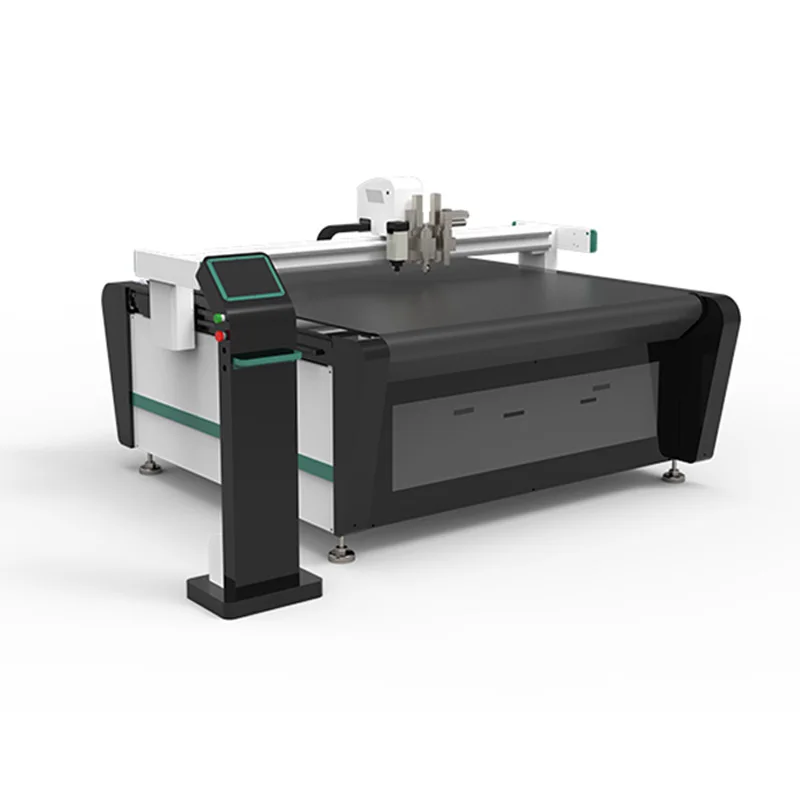
Swiss Oscillating Tooling Matched to Material — RT-D2516/RT-S2516 configuration specifies knife head, vacuum zoning and feed rate per substrate rather than selling a fixed working area.
Technical Specifications
| Parameter | Value |
|---|---|
| Product Type | CNC Oscillating Knife Cutting Machine |
| Model | RT-D2516/RT-S2516 |
| Working Area | 1600×2500mm |
| Overall Dimensions (L×W×H) | 3450×2300×1250mm |
| Rated Power | 11 kW |
| Voltage & Frequency | 380V±10% (frequency to be confirmed for target market) |
| Tool Head | Swiss imported oscillating knife (full cut, half cut, cursor location) |
| Translational Velocity | 800-1200mm/s |
| Cutting Speed | 200-800mm/s (basis not stated in source — confirm material type and thickness) |
| Repeated Accuracy | ≤0.1mm |
| Servo Motor | Japanese Yaskawa digital servo |
| Linear Rail | Taiwan Hiwin |
| Conveyor Belt | Germany imported |
| Vacuum Pump | 7.5 kW |
| Table Type | Vacuum table with auto feeding |
| Safety Device | Infrared sensors |
| Instruction System | HP-GL compatible format |
| Certification | CE |
Application Suitability
| Application | Material or Output |
|---|---|
| Large-format signage and display graphics | PVC foam board, vinyl, flexible banner stock, self-adhesive film |
| Garment panel and leather cutting | Natural leather, synthetic PU, textile fabric, sponge composite leather |
| Automotive interior and gasket fabrication | Rubber, silicon sheet, soft glass, composite gasket material |
| Composite and foam fabrication | Multi-layer foam, flexible insulation, packaging insert stock |
Why "Working Area 2500mm" Tells You Nothing About Edge Quality
The cutting method and tool head must be matched to your exact material density and thickness, not just your sheet size.
A buyer specifies a 1600×2500mm table for advertising board, tests on standard PVC foam, and signs off. Then the first production batch runs on high-density flame-retardant board. The oscillating knife chatters through it, leaving ragged edges and crushed fibres across every cut [NEED_CITE: material density effect on knife cutting edge quality]. The entire signage run is scrapped, and the machine sits idle while the buyer argues with the supplier about who should have asked what. This scenario repeats across workshops in Africa and South Asia where material supply chains are inconsistent and board density varies shipment to shipment. A CNC oscillating knife cutting machine manufacturer who does not ask for your actual production material is selling you a frame, not a solution.
Full Catalogue Positioning: Knife Versus Laser Method Match
Before committing to a cutting method, buyers survey the complete equipment range to understand where oscillating knife and laser each sit by material and volume. The RT-D2516/RT-S2516 sits in the knife family, handling flexible and semi-rigid substrates where laser would leave a melted or discoloured edge. For acrylic or thin sheet metal, a fiber or CO2 laser is the correct match. This page positions the machine within the broader flatbed cutting range so you select the process first, then refine the configuration.
Oscillating Knife for Flexible and Semi-Rigid Substrates
The Swiss imported oscillating knife head on the RT-D2516/RT-S2516 delivers full cut, half cut and cursor location in a single tool station. Full cut separates the part from the nest; half cut scores a crease line for folding without breaking the substrate surface; cursor location provides a reference point for manual alignment of pre-printed sheets [NEED_CITE: oscillating knife half-cut versus creasing wheel selection]. This three-function head means a signage producer can cut vinyl lettering, score a fold line on a display stand and locate a registration mark without changing tools mid-job.
What the Specification Sheet Actually Means on the Floor
The 7.5 kW vacuum pump paired with the auto feeding conveyor table determines whether small parts stay flat during high-speed cutting. A 2500mm bed with single-zone vacuum will lift lightweight vinyl at the edges when the knife translates at 1200mm/s, producing dimensional errors that only show up after nesting. The Yaskawa servo and Hiwin linear rail combination delivers ≤0.1mm repeated accuracy, but that figure assumes the material is held immobile by adequate vacuum zoning across the working area. The HP-GL compatible instruction system accepts files from standard signage design software, but file format and nesting workflow compatibility must be confirmed against your specific RIP or nesting package before order.
The Hidden Cost of Wrong Tool Head and Table Configuration
Choosing a drag knife instead of an oscillating knife for thick sponge composite leather produces crushed edges that fail quality inspection. Specifying a flat table without auto feeding for high-volume garment panel work forces an operator to manually load and unload each sheet, cutting daily throughput far below what the machine head can physically deliver [NEED_CITE: manual loading bottleneck on flatbed cutting tables]. A vacuum pump sized for large sheets will not generate sufficient hold-down on small gasket parts, causing lift and dimensional drift that accumulates across a production shift.
Why Source the Full Range From One Manufacturer
In-house design covers both knife and laser cutting technologies, so the buyer matches the method to the material rather than forcing one machine to do everything. Tool head and table configuration is specified per material type, thickness and daily production volume, not sold as a fixed package. Sample cutting on the buyer’s own material runs before commitment, producing a cutting report that documents edge quality, feed rate and tool wear on the actual substrate. Voltage, plug type and control interface language are confirmed for the target market before shipment, preventing the common problem of machines arriving with incompatible electrical or software settings.
Documentation & Verification
- Machine specification sheet with tool head and table configuration list for your material
- Electrical schematic and voltage confirmation matching your local supply standard
- Sample cutting report on your actual substrate with edge quality photographs
- Factory test record documenting repeated accuracy and cutting speed before dispatch
- Operation and maintenance manual with spare parts list and recommended intervals
- Software licence and file format compatibility note for your existing nesting system
Installation, Commissioning & Support
- 3450×2300mm footprint requires level concrete floor with clearance for auto feed conveyor extension
- 11 kW rated power plus 7.5 kW vacuum pump needs dedicated 380V circuit with confirmed frequency
- Machine ships fully assembled; verify doorway and overhead clearance at your facility before arrival
- First-run commissioning includes vacuum zoning adjustment and servo parameter tuning on your material
- Operator training covers HP-GL file import, tool head changeover and oscillating knife blade replacement
- Spare oscillating knife blades, conveyor belt segments and vacuum seals included in initial spares package
Preparing a Meaningful Inquiry
Send the material type, density, thickness range and maximum sheet size you will actually run in production. State your daily volume target and whether you need continuous auto feed or batch loading. Confirm your local voltage, frequency and plug type, plus the control interface language your operators need. If your existing workflow uses a specific nesting or RIP software, provide the file format so compatibility can be verified before quotation.
Frequently Asked Questions
Q: How do I decide between oscillating knife and laser for my material?
A: Oscillating knife handles flexible and semi-rigid substrates like PVC foam, leather, fabric and gasket material without melting or discolouring the edge. Laser suits acrylic, wood and thin sheet metal where a sealed or polished cut is required. The correct method depends on your material composition and the edge finish your end product demands.
Q: Will small gasket parts stay flat on the vacuum table during cutting?
A: Small parts require adequate vacuum zoning so suction concentrates under the part rather than spreading across the full 1600×2500mm bed. Vacuum zoning configuration must be specified against your typical part size and material porosity before the table is built, as retrofitting zones after assembly is not practical.
Q: Can the system track printed marks for contour cutting?
A: CCD camera contour recognition is an available configuration for printed material where the knife must follow a registered print outline. Tracking performance at production speed depends on mark contrast, lighting and camera specification. Request a sample cutting test on your printed material to verify mark detection before committing.
Q: What voltage and language options are available for my market?
A: The standard specification is 380V±10%, but frequency must be confirmed as 50Hz or 60Hz depending on your local grid. Control interface language is configured before shipment. Voltage, plug type and language are documented in the electrical schematic and confirmed in writing during the order process.
Q: Will my existing nesting software files work with this machine?
A: The instruction system accepts HP-GL compatible format, which covers many standard signage and nesting packages. File format and nesting workflow compatibility must be confirmed against your specific software version before order. Provide a sample production file during the inquiry stage so the control system can be tested against your actual data.










商品评价
There are no reviews yet.