



Fast Delivery
Quick, reliable shipping to any location.

Free & easy returns
Return this item by mail or in store within 90 days for a full refund.
Knife and Laser Range — matching oscillating knife, drag knife, and laser technologies to exact material characteristics across the full equipment portfolio.
Technical Specifications
| Parameter | Value |
|---|---|
| Model | RT-D2516 |
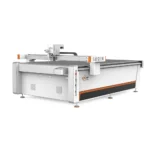
| Product Type | CNC Oscillating Knife Cutting Machine |
| Working Area | 1600 × 2500 mm |
| Machine Size | 3450 × 2300 × 1250 mm |
| Rated Power | 9 kW |
| Table Type | Flat working table with vacuum hold-down |
| Vacuum Pump | 7.5 kW |
| Multifunctional Head | Swiss imported knife: vibration full cutting, vibration half cutting, cursor location |
| Safety Device | Infrared sensors |
| Translational Velocity | 800–1200 mm/s |
| Repeated Accuracy | ≤ 0.1 mm |
| Transmission System | Digital servo motor, linear guide, synchronous belt, ball screw |
| Servo Motor | Japanese Yaskawa |
| Linear Rail | Taiwan Hiwin |
| Conveyor Belt | Germany imported |
| Instruction System | HP-GL compatible format |
| Voltage | 380V ± 10% |
| Standards | CE |
Application Suitability
| Application | Material or Output |
|---|---|
| Leather goods production | Natural leather, synthetic leather, PU, PVC for shoe uppers, bags, and accessories |
| Garment and footwear cutting | Clothing flexible materials, textile composites, sponge composite leather |
| Packaging sample making | Cardboard, grey board, stickers, gift box prototypes |
| Gasket and seal fabrication | Soft glass, silicon, rubber, non-metallic sheet stock |
| Automotive interior trimming | Leather and composite panels for cabin and upholstery components |
Why Specifying Working Area Alone Fails the Material Test
A cutting machine chosen only for table size often cannot handle the actual material composition on the shop floor.
Buyers regularly quote a working area and assume the tool head will adapt. With leather and composite flexible materials, the real variable is what hides inside the sheet — a PVC coating over woven backing, a glass-fiber reinforcement layer in automotive synthetic leather, or a foam core bonded to a PU skin. Each of these demands a different oscillation frequency, blade geometry, and hold-down strategy. The RT-D2516 addresses this through its Swiss imported knife system offering vibration full cutting and half cutting modes, paired with a 7.5 kW vacuum pump that zones the 1600 × 2500 mm table to grip both large hides and small pattern pieces [NEED_CITE: vacuum zoning requirements for small-part cutting on flexible materials]. Without confirming the material layers beforehand, even a correctly sized CNC Oscillating Knife Cutting Machine manufacturer delivery can arrive under-configured for the job it was actually bought to do.
Matching the Cutting Method to the Material Stack
The equipment range on lyjcut.com spans oscillating knife, drag knife, and laser platforms, each suited to different material behaviors. Oscillating knife excels on layered composites and thicker flexible stock where a clean shear cut is required without melting the edge. Drag knife serves thinner vinyl and single-ply films where drag pressure alone produces an acceptable finish. Laser handles acrylic, wood, and certain textiles where edge sealing is a benefit rather than a defect. Selecting the right method before narrowing to a model prevents forcing one technology across materials it was never designed for.
How Knife Versus Laser Changes the Edge on Synthetics
When cutting sponge composite leather or PU-backed fabric, an oscillating knife leaves a clean mechanical edge without thermal distortion. A CO2 laser on the same material would seal the edge — desirable for some synthetics but problematic when the downstream process requires gluing or stitching through that edge [NEED_CITE: thermal edge sealing effects on bond strength for stitched leather assemblies]. The RT-D2516 vibration half cutting mode allows kiss-cutting through the top layer while leaving the backing intact, a capability that laser cannot replicate on the same machine pass. Buyers comparing options should weigh whether their downstream assembly needs a sealed edge or a mechanically cut one.
Reading the Specs Beyond the Working Area Number
The 1600 × 2500 mm table accommodates full hides and large garment marker layouts, but the translational velocity of 800–1200 mm/s determines actual throughput on nested patterns — a figure that only translates to production output when combined with the nesting density and material loading time. The repeated accuracy of ≤ 0.1 mm matters most when cutting shoe uppers or automotive panels where multiple pieces must align during assembly. Yaskawa servo motors and Hiwin linear rails maintain that tolerance over continuous shifts. The HP-GL compatible instruction system accepts files from standard nesting and pattern software, avoiding workflow conversion steps that delay production startup [NEED_CITE: HP-GL file compatibility with common nesting and CAD software in leather cutting].
The Hidden Cost of Underspecifying the Tool Head
Choosing the wrong blade profile for a layered composite produces ragged edges on the top skin while crushing the foam core underneath. On materials with abrasive reinforcement layers, a standard blade dulls within hours, forcing unplanned stoppages for blade changes and generating inconsistent cut quality across a single shift. A vacuum table without adequate zoning allows small pattern pieces to lift during the oscillating stroke, producing dimensional drift that only shows up at the sewing station. These problems compound — re-cutting wasted material, delayed shipments, and strained relationships with downstream customers [NEED_CITE: material lift causes on vacuum tables during oscillating knife cutting of small parts].
Why Source This Range Here
The design team covers both knife and laser cutting technologies in-house, so the recommendation starts with the material rather than with a single machine family. The RT-D2516 tool head and table configuration are specified per material type and production volume after reviewing the buyer’s actual sheet composition. CCD camera positioning is available across the range for printed contour work on patterned leather and textile. Voltage, control language, and plug type are confirmed before production begins, not discovered at the dock. Every unit ships with a factory test record run on the buyer’s own material, so cutting performance is verified before the crate is closed.
Documentation & Verification
- Machine specification sheet listing RT-D2516 working area, rated power, and tool head configuration
- Electrical schematic with 380V ± 10% wiring diagram and circuit breaker schedule
- Tool head and vacuum table configuration list matched to your material type
- Sample cutting report on your leather or composite material with edge photographs
- HP-GL file format compatibility note confirming software and nesting workflow
- Spare parts list covering Swiss knife blades, vacuum cups, and drive belts
Installation, Commissioning & Support
- Floor space requirement based on 3450 × 2300 mm machine footprint plus operator clearance
- Dedicated 380V ± 10% circuit rated for 9 kW continuous draw with proper earthing
- Vacuum pump 7.5 kW requires separate electrical protection and ducting for exhaust
- First-run parameter setting on your specific leather thickness and composite layer structure
- Operator training covering Swiss knife blade changes, vacuum zoning adjustment, and HP-GL file loading
- Preventive maintenance schedule for Hiwin rail lubrication and Yaskawa servo inspection
What to Include in Your Inquiry
Send the material type, layer composition, and typical sheet dimensions so the correct tool head and vacuum zoning can be specified. Confirm your local voltage and frequency, the control interface language your operators need, and whether your current nesting software outputs HP-GL or requires a different format. If your material has reinforcement layers or unusual coating chemistry, a sample cutting test on your actual stock is the most reliable way to lock the configuration before the order is placed.
Frequently Asked Questions
Q: How do I decide between oscillating knife and laser for my leather products?
A: Oscillating knife produces a clean mechanical edge suited for pieces that will be glued or stitched afterward, and handles layered composites without thermal damage. Laser seals the edge on synthetics, which benefits applications where fraying must be prevented but can compromise bond strength for downstream assembly. The decision starts with the material and the joining method used after cutting.
Q: What file formats does the RT-D2516 instruction system accept?
A: The system is HP-GL compatible, which covers output from most standard pattern design and nesting software used in leather and garment industries. Before order confirmation, your specific software output format is tested against the machine controller to verify that nesting layouts, cut paths, and half-cut markings transfer correctly without manual conversion.
Q: Can the vacuum table hold small pattern pieces securely during cutting?
A: The 7.5 kW vacuum pump feeds a zoned table surface, allowing specific zones to be activated based on the piece size and location on the bed. This prevents small parts from lifting during the oscillating knife stroke. The zoning configuration is matched to your typical nesting layout during the specification stage so that hold-down is adequate across your standard pattern mix.
Q: Is voltage and control language customization available for export markets?
A: The standard voltage is 380V ± 10%, but the electrical system can be configured for different supply standards before production. Control interface language is set to match your operator team. Both voltage and language are confirmed in writing during the specification review so the machine arrives ready to connect without on-site electrical modification.
Q: Where does this machine sit within the broader equipment range?
A: The RT-D2516 occupies the medium-to-large format oscillating knife position, suited for leather, composite flexible materials, and packaging sample work. The full catalogue includes compact drag knife units for vinyl and thin film, larger multi-head knife systems for high-volume fabric production, and CO2 and fiber laser platforms for non-metal and sheet metal cutting respectively.










商品评价
There are no reviews yet.